

This product8-arm standard
8-Arm Radial Maze
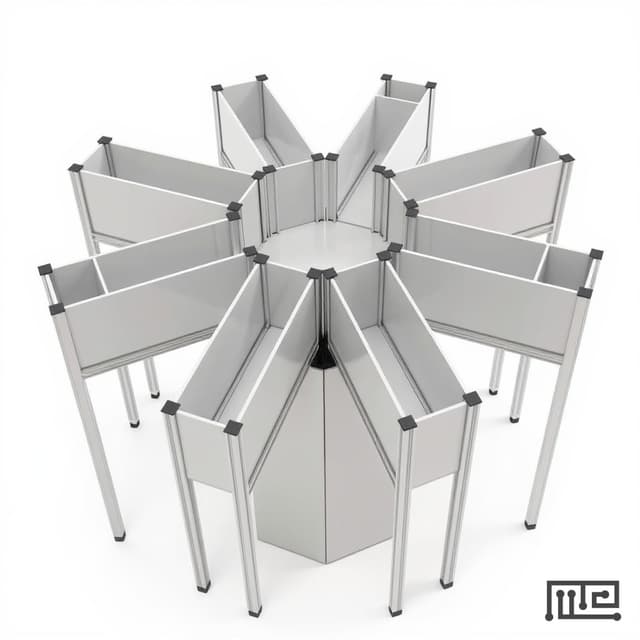
Central hub with eight equally spaced arms and removable food wells
Standard spatial working-memory configuration for baited-arm, win-shift, delay, and reference-memory protocols.
Quote
Request Quote
Eight-arm radial maze for assessing spatial working memory and reference memory in mice and rats through food-motivated foraging tasks.
| maze_configuration | 8 arms (6 arm variant available) |
| central_platform_width | 34 cm |
| goal_box_dimensions_mouse | 9cm x 9cm x 10cm |
| goal_box_dimensions_rat | 9cm x 9cm x 10cm |
| goal_box_cost | $250 |
| light_cues_cost | $150 |

The Radial Arm Maze (RAM) is a standardized behavioral apparatus designed for assessing spatial working memory and reference memory in rodents. The traditional eight-arm configuration presents subjects with a central platform from which eight arms radiate outward, each potentially containing food rewards at the distal end. Animals must utilize spatial working memory to track previously visited arms and avoid re-entries while foraging efficiently.
The maze relies on the subject's ability to encode spatial relationships between arms using extramaze and intramaze cues present in the testing environment. This paradigm has proven particularly valuable for investigating hippocampal-dependent spatial memory processes and has been extensively validated in studies of neurodegenerative disease models, brain injury, and pharmacological interventions affecting cognition.
The Radial Arm Maze exploits the natural foraging behavior of rodents while requiring spatial working memory to achieve optimal performance. In the standard protocol, each of the eight arms is baited with food reward at the distal end. The subject begins from the central platform and must visit each arm once to collect all rewards while avoiding re-entries to previously visited arms.
Successful performance requires encoding the spatial location of each arm relative to extramaze visual cues (room landmarks, experimenter position) and potentially intramaze cues (texture, odor, local visual markers). Working memory errors occur when subjects re-enter previously visited arms within the same trial, while reference memory errors occur when subjects consistently enter never-baited arms across multiple sessions in partial-baiting protocols.
The task engages the hippocampal formation for spatial mapping and working memory, while prefrontal cortical areas contribute to strategic planning and error monitoring. Performance metrics include total errors, working memory errors, reference memory errors, trial completion time, and foraging strategy analysis.
| Feature | This Product | Typical Alternative | Advantage |
|---|---|---|---|
| Arm Configuration | Standard 8-arm design with optional 6-arm variant | Fixed configurations typically offer fewer customization options | Allows researchers to match task complexity to subject cognitive capacity and experimental requirements |
| Species Compatibility | Dedicated mouse (5cm width) and rat (10cm width) configurations | Single-size designs may compromise performance for one species | Optimizes arm dimensions for natural locomotion patterns and spatial scaling appropriate for each species |
| Central Platform Size | 34cm diameter central platform | Smaller platforms may limit movement flexibility | Provides adequate space for natural orientation behaviors and decision-making processes during arm selection |
| Modular Components | Optional guillotine doors, goal boxes, light cues, and maze inserts | Basic models often lack protocol customization options | Enables multiple behavioral paradigms and experimental protocols within a single apparatus investment |
| Wall Height Design | Species-specific heights (10cm mice, 20cm rats) | Uniform wall heights may be inappropriate for species differences | Prevents escape while maintaining visual access to extramaze cues essential for spatial navigation |
This radial arm maze system offers comprehensive spatial memory assessment capabilities through species-optimized dimensions, modular protocol components, and standardized construction suitable for multi-paradigm behavioral studies. The eight-arm configuration with optional six-arm variant provides flexibility for different cognitive capacity requirements while maintaining established protocol compatibility.
Verify arm alignment using a protractor to ensure 45-degree spacing between arms, and measure arm lengths to confirm species-appropriate dimensions.
Why: Consistent spatial geometry ensures reliable spatial encoding and prevents systematic biases in arm selection patterns.
Inspect and tighten all connection joints monthly, checking for warping or damage that could affect structural integrity.
Why: Maze movement during testing can disrupt spatial cue relationships and compromise data validity.
Establish a standardized room setup with fixed extramaze cues and document their positions for consistent replication across sessions.
Why: Spatial memory performance depends critically on stable environmental landmarks for accurate navigation.
Record ambient lighting conditions and time of day for each session to control for circadian effects on cognitive performance.
Why: Both lighting levels and circadian phase can significantly influence spatial learning and memory consolidation processes.
Define clear criteria for arm entry (e.g., all four paws past the threshold) and train observers to consistent scoring standards.
Why: Standardized entry criteria prevent scoring variability that can obscure treatment effects and reduce statistical power.
If subjects show persistent side biases, rotate the maze orientation randomly across trials or block maze access until proper baiting is complete.
Why: Side preferences can mask spatial memory deficits and lead to ceiling or floor effects in performance measures.
Ensure maze height is appropriate for the testing surface to prevent injury from falls, especially when using elevated platform configurations.
Why: Subject injury can compromise both animal welfare and experimental validity through stress-related performance changes.
Allow 15-20 minute intervals between subjects for thorough cleaning and to prevent residual arousal or stress effects from affecting subsequent animals.
Why: Adequate inter-subject intervals prevent carry-over effects and ensure each animal begins testing under equivalent conditions.
ConductScience provides a one-year manufacturer warranty covering defects in materials and workmanship, with technical support available for protocol optimization and troubleshooting.
Background reading relevant to this product:
What is the Radial Arm Maze?
The Radial Arm Maze is a behavioral apparatus with multiple arms (typically 8) radiating from a central platform, used to assess spatial reference and working memory in rodents through food-reward paradigms.
How does the Radial Arm Maze work?
Food rewards are placed at the end of selected arms. Rodents must remember which arms contain rewards (reference memory) and which arms they have already visited (working memory). Errors of both types are quantified across trials.
What research applications use the Radial Arm Maze?
The Radial Arm Maze dissociates reference from working memory, making it valuable in Alzheimer's research, cholinergic system studies, and assessment of hippocampal and prefrontal cortex function.
Enhance your setup with compatible accessories
Use this apparatus with
Automate arm entries, repeat entries, latency, path order, and baited-arm performance from overhead video.
ConductVision Radial Arm Maze ->Habituation, food restriction, baiting schedules, delay variants, and working-memory error definitions.
ConductMaze Radial Arm Maze Protocol ->Free tool for working-memory errors, reference-memory errors, repeat entries, and percent-correct summaries.
Radial Arm Maze Error Calculator ->Configuration considerations
Use these notes to scope species, cohort, tracking, and automation needs. Only verified product or support routes are linked from this section.
Central hub with eight equally spaced arms and removable food wells
Standard spatial working-memory configuration for baited-arm, win-shift, delay, and reference-memory protocols.
Quote
Request QuoteScaled arm width and hub diameter for mouse cohorts
Smaller layout for mouse spatial working-memory studies where body size and turning radius affect arm choice.
Quote
View options ->Optional guillotine doors, sensor logic, and camera tracking
Useful when delay periods, forced-choice phases, or high-throughput scoring require automated arm access.
Quote
Configure tracking ->§ 1
The Radial Arm Maze measures spatial working memory by asking animals to remember which arms they have already visited within a trial. Olton and Samuelson introduced the task to separate efficient place-based search from repeat-entry errors, making it a core assay for hippocampal and prefrontal memory systems. 1
The same apparatus can test working memory, reference memory, win-shift behavior, delayed choice, and baited-arm discrimination. That flexibility makes arm geometry, automation options, error definitions, and control rules important for interpreting repeat entries as memory failures rather than strategy or motivation effects. 1
Food motivation, odor trails, arm preference, lighting, and motor speed all change radial-arm performance. A strong protocol records entry order, latency, unvisited arms, repeat visits, and baited versus unbaited errors so the commercial apparatus supports publishable methods. 1
§ 2
Baited-arm acquisition with entry-order scoring, memory-error classification, and optional delay probes.
Critical methodological constraints
Core radial-arm endpoints for memory, strategy, and motivation checks.
Working-Memory Errors
Within-trial memory
Reference-Memory Errors
Rule memory
Percent Correct
Performance summary
Latency To First Choice
Motivation and initiation
Entry Sequence
Search strategy
+ Additional metrics: arms visited before first repeat, rewards retrieved, omission errors, hub dwell time, arm dwell time, trial duration, and route entropy.
A compact within-trial error index for baited-arm spatial memory.
Estimate the N per group needed to detect a literature-anchored effect at the endpoint you plan to report. Override the defaults with your own pilot numbers.
§ 3
Aggregate publication data, sample apparatus output, and recent findings from the live PubMed feed.
PubMed volume and co-occurring behavioral methods for radial-arm memory studies.
Representative output from an eight-arm baited spatial working-memory trial.
STAT6-Mediated SOCS2 Alleviates Cognitive Impairments and Neuronal Damage in Alzheimer's Disease Rat Models.
Liu Y, Peng L, Li M, et al. Mol Neurobiol. 2026.
Rat AD model evaluated with 8-arm radial maze working-memory and reference-memory error scoring. Methods relevance: pre-specified error taxonomy, latency, and reward-retrieval reporting alongside hippocampal endpoints.
Memory and mood-enhancing neuroprotective effects of photoactivated gold nanoparticles in a rat animal model.
Postu PA, Ionita R, Pricop DA, et al. Biomater Adv. 2026.
Radial-arm error rate paired with anxiety-like tests as part of a multi-paradigm cognitive battery. Methods relevance: cross-paradigm batteries and motivation controls reported with memory endpoints.
Metabolic insights into the 3xTg-AD Alzheimer model mice: hypothalamic-pituitary-thyroid axis and beyond.
Szabó A, Farkas S, Kádár A, et al. Psychoneuroendocrinology. 2026.
Transgenic 3xTg-AD cohorts assessed with radial-arm working-memory errors. Methods relevance: transgenic-model behavioral phenotyping and age-matched control reporting.
Radial arm maze methods continue to emphasize error taxonomy and strategy-aware scoring.
Static methods note aligned with Olton and Samuelson (1976), Dudchenko (2004), and radial-arm error-taxonomy literature.
Review radial-arm studies for pre-specified working-memory errors, reference-memory errors, reward retrieval, latency, and strategy patterns before interpreting group differences.
§ 4
Limitations of the paradigm, methodological caveats, and current directions.
Variables that shift Radial Arm Maze results independent of anxiety state.
Reduced reward seeking or satiety increases omissions and latency without proving a memory deficit.
Reward odor, cleaning differences, and previous path scent can drive choices unless arm cleaning is consistent.
Animals can use a serial route instead of flexible spatial memory. Entry order should be reviewed, not only total errors.
Persistent preference for specific arms can change error counts and mask learning.
Delay probes should be separated from acquisition because they stress retention rather than initial rule learning.
## Radial Arm Maze — methods controls

Confounds controlled in this protocol:

- **Food motivation.** Reduced reward seeking or satiety increases omissions and latency without proving a memory deficit.
- **Odor trails.** Reward odor, cleaning differences, and previous path scent can drive choices unless arm cleaning is consistent.
- **Chaining strategy.** Animals can use a serial route instead of flexible spatial memory. Entry order should be reviewed, not only total errors.
- **Arm and side bias.** Persistent preference for specific arms can change error counts and mask learning.
- **Delay design.** Delay probes should be separated from acquisition because they stress retention rather than initial rule learning.
Radial Arm Maze is strongest when the error taxonomy is pre-specified. A repeat entry, an unbaited-arm visit, an omitted baited arm, and a long latency are different behavioral failures and should not be collapsed into one memory label. 1
Use T Maze when the experiment needs a simpler forced-choice, alternation, or reward-discrimination setup with fewer spatial locations and faster daily throughput.
Eight arms are standard because they provide enough choices for repeat-entry scoring, but four-arm and twelve-arm designs can be justified for species, task load, or automation constraints.
Yes. Latency and reward retrieval help separate memory errors from motivation, locomotor, and anxiety-like behavior.
Quarterly editorial review of emerging Radial Arm Maze methodology. Q2 2026
Entry-sequence classification is increasingly important because total error counts miss serial chaining and arm-bias patterns.
Gate-controlled variants make delay periods, forced-choice phases, and reproducible trial timing easier to run.
Food restriction, reward preference, and body-weight tracking should be reported with memory endpoints.
Radial Arm Maze is often paired with MWM, Barnes Maze, and Y Maze to triangulate spatial learning under different stress and motor loads.
§ 5
10 selected methods and validation references for Radial Arm Maze.