
When to use
- For research protocol documentation and descriptive session summaries
- For preparing ConductVision Human Tracking video workflows
- For organizing export-ready methods text, filenames, or CSV quality checks
Summarize single-leg stance research trials by side, eyes condition, duration, and session notes.
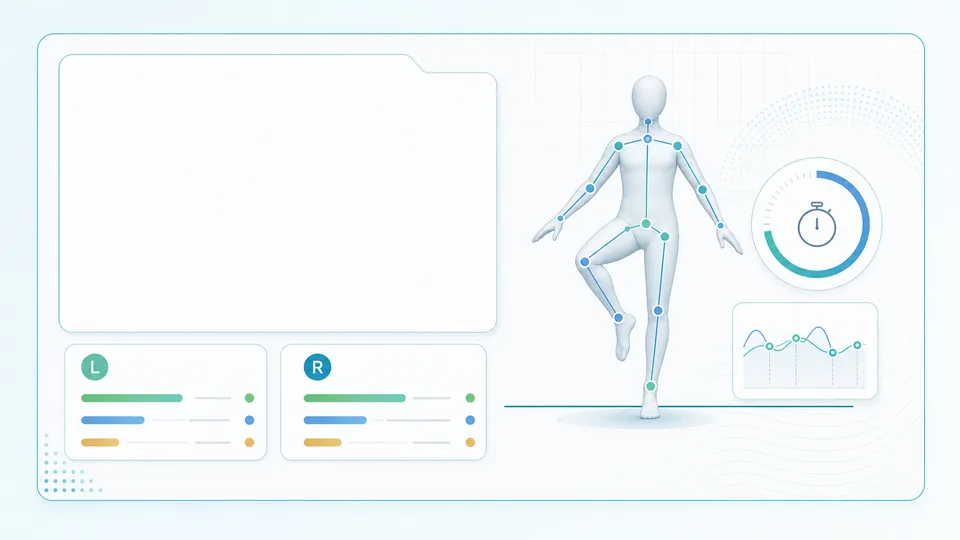
Document single-leg stance durations for left and right sides, eyes-open or eyes-closed protocols, and export descriptive text.
Average
16.33 sec
Mean of entered valid trials
Best trial
18.00 sec
Highest entered duration
Single-leg stance research summary
Single-leg stance durations were documented as descriptive research endpoints only.
Trials entered: 18.00, 16.00, 15.00.
Average: 16.33 sec.
Best stance duration: 18.00 sec.
Protocol notes: Fixed camera, standard research protocol, research-only interpretation.
Research use only. This tool is for education, protocol documentation, and research workflow planning. It is not for care decisions, participant triage, or health advice.
When to use
Do not use for
Use participant, subject, trial, protocol, and research session language. Avoid care-directed interpretations.
Store source video, keypoint exports, confidence values, and session notes so outputs remain auditable.
Run one short pilot and inspect visibility, lighting, scale references, and keypoint confidence before collecting a full dataset.
The tool performs deterministic arithmetic, checklist generation, or CSV summary operations in the browser. It does not assess injuries, classify participants for care, or replace a protocol approved for research use.
Published 2026-06-02. Calculations support planning and documentation; verify procurement decisions against manufacturer specifications or institutional SOPs.
ConductScience Single-Leg Stance Test Calculator. ConductScience, Inc. 2026. Available at: https://conductscience.com/tools/single-leg-stance-test-calculator
Podsiadlo D, Richardson S. The timed Up & Go: a test of basic functional mobility for frail elderly persons. J Am Geriatr Soc. 1991;39(2):142-148.
Duncan PW, Weiner DK, Chandler J, Studenski S. Functional reach: a new clinical measure of balance. J Gerontol. 1990;45(6):M192-M197. doi:10.1093/geronj/45.6.M192
Mathis A et al. DeepLabCut: markerless pose estimation of user-defined body parts with deep learning. Nat Neurosci. 2018;21(9):1281-1289.
ConductVision supports stance timing and markerless sway exports for research.
Open app AppDocument reach trials.
Open app AppPair static balance with gait analysis.
Open app QuoteGet a quote on equipment or talk to the ConductScience team.
Request quote