
Find research datasets worth reusing
Search datasets from major research repositories and use ShareScore to quickly assess how well each record supports discovery, access, and reuse.
1,832
datasets available to search
ShareScore release 0.9.0
Dataset results
1,832 results for “Cameras”
Vintage Film Camera Eumig C16R
Hi! It's my personal project. Wanted to model something a little bit more complex than my previous works so i could learn more in 3D modeling and creating textures. I found an image of Eumig C16R - 16mm cine camera from Austria (1957) and fell in love with this camera :)  Modeled in Blender Textures in Substance Designer (base material and pattern for body) and Substance Painter. Source: Objaverse 1.0 / Sketchfab
Vintage Camera
I made this Camera using Blender Substance Painter and Gimp. Took me about 6 Hours. U can use it for whatever You want aslong as you credit me :). Source: Objaverse 1.0 / Sketchfab
Old 8mm Camera
Edit 11/2020 : made this asset downloadable, feel free to use it in your project. old 8 mm camera this is a reduced poly version of this project : https://www.artstation.com/artwork/zWvn2 displace is replace with a normal map instead Source: Objaverse 1.0 / Sketchfab
Kodak Brownie Camera
Kodak Brownie Camera Self-Erecting Folding Rollfim Introduced: 1948 - Discontinued: 1954 Film Size: 620 Picture Size: 2 1/4 X 3 1/4" Manufactured: UK Lenses: Meniscus Fixed Focus Or Anaston F/6.3, 100mm Focusing Shutters: Kodette II (Meniscus Lens And Shutter Release Cable Capable) Or Dakon (Anaston Lens) With Bayonet Flash Contacts Structured light scan Private collection Source: Objaverse 1.0 / Sketchfab
Zenit 6 camera
ID no.: MHF 797/I Museum of Photography in Kraków https://muzea.malopolska.pl/en/objects-list/952 Digitalisation: RDW MIC, Virtual Małopolska project Source: Objaverse 1.0 / Sketchfab
Konishiroku(Konica) Camera
BABY PEARL 1934-1950 1873:KONISHI-HONTEN Company opened. After that, the company name was changed from KONISHIROKU Company to KONICA Company. 2003:KONICA Company and MINOLTA Company merged to form KONICA MINOLTA Company. 2006:The camera department was taken over by SONY Company. 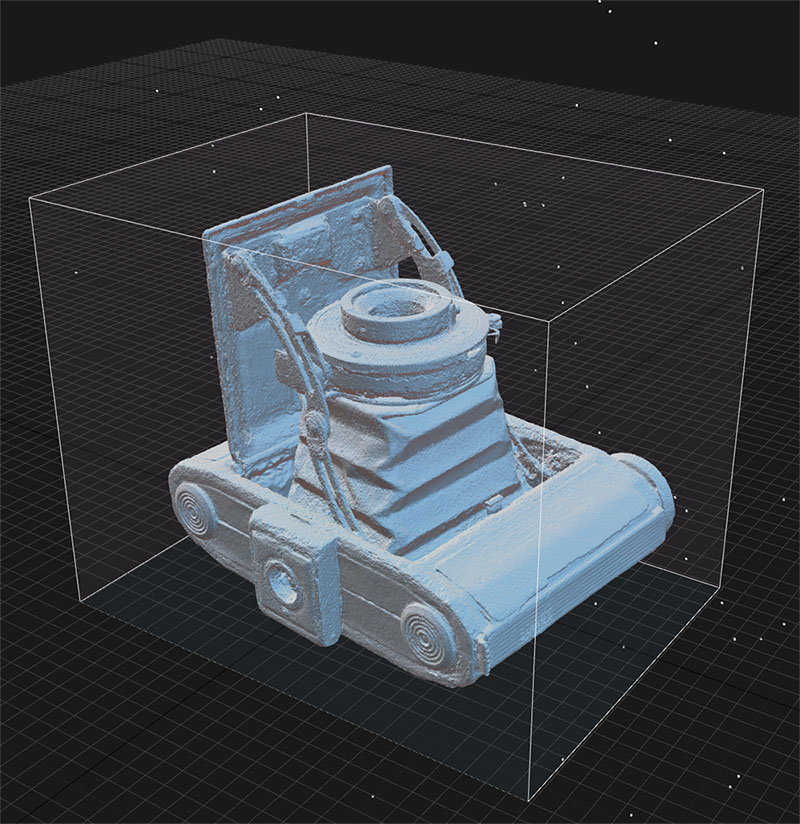 3D digitizing methods : Photogrammetry Software : RealityCapture,zbrush,Substance Painter Equipment : Nikon D750,NIKKOR 24-120mm f/4G Images : 732 photos Source: Objaverse 1.0 / Sketchfab
Yashica 8mm Leather Camera Bag
Photogrammetry and modeling. Metashape and Blender. 27k tris. 4k textures Source: Objaverse 1.0 / Sketchfab
Aparat mieszkowy // Folding camera
Aparat mieszkowy który należał do pierwszego poznańskiego tramwajarza. Posiada plakietkę słynnego dystrybutora Kazimierza Gregera, który sam był fotografem. Podczas powstania wielkopolskiego dokumentował to wydarzenie historyczne. Source: Objaverse 1.0 / Sketchfab
Zefir camera with Domiplan lens
ID no.: MHF 412/I Museum of Photography in Kraków https://muzea.malopolska.pl/en/objects-list/945 Digitalisation: RDW MIC, Virtual Małopolska project Source: Objaverse 1.0 / Sketchfab
Фотоаппарат «Фотокор-1» • Camera 'Photokor-1'
1938 15.5 x 27.5 x 11 cm Фотоаппарат принадлежал Михаилу Проскурякову, инженеру, который увлекался фотографией. Фотопечатью он занимался по ночам в ванной коммунальной квартиры. Соседи сообщили о таком подозрительном поведении в органы и Михаила вызвали на Лубянку. К счастью, следователь тоже оказался фотолюбителем, все понял, но настоятельно рекомендовал ему бросить фотографию. This camera belonged to Mikhail Proskuryakov, an engineer who enjoyed photography. As he lived in communal living quarters, he had to print the photos at night time in the communal bathroom. His neighbours informed the security services about such suspicious behaviour and he was summoned to the Lubyanka. Happily the investigator also loved photography, he understood everything but strongly recommended Mikhail to quit photography. Source: Objaverse 1.0 / Sketchfab
Zefir Camera with Emitar lens
ID no.: MHF 411/I Museum of Photography in Kraków https://muzea.malopolska.pl/en/objects-list/949 Digitalisation: RDW MIC, Virtual Małopolska project Source: Objaverse 1.0 / Sketchfab
Dataset, Model Statistics, and 3D designs for "From Eyes to Cameras: Computer Vision for High-Throughput Liquid-Liquid Separation"
<p>Dataset, model statistics, and 3D design of high throughput platform associated with HeinSight3.0. </p> <p> </p> <p>Pre-print: https://chemrxiv.org/engage/chemrxiv/article-details/65e5481f9138d231619c1879</p> <p> </p> <p>The code and model of HeinSight3.0 can be found at (https://doi.org/10.5281/zenodo.11053915)</p>
Data belonging to "Successful invasion: camera trap distance sampling reveals higher density for invasive raccoon dog compared to native mesopredators"
<p>Data files (comma separated text files) containing the camera data (CameraData) containing the information on camera trap placements in the various sites and their operation time in days and aperture, the distance sampling data (DistanceData) containing the information on the species and distance detected for each 1s time interval in front of each camera, and the trigger data (TriggerData) containing the time stamps for the pictures taken of each species with each camera, collected in the years 2020 and 2021 in southern Finland. The repository further contains an R script "distanceSamplingScript" which uses the reposited above-described files for analysis reported in the publication "Successful invasion: camera trap distance sampling reveals higher density for invasive raccoon dog compared to native mesopredators" https://doi.org/10.1007/s10530-024-03323-4. The R script has been confirmed to run in R version 4.3.3 using packages "activity" vs 1.3.4 and "Distance" vs 1.0.9</p>
Benchmark for classifying camera motion in coral videos
<p>A benchmark of coral vidoes where camera motion which indicates coral structures being viewed from multiple angles have been identified. This may be used for 3D reconstructions of corals. Time stamps are seperated by ";" and time segments are joined by "-". <br><br>This work was partially supported by the Data Science Research Center at the University of Haifa through the Israel PBC grant Advancing Data Science to Serve Humanity and Protect the Global Environment (grant no. 100009443)</p>
Repository of camera trap data recorded during three pilot studies of the Amsterdamse Waterleidingduinen
<p>Three camera trap data packages (https://camtrap-dp.tdwg.org/) of data collected as part of pilot studies carried out in the Amsterdamse Waterleidingduinen. The pilots were aimed at determining how different types of camera deployment (e.g. regular vs. wide lens, various heights, inside/outside exclosures) might influence species detections, and how to deploy autonomous wildlife monitoring networks. Two pilots were conducted in herbivore exclosures and mainly detected European rabbits (Oryctolagus cuniculus) and red fox (Vulpes vulpes). The third pilot was conducted outside exclosures, with the European fallow deer (Dama dama) being most prevalent. Across all three pilots, a total of 47,597 images were annotated using the Agouti platform. All annotations were verified and quality-checked by a human expert. A total of 2,779 observations of 20 different species (including humans) were observed using 11 wildlife cameras during 2021–2023. The raw image files (excluding humans), image metadata, deployment metadata and observations from each pilot are shared using the Camtrap DP open standard and the extended data publishing capabilities of GBIF to increase the findability, accessibility, interoperability, and reusability of this data. The data are freely available and can be used for developing artificial intelligence (AI) algorithms that automatically detect and identify species from wildlife camera images.</p> <p><a name="_Hlk161305518"></a>The repository contains a data package in <a href="https://camtrap-dp.tdwg.org/">Camtrap DP format </a> for each of the three pilots. Camtrap DP is an open standard for the exchange and archiving of camera trap data using a standardized data structure. Each data package consists of the following resources:</p> <p>· <strong>datapackage.json:</strong> Contains metadata about the data package and camera trap project from which the data originates. Describes taxonomic, temporal, and spatial extent.</p> <p>· <strong>deployments.csv:</strong> Table of individual camera trap deployments, detailing exact location and times active of each camera deployment.</p> <p>· <strong>media.csv: </strong>Table detailing every image in the data package. Lists the filenames and paths of images within the data package.</p> <p>· <strong>observations.csv:</strong> Table of observations of species (or lack thereof) derived from the images.</p> <p>· <strong>e</strong><strong>vents.csv: </strong>Table linking observation events to media.</p> <p>· <strong>media folder:</strong> Folder containing a subfolder for each deployment, which contains the raw images from that deployment.</p> <p>Some additional notes, specific to these datasets:</p> <p>· The deployment table contains “deployment tags”, which specify extra information about the deployment, formatted as key:value pairs, separated by pipes (‘|’). Of particular interest for these datasets are the tags that state lens angle, specify habitat type and identify paired cameras (e.g. to assess differences in species detections between cameras with regular and wide lens, respectively).</p> <p>· In all three pilots, most observations are linked to sequences of images recorded within 120 seconds of each other. Hence, observations in these datasets are generally linked to an “event” (i.e. a sequence of images) rather than to an individual media file. We have added an events table to more easily link observation events and the media items that make up that event. This is an extension of the camera trap DP standard.</p> <p>· All annotations were verified and checked by a human expert, even in cases where an observation is listed as being made by an AI algorithm.</p> <p>· Whether or not an image is included in the data package is indicated by the ‘filePublic’ column in the media table. All raw images are included except for those where humans were detected. Images in which humans were detected have a ‘filePublic’ value of FALSE. Although the current location of these files within the Agouti platform (<a href="https://www.agouti.eu/">https://www.agouti.eu/</a>) is recorded in the ‘filePath’ column, these files cannot be accessed. The ‘fileName’ of these filles is the original filename they possessed when uploaded to Agouti.</p> <p>· Where ‘filePublic’ is TRUE, the `filePath` given is relative to the root of the data package (e.g. ‘media/<deployment>’) and the `fileName` of the file is the current name of the file within the data package (‘<mediaID>.JPG’). </p> <p>More details about individual metadata fields in the Camtrap DP format can be found on <a href="https://camtrap-dp.tdwg.org/">https://camtrap-dp.tdwg.org/</a>.</p> <p> </p> <p> </p>
Assessing the potential of camera traps for estimating activity pattern compared to collar-mounted activity sensors: A case study on Eurasian lynx (Lynx lynx) in South-Eastern Norway
<div> <div> <div> <div> <p>The diel activity patterns of animals convey information about physiology, ecological niches and animal behaviour relevant for both applied conservation and more theoretical research. However, these patterns are challenging to study in the field. The current gold-standard approach to quantify the movements and activity patterns of medium to large wildlife species is to use Global Positioning Systems (GPS) collars equipped with activity sensors (e.g., accelerometers). A more recent approach consists of inferring activity patterns from the time-stamped pictures of wildlife obtained from the camera traps now routinely used in wildlife monitoring projects. However, few studies have attempted to validate estimates of activity patterns obtained from camera traps against those obtained from activity sensors. In this study, we compared the diel activity pattern of the Eurasian lynx Lynx lynx inferred from detections by a network of over 300 camera traps active between 2010 and 2020, to activity patterns obtained from 18 GPS-collared lynx (8 females, 10 males) equipped with 2-axis accelerometer sensors, in the same area of southern Norway. Our results suggest that camera traps can be used to estimate diel activity curves that are comparable to those obtained from accelerometers. In our study 75 detections were sufficient to approximate the diel activity pattern obtained from accelerometer. Subsampling indicated that a low number of detections results in a coarser approximation of the diel activity pattern.</p> </div> </div> </div> </div>
ENDGAME - Laboratory Experiment 2023-02-24 Exp. 003 - High Speed Camera data
<p>Shock-tube experiments in combination with high speed Schlieren shadow photography. </p> <p>The shocktube setup consists of a high-pressure reservoir connected with a cylindrical tube through a diaphragm pulse valve which allows a fast release of pressurized gas into the ambient pressure tube. The high-pressure reservoir is filled with compressed air at a given overpressure with respect to ambient pressure (up to 8 bar). The pipe was either empty (i.e. with air at ambient conditions) or filled with a given amount of fluids (water or viscous fluid) or small particles. We adopted pipes with different inner diameters (3 and 4 cm) and different lengths (30 and 80 cm). Images were collected at a frame rate of 30000 fps.</p> <p>When the valve is open, a jet flow is produced, with shock and acoustic waves propagating in the atmosphere, which become visible due to the high speed Schlieren shadow photography.</p>
Remote camera monitoring and arboreal trapping data for a reintroduced population of red-tailed phascogales (Phascogale calura)
<p>Effective monitoring methods are required to evaluate the success of wildlife reintroduction programs. To improve the threat status of the Vulnerable red-tailed phascogale (<em>Phascogale calura</em>), the Australian Wildlife Conservancy reintroduced the species to a fenced reserve at Mt. Gibson Wildlife Sanctuary. After trialing a variety of post-release monitoring methods, remote camera monitoring and arboreal trapping with an extensive period of pre-luring provided the most information with which to evaluate the success of the reintroduction. To date, reintroduced red-tailed phascogales have increased in both occupancy and population size following releases which began at Mt. Gibson in 2017. Other managers of red-tailed phascogale populations may find the described methods useful, particularly in the context of multi-species reintroductions where trap saturation can reduce capture rates of smaller species, such as phascogales.</p>
ULB Plenoptic 2.0 Raytrix R8 Video with Single Moving Camera: DeerComplexToys, part 2
<p><strong>ULB Plenoptic 2.0 Raytrix R8 Video with Single Moving Camera: DeerComplexToys, Part 2</strong></p> <p>The test sequence "ULB Plenoptic 2.0 Raytrix R8 Video with Single Moving Camera: DeerComplexToys, Part 2" is provided by Daniele Bonatto, Sarah Fachada, Hamed Razavi Khosroshahi, Gauthier Lafruit, and Mehrdad Teratani, members of the LISA department, EPB (Ecole Polytechnique de Bruxelles), ULB (Université Libre de Bruxelles), Belgium.</p> <p><strong> </strong></p> <p><strong>License:</strong></p> <p>CC BY-NC-SA</p> <p><strong> </strong></p> <p><strong>Terms of Use:</strong></p> <p>Any kind of publication or report using this sequence should refer to the following reference:</p> <p>[1] Sarah Fachada, Daniele Bonatto, Hamed Razavi Khosroshahi, Gauthier Lafruit, and Mehrdad Teratani, "ULB Plenoptic 2.0 Raytrix R8 Video with Single Moving Camera: DeerComplexToys, Part 2," 2024.07, 10.5281/zenodo.12668349.</p> <p><code>@misc{bonatto_ulb_deercomplextoys_moving_2024,</code><br><code> title = {{ULB} {Plenoptic} 2.0 {Raytrix} {R8} {Video} with {Single} {Moving} {Camera}: {DeerComplexToys}, {Part} 1},</code><br><code> author = {Bonatto, Daniele and Fachada, Sarah and Razavi Khosroshahi, Hamed, and Lafruit, Gauthier and Teratani, Mehrdad},</code><br><code> month = jul,</code><br><code> year = {2024},</code><br><code> doi = {10.5281/zenodo.12668349}</code><br><code>}</code></p> <p><strong> </strong></p> <p><strong>Production:</strong></p> <p>Laboratory of Image Synthesis and Analysis, LISA department, Ecole Polytechnique de Bruxelles, Université Libre de Bruxelles, Belgium.</p> <p> </p> <p><strong>Content:</strong></p> <p>This dataset contains a dynamic scene featuring moving toys captured with a Raytrix R8 camera [1].</p> <p>The dataset is split in two Zenodo links:</p> <ul> <li> <p>10.5281/zenodo.12546958 (sequences 0-2)</p> </li> <li> <p>10.5281/zenodo.12668349 (this, sequences 3,4)</p> </li> </ul> <p>The dataset is separated into five different sequences of 300 frames each:</p> <p>1. <strong>Sequence 0:</strong></p> <p> - A mix of a non-moving camera for about half of the video, followed by the camera starting to move in a linear fashion.</p> <p>2. <strong>Sequences 1 to 4:</strong></p> <p> - The same video split into 300 frames each, starting only when the camera begins its movement.</p> <p><strong> </strong></p> <p>Additionally, the dataset includes a grid of views and calibration images captured with the plenoptic camera under the same lighting conditions. These calibration images include views of a chessboard rotated in several positions.</p> <p>The sequences consist of a linear movement of the camera, the images are named R8-C-A-U3-B028-RS-A - 2081_000000000X_Processed.png, where the X represent the frame number.</p> <p>The grid follow the format of `X{x position}_Y{x position}_Processed.png` it is composed of images acquired between x=0 and x=20 by steps of 5cm and y=00 and y=100 by steps of 10cm.</p> <p>Calibration files are provided in XML format. The datasets were acquired with a robotic bench made at ULB [2][3].</p> <p><strong> </strong></p> <p><strong>The dataset contains:</strong></p> <p>- `sequences` zip files containing:</p> <p> - one zip file for each sequence, with plenoptic images in PNG format.</p> <p> - XML calibration files.</p> <p>- A `grid` folder containing:</p> <p> - Plenoptic images in PNG format of the grid views.</p> <p> - XML calibration files.</p> <p>- A `checkerboard` folder containing:</p> <p> - Plenoptic raw images in PNG format of the checkerboard in various positions.</p> <p> - XML calibration files.</p> <p><strong> </strong></p> <p><strong>References and links:</strong></p> <p>[1] <a href="https://raytrix.de/">https://raytrix.de/</a></p> <p>[2] D. Bonatto, A. Schenkel, T. Lenertz, Y. Li, et G. Lafruit, « [MPEG-I Visual] ULB High Density 2D/3D Camera Array data set, version 2 [m41083] », in ISO/IEC JTC1/SC29/WG11 MPEG2017/M41083, Torino, Italy, juill. 2017.</p> <p>[3] D. Bonatto, « From multi-modal capture to photo-realistic view synthesis - A high-quality and real-time multiview approach », 2024.</p> <p><strong> </strong></p> <p><strong>Acknowledgments:</strong></p> <p>Sarah Fachada is a Postdoctoral Researcher of the Fonds de la Recherche Scientifique - FNRS, Belgium. This work was supported in part by the HoviTron project (no. 951989), the FER 2021 project (no. 1060H000066-FAISAN), the Emile DEFAY 2021 project (no. 4R00H000236), and the FER 2023 project (no. 1060H000075).</p>
ULB Plenoptic 2.0 Raytrix R8 Video with Single Moving Camera: DeerComplexToys, part 1
<p><strong>ULB Plenoptic 2.0 Raytrix R8 Video with Single Moving Camera: DeerComplexToys, Part 1</strong></p> <p>The test sequence "ULB Plenoptic 2.0 Raytrix R8 Video with Single Moving Camera: DeerComplexToys, Part 1" is provided by Daniele Bonatto, Sarah Fachada, Hamed Razavi Khosroshahi, Gauthier Lafruit, and Mehrdad Teratani, members of the LISA department, EPB (Ecole Polytechnique de Bruxelles), ULB (Université Libre de Bruxelles), Belgium.</p> <p><strong> </strong></p> <p><strong>License:</strong></p> <p>CC BY-NC-SA</p> <p><strong> </strong></p> <p><strong>Terms of Use:</strong></p> <p>Any kind of publication or report using this sequence should refer to the following reference:</p> <p>[1] Sarah Fachada, Daniele Bonatto, Hamed Razavi Khosroshahi, Gauthier Lafruit, and Mehrdad Teratani, "ULB Plenoptic 2.0 Raytrix R8 Video with Single Moving Camera: DeerComplexToys, Part 1" 2024.07, 10.5281/zenodo.12546958.</p> <p><code>@misc{bonatto_ulb_deercomplextoys_moving_2024,</code><br><code> title = {{ULB} {Plenoptic} 2.0 {Raytrix} {R8} {Video} with {Single} {Moving} {Camera}: {DeerComplexToys}, {Part} 1},</code><br><code> author = {Bonatto, Daniele and Fachada, Sarah and Razavi Khosroshahi, Hamed, and Lafruit, Gauthier and Teratani, Mehrdad},</code><br><code> month = jul,</code><br><code> year = {2024},</code><br><code> doi = {10.5281/zenodo.12546958}</code><br><code>}</code></p> <p><strong> </strong></p> <p><strong>Production:</strong></p> <p>Laboratory of Image Synthesis and Analysis, LISA department, Ecole Polytechnique de Bruxelles, Université Libre de Bruxelles, Belgium.</p> <p> </p> <p><strong>Content:</strong></p> <p>This dataset contains a dynamic scene featuring moving toys captured with a Raytrix R8 camera [1].</p> <p>The dataset is split in two Zenodo links:</p> <p>10.5281/zenodo.12546958 (this, sequences 0-2)</p> <p>10.5281/zenodo.12668349 (sequences 3,4)</p> <p>The dataset is separated into five different sequences of 300 frames each:</p> <p>1. <strong>Sequence 0:</strong></p> <p> - A mix of a non-moving camera for about half of the video, followed by the camera starting to move in a linear fashion.</p> <p>2. <strong>Sequences 1 to 4:</strong></p> <p> - The same video split into 300 frames each, starting only when the camera begins its movement.</p> <p><strong> </strong></p> <p>Additionally, the dataset includes a grid of views and calibration images captured with the plenoptic camera under the same lighting conditions. These calibration images include views of a chessboard rotated in several positions.</p> <p>The sequences consist of a linear movement of the camera, the images are named R8-C-A-U3-B028-RS-A - 2081_000000000X_Processed.png, where the X represent the frame number.</p> <p>The grid follow the format of `X{x position}_Y{x position}_Processed.png` it is composed of images acquired between x=0 and x=20 by steps of 5cm and y=00 and y=100 by steps of 10cm.</p> <p>Calibration files are provided in XML format. The datasets were acquired with a robotic bench made at ULB [2][3].</p> <p><strong> </strong></p> <p><strong>The dataset contains:</strong></p> <p>- `sequences` zip files containing:</p> <p> - one zip file for each sequence, with plenoptic images in PNG format.</p> <p> - XML calibration files.</p> <p>- A `grid` folder containing:</p> <p> - Plenoptic images in PNG format of the grid views.</p> <p> - XML calibration files.</p> <p>- A `checkerboard` folder containing:</p> <p> - Plenoptic raw images in PNG format of the checkerboard in various positions.</p> <p> - XML calibration files.</p> <p><strong> </strong></p> <p><strong>References and links:</strong></p> <p>[1] <a href="https://raytrix.de/">https://raytrix.de/</a></p> <p>[2] D. Bonatto, A. Schenkel, T. Lenertz, Y. Li, et G. Lafruit, « [MPEG-I Visual] ULB High Density 2D/3D Camera Array data set, version 2 [m41083] », in ISO/IEC JTC1/SC29/WG11 MPEG2017/M41083, Torino, Italy, juill. 2017.</p> <p>[3] D. Bonatto, « From multi-modal capture to photo-realistic view synthesis - A high-quality and real-time multiview approach », 2024.</p> <p><strong> </strong></p> <p><strong>Acknowledgments:</strong></p> <p>Sarah Fachada is a Postdoctoral Researcher of the Fonds de la Recherche Scientifique - FNRS, Belgium. This work was supported in part by the HoviTron project (no. 951989), the FER 2021 project (no. 1060H000066-FAISAN), the Emile DEFAY 2021 project (no. 4R00H000236), and the FER 2023 project (no. 1060H000075).</p>
ScienceDex guides
Understand access before you commit
These curated guides explain access requirements, typical timelines, costs, and reuse considerations for widely used research datasets.
Allen Brain Atlas
Allen Brain Atlas is an Allen Institute collection of brain map atlases, datasets, APIs, and analysis tools covering mouse, human, and non-human primate brain resources.
Annotated Behaviour and Observability Dataset (ABODe)
ABODe is a University of Edinburgh DataShare dataset for behavior classification in group-housed mice using home-cage video, identities, bounding boxes, ground-plate positions, and annotator labels.
DANDI Archive for NWB datasets
DANDI is a BRAIN Initiative archive for publishing and sharing neurophysiology data, including electrophysiology, optophysiology, and behavioral data packaged as NWB and related standards.
International Brain Laboratory public data
The International Brain Laboratory public data releases expose standardized mouse decision-making experiments, including Neuropixels recordings, widefield calcium imaging, behavior, and session metadata accessed through the ONE API.
OpenNeuro
OpenNeuro is a free, open platform for sharing neuroimaging datasets, with public search, dataset pages, and download paths for web, S3, DataLad, and the OpenNeuro CLI.