
Find research datasets worth reusing
Search datasets from major research repositories and use ShareScore to quickly assess how well each record supports discovery, access, and reuse.
488
datasets available to search
ShareScore release 0.9.0
Dataset results
488 results for “Ceramics”
Ceramic jug
This model is a *ceramic jug* with some beautiful hand-painted designs. Source: Objaverse 1.0 / Sketchfab
Ceramic Cream Preserve Pot
From collection at Timespan Museum. "Rich Preserved Cream, From The Wigtownshre Creamery Co. Stranraer Boracsed". Source: Objaverse 1.0 / Sketchfab
Ceramic Dipper (2354a483)
**Ceramic dipper** Location: Leatherwood Creek site (RLA-Vir 196; 44Hr1), Henry County, Virginia. Period: Late Woodland, Dan River phase (AD 1250-1450). Material: ceramic. Dimensions: length, 121.5 mm; width, 50.5 mm; thickness, 27.6 mm. Notes: Catalog no. 2354a483, North Carolina Archaeological Collection, Research Laboratories of Archaeology, University of North Carolina at Chapel Hill. Model by Abigail Gancz. Source: Objaverse 1.0 / Sketchfab
Ceramic figure of a zebra
Material: Ceramic. Accession No: MG 139/010. Current Location: [The Hunt Museum](https://www.huntmuseum.com/), [Limerick](https://www.geonames.org/7778675/limerick-city.html). A ceramic head of a zebra. [More](https://www.huntmuseum.com/explore/item/78345dd1-41a9-3a03-93db-cd3e4c3f4a1b/?s%3Dzebra&pos=1). Source: Objaverse 1.0 / Sketchfab
X-Rays micro-tomography of 54 Egyptian predynastic ceramic vessels from the MAN (Musée d'Archéologie Nationale-Domaine national du château de Saint-Germain-en-Laye, France) made in the frame of the project TECHNOPREGYPT 2021/43/P/HS3/03262. STACK DATA
<p><span>54 complete pots and sherds from the collection of the <span><span>Musée d’Archéologie Nationale-Domaine national du château de Saint-Germain-en-Laye, France, were scanned with X-Rays microtomography (CT-Scan) to carry out the technological analysis of the samples. The aim was to be able to see the internal structure of the ceramic vessels to reconstruct the manufacturing process. </span></span></span></p> <p><span>The scans are part of the project </span><span>TECHNOPREGYPT</span><em><span> <span>Ceramic technology and the socio-political environment of Predynastic Egypt</span></span></em><span><span> </span></span><span><span>2021/43/P/HS3/03262 directed by dr Jade BAJEOT. </span></span></p> <p><a title="TECHNOPREGYPT website" href="https://technopregypt.iksio.pan.pl/index.php/about-the-project"><span><span>TECHNOPREGYPT website</span></span></a></p> <p> </p> <p><strong>Funding</strong></p> <p><span>This research was led at the Institute of Mediterranean and Oriental Cultures, Polish Academy of Sciences and was </span><span>co-funded by the Polish National Science Centre and the European Union’s Horizon 2020 research and innovation programme under the Marie Skłodowska-Curie grant agreement no. 945339.</span><strong><span> </span></strong><span>For the purpose of Open Access, the author has applied a CC-BY public copyright license to any Author Accepted Manuscript (AAM) version arising from this submission.</span></p>
Materials for Design Open Repository. Polymer Derived Ceramics
<p>The current dataset is composed of a collection of Polymer Derived Ceramics (PDCs). It contains the number of chemical elements (NoE), PDC composition, used precursor, Pyrolysis temperature <em>T</em><sub>p</sub>, Pyrolysis time <em>t</em><sub>p</sub>, gas atmosphere, a set of columns containing the chemical elements and their corresponding fraction, and the references. This dataset was developed in the framework of the European project ACHIEF for the discovery of novel materials to be used in industrial processes.</p>
Ceramic Monolith dataset
<p>This dataset is collected in a Faurecia Clean mobility laboratory on ceramics monoliths. Its aim is to adjust orientation of the ceramic when needed. Images have been collected with different angles (1300 images par angle)</p>
Characterization of the nanoparticles and modified ceramic membranes
<p>The membranes were coated with one layer of CeO<sub>2</sub> solution and one layer of CeTiOx. Consequently, three different coating layers will be evaluated</p> <ul> <li>One layer of CeO<sub>2</sub></li> <li>One layer of CeTiO<sub>x</sub></li> <li>One layer of CeO2 and one layer of CeTiO<sub>x</sub></li> </ul> <p>The ceramics membranes, as well as, their modified surfaces were characterized in order to determine its chemical and phase composition, crystallite size, structure and morphology, using the following analytical techniques: Scanning Electron Microscopy (SEM) with Energy Dispersive X-ray Spectroscopy (EDS); X-ray Diffraction Analysis (XRD); Fourier Transform Infrared Spectroscopy (FTIR) and Atomic Force Microscopy (AFM). Mercury Intrusion Porosimetry (MIP) was used to investigate the surface area and pore size distribution. Zetasizer was used to identify the zeta potential of the nanoparticles used in the suspension experiments. </p>
Ceramic sculpture of Xolo
[1923.06.0545](https://collections.smvk.se/carlotta-vkm/web/object/101072), figur: hund, Lergodsfigur. Stor hund av lergods med tjock mage och knubbiga ben. Beträffande dessa hundar, som redan Hernandez (1651) beskrev från Michuacan, och vilka troligen härstamma från taxen, se Caecilie Seler: Auf alten Wegen in Mexico und Guatemala sid. 351/2. Hunden är jämte kalkonen mexicanernas enda husdjur och spelar en stor roll i detta folks religiösa liv. Hundar av rödgul färg voro gravgåvor hos aztekerna, på det att dessa djur skulle föra dem över de nio underjordiska strömmarna. Hos Maya ansågs hunden som majsbringare och vissa årsfester frambars hundar som offer, gjorda av lergods, vilka på ryggen buro majskakor. Hos atlantkustens stammar var hunden ett vanligt offerdjur, vilket bevisas av bilderna i Codex Nuttall fol. 17 och 69. Möjligen äro samma tankar förbundna med lerhundarna från Colima. Orig. nummer IV Ca 21523. 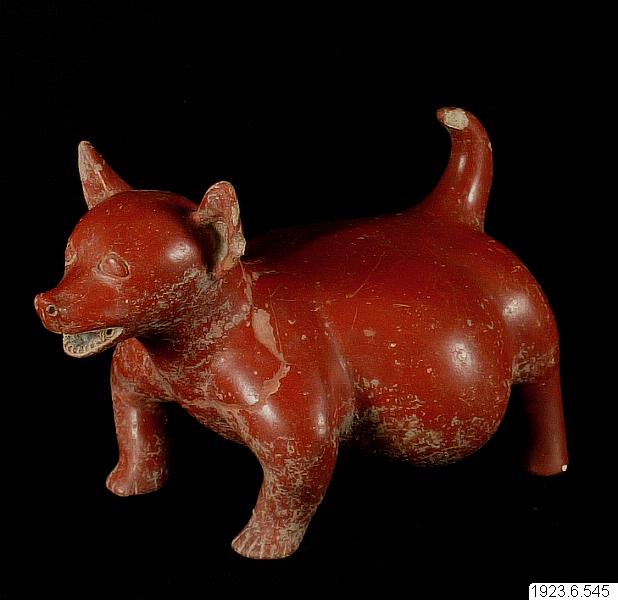 Source: Objaverse 1.0 / Sketchfab
Ceramic plates
The article deals with production technology and decoration technique of ceramic plates dating back to the late XVI century-the first half of the XVII century. The analysis is based on materials originated from the study of the remains of a pottery workshop in Forder Rossgarten district in Koenigsberg. The distinctive features of the decoration are the use of white and colored slip, the use of sgraffito technique and the process of coating with glaze. Fig.2:Plates after the first firing (before glazing).2.1-painting with slip,2.2-4-painting with colored slip over white slip,2.5-sgraffito over white slip. Fig.3:Plates after the second firing (after glazing).3.1-5-plant motives. Fig.4:Plates after the second firing (after glazing).4.1-2-zoomorphic motifs, 4.3-4-anthropomorphic motifs,4.5-mythological motives. Fig.5:Plates after the second firing (after glazing).5.1-heraldic motifs,5.2-without central ornament depicting fish,5.3-4-ornament made in sgraffito technique Excavation made by "Baltspetsarkheologia" Source: Objaverse 1.0 / Sketchfab
Blue Ceramic Body Sherd#2
This is a 3D scan of an 1800s, mass produced, blue glaze stoneware mixing bowl body sherd. The artifact was found on an archaeological site called the McClure Site. The McClure farmstead is part of Miller Grove. This was a freed African-American community located in the Shawnee National Forest. The artifacts were excavated by an SIUC 2019 Field School, lead by Dr. Mark J. Wagner. Source: Objaverse 1.0 / Sketchfab
White and Blue Ceramic Sherd
By Charlie Hall/ Pottery sherd recovered from the Fort Mose Historical Site under the supervision of Dr. Lori Lee. Model made with Metashape and/or RealityCapture. Source: Objaverse 1.0 / Sketchfab
Nayarit Ceramic Female Figure
This figure was likely created between 200 B.C.E. and 500 C.E. in the Nayarit region of western Mexico. Artifacts such as this one were often used as tomb ornaments. This figure of a pregnant woman was most likely created to honor a deceased mother. The object is in the collection of the Museum of Art at the University of New Hampshire. To learn more about this artifact, visit https://mypages.unh.edu/nayarit 3D model created with Agisoft Metashape and a Nikon D7000 DSLR. Source: Objaverse 1.0 / Sketchfab
Гаршчок / Ceramic pot
Гаршчок быў знойдзены падчас археалагічных раскопак на Верхнім горадзе Кіева. Датуецца сярэдзінай 18 стагоддзя. Яго памеры: h - 15 cm, d1 - 17 cm, d2 - 10 cm. / The pot was found during the archaeological excavations of the Upper town of Kyiv (Ukraine). It dates from the middle of 18 century. Source: Objaverse 1.0 / Sketchfab
Ceramic dish
This model is a ceramic dish with some beautiful drawings painted by hand. Source: Objaverse 1.0 / Sketchfab
6683194 Harappan Ceramic Model Cart
Found as part of the Archaeological Survey of India, 1944-1948, led by Mortimer Wheeler. Currently held at the University College London Institute of Archaeology. Source: Objaverse 1.0 / Sketchfab
ARH8500 ceramic fragment
ceramic fragment found at Pavilion X, Academical Village, University of Virginia Source: Objaverse 1.0 / Sketchfab
Handmade Ceramic Animal Vessel
We found this unusual ceramic vessel at a local Goodwill. The model was constructed from Artec Spider scan data and the texture was adjusted in Artec Studio 15. What kind of animal do you think this was made to resemble? Source: Objaverse 1.0 / Sketchfab
Ceramic mask
Lowpoly version of a 3d scan of a ceramic mask from ethnology museum of Chita. Very little know about this mask. Source: Objaverse 1.0 / Sketchfab
Ceramic mosaic relief, Stříbrnická school
Elementary School Střibrnická ZŠ entry sqaure wall public art ceramic mosaic relief sculpture Sculpture artist: Vladimír Šmíd, 1983 @ Ústí nad Labem CZ, Revoluční • https://goo.gl/maps/g7SrAFq1tZ17Fx7Q8 August 3 2019 photogrammetry scan (24MP, 200+ photos) + Reality capture • https://pavelmatousek.cz Source: Objaverse 1.0 / Sketchfab
ScienceDex guides
Understand access before you commit
These curated guides explain access requirements, typical timelines, costs, and reuse considerations for widely used research datasets.
Allen Brain Atlas
Allen Brain Atlas is an Allen Institute collection of brain map atlases, datasets, APIs, and analysis tools covering mouse, human, and non-human primate brain resources.
Annotated Behaviour and Observability Dataset (ABODe)
ABODe is a University of Edinburgh DataShare dataset for behavior classification in group-housed mice using home-cage video, identities, bounding boxes, ground-plate positions, and annotator labels.
DANDI Archive for NWB datasets
DANDI is a BRAIN Initiative archive for publishing and sharing neurophysiology data, including electrophysiology, optophysiology, and behavioral data packaged as NWB and related standards.
International Brain Laboratory public data
The International Brain Laboratory public data releases expose standardized mouse decision-making experiments, including Neuropixels recordings, widefield calcium imaging, behavior, and session metadata accessed through the ONE API.
OpenNeuro
OpenNeuro is a free, open platform for sharing neuroimaging datasets, with public search, dataset pages, and download paths for web, S3, DataLad, and the OpenNeuro CLI.