
Find research datasets worth reusing
Search datasets from major research repositories and use ShareScore to quickly assess how well each record supports discovery, access, and reuse.
513
datasets available to search
ShareScore release 0.9.0
Dataset results
513 results for “miniaturization”
Concatenated matrix from: Pristimantis trachyblepharis species group, a clade of miniaturized frogs: description of four new species and insights into the evolution of body size within the genus
<p>Matrix in nexus format that include sequences of <em>RAG1 </em>(1 - 600 bp), <em>16S</em> (601 - 1912 bp), and <em>12S</em> (1913 - 2819 bp) genes for 347 specimens belonging to the genus Pristimantis, in addition to several specimens of neotropical frog genera as outgroups.</p>
Photographs of live individuals from: Pristimantis trachyblepharis species group, a clade of miniaturized frogs: description of four new species and insights into the evolution of body size within the genus
<p>Photographs in jpg format of live individuals examined for morphological comparisons and descriptions. </p> <ul> <li><em>P. albujai</em> (photographs of 28 specimens).</li> <li><em>P. aquilonaris</em> (photographs of 12 specimens).</li> <li><em>P. nanus</em> sp. nov. (photographs of 7 specimens).</li> <li><em>P. pramukae </em>sp. nov. (photographs of 36 specimens).</li> <li><em>P. trachyblepharis</em> (photographs of 26 specimens).</li> <li><em>P. ujucami</em> sp. nov. (photographs of 27 specimens).</li> <li><em>P. ventristellatus</em> sp. nov. (photographs of 26 specimens).</li> </ul> <p>Available photographs of several Unconfirmed Candidate Species (UCS) are also provided.</p>
Fig. 4 in Paedocypris Carbunculus, A New Species Of Miniature Fish From Borneo (Teleostei: Cypriniformes: Cyprinidae)
Fig. 4. Paedocypris carbunculus, new species, holotype (left), male, MZB 10981, 9.7 mm, and paratype (right), female, CMK 19658, 10.8 mm; head and anterior trunk in dorsal (above) and ventral view (below) to illustrate pigmentation pattern.
Fig. 3 in Paedocypris Carbunculus, A New Species Of Miniature Fish From Borneo (Teleostei: Cypriniformes: Cyprinidae)
Fig. 3. Paedocypris carbunculus, new species, holotype, male, MZB 10981, 9.7 mm, and paratype, female, CMK 19658, 10.8 mm; Indonesia: Kalimantan Tengah, Pangkalan Bun.
Fig. 7 in Paedocypris Carbunculus, A New Species Of Miniature Fish From Borneo (Teleostei: Cypriniformes: Cyprinidae)
Fig. 7. Paedocypris carbunculus, spawning behaviour: a, male has attracted a female; b, male and female in parallel posture during egg deposition; c, both in spawning embrace; d, male in contact with eggs via pelvic fins and keratinized pad (Photos: Oliver Perrin).
Fig. 5 in Paedocypris Carbunculus, A New Species Of Miniature Fish From Borneo (Teleostei: Cypriniformes: Cyprinidae)
Fig. 5. Paedocypris micromegethes, holotype, male, ZRC 49869, 10.4 mm; head and anterior trunk in dorsal (above) and ventral view (below) to illustrate pigmentation pattern.
Fig. 2 in Paedocypris Carbunculus, A New Species Of Miniature Fish From Borneo (Teleostei: Cypriniformes: Cyprinidae)
Fig. 2. Live specimen of Paedocypris carbunculus, not preserved, male above, female below (Photos: Heok Hui Tan).
Fig. 1 in Paedocypris Carbunculus, A New Species Of Miniature Fish From Borneo (Teleostei: Cypriniformes: Cyprinidae)
Fig. 1. Schematic representations of the pigment pattern terminology for Paedocypris in lateral (above), dorsal (middle) and ventral (below) views. Note that not all chromatophore patterns visible are actually depicted in each view.
Designed Rubredoxin miniature in a fully artificial electron chain triggered by visible light
<p>This dataset contains Raw and Processed Data, and Computational Protein Design files related to the publication "Designed Rubredoxin miniature in a fully artificial electron chain triggered by visible light".<br> For further details, please refer to the preprint that is available at the following link <a href="http://dx.doi.org/10.21203/rs.3.rs-1473985/v1">https://dx.doi.org/10.21203/rs.3.rs-1473985/v1</a><br> Peer-reviewed manuscript will be published soon in Nature Communications.</p>
Designed Rubredoxin miniature in a fully artificial electron chain triggered by visible light
<ul> <li><strong>Data type</strong>: Experimental spectroscopic measurements, computer plots.</li> <li>Files are with filename extensions: .<strong>DSC</strong>, .<strong>DAT</strong>, .<strong>txt</strong>, .<strong>m</strong></li> <li>Information on <strong>origin of the data</strong>:</li> </ul> <ul> <li>EPR spectroscopic measurements with filename extensions: .<strong>DSC</strong>, .<strong>DTA</strong>, .<strong>txt</strong>.</li> <li>EPR spectroscopic plots with filename extension: .<strong>m</strong>.</li> </ul> <ul> <li>CW-EPR X-band were performed on a Bruker Elexys E580 X-band spectrometer (microwave frequency 9.76 GHz) equipped with a cylindrical dielectric cavity and a helium gas-flow cryostat from Oxford Inc. The spectrum was recorded at 4.5 K and a microwave power of 1mW, a modulation amplitude of 0.7mT and a modulation frequency of 100 KHz were used.</li> <li>Raw and Processed Data, and Computational Protein Design files</li> </ul> <ul> <li><strong>If the dataset includes multiple files that relate to each other:</strong> <ul> <li>Files in <strong>PARACAT_WP5_20230425_CW</strong> folder includes X-band CW-EPR spectroscopic measurements, original data are in .<strong>DTA</strong>/.<strong>DSC</strong>/.<strong>txt</strong>.</li> <li>Files in <strong>PARACAT_WP5_20230425_MATLAB</strong> folder includes plots of the EPR measurements, data are in .<strong>m</strong> format.</li> </ul> </li> </ul> <p> </p> <ul> <li><strong>Information on</strong>: <ul> <li>Specialized abbreviations: <strong>EPR</strong> – Electron Paramagnetic Resonance; <strong>CW</strong> – Continuous Wave-EPR; <strong>METP</strong> - Miniaturized Electron Transfer Protein; METP<strong>sc</strong>1 - single-chain high-potential miniaturized electron transfer protein.</li> <li>Definitions of variables: <strong>Magnetic field, Temperature</strong>.</li> <li>Units of measurement: <strong>Gauss (G), milliTesla (mT), Kelvin (K)</strong></li> </ul> </li> </ul>
Miniaturized helical antenna manufacturing process - H2020 UWIPOM2 PROJECT
<p>Miniaturized helical antenna manufacturing process</p> <p>https://www.youtube.com/watch?v=Va-iSQlFMnY&ab_channel=Prof.Efr%C3%A9nD%C3%ADezJim%C3%A9nez-UniversidaddeAlcal%C3%A1</p>
Miniaturized spectral sensing with a tunable optoelectronic interface
Open the record for dataset details and reuse information.
Data from: The effect of miniaturization on the evolution of sexual size dimorphism in geckos
Open the record for dataset details and reuse information.
Data and code from: Life under leaves: Substrate-borne vibrations provide a window into the behavior and ecology of two miniaturized geckos
Open the record for dataset details and reuse information.
Data from: Miniaturization, genome size, and biological size in a diverse clade of salamanders
Genome size (C-value) can affect organismal traits across levels of biological organization, from tissue complexity to metabolism. Neotropical salamanders show wide variation in genome and body sizes, including several clades with miniature species. Because miniaturization imposes strong constraints on morphology and development, and genome size is strongly correlated with cell size, we hypothesize that body size has played an important role in the evolution of genome size in bolitoglossine salamanders. If this hypothesis is correct, then genome size and body size should be correlated in this group. Using Feulgen Image Analysis Densitometry (FIAD), we estimated genome sizes for 60 species of neotropical salamanders. We also estimated the "biological size" of species by comparing genome size and physical body sizes in a phylogenetic context. We found a significant correlation between C-value and physical body size using optimal regression with an Ornstein-Uhlenbeck model, and report the smallest salamander genome found to date. Our index of biological size showed that some salamanders with large physical body size have smaller biological body size than some miniature species, and that several clades showed patterns of increased or decreased biological size compared to their physical size. Our results suggest a causal relationship between physical body size and genome size and show the importance of considering the impact of both on the biological size of organisms. Indeed, biological size may be a more appropriate measure than physical size when considering phenotypic consequences of genome size evolution in many groups.
Miniature of Nishimonobe
Miniature of Nishimonobe village in Omi_02 scans with iPhone12 Pro This is a replication miniature of the village in Nishimonobe, Takatsuki-cho, Nagahama city, Shiga Prefecture. It represents one day in early summer in the latter half of the 50's of the Showa Era. [National Museum of Japanese History](https://www.rekihaku.ac.jp/english/index.html) 117 Jonai-cho, Sakura City, Chiba Prefecture 285-8502 JAPAN 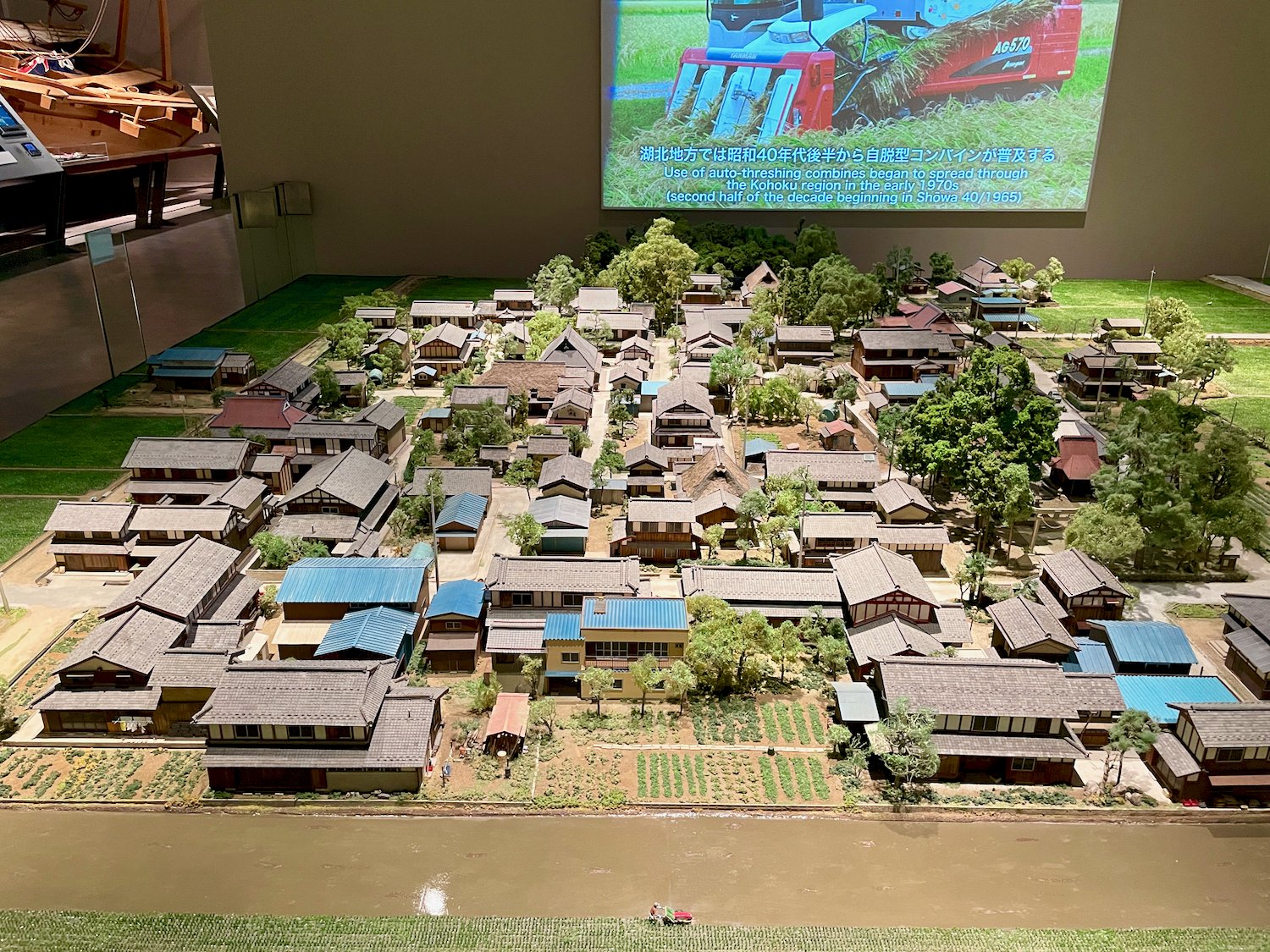 [Miniature of Nishimonobe village in Omi](https://www.rekihaku.ac.jp/english/exhibitions/regular/room4.html) Source: Objaverse 1.0 / Sketchfab
Miniatyyrikannu - Miniature Jar
TMK23146:KE056:002 Katedralskolanin 2014-2015 kaivauksilta löytynyt pienikokoinen kivisavikannu. Tämä kannu löytyi vuosina 1450-1520 käytössä olleen latriinin seinähirsien vierestä. Tämän kaltaiset miniatyyrikannut ovat luultavasti olleet voidesalvan säilytysastioita. A miniature stoneware jug that was found next to a late Medieval latrine (1450-1520) during an excavation at Katedralskolan in 2014-2015. A likely use for these tiny jugs was to store ointment. Source: Objaverse 1.0 / Sketchfab
Porcelain bottle with miniature landscapes
Porcelain bottle with miniature landscapes and gilding ID no.: FZRS/4 Museum: Collection of the Sosenko Family Foundation https://muzea.malopolska.pl/en/objects-list/881 Digitalisation: RDW MIC, Virtual Małopolska project Source: Objaverse 1.0 / Sketchfab
Nô Mask (miniature)
Japanese | grimacing grotesque man (miniature replica) | H. 3-3/4 x W. 2-1/2 inches | Terracotta | MWJ16:3 Source: Objaverse 1.0 / Sketchfab
Broughmore Wood 3 - Miniature Quernstones
A small panel with an array of miniature quern stone rough-outs. A plan is now in the pipeline for a full excavation of the site, which it is hoped will shed more light on its chronology and, hopefully, reveal even of these more fascinating rock surfaces. This panel was recorded and 3D modelled by Nick Parish for Scotland's Rock Art Project (ScRAP). Source: Objaverse 1.0 / Sketchfab
ScienceDex guides
Understand access before you commit
These curated guides explain access requirements, typical timelines, costs, and reuse considerations for widely used research datasets.
Allen Brain Atlas
Allen Brain Atlas is an Allen Institute collection of brain map atlases, datasets, APIs, and analysis tools covering mouse, human, and non-human primate brain resources.
Annotated Behaviour and Observability Dataset (ABODe)
ABODe is a University of Edinburgh DataShare dataset for behavior classification in group-housed mice using home-cage video, identities, bounding boxes, ground-plate positions, and annotator labels.
DANDI Archive for NWB datasets
DANDI is a BRAIN Initiative archive for publishing and sharing neurophysiology data, including electrophysiology, optophysiology, and behavioral data packaged as NWB and related standards.
International Brain Laboratory public data
The International Brain Laboratory public data releases expose standardized mouse decision-making experiments, including Neuropixels recordings, widefield calcium imaging, behavior, and session metadata accessed through the ONE API.
OpenNeuro
OpenNeuro is a free, open platform for sharing neuroimaging datasets, with public search, dataset pages, and download paths for web, S3, DataLad, and the OpenNeuro CLI.