
Find research datasets worth reusing
Search datasets from major research repositories and use ShareScore to quickly assess how well each record supports discovery, access, and reuse.
513
datasets available to search
ShareScore release 0.9.0
Dataset results
513 results for “miniaturization”
Miniature axe
ID no.: MAK/3664 Archaeological Museum in Kraków https://muzea.malopolska.pl/en/objects-list/1525 Digitalisation: RDW MIC, Virtual Małopolska project Source: Objaverse 1.0 / Sketchfab
Miniature Gymnastics Horse
This miniature pommelled horse belongs to a series of models of gymnastics appliances donated by Anni Collan to the Sports Museum in 1941. The 1/10 scale models are made of lacquered wood, metal, leather and wool cloth. The series was produced in 1907 by the carpenter Oskari Anttila on the commission of a committee of gymnastics teachers including Collan. The models were used as teaching material at gymnastic instructors' courses. Anni Collan was a leading figure in Finnish women's gymnastics in the first half of the 20th century. She worked as gymnastics teacher at several colleges in Helsinki and later as inspector of gymnastics in Finnish school administration while serving as chairwoman of the Finnish Women's Gymnastics Association and as a prominent leader in the international girl scout movement. Source: Objaverse 1.0 / Sketchfab
Miniature of a dancing mask
Miniature of a dancing mask in the Bonn Collection of the Americas at the University of Bonn (Inv. Nr. 1156) * Object: Miniature of a dancing mask made of plaster, devil figure in the dance "Diablada", polychrome painting with basic color red, intended for sale to tourists. * Place of origin: Bolivia, Departamento Oruro, Oruro * Culture: Aymara * Acquisition: 1955/56 during expedition in Oruro * Collection: Hermann Trimborn * Hardware: Nikon D750, Nikon 60 mm macro * Software: RealityCapture, Substance Designer, Blender Source: Objaverse 1.0 / Sketchfab
1990.84 Miniature Votive Stupa
You can copy, modify, and distribute this work, even for commercial purposes, all without asking permission. Learn more about The Cleveland Museum of Art's Open Access initiative: http://www.clevelandart.org/open-access-faqs Miniature Votive Stupa, AD 435. China, Gansu province, Northern Wei dynasty (386-534). Steatite; overall: 16.9 cm (6 5/8 in.). The Cleveland Museum of Art, Purchase from the J. H. Wade Fund 1990.84 Learn more on The Cleveland Museum of Art's Collection Online: https://www.clevelandart.org/art/1990.84 Source: Objaverse 1.0 / Sketchfab
Miniature multihole airflow sensor for lightweight aircraft over wide speed and angular range
<p>This repository contains:</p> <ul> <li>the data collected for the paper "Miniature multihole airflow sensor for lightweight aircraft over wide speed and angular range"</li> <li>the python code to extract the wind tunnel and flight data to reproduce the plots in the paper</li> <li>the exact polynomials used for the calibration</li> <li>the 3D object files of the airflow sensor</li> <li>the schematics of the PCB</li> <li>the video of the flown manoeuvres (available on youtube: https://youtu.be/U3nR1v3fbZg)</li> </ul> <p>The data and the plots are included in the repository, but can be reproduced by running the python scripts in the following order:</p> <ol> <li>Code/reduce_data.py</li> <li>Code/plot_averages.py</li> <li>Code/read_tunnel.py</li> <li>Code/Regress.py</li> <li>Code/Validation_plot.py</li> </ol>
Data for A miniaturized magnetic field sensor based on nitrogen-vacancy centers
<p>Here, data sets as plotted in the preprint "A miniaturized magnetic field sensor based on nitrogen-vacancy centers" are uploaded. <br><br>The zip file Data_Zenodo_v3.zip contains a folder for each figure and one additional table supporting the findings in the preprint/publication. Folders of figures containing only images include the images in the preprint/publication as .png and .svg or .pdf data. Folders of figures containing plots include the plot as .png and .pdf aswell as the data points and fit parameters collected in a .xlsx, .csv or .h5 file.</p>
Fig. 12. Petruichthys brevis. A, NRM 28473 in Physoschistura mango, a new miniature species of loach from Myanmar (Teleostei: Nemacheilidae)
Fig. 12. Petruichthys brevis. A, NRM 28473, male, 28.6 mm SL; B, NRM 28473, female, 32.1 mm SL.
Witkiewicz house miniature
A miniature of a house showing Stanislaw Witkiewicz's architecture style. From wiki: "In 1886, he visited Zakopane for the first time. He developed a fascination with the mountains, the Podhale highlanders and their vernacular traditions. His ambition became to create a Polish national style through extraction of all-Polish forms from the architectural and decorative art of the highlanders. He formulated the Zakopane Style (styl zakopiański) (also known as Witkiewicz Style (styl witkiewiczowski)) in architecture, in which he designed homes and interiors for well-off, artistically inclined Poles. He was strongly associated with Zakopane and promoted it in the art community." Source: Objaverse 1.0 / Sketchfab
Matkaikonostaasi,Miniature iconostasis(H77006:1)
Kolmiosainen matkaikonostaasi, jonka keskilevyssä Nikolaus Mozhaiskilainen kädessään miekka, vasemmassa temppelin pienoismalli. Pään molemmin puolin esirukoilijat Pyhä Jumalanäiti ja Jeesus Kristus. Siipilevyjen neliöissä kirkkopyhiä: vasemmalla ylhäällä Jeesus ratsastaa Jerusalemiin, alhaalla Jeesus tuodaan temppeliin. Oikealla ylhäällä Kristus Tuonelassa ja alhaalla Kristuksen taivaaseenastuminen. Ylinnä keskilevyyn kiinnittyneenä maljamaisessa kehyksessä Vanhan Testamentin Pyhä Kolminaisuus kahden serafin ympäröimänä. Ripustinrengas levyssä Käsintekemätön Kristus. Ikoni on löydetty Ruotsinsalmen II meritaistelussa uponneen saaristofregatti st. Nikolain hylystä. Suomen merimuseon kokoelmat, Suomen kansallismuseo. A miniature iconostasis. Found from the wreck of frigate st. Nikolai, sunk during the second Battle of Svensksund in 1790. Collections of the Maritime Museum of Finland , The National Museum of Finland. Source: Objaverse 1.0 / Sketchfab
greek_column_mesh_miniature_gkasidou
Το παρόν αποτελεί εργασία της φοιτήτριας Γκασίδου Αναστασία στο μάθημα "ΜΙΚΤΗ ΠΡΑΓΜΑΤΙΚΟΤΗΤΑ ΚΑΙ ΗΛΕΚΤΡΟΝΙΚΟΣ ΠΟΛΙΤΙΣΜΟΣ". Source: Objaverse 1.0 / Sketchfab
Catawba Earthenware Miniature Jar (2554p2723)
**Catawba earthenware miniature jar** Location: Ayers Town (38Yk534), York County, South Carolina. Period: Historic (1780-1800). Material: ceramic. Dimensions: height, 6.0 cm; diameter, 5.7 cm. Notes: Catalog no. 2554p2723. Vessel 23. Recovered during excavations at the historic Catawba site of Ayers Town. Model by Chris LaMack. Source: Objaverse 1.0 / Sketchfab
Copy of Stone of Tizoc, miniature
[1936.06.0002](https://collections.smvk.se/carlotta-vkm/web/object/102937), offersten, modell, Miniatyrmodell. Miniatyrmodell av offersten. The Stone of Tizoc, Tizoc Stone or Sacrificial Stone is a large, round, carved Aztec stone. Because of a shallow, round depression carved in the center of the top surface, it may have been a cuauhxicalli or possibly a temalacatl. Richard Townsend maintains, however, that the depression was made in the 16th century for unknown purposes. 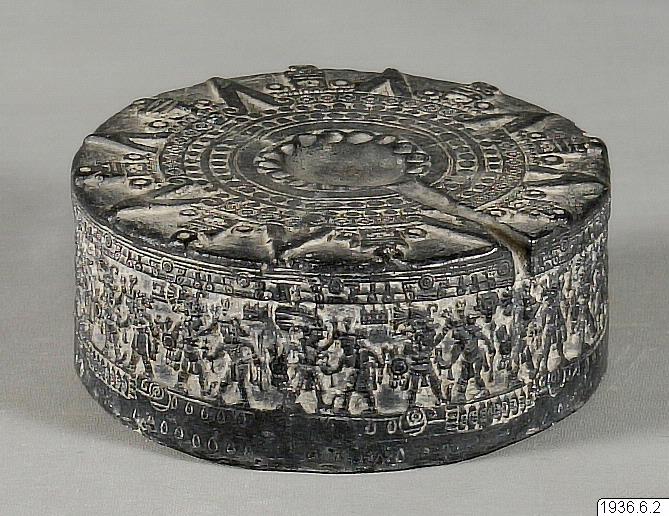 Source: Objaverse 1.0 / Sketchfab
Thai Buddha miniature
This is a scan of a thai Buddha miniature Height: 25cm Scan: 77.700 poly Quick Low: 1600 poly Source: Objaverse 1.0 / Sketchfab
Miniature of the sarcophagus of Casimir IV
Miniature of the sarcophagus of Casimir IV the Jagiellonian from the Holy Cross Chapel of Wawel Cathedral ID no.: ZKWawel 9327 Museum: Wawel Royal Castle – State Art Collection http://muzea.malopolska.pl/en/obiekty/-/a/4869610/4878259 Digitalisation: RDW MIC, Małopolska's Virtual Museums Plus project Source: Objaverse 1.0 / Sketchfab
Wireless flow-powered miniature robot capable of traversing tubular structures
<p>Wireless millimeter-scale robots capable of navigating through fluid-flowing tubular structures hold substantial potential for inspection, maintenance, or repair use in nuclear, industrial, and medical applications. However, prevalent reliance on external power constrains their operational range and applicable environments. Alternatives with onboard powering must trade off size, functionality, and operation duration. Here, we propose a wireless millimeter-scale wheeled robot capable of using environmental flows to power and actuate its long-distance locomotion through complex pipelines. The flow-powering module can convert flow energy into mechanical energy, achieving an impeller speed of up to 9595 revolutions per minute, accompanied by an output power density of 11.7 watts per cubic meter and an efficiency of 33.7%. A miniature gearbox module can further transmit the converted mechanical energy into the robot's locomotion system, allowing the robot to move against water flow at an average rate of up to 1.05 meters per second. The robot's motion status (moving against/with flow or pausing) can be switched using an external magnetic field or an onboard mechanical regulator, contingent upon different proposed control designs. Additionally, we design kirigami-based soft wheels for adaptive locomotion. The robot can move against flows of various substances within pipes featuring complex geometries and diverse materials. Solely powered by flow, the robot can transport cylindrical payloads with a diameter of up to 55% of the pipe's diameter and carry devices, such as an endoscopic camera for pipeline inspection, a wireless temperature sensor for environmental temperature monitoring, and a leak-stopper shell for infrastructure maintenance.</p>
FIGURE 2 in A new sexually dichromatic miniature Characidium (Characiformes: Crenuchidae) from the rio Guaporé, rio Madeira basin, Brazil, with remarkable morphological novelties to the genus
FIGURE 2 | Dentary of Characidium fleurdelis, UFBA 9234, paratype, male, 21.0 mm SL, outer view.
Avoiding obstacles while intercepting a moving target: A miniature fly's solution
<p>The miniature robber fly <i>Holcocephala fusca<i> </i></i>intercepts its targets using a system whose behaviour is approximated by the proportional navigation guidance law. During predatory trials, we challenged <em>Holcocephala</em>'s interception performance by placing a large object in its potential flight path. In response, <em>Holcocephala</em> deviated from the path predicted by pure-proportional navigation, but in many cases still eventually contacted the target. We show that such flight deviations can be explained as the output of two competing navigational systems; pure-proportional navigation and a simple obstacle avoidance algorithm. Obstacle avoidance by <em>Holcocephala</em> is here described by a simple feedback loop that uses the visual expansion of the approaching obstacle to mediate the magnitude of the turning-away response. We name the integration of this this steering law with pro-nav "Combined Guidance". The results demonstrate that predatory intent does not operate a monopoly on the fly's steering when attacking a target, and that simple guidance combinations can explain obstacle avoidance during interceptive tasks.</p>
Miniaturization eliminates detectable impacts of drones on bat activity
<p>A new way to survey wildlife populations may be possible with advancements in drones, or unmanned aerial vehicles (UAVs) that render aerial technology more accessible and promote surveying in inapproachable habitats. However, it remains unclear whether UAV disturbance deters animals, which would make this method inaccurate for data collection and hazardous to wildlife welfare. This study addresses the viability of UAV use for wildlife research by measuring the effects of UAV flight on acoustic bat detection and comparing bat activity in response to varying UAV models. Depending on the way UAVs effect bat detection rate, it may be possible to identify whether wildlife surveys should be done with UAVs and the drone models best suited for this purpose. The results reveal that larger and louder UAVs deterred significantly more bats, and the smallest and quietest model had no effect on bat detection. Indeed, drone noise was positively correlated with drone size, but drone size had little effect on the range of frequencies emitted. While detecting bats with small and quiet UAVs may be possible, complications still arise with acoustic detection and the species-specific effects of drone flight. The reliability of automatic identification with the acoustic detecting software is limited, as over a quarter of detections were triggered by non-bat noises yet still classified as bats (25.99%). Overall, using drones for wildlife detection should be approached with caution, as this study illustrates that some drones deter and disturb wild bats. If drones are used in wildlife habitat, consider flying smaller and quieter models, which are significantly less disturbing. Otherwise, large and loud drones will likely deter more animals and skew the results of the survey.</p>
Data from: Manipulation of Miniature and Microminiature Bodies on a Harmonically Oscillating Platform by Controlling Dry Friction
<p>Data from the paper "Manipulation of Miniature and Microminiature Bodies on a Harmonically Oscillating Platform by Controlling Dry Friction" <a href="https://doi.org/10.3390/mi12091087">https://doi.org/10.3390/mi12091087</a></p> <p>Currently used nonprehensile manipulation systems that are based on vibrational techniques employ temporal (vibrational) asymmetry, spatial asymmetry, or force asymmetry to provide and control a directional motion of a body. This paper presents a novel method of nonprehensile manipulation of miniature and microminiature bodies on a harmonically oscillating platform by creating a frictional asymmetry through dynamic dry friction control. To theoretically verify the feasibility of the method and to determine the control parameters that define the motion characteristics, a mathematical model was developed, and modeling was carried out. Experimental setups for miniature and microminiature bodies were developed for nonprehensile manipulation by dry friction control, and manipulation experiments were carried out to experimentally verify the feasibility of the proposed method and theoretical findings. By revealing how characteristic control parameters influence the direction and velocity, the modeling results theoretically verified the feasibility of the proposed method. The experimental investigation verified that the proposed method is technically feasible and can be applied in practice, as well as confirmed the theoretical findings that the velocity and direction of the body can be controlled by changing the parameters of the function for dynamic dry friction control. The presented research enriches the classical theories of manipulation methods on vibrating plates and platforms, as well as the presented results, are relevant for industries dealing with feeding, assembling, or manipulation of miniature and microminiature bodies.</p>
Altstadt Spandau Miniatur
 Shot with GoPro 9, 100 Pics Source: Objaverse 1.0 / Sketchfab
ScienceDex guides
Understand access before you commit
These curated guides explain access requirements, typical timelines, costs, and reuse considerations for widely used research datasets.
Allen Brain Atlas
Allen Brain Atlas is an Allen Institute collection of brain map atlases, datasets, APIs, and analysis tools covering mouse, human, and non-human primate brain resources.
Annotated Behaviour and Observability Dataset (ABODe)
ABODe is a University of Edinburgh DataShare dataset for behavior classification in group-housed mice using home-cage video, identities, bounding boxes, ground-plate positions, and annotator labels.
DANDI Archive for NWB datasets
DANDI is a BRAIN Initiative archive for publishing and sharing neurophysiology data, including electrophysiology, optophysiology, and behavioral data packaged as NWB and related standards.
International Brain Laboratory public data
The International Brain Laboratory public data releases expose standardized mouse decision-making experiments, including Neuropixels recordings, widefield calcium imaging, behavior, and session metadata accessed through the ONE API.
OpenNeuro
OpenNeuro is a free, open platform for sharing neuroimaging datasets, with public search, dataset pages, and download paths for web, S3, DataLad, and the OpenNeuro CLI.