
Find research datasets worth reusing
Search datasets from major research repositories and use ShareScore to quickly assess how well each record supports discovery, access, and reuse.
17
datasets available to search
ShareScore release 0.9.0
Dataset results
17 results for “Phoenicopterus”
Flamenco (Phoenicopterus roseus)
**Ejemplar:** *Phoenicopterus roseus* **Nombre común**: flamenco rosa **Descripción:** **Sigla museo, colección y entidad:** VER0000489. Colección del Dpto. de Zoología (Facultad Ciencias Biológicas). MUVHN. **Técnica digitalización / modelo**: escaneado superficial, escáner 3D Einscan Pro **Software empleado**: einscan v3.1.0.2 **Parámetros software:** modo manual con plataforma giratoria, calidad media **Archivo 3D:** OBJ 128Mb , textura JPG 3'6Mb **Autor digitalización:** Jose A. Villena **Cita ejemplar:** modelo 3D Colección cráneos de aves del Dpto. de Zoología. Museo Universitat de València de Historia Natural (MUVHN). 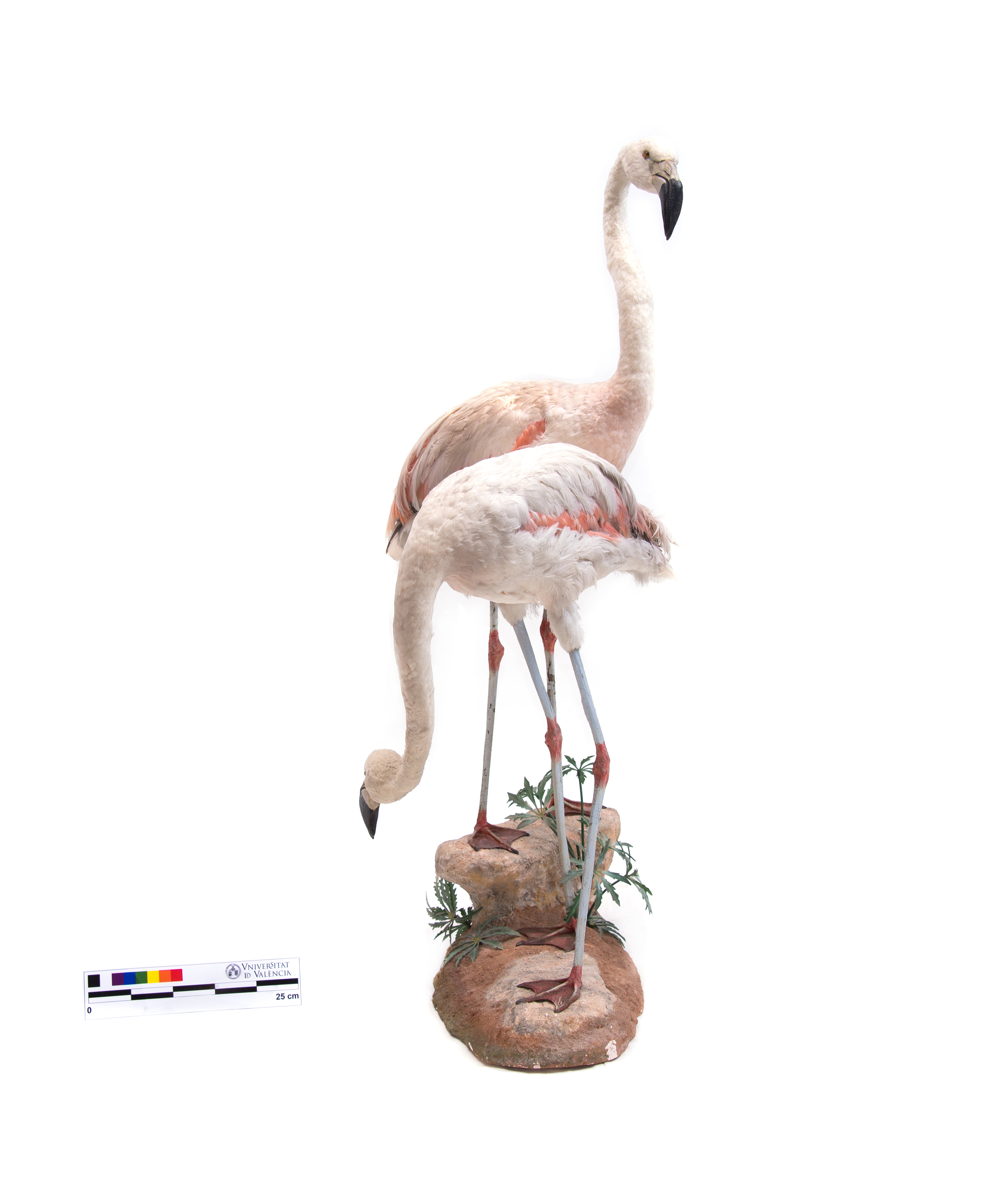 VER0000232. Ejemplares taxidermizados de la especie *Phoenicopterus chilensis*. Colección Histórica de Aves (MUVHN). Previo 1950 Source: Objaverse 1.0 / Sketchfab
Data from: Genetic polymorphism in dopamine receptor D4 is associated with early body condition in a large population of greater flamingos, Phoenicopterus roseus
Body condition is an important determinant of fitness in many natural populations. However, as for many fitness traits, the underlying genes that regulate body condition remain elusive. The dopamine receptor D4 gene (DRD4) is a promising candidate as dopamine is known to play an important role in the regulation of food intake and the metabolism of both glucose and lipids in vertebrates. In this study we take advantage of a large dataset of greater flamingos, Phoenicopterus roseus, to test whether DRD4 polymorphism predicts early body condition (EBC) while controlling for whole genome effects of inbreeding and outbreeding using microsatellite multi-locus heterozygosity (MLH). We typed 670 of these individuals for exon 3 of the homologue of the human DRD4 gene and 10 microsatellite markers. When controlling for effects of yearly environmental variations and differences between sexes, we found strong evidence of an association between exon 3 DRD4 polymorphisms and EBC, with 2.2-2.3% of the variation being explained by DRD4 polymorphism, whereas there was only weak evidence that MLH predicts EBC. Because EBC is most likely a polygenic trait, this is a considerable amount of variation explained by a single gene. This is to our knowledge the first study to show an association between exon 3 DRD4 polymorphism and body condition in nonhuman animals. We anticipate that the DRD4 gene as well as other genes coding for neurotransmitters and their receptors may play an important role in explaining variation in traits that affect fitness.
Figure 6 in Behavioral repertoire of a population of wild Chilean Flamingos Phoenicopterus chilensis in southern Brazil
Figure 6. Representations of agonistic social behaviours observed on Chilean Flamingos at Lagoa do Peixe National Park. a) Alert posture; b) Hooking or Threat posture 1; c) Neck swaying or Threat posture 2; d) Sparring or Fighting; e) Front pecking; f) Back pecking.
Figure 4 in Behavioral repertoire of a population of wild Chilean Flamingos Phoenicopterus chilensis in southern Brazil
Figure 4. Representations of locomotion behaviours observed on Chilean Flamingos at Lagoa do Peixe National Park. a) Walking; b) Strolling; c) Running; d) Flying.
Figure 3 in Behavioral repertoire of a population of wild Chilean Flamingos Phoenicopterus chilensis in southern Brazil
Figure 3. Representations of feeding behaviours observed on Chilean Flamingos at Lagoa do Peixe National Park. a) Pecking up; b) Head dipping; c) Feet trembling or Treading; d) Dredging or Moving Tread; e) False feet-trembling or false treading.
Figure 2 in Behavioral repertoire of a population of wild Chilean Flamingos Phoenicopterus chilensis in southern Brazil
Figure 2. Behavioural accumulation curve constructed under the protocol of Dias et al. (2009). The black line indicates the curve and the grey area is the confidence interval. Our observations surpass the 90% sampling sufficiency calculated by the Clench equation, indicating good sampling effort.
Figure 1 in Behavioral repertoire of a population of wild Chilean Flamingos Phoenicopterus chilensis in southern Brazil
Figure 1. Map showing the area and limits of Lagoa do Peixe National Park, at the middle coast of Rio Grande do Sul state, southern Brazil. The point indicates the 'Barra', region where the lagoon meets the sea and place where Chilean flamingos usually ocupate in the park.
Figure 7 in Phylogeny of the order Phoenicopteriformes and population genetics of the Caribbean flamingo (Phoenicopterus ruber: Aves)
Figure 7. Summary of genetic diversity indexes, based on 15 microsatellite loci, in three colonies of the Caribbean flamingo. Na = No. of different alleles, Na (Freq ≥ 5%) = No. of different alleles with a frequency ≥ 5%, Ne = No. of effective alleles, I = Shannon's information index, and He = expected heterozygosity. The allelic richness of Galápagos was calculated for 13 rather than 15 loci (FlamHD43 has no data and FlamHD20 has 91.3% of missing data).
Figure 6 in Phylogeny of the order Phoenicopteriformes and population genetics of the Caribbean flamingo (Phoenicopterus ruber: Aves)
Figure 6. Structure results on the clustering of 160 individuals from Phoenicopterus ruber, assuming three populations and using 15 microsatellite loci. The colonies from Cuba and Bonaire showed a signal of structure, even though the most probable number of clusters suggested by the method of Evanno et al. (2005) is two.
Figure 5. The haplotype minimum spanning network using 612 in Phylogeny of the order Phoenicopteriformes and population genetics of the Caribbean flamingo (Phoenicopterus ruber: Aves)
Figure 5. The haplotype minimum spanning network using 612 bp of the cytochrome b gene to compare colonies of Caribbean flamingos from Cuba (N = 49), Bonaire (N = 38) and Galápagos (N = 35).
Figure 4 in Phylogeny of the order Phoenicopteriformes and population genetics of the Caribbean flamingo (Phoenicopterus ruber: Aves)
Figure 4. Genetic structure of Phoenicopteriformes using 17 microsatellite loci. Phoenicoparrus jamesi and Phoeniconaias minor are grouped in the same cluster when K = 5, following Evanno et al. (2005)'s estimation (A), but they separate when K = 6, based on Puechmaille (2016)'s assessment (B).
Figure 3 in Phylogeny of the order Phoenicopteriformes and population genetics of the Caribbean flamingo (Phoenicopterus ruber: Aves)
Figure 3. Time-scaled maximum clade credibility tree based on a partial sequence of flamingos cytochrome b (611 bp). The analysis includes the six extant flamingo species; individuals from the Caribbean flamingo (Phoenicopterus ruber) are identified by their colony of origin: CU (Cuba), Bon (Bonaire) and Gal (Galápagos). Blue bars represent the 95% highest posterior density intervals (95% HPD) of the node ages (in millions of years). The crown Phoenicopteridae diversified around 13 (9–18; 95% HPD) Mya followed by the split of the two main extant flamingo clades approximately 7 Mya. The expansion of existing haplotypes of all species occurred in the last two million years. The branch leading to the endemic haplotype from Galápagos, sample 51637, is coloured red.
Data from: Genetic polymorphism in dopamine receptor D4 is associated with early body condition in a large population of greater flamingos, Phoenicopterus roseus
Open the record for dataset details and reuse information.
Figure 7 in Behavioral repertoire of a population of wild Chilean Flamingos Phoenicopterus chilensis in southern Brazil
Figure 7. Representations of non-agonistic social behaviours observed on Chilean Flamingo at Lagoa do Peixe National Park. a) Wing opening; b) Double wing-salute; c) Inverted wing-salute; d) Head-tohead interaction; e) Head Flagging; f) Neck stretching.
Figure 5 in Behavioral repertoire of a population of wild Chilean Flamingos Phoenicopterus chilensis in southern Brazil
Figure 5. Representations of maintenance behaviours observed on Chilean Flamingos at Lagoa do Peixe National Park. a) Head scratching; b) Neck preening; c) Chest preening; d) Back preening; e) Wing preening; f) Twist preening; g) Stretching; h) Two-feet resting; i) One-foot resting; j) Sleeping; k) Squatting; l) Bathing; m) Foot-shaking.
Figure 2 in Phylogeny of the order Phoenicopteriformes and population genetics of the Caribbean flamingo (Phoenicopterus ruber: Aves)
Figure 2. Phylogeny of the order Phoenicopteriformes using cytochrome b partial sequences. The hybrid flamingos are grouped with Phoenicopterus chilensis and Phoenicopterus ruber. The Phoenicopterus ruber samples have references to their colony of origin: CU (Cuba), Bon (Bonaire) and Gal (Galápagos). As a control, we included the flamingo sequences from Torres et al. (2014) and a partial sequence of Phoenicopterus roseus (-mtDNA) GenBank: EF532932.1. The tree was inferred by using the maximum likelihood method and the Hasegawa–Kishino–Yano mutation model, numbers at the nodes represent bootstrap support.
Figure 1 in Phylogeny of the order Phoenicopteriformes and population genetics of the Caribbean flamingo (Phoenicopterus ruber: Aves)
Figure 1. Distribution area of the Caribbean flamingo (Birdlife-International, 2016; Torres-Cristiani et al., 2020). The colonies sampled in Cuba are labelled as; CP, Cayo Las Picúas; RM, Río Máximo; RC, Río Cauto; the rest of the samples come from Bonaire and Galápagos. The genetic flow between the northern and southern Caribbean colonies remains unknown.
ScienceDex guides
Understand access before you commit
These curated guides explain access requirements, typical timelines, costs, and reuse considerations for widely used research datasets.
Allen Brain Atlas
Allen Brain Atlas is an Allen Institute collection of brain map atlases, datasets, APIs, and analysis tools covering mouse, human, and non-human primate brain resources.
Annotated Behaviour and Observability Dataset (ABODe)
ABODe is a University of Edinburgh DataShare dataset for behavior classification in group-housed mice using home-cage video, identities, bounding boxes, ground-plate positions, and annotator labels.
DANDI Archive for NWB datasets
DANDI is a BRAIN Initiative archive for publishing and sharing neurophysiology data, including electrophysiology, optophysiology, and behavioral data packaged as NWB and related standards.
International Brain Laboratory public data
The International Brain Laboratory public data releases expose standardized mouse decision-making experiments, including Neuropixels recordings, widefield calcium imaging, behavior, and session metadata accessed through the ONE API.
OpenNeuro
OpenNeuro is a free, open platform for sharing neuroimaging datasets, with public search, dataset pages, and download paths for web, S3, DataLad, and the OpenNeuro CLI.