
Find research datasets worth reusing
Search datasets from major research repositories and use ShareScore to quickly assess how well each record supports discovery, access, and reuse.
1,478
datasets available to search
ShareScore release 0.9.0
Dataset results
1,478 results for “faces”
Data from: Genomic characterization of the evolutionary potential of the sea urchin Strongylocentrotus droebachiensis facing ocean acidification
Ocean acidification (OA) is increasing due to anthropogenic CO2 emissions and poses a threat to marine species and communities worldwide. To better project the effects of acidification on organisms' health and persistence, an understanding is needed of the 1) mechanisms underlying developmental and physiological tolerance and 2) potential populations have for rapid evolutionary adaptation. This is especially challenging in nonmodel species where targeted assays of metabolism and stress physiology may not be available or economical for large-scale assessments of genetic constraints. We used mRNA sequencing and a quantitative genetics breeding design to study mechanisms underlying genetic variability and tolerance to decreased seawater pH (-0.4 pH units) in larvae of the sea urchin Strongylocentrotus droebachiensis. We used a gene ontology-based approach to integrate expression profiles into indirect measures of cellular and biochemical traits underlying variation in larval performance (i.e., growth rates). Molecular responses to OA were complex, involving changes to several functions such as growth rates, cell division, metabolism, and immune activities. Surprisingly, the magnitude of pH effects on molecular traits tended to be small relative to variation attributable to segregating functional genetic variation in this species. We discuss how the application of transcriptomics and quantitative genetics approaches across diverse species can enrich our understanding of the biological impacts of climate change.
In the face of climate change and exhaustive exercise: The physiological response of an important recreational fish species
<p>Cobia (<i>Rachycentron canadum</i>) support recreational fisheries along the U.S. mid- and south-Atlantic states and have been recently subjected to increased fishing effort, primarily during their spawning season in coastal habitats where increasing temperatures and expanding hypoxic zones are occurring due to climate change. We therefore undertook a study to quantify the physiological abilities of cobia to withstand increases in temperature and hypoxia, including their ability to recover from exhaustive exercise. Respirometry was conducted on cobia from Chesapeake Bay to determine aerobic scope, critical oxygen saturation, ventilation volume, and the time to recover from exhaustive exercise under temperature and oxygen conditions projected to be more common in inshore areas by the middle and end of this century. Cobia physiologically tolerated predicted mid- and end-of-century temperatures (28-32°C) and oxygen concentrations as low as 1.7-2.4 mg l<sup>-1</sup> suggesting that they may be a climate change winner. Our results indicated cobia can withstand environmental fluctuations that occur in coastal habitats and the broad environmental conditions their prey items can tolerate. However, at these high temperatures some cobia did suffer post exercise mortality. It appears cobia will be able to withstand near future climate impacts in coastal habitats like Chesapeake Bay, but as conditions worsen, catch-and-release fishing may result in higher mortality than under present conditions.</p>
Oval garnet intaglio with a flat back, engraved on the face with a one-line brāhmī inscription.
<p>Oval garnet intaglio with a flat back, engraved on the face with a one-line brāhmī inscription. British Museum 1892,1103.133.</p>
Oval garnet intaglio with a hollowed back, engraved on the face with a one-line brāhmī inscription; broken.
<p>Oval garnet intaglio with a hollowed back, engraved on the face with a one-line brāhmī inscription; broken. British Museum 1892,1103.132.</p>
Oval intaglio with a bevelled edge in a rose-coloured garnet, face engraved with a one-line brāhmī inscription.
<p>Oval intaglio with a bevelled edge in a rose-coloured garnet, face engraved with a one-line brāhmī inscription. British Museum 1892,1103.131.</p>
Greenwich Visitors Centre Stones With Faces
400 frames extracted from video recorded on Sony Xperia XZ2 in August 2020 and processed in Reality Capture. Source: Objaverse 1.0 / Sketchfab
Olmec face
[1996.29.0021](https://collections.smvk.se/carlotta-em/web/object/1060272), skulptur, figur 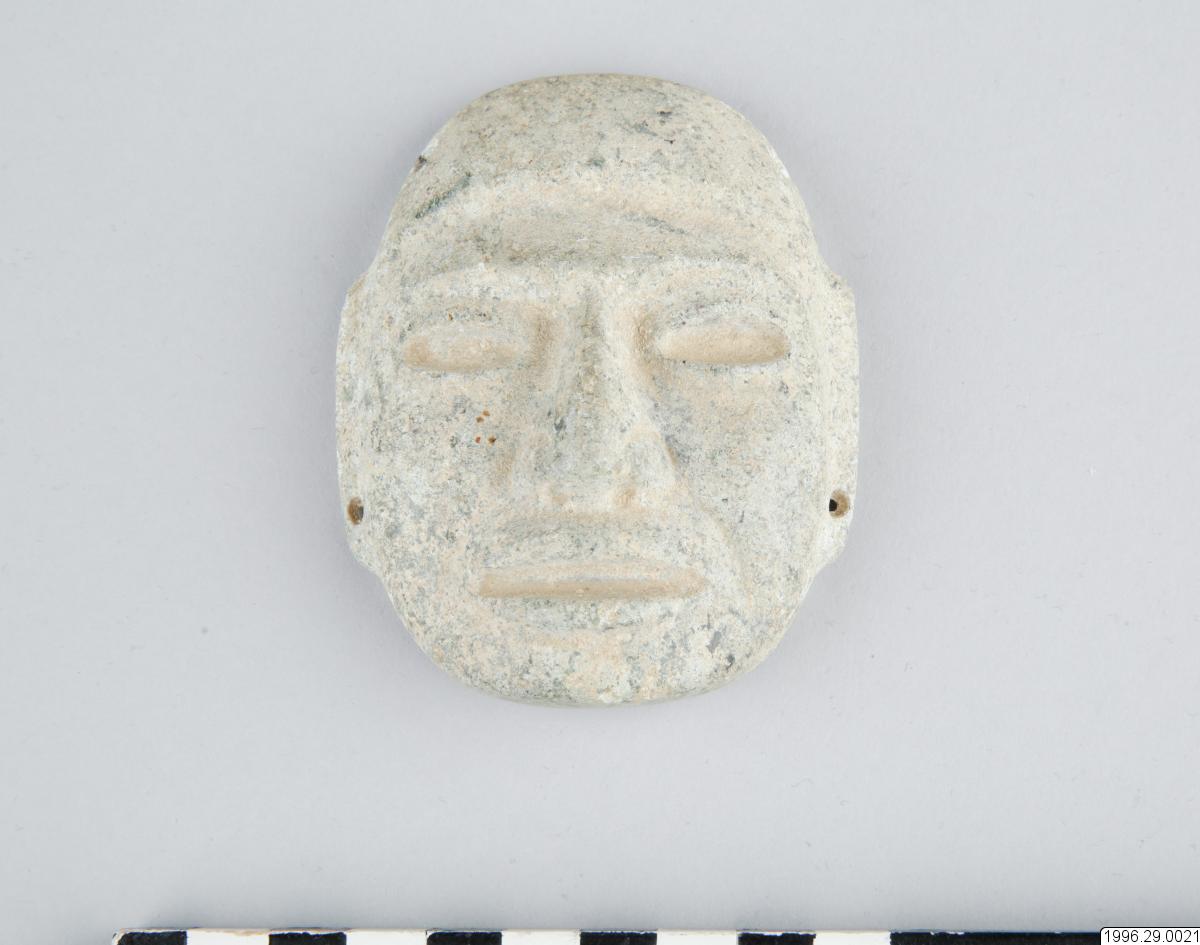 Source: Objaverse 1.0 / Sketchfab
Greenwich Visitors Centre Stone With Face
136 photos taken in May 2019 with a Sony a6000 and processed in Agisoft Metashape. Source: Objaverse 1.0 / Sketchfab
RK18 T00211 Timber - Face 2
RK18 T00211 is a timber found during the archaeological excavation of the Rooswijk in 2018. In 2017 and 2018, the shipwreck of the Rooswijk, a 300 year old Dutch East India Company (VOC) ship which sank on the treacherous Goodwin Sands in January 1740 off the coast of England, was excavated by an international team of maritime archaeologists. Post-excavation work began straight after each excavation campaign, focusing on ex-situ research, the conservation and analysis of the artefacts and will continue until the end of the project. The #Rooswijk1740 project is funded and led by the Cultural Heritage Agency of the Netherlands (Ministry of Education, Science and Culture), in collaboration with project partner Historic England and UK-contractor MSDS Marine. Follow #Rooswijk1740 on social media and https://english.cultureelerfgoed.nl/topics/maritime-heritage/shipwrecks/rooswijk1740 Source: Objaverse 1.0 / Sketchfab
HIGH Lentäjän kasvosuojus Cold Weather Face Mask
Yhdysvaltain ilmavoimien D-1A -kasvosuojus. Se oli suomalaisen retkikunnan käytössä tutkimusmatkalla, joka tehtiin keväällä 1966 Grönlannin jäätikköalueelle. Helsingin Sanomat oli yksi hankkeen rahoittajista ja lehdessä julkaistiin runsaasti kirjoituksia ryhmän matkavalmisteluista, matkasta ja kotiinpaluusta. Kasvosuojain oli retkikuntaan kuuluneen Peter Bouchtin käytössä. A D-1A face mask of the US air force. This mask was used by a Finnish expedition to the glaciers of Greenland in the spring of 1966. Helsingin Sanomat was one of the financiers of the expedition and the newspaper published many stories about how the group prepared for the expedition, the journey itself and the group's homecoming. The face mask was used by expedition member Peter Boucht. The object (pm766) and 3D model: Päivälehti Museum, Finland (member of Traffic Museums Association). The photogrammetric 3D model may include touch-ups and modelled additions. Source: Objaverse 1.0 / Sketchfab
Face Mask
Face Mask Scanned by Thunk3D Handheld Scanner fisher Contact me for more information. Whatsapp/phone/wechat: +86 18518781107 Email:daicy@thunk3d.com Facebook:www.facebook.com/qinqin.li.77 Linkedin: https://www.linkedin.com/in/daicy-li-399b82119/ Titter: https://twitter.com/DaicyLi Source: Objaverse 1.0 / Sketchfab
Quarry Face
3D recreation of an old limestone quarry which is part of the Foel Fraith Limeworking complex on the Brecon Beacons, Wales. The quarry face is about 40m wide. The model was created using 150 images extracted from 2.7K video footage from a DJI Mavic Mini drone. 6 passes along the face of the quarry were done at different heights. The model was created using [Alicevision Meshroom](https://alicevision.org/#meshroom). More detail about the quarry itself and the associated industrial complex can be found on my blog: https://theretiredengineer.wordpress.com/2017/12/17/brecon-beacons-industrial-remains/ https://theretiredengineer.wordpress.com/2019/06/30/brecon-beacons-industrial-remains-2/ Source: Objaverse 1.0 / Sketchfab
decorative face mask
this model craeted in rhino 6 and rendered by keyshot. it can be used for cnc or decorative purposes. no naked edges and closed meshes. Source: Objaverse 1.0 / Sketchfab
Buddha Face Mask
This is a wooden Buddha face mask that I bought on a trip to China in 2006. The scan was made in 2019 using an Artec Space Spider handheld 3D scanner. The scan was cleaned up using Zbrush and Photoshop. Source: Objaverse 1.0 / Sketchfab
Face urn
ID no.: MAK/3310 Archaeological Museum in Kraków https://muzea.malopolska.pl/en/objects-list/1535 Digitalisation: RDW MIC, Virtual Małopolska project Source: Objaverse 1.0 / Sketchfab
MH 1996.9.13 Hanuman: Monkey-faced Diety
Thai; late 19th century; Materials: Bronze; Measurements: Overall: 10 1/2 x 8 3/4 in.; Accession Number: MH 1996.9.13; Credit Line: Gift of Mr. Hershel Richman and Dr. Elizabeth Rosner Richman (Class of 1967); View this object on the Collections Database: http://museums.fivecolleges.edu/detail.php?museum=all&t=objects&type=all&f=&s=mh_1996_9_13&record=0 Photographs and photogrammetry by Laura Shea (Digital Collections Coordinator and Museum Photographer), Mount Holyoke College Art Museum; Copyright info: Contact the Mount Holyoke College Art Museum South Hadley, Massachusetts, USA 01075 413-538-2245 http://www.mtholyoke.edu/artmuseum/ The Mount Holyoke College Art Museum is dedicated to teaching and learning; therefore, we value your feedback and welcome any scholarly observations. Please feel free to contact us if you would like to learn more about the objects you see here or to request 3D models of other objects in our collections. Source: Objaverse 1.0 / Sketchfab
Adjudicating between face-coding models with individual-face fMRI responses: Data and analysis software
<p>Computational model fits to human neuroimaging data. Please see included readme.txt file.</p>
EEG Dataset of 38 Infants (Aged 5-13 Months) Viewing Human and Monkey Faces (Two Identities Each)
<p><strong>EEG Dataset of 38 Infants (Aged 5-13 Months) Viewing Human and Monkey Faces (Two Identities Each)</strong></p> <p><em><strong>Roman Kessler</strong> & <strong>Michael A. Skeide</strong></em></p> <p><br><br>Raw data set used in the study titled: </p> <p><strong>Electrophysiological decoding captures the temporal trajectory of face categorization in infants</strong></p> <p><em><strong>Roman Kessler</strong> & <strong>Michael A. Skeide</strong></em></p> <p> </p> <p>Processing scripts related to the study, cleaned raw data, demographical information, and processed data can be found at:</p> <p>https://github.com/SkeideLab/PRAWN</p> <p> </p> <p>When using this data, please cite:</p> <ul> <li>Kessler, R., & Skeide, M. A. (2024). Electrophysiological decoding captures the temporal trajectory of face categorization in infants. bioRxiv. <a href="https://doi.org/10.1101/2024.10.07.617144">https://doi.org/10.1101/2024.10.07.617144</a></li> <li>Kessler, R., & Skeide, M. A. (2024). EEG Dataset of 38 Infants (Aged 5-11 Months) Viewing Human and Monkey Faces (Two Identities Each) (1.0) [Data set]. Zenodo. <a href="https://doi.org/10.5281/zenodo.13881207" target="_blank" rel="noopener">https://doi.org/</a><a href="https://doi.org/10.5281/zenodo.13881207">10.5281/zenodo.13881206</a></li> </ul> <p> </p> <p>The dataset contains raw data of 38 infants, that were invited 1-2 times each for an EEG experiment showing human (2 individuals) or monkey (2 individuals) faces. See Kessler & Skeide 2024 (bioRxiv) for more information.</p> <p>The preprocessed and all downstream data is located in the GitHub repository.</p> <p>The raw_eeg.zip file is the raw data as provided from the EEG system. Sometimes the session is comprised of several raw eeg files, that are concatenated and cleaned of artifacts from technical failures.</p> <p>The raw_adult_pilots.zip contains the raw data of two adult participants.</p>
Multivocal Literature Review Protocol - Investigating the Barriers that Women face in Software Development Teams focusing on the context of Proprietary Software Ecosystems
Open the record for dataset details and reuse information.
Dataset of the paper: "How do Hugging Face Models Document Datasets, Bias, and Licenses? An Empirical Study"
<p>This replication package contains datasets and scripts related to the paper: "*How do Hugging Face Models Document Datasets, Bias, and Licenses? An Empirical Study*"</p><p> </p><p>## Root directory</p><p>- `statistics.r`: R script used to compute the correlation between usage and downloads, and the RQ1/RQ2 inter-rater agreements</p><p>- `modelsInfo.zip`: zip file containing all the downloaded model cards (in JSON format)</p><p>- `script`: directory containing all the scripts used to collect and process data. For further details, see README file inside the script directory.</p><p> </p><p>## Dataset</p><p>- `Dataset/Dataset_HF-models-list.csv`: list of HF models analyzed</p><p>- `Dataset/Dataset_github-prj-list.txt`: list of GitHub projects using the *transformers* library</p><p>- `Dataset/Dataset_github-Prj_model-Used.csv`: contains usage pairs: project, model</p><p>- `Dataset/Dataset_prj-num-models-reused.csv`: number of models used by each GitHub project</p><p>- `Dataset/Dataset_model-download_num-prj_correlation.csv` contains, for each model used by GitHub projects: the name, the task, the number of reusing projects, and the number of downloads</p><p> </p><p> </p><p>## RQ1</p><p>- `RQ1/RQ1_dataset-list.txt`: list of HF datasets</p><p>- `RQ1/RQ1_datasetSample.csv`: sample set of models used for the manual analysis of datasets</p><p>- `RQ1/RQ1_analyzeDatasetTags.py`: Python script to analyze model tags for the presence of datasets. it requires to unzip the `modelsInfo.zip` in a directory with the same name (`modelsInfo`) at the root of the replication package folder. Produces the output to stdout. To redirect in a file fo be analyzed by the `RQ2/countDataset.py` script</p><p>- `RQ1/RQ1_countDataset.py`: given the output of `RQ2/analyzeDatasetTags.py` (passed as argument) produces, for each model, a list of Booleans indicating whether (i) the model only declares HF datasets, (ii) the model only declares external datasets, (iii) the model declares both, and (iv) the model is part of the sample for the manual analysis</p><p>- `RQ1/RQ1_datasetTags.csv`: output of `RQ2/analyzeDatasetTags.py`</p><p>- `RQ1/RQ1_dataset_usage_count.csv`: output of `RQ2/countDataset.py`</p><p> </p><p> </p><p>## RQ2</p><p>- `RQ2/tableBias.pdf`: table detailing the number of occurrences of different types of bias by model Task</p><p>- `RQ2/RQ2_bias_classification_sheet.csv`: results of the manual labeling</p><p>- `RQ2/RQ2_isBiased.csv`: file to compute the inter-rater agreement of whether or not a model documents Bias</p><p>- `RQ2/RQ2_biasAgrLabels.csv`: file to compute the inter-rater agreement related to bias categories</p><p>- `RQ2/RQ2_final_bias_categories_with_levels.csv`: for each model in the sample, this file lists (i) the bias leaf category, (ii) the first-level category, and (iii) the intermediate category</p><p> </p><p> </p><p>## RQ3</p><p>- `RQ3/RQ3_LicenseValidation.csv`: manual validation of a sample of licenses</p><p>- `RQ3/RQ3_{NETWORK-RESTRICTIVE|RESTRICTIVE|WEAK-RESTRICTIVE|PERMISSIVE}-license-list.txt`: lists of licenses with different permissiveness</p><p>- `RQ3/RQ3_prjs_license.csv`: for each project linked to models, among other fields it indicates the license tag and name</p><p>- `RQ3/RQ3_models_license.csv`: for each model, indicates among other pieces of info, whether the model has a license, and if yes what kind of license</p><p>- `RQ3/RQ3_model-prj-license_contingency_table.csv`: usage contingency table between projects' licenses (columns) and models' licenses (rows)</p><p>- `RQ3/RQ3_models_prjs_licenses_with_type.csv`: pairs project-model, with their respective licenses and permissiveness level</p><p> </p><p>## scripts</p><p>Contains the scripts used to mine Hugging Face and GitHub. Details are in the enclosed README</p><p> </p>
ScienceDex guides
Understand access before you commit
These curated guides explain access requirements, typical timelines, costs, and reuse considerations for widely used research datasets.
Allen Brain Atlas
Allen Brain Atlas is an Allen Institute collection of brain map atlases, datasets, APIs, and analysis tools covering mouse, human, and non-human primate brain resources.
Annotated Behaviour and Observability Dataset (ABODe)
ABODe is a University of Edinburgh DataShare dataset for behavior classification in group-housed mice using home-cage video, identities, bounding boxes, ground-plate positions, and annotator labels.
DANDI Archive for NWB datasets
DANDI is a BRAIN Initiative archive for publishing and sharing neurophysiology data, including electrophysiology, optophysiology, and behavioral data packaged as NWB and related standards.
International Brain Laboratory public data
The International Brain Laboratory public data releases expose standardized mouse decision-making experiments, including Neuropixels recordings, widefield calcium imaging, behavior, and session metadata accessed through the ONE API.
OpenNeuro
OpenNeuro is a free, open platform for sharing neuroimaging datasets, with public search, dataset pages, and download paths for web, S3, DataLad, and the OpenNeuro CLI.