
Find research datasets worth reusing
Search datasets from major research repositories and use ShareScore to quickly assess how well each record supports discovery, access, and reuse.
77
datasets available to search
ShareScore release 0.9.0
Dataset results
77 results for “Monastery”
Arched Walkway of the Monastery of Lerins
The beautiful arched walkway of the Monastery of Lerins on one of Cannes' islands in France. Captured with a Sony A7rii and processed with RealityCapture. 1:1 scaled model. Source: Objaverse 1.0 / Sketchfab
Non-existent monastery of St. Modestos
The mesh is a 3D representation of **the destroyed Byzantine monastery of St. Modestos – Modi**. Surface traces and ruins of its tower are still visible on the ridge of the rock. These archaeological evidences along with the interpretative hypotheses based on coeval constructions lead to the determination of the geometry, size and spatial position of the no-longer existing structures. Official Website: http://meteora.topo.auth.gr/ Join the community: ▶ Facebook: https://www.facebook.com/Meteora-Proj... ▶ Twitter: https://twitter.com/project_meteora ▶ LinkedIn: https://www.linkedin.com/in/5dmeteora... Acknowledgements: This research has been co‐financed by the European Union and Greek national funds through the Operational Program "Competitiveness, Entrepreneurship and Innovation", under the call RESEARCH–CREATE–INNOVATE (project code: T1EDK02859). Source: Objaverse 1.0 / Sketchfab
Monastery of Sant Cugat, capital from cloister
The Monastery of Sant Cugat is a Benedictine abbey in Sant Cugat del Vallès, Catalonia. Founded in the ninth century, and under construction until the 14th century, it was the most important monastery in the county of Barcelona. Its most notable architectural feature is its large Romanesque cloister. +info: [https://ca.wikipedia.org/wiki/Monestir_de_Sant_Cugat](https://ca.wikipedia.org/wiki/Monestir_de_Sant_Cugat) Very interesting project of collaborative 3D sacanning: "3D CAPITALS: THE CLOISTER OF SANT CUGAT DEL VALLÈS MONASTERY" http://librarylivinglab.cvc.uab.cat/home/capitals/?lang=en Source: Objaverse 1.0 / Sketchfab
Tomb of Inês de Castro, Alcobaça Monastery (PL)
Túmulo de D. Inês de Castro (Mosteiro de Alcobaça, Portugal) [wikipedia](https://pt.wikipedia.org/wiki/T%C3%BAmulos_de_D._Pedro_I_e_de_In%C3%AAs_de_Castro) Source: Objaverse 1.0 / Sketchfab
Deir Al-Mukhraqa Carmelite Monastery - Israel
Deir Al-Mukhraqa Carmelite Monastery on Mount Carmel in Northern Israel, next to the Mediterranean Sea. Israel Inside Out says: "Perched high on the eastern wooded peak of Mt. Carmel, the Carmelite Monastery of the Mukhraqa offers stunning views of northern Israel and beyond from its roof top lookout. Located southeast of Haifa on the same mountain range, the monastery was built in 1868 and belongs to the Catholic order of Barefoot Carmelites. The Mukhraqa is dedicated to the site where the Prophet Elijah competed with 450 priests of Baal sent by King Ahab and then slew them. In the courtyard in front of the monastery is a statue of Elijah, sword raised over his head as he stands over the bearded figure of a priest of Baal. The name Mukhraqa means burnt or scorched in Arabic, in reference to the way in which, according Kings 1, 18, the Prophet Elijah's offering was consumed – it was soaking wet and everything was consumed including the alter, earth and all by a fire sent from heaven." Source: Objaverse 1.0 / Sketchfab
Confidence Matrices of Automatically Recognized Charters of the Monastery of Einsiedeln
<p>The data set consists of data gained through automatic text recognition with HTR+ models.<br>The model is usable within the Transkribus environment: <a href="https://readcoop.eu/model/charter-scripts-german-latin-french/">readcoop.eu/model/charter-scripts-german-latin-french/</a>.</p><p>Each folder is a group of documents, depending on the call-number in the archives (<a href="https://www.klosterarchiv.ch/">https://www.klosterarchiv.ch/</a>). Each sub-folder is a document and each CSV is a line of recognized text in the form of a Confidence Matrix.</p>
Bardney Benedictine Monastery, Lincolnshire
The monument includes the remains of Bardney Abbey, a Benedictine monastery traditionally founded in the late seventh century by King AEthelred and Queen Osthryd of Mercia. It was a prominent Anglo-Saxon establishment and pilgrimage centre where the relics of Osthryd's uncle, St Oswald, King of Northumbria, were enshrined. After Osthryd's death in AD 697 AEthelred retired to Bardney and in AD 704 is recorded as abbot. The monastery was destroyed by the Danes in the late ninth century, and in the early tenth century the relics of St Oswald were removed to Gloucester. After the Conquest the property was granted to King William's nephew, Gilbert de Ghent, who in 1087 refounded the monastery as a dependent priory of the abbey of Charroux in France. Less than 30 years later it became an independent abbey with further gifts from Gilbert's son Walter. In the late 14th century there were about 20 monks at Bardney, declining to 13 at ... https://historicengland.org.uk/listing/the-list/list-entry/1008315 Source: Objaverse 1.0 / Sketchfab
Monastery
Excavations of the island Monastery on the lake Niespish, Belarus. Source: Objaverse 1.0 / Sketchfab
Batalha Monastery #11 - 3D Print
Using @shahriyarshahrabi 's scan of the [Batalha Monastery](https://sketchfab.com/3d-models/monastery-of-batalha-76b0b60b24aa471c9d0cf719db236045), I 3D printed a cross-section of the Monastery to make this beautiful print. Nothing better than IRL light for lighting a model! Print specs - 34 hrs - Filament: Marble PLA, Matte Black PLA - Printer Ender 3 Pro Source: Objaverse 1.0 / Sketchfab
Nekresi monastery
The Nekresi monastery is a Georgian Orthodox monastery in the eastern Georgian region of Kakheti, founded in the 6th century. Perched on one of the easternmost spurs of the Greater Caucasus crest, the monastery is part of the larger historic site of Nekresi, once a flourishing town of the Late Antiquity Source: Objaverse 1.0 / Sketchfab
Göttweig Abbey (Benedictine monastery)
Göttweig Abbey (German: Stift Göttweig) is a Benedictine monastery near Krems in Lower Austria. It was founded in 1083 by Altmann, Bishop of Passau. Göttweig Abbey was founded as a monastery of canons regular by Blessed Altmann (c. 1015–1091), Bishop of Passau. The high altar of a chapel was dedicated in 1072, but the monastery itself not until 1083:[1] the foundation charter, dated 9 September 1083, is still preserved in the abbey archives. Sourced footage from YouTube. Processed in Reality Capture and Blender. Source: Objaverse 1.0 / Sketchfab
Jvari Monasteri, Mtskheta, Georgia
Photogrammetry of Jvari Monasteri, which is located in Mtskheta, Georgia (Country) Source: Objaverse 1.0 / Sketchfab
Nothern tower of Donskoy Monastery, Moscow
Donskoy Monastery is a major monastery in Moscow, founded in 1591. Commanding a highway to the Crimea, the monastery was intended to defend southern approaches to the Moscow Kremlin. https://en.wikipedia.org/wiki/Donskoy_Monastery Location: https://goo.gl/maps/DUBkxizha7mM7Ujb6 **Северная башня Донского монастыря в Москве** — ставропигиальный мужской монастырь Русской православной церкви в Москве. Был основан в 1591 году на месте расположения русского гуляй-города после отражения нападения крымского хана Газы II Гирея. https://ru.wikipedia.org/wiki/Донской_монастырь Местоположение: https://yandex.ru/maps/-/CCUMaFBOLC Source: Objaverse 1.0 / Sketchfab
Early Buddhist rock-cut monasteries of the Western Ghats: Caves and Sculptures
<p>csv files containing basic information on early Buddhist rock-cut monasteries in the Western Ghats and Konkan coast regions of India. Only the caves cut between second century BCE and the early fifth century CE are included: from the earliest period of cutting up until just prior to the introduction of the Buddha image. Data featured are geographical groupings of caves alongside the number of caves and sculptures with descriptions. </p>
Rodos Ρόδος, Ιερά Μονή Παναγίας Φιλερήμου Holy Monastery of Panagia Filerimou, fresco
<p>Rodos Ρόδος, Ιερά Μονή Παναγίας Φιλερήμου Holy Monastery of Panagia Filerimou, fresco in grotto, showing donor figure.</p>
The Middle Dutch Manuscripts Surviving from the Carthusian Monastery of Herne (14th century)
<p>This repository contains the dataset described in the following conference paper:</p><blockquote><p>Wouter Haverals & Mike Kestemont, "The Middle Dutch Manuscripts Surviving from the Carthusian Monastery of Herne (14th century): Constructing an Open Dataset of Digital Transcriptions". CHR 2023: Computational Humanities Research Conference. December 6-8, 2023, Paris, France.</p></blockquote><p>The dataset consists of (automatically created) hyper-diplomatic, digital transcriptions of 18 Middle Dutch manuscripts that survive from the carthusian monastery in Herne in nowadays Belgium (or manuscripts which have meaningful ties with the charterhouse). These manuscripts primarily date to the second half of the fourteenth century and offer exciting possibilities for the analysis of authorship, translatorship and scribal practices in the history of the Low Countries. The transcriptions have been (partly) automated through the use of handwritten text recognition (on the Transkribus platform). This dataset is licensed under a CC-BY 4.0 licence, encouraging the further re-use of this data for all purposes, provided an unambiguous scholarly reference to the paper above is given.</p><p><strong>Content</strong></p><p>Transcriptions for the following 18 manuscripts are included in various formats:</p><ul><li>Brussels, RL, 1805-1808</li><li>Brussels, RL, 2485</li><li>Brussels, RL, 2849-51</li><li>Brussels, RL, 2877-78</li><li>Brussels, RL, 2879-80</li><li>Brussels, RL, 2905-09</li><li>Brussels, RL, 2979</li><li>Brussels, RL, 3091</li><li>Brussels, RL, 3093-95</li><li>Ghent, UL, 1374</li><li>Ghent, UL, 941</li><li>Paris, Bibl. Mazarine, 920</li><li>Paris, Bibl. de l'Arsenal, 8224</li><li>Saint Petersburg, BAN, O 256</li><li>Vienna, ÖNB, SN 12.857</li><li>Vienna, ÖNB, SN 12.905</li><li>Vienna, ÖNB, Cod. 13.708</li><li>Vienna, ÖNB, SN 65</li></ul><p>The contents of the repository have been structured as follows:</p><ul><li><i>transcriptions</i>: transcriptions of the 18 manuscripts in various formats (hyper-diplomatic; i.e. without brevigraph expansion):<ul><li>pagexmls: One file per folium, encoded in the PAGEXML format as outputted by Transkribus. One zip-file per manuscript folder.</li></ul></li><li><i>spreadsheets.zip</i>: detailed metadata on various aspects of the data in spreadsheat format.<ul><li>silent_voices_summary.xlsx: summary statistics at the codex-level (cf. Table 2 in the paper)</li><li>codex_info.xlsx: folium-level metadata</li><li>manuscript_data_metadata.xlsx: text region-level metadata</li><li>manuscript_data_metadata_rich.xlsx: contains the most convenient and complete version of the dataset, including the texts with automatically expanded abbreviations and the linguistic enrichment (lemma's and part-of-speech tags).</li></ul></li><li><i>code</i>: Python notebooks (requiring Python >= 3.8).<ul><li>transduction.ipynb: the notebook for the replication of the abbreviation expansion experiments described in the paper. (See also the configuration file for there tagger norm.json.</li><li>enrich.ipynb: the notebook used for the linguistic enrichment of the expanded texts, on the basis of the PIE(-NLP) lemmatizer. (See also the PIE model file herne-norm.tar, which is used in the enrichment.)</li><li>requirements.txt: third-party dependencies for running the code in these notebooks. Note: enrich.ipynb will require you the Middle Dutch (DUM) model for nlp-pie.</li></ul></li></ul><p><strong>Related data</strong></p><ul><li>The final Transkribus model used to generate the transcriptions will be make publicly available on the platform.</li><li>The accompanying images are released in a separate, restricted access repository on Zenodo, because we were unable to clear the copyright on some of the facsimiles. We will only be able to share these images under very strict conditions.</li></ul><p><strong>Acknowledgments</strong></p><p>Thanks to Anouck Kuypers, Sam Verellen and Frans de Jonge for their work on the transcriptions. The transcription of Brussels, RL, 3093-95 was contributed by Dr. Ine Kiekens. We acknowledge the help of Renée Gabriël and Peter Boot in previous collaborations that relate to the present paper. Finally, we would like to thank Caroline Vandyck who has helped with the finalization of the dataset.</p><p><strong>Funding statement</strong></p><p>This work has been funded by the Flemish Research Agency (FWO) in the context of the project "Silent voices: A Digital Study of the Herne Charterhouse as a Textual Community (ca. 1350-1400)".</p>
KLASTORISKO carthusian monastery Lapis refugii
National park Slovak paradise, village territory Letanovce, region Kosice. Source: Objaverse 1.0 / Sketchfab
Monastery of Santa Maria de Les Franqueses
### Cistercian Monastery of Santa Maria de Les Franqueses #### (Balaguer, Catalonia) 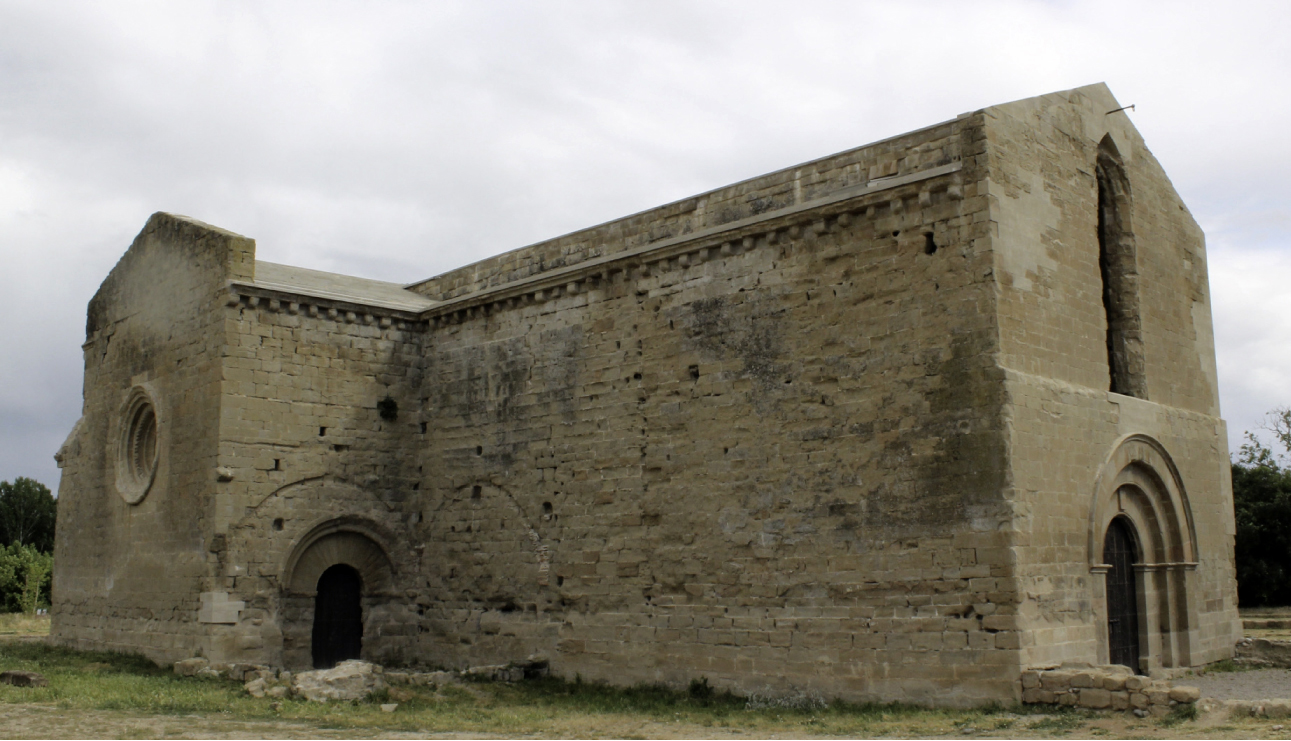 Currently only preserved remains of the church and the site of the monastery. Model 3D images obtained from ground capture and own's contruccion DJI F450 Drone flight. Final Project made by Albert Lopez Balagué (Bachelor's Degree in Geomatics and Surveying Engineering, UPC BarcelonaTech). Source: Objaverse 1.0 / Sketchfab
Nun's Monastery - Upper Vardzia, Georgia
This is a videogrammetry scan made in Agisoft software from 130 images from this video: https://www.youtube.com/watch?v=OdTXHb0vpQc Zeda Vardzia is an 11th-century Georgian Orthodox church, of the Theotokos, located in the Aspindza Municipality in Georgia's southern region of Samtskhe-Javakheti. The church is situated 3 km northwest of Vardzia, the medieval rock-hewn complex. The church is inscribed on the list of the Immovable Cultural Monuments of National Significance of Georgia. Source: Objaverse 1.0 / Sketchfab
Mount Grace Priory Carthusian monastery
A charterhouse is a monastery of the Carthusians. The order was founded in the 11th century, the first houses in England being established in the 12th or 13th century. It is a settlement planned to provide a community of contemplative monks with facilities for worship, accommodation and, to some extent, subsistence. Carthusian life was centred on solitude and favoured meditation over communal meeting. In taking this approach to monastic life the Carthusians were unique amongst orders in the West. In contrast to other monastic establishments the components of the charterhouse were devoted to individual accommodation in preference to communal buildings. Most notable were the individual cells and gardens built for each monk, these being ranged around a great cloister. see: https://historicengland.org.uk/listing/the-list/list-entry/1013019 https://historicengland.org.uk/listing/the-list/list-entry/1013019 https://en.wikipedia.org/wiki/Carthusians#Charterhouse Source: Objaverse 1.0 / Sketchfab
ScienceDex guides
Understand access before you commit
These curated guides explain access requirements, typical timelines, costs, and reuse considerations for widely used research datasets.
Allen Brain Atlas
Allen Brain Atlas is an Allen Institute collection of brain map atlases, datasets, APIs, and analysis tools covering mouse, human, and non-human primate brain resources.
Annotated Behaviour and Observability Dataset (ABODe)
ABODe is a University of Edinburgh DataShare dataset for behavior classification in group-housed mice using home-cage video, identities, bounding boxes, ground-plate positions, and annotator labels.
DANDI Archive for NWB datasets
DANDI is a BRAIN Initiative archive for publishing and sharing neurophysiology data, including electrophysiology, optophysiology, and behavioral data packaged as NWB and related standards.
International Brain Laboratory public data
The International Brain Laboratory public data releases expose standardized mouse decision-making experiments, including Neuropixels recordings, widefield calcium imaging, behavior, and session metadata accessed through the ONE API.
OpenNeuro
OpenNeuro is a free, open platform for sharing neuroimaging datasets, with public search, dataset pages, and download paths for web, S3, DataLad, and the OpenNeuro CLI.