
Find research datasets worth reusing
Search datasets from major research repositories and use ShareScore to quickly assess how well each record supports discovery, access, and reuse.
64
datasets available to search
ShareScore release 0.9.0
Dataset results
64 results for “Rodin”
Eva por Auguste Rodin
Auguste Rodin (París, Francia, 1840 – Meudon, Francia, 1917) *Eva* *Ève* *Eve* Concepción: 1881 Versión reducida: 1883 Ejecución: 1892 Mármol 75.74.8 x 24.4 x 28.4 cm Source: Objaverse 1.0 / Sketchfab
Victor Hugo's chest by Auguste Rodin
To know more about this chest : http://parismuseescollections.paris.fr/en/node/228077 Source: Objaverse 1.0 / Sketchfab
Torso de jeune fille: Rodin
A bronze cast torso of a young girl. Streaky green patina. Auguste Rodin. Torse de jeune fille cambrée Translated as: Torso of a young girl with arched back (Torso of a young girl with arched back) Maker(s) Rodin, Auguste (Sculptor) Lebossé, Henri (Sculptor) https://data.fitzmuseum.cam.ac.uk/id/object/134032 Source: Objaverse 1.0 / Sketchfab
Rodin - The Three Shades
A 3D scan of Rodin's "The Three Shades". Scanned at Stanford University, on May 23, using a Lenovo Phab 2 phone Source: Objaverse 1.0 / Sketchfab
Rodin, "Clenched Hand", Fitzwilliam Museum
Auguste Rodin, "Clenched Hand", Fitzwilliam Museum. From photos by [Daniel Pett](https://sketchfab.com/danielpett). Photos available [here](https://drive.google.com/drive/folders/1LgHMXdZYsyGWj-Q-Qm4LmuSnfrcSghNE) in the `rodinHandFitzwilliam` folder. Processed in PhotoScan with an initial "medium" first pass, followed by mask refinement and a "high" pass, with color correction from model before texturing. Source: Objaverse 1.0 / Sketchfab
Le Baiser - Rodin
statue in photogrammetry - Capturing Reality - 230 images "Le Baiser" Rodin 1889 - tirage en Bronze - Jardin des Tuleries Source: Objaverse 1.0 / Sketchfab
3d model of "The Thinker" by Auguste Rodin
The original scan is made by Musée Rodin over at MyMiniFactory. I needed an embedable link for reseearch purposes. Original Link- Source: Objaverse 1.0 / Sketchfab
RODIN X-ray Diffraction Data 2334961
<p>This dataset is part of the Resource of Diffraction Images Newcastle (RODIN), intended for the teaching of crystallography. More information about RODIN can be found on the <a title="Link to RODIN webpage on CCDC website" href="https://www.ccdc.cam.ac.uk/community/education-and-outreach/education/rodin/" target="_blank" rel="noopener">CCDC website</a>, as well as in the following article: </p> <p>J. Chem. Educ. 2024, 101, 10, 4276–4281 DOI: <a href="https://doi.org/10.1021/acs.jchemed.4c00797">10.1021/acs.jchemed.4c00797</a> </p> <p>RODIN was created for educational purposes and is ideal for teaching at secondary school and University level. We also encourage its use for teaching early-stage researchers crystallographic data processing and training new diffractometer users. The diffraction images from this project can be downloaded from Zenodo and used in teaching. You can use this resource to help students understand how to go from diffraction images to a solved crystal structure. Please note that structures from these datasets are already in the Cambridge Structural Database (CSD) and you should not submit your final structure solution to the CSD or publish them, they are intended for teaching purposes only. The diffraction images are provided under a CC-BY license. </p> <p>The zip file contains X-ray diffraction images for 1-phenyl-3,3-bis(phenylsulfanyl)prop-2-en-1-one collected for a crystal exhibiting non-merohedral twinning. A final structure solution for this data can be found in the CSD. This structure is published in the CSD as a CSD Communication and data shared with permission of the authors: Roly J. Armstrong, Aaron D. G. Campbell, Paul G. Waddell, CSD Communication, 2024</p> <p>The tables below summarise the data collection parameters for the experiment.</p> <p> </p> <p><strong>General information</strong></p> <table> <tbody> <tr> <td> <p>Project</p> </td> <td> <p>Repository of Diffraction Images Newcastle (RODIN)</p> </td> </tr> <tr> <td> <p>Collection Site</p> </td> <td> <p>Newcastle University, UK</p> </td> </tr> <tr> <td> <p>Sample Label</p> </td> <td> <p>rja230015_2</p> </td> </tr> <tr> <td> <p>Linked CCDC number</p> </td> <td> <p>2334961</p> </td> </tr> <tr> <td> <p>CSD Refcode</p> </td> <td> <p>GOLSOT</p> </td> </tr> </tbody> </table> <p> </p> <p><strong>Instrument information</strong></p> <table> <tbody> <tr> <td> <p>Instrument</p> </td> <td>four-circle diffractometer</td> </tr> <tr> <td> <p>Instrument type</p> </td> <td>XtaLAB Synergy Single source at home/near HyPix-Arc 100</td> </tr> <tr> <td> <p>Instrument manufacturer</p> </td> <td>Rigaku</td> </tr> <tr> <td> <p>Detector</p> </td> <td>Hybrid Pixel Array Detector</td> </tr> <tr> <td> <p>Detector type</p> </td> <td>HyPix-Arc 100</td> </tr> <tr> <td> <p>X-ray source</p> </td> <td>fine-focus sealed X-ray tube</td> </tr> <tr> <td> <p>X-ray source type</p> </td> <td>Enhance (Cu) X-ray Source</td> </tr> <tr> <td> <p>X-ray monochromator</p> </td> <td>graphite</td> </tr> </tbody> </table> <p> </p> <p><strong>Experimental information</strong></p> <table> <tbody> <tr> <td> <p>Collection probe</p> </td> <td>x-ray</td> </tr> <tr> <td> <p>Radiation type</p> </td> <td>CuK\a</td> </tr> <tr> <td> <p>Wavelength (Å)</p> </td> <td>1.54184</td> </tr> <tr> <td> <p>Collection temperature (K)</p> </td> <td>150.0(2)</td> </tr> <tr> <td> <p>Collection pressure</p> </td> <td>Sample was collected at atmospheric pressure</td> </tr> </tbody> </table> <p> </p> <p><strong>Crystal information</strong></p> <table> <tbody> <tr> <td> <p>Chemical name</p> </td> <td>1-phenyl-3,3-bis(phenylsulfanyl)prop-2-en-1-one</td> </tr> <tr> <td> <p>Chemical formula</p> </td> <td> <p>C21 H16 O S2</p> </td> </tr> <tr> <td> <p>Crystal max size (mm)</p> </td> <td> <p>0.20</p> </td> </tr> <tr> <td> <p>Crystal mid size (mm)</p> </td> <td> <p>0.11</p> </td> </tr> <tr> <td> <p>Crystal min size (mm)</p> </td> <td> <p>0.04</p> </td> </tr> <tr> <td> <p>Crystal colour</p> </td> <td> <p>yellow</p> </td> </tr> <tr> <td> <p>Crystal habit</p> </td> <td> <p>block</p> </td> </tr> <tr> <td> <p>Sample preparation</p> </td> <td> <p>Re-crystallisation from solvent: Chloroform</p> </td> </tr> </tbody> </table> <p> </p> <p><strong>Software information</strong></p> <table> <tbody> <tr> <td> <p>Software for data collection</p> </td> <td>CrysAlisPro 1.171.42.73a (Rigaku OD, 2022)</td> </tr> </tbody> </table> <p> </p> <p><strong>File information</strong></p> <p>The .par file in the folder has been modified from the original version (the unit cell is set to 10 10 10 90 90 90 to require the user to determine the unit cell when processing the data). The original .par file (along with *_peakhunt.tabbin and *_proffitpeak.tabbin files) can be found in the folder named ‘original’.</p> <table> <tbody> <tr> <td> <p>Image folders</p> </td> <td> <p>.frames/xxx.rodhypix</p> </td> </tr> <tr> <td> <p>Image format</p> </td> <td> <p>.rodhypix (Rigaku proprietary image format)</p> </td> </tr> <tr> <td> <p>Additional files</p> </td> <td> <p>CrysAlisPro input files:</p> <p>./expinfo/</p> <p>./CrysalisExpSettings.ini</p> <p>./rja230015_2.par</p> <p>./rja230015_2.run</p> <p> </p> <p>Crystal Images:</p> <p>./movie/</p> </td> </tr> </tbody> </table>
RODIN X-ray Diffraction Data 2360262
<p>This dataset is part of the Resource of Diffraction Images Newcastle (RODIN), intended for the teaching of crystallography. More information about RODIN can be found <span>on the <a title="Link to RODIN webpage on CCDC website" href="https://www.ccdc.cam.ac.uk/community/education-and-outreach/education/rodin/" target="_blank" rel="noopener">CCDC website</a></span>, as well as in the following article: </p> <p>J. Chem. Educ. 2024, 101, 10, 4276–4281 DOI: <a href="https://doi.org/10.1021/acs.jchemed.4c00797"><span>10.1021/acs.jchemed.4c00797</span></a><span> </span></p> <p>RODIN was created for educational purposes and is ideal for teaching at secondary school and University level. We also encourage its use for teaching early-stage researchers crystallographic data processing and training new diffractometer users. The diffraction images from this project can be downloaded from Zenodo and used in teaching. You can use this resource to help students understand how to go from diffraction images to a solved crystal structure. Please note that structures from these datasets are already in the Cambridge Structural Database (CSD) and you should not submit your final structure solution to the CSD or publish them, they are intended for teaching purposes only. The diffraction images are provided under a CC-BY license. </p> <p>The zip file contains X-ray diffraction images of Coumarin. A final structure solution for this data can be found in the CSD.</p> <p>The tables below summarise the data collection parameters for the experiment.</p> <p> </p> <p><strong>General information</strong></p> <table> <tbody> <tr> <td> <p>Project</p> </td> <td> <p>Resource of Diffraction Images Newcastle (RODIN)</p> </td> </tr> <tr> <td> <p>Collection Site</p> </td> <td> <p> Newcastle University, UK</p> </td> </tr> <tr> <td> <p>Sample Label</p> </td> <td>pgw240007</td> </tr> <tr> <td> <p>Linked CCDC number</p> </td> <td>2360262</td> </tr> <tr> <td> <p>CSD Refcode</p> </td> <td> <p>COUMAR23</p> </td> </tr> </tbody> </table> <p> </p> <p><strong>Instrument information</strong></p> <table> <tbody> <tr> <td> <p>Instrument</p> </td> <td>four-circle diffractometer</td> </tr> <tr> <td> <p>Instrument type</p> </td> <td>XtaLAB Synergy Single source at home/near HyPix-Arc 100</td> </tr> <tr> <td> <p>Instrument manufacturer</p> </td> <td> <p>Rigaku</p> </td> </tr> <tr> <td> <p>Detector</p> </td> <td>Hybrid Pixel Array Detector</td> </tr> <tr> <td> <p>Detector type</p> </td> <td>HyPix-Arc 100</td> </tr> <tr> <td> <p>X-ray source</p> </td> <td>fine-focus sealed X-ray tube</td> </tr> <tr> <td> <p>X-ray source type</p> </td> <td>Enhance (Cu) X-ray Source</td> </tr> <tr> <td> <p>X-ray monochromator</p> </td> <td>graphite</td> </tr> </tbody> </table> <p> </p> <p><strong>Experimental information</strong></p> <table> <tbody> <tr> <td> <p>Collection probe</p> </td> <td>x-ray</td> </tr> <tr> <td> <p>Radiation type</p> </td> <td>CuK\a</td> </tr> <tr> <td> <p>Wavelength (Å)</p> </td> <td>1.54184</td> </tr> <tr> <td> <p>Collection temperature (K)</p> </td> <td>150.0(2)</td> </tr> <tr> <td> <p>Collection pressure</p> </td> <td> <p>Sample was collected at atmospheric pressure</p> </td> </tr> </tbody> </table> <p> </p> <p><strong>Crystal information</strong></p> <table> <tbody> <tr> <td> <p>Chemical name</p> </td> <td>Coumarin</td> </tr> <tr> <td> <p>Chemical formula</p> </td> <td>C9 H6 O2</td> </tr> <tr> <td> <p>Crystal max size (mm)</p> </td> <td>0.18</td> </tr> <tr> <td> <p>Crystal mid size (mm)</p> </td> <td>0.05</td> </tr> <tr> <td> <p>Crystal min size (mm)</p> </td> <td>0.03</td> </tr> <tr> <td> <p>Crystal colour</p> </td> <td>colourless</td> </tr> <tr> <td> <p>Crystal habit</p> </td> <td>block</td> </tr> <tr> <td> <p>Sample preparation</p> </td> <td>Re-crystallisation from solvent: Diethyl Ether</td> </tr> </tbody> </table> <p> </p> <p><strong>Software information</strong></p> <table> <tbody> <tr> <td> <p>Software for data collection</p> </td> <td>CrysAlisPro 1.171.42.90a (Rigaku OD 2023)</td> </tr> </tbody> </table> <p> </p> <p><strong>File information</strong></p> <p>The .par file in the folder has been modified from the original version (the unit cell is set to 10 10 10 90 90 90 to require the user to determine the unit cell when processing the data). The original .par file (along with *_peakhunt.tabbin and *_proffitpeak.tabbin files) can be found in the folder named ‘original’.</p> <table> <tbody> <tr> <td> <p>Image folders</p> </td> <td> <p>.frames/xxx.rodhypix</p> </td> </tr> <tr> <td> <p>Image format</p> </td> <td> <p>.rodhypix (Rigaku proprietary image format)</p> </td> </tr> <tr> <td> <p>Additional files</p> </td> <td> <p>CrysAlisPro input files:</p> <p>./expinfo/</p> <p>./CrysalisExpSettings.ini</p> <p>./pgw240007.par</p> <p>./pgw240007.run</p> <p> </p> <p>Crystal Images:</p> <p>./movie/</p> </td> </tr> </tbody> </table> <p> </p>
3d model of "The Kiss" by Auguste Rodin
The original scan is made by Scan The World over at MyMiniFactory. I needed an embedable link for reseearch purposes. Original Link- https://www.myminifactory.com/object/3d-print-the-kiss-80486 Source: Objaverse 1.0 / Sketchfab
Los burgueses de Rodin (Basel)
Los burgueses de Rodin (Basel) mobile scan Source: Objaverse 1.0 / Sketchfab
Interpretation Gates of hell Auguste Rodin
Plaster made interpretation of the gates of hell by August Rodin Source: Objaverse 1.0 / Sketchfab
Cybele by Rodin - North Carolina Museum of Art
This is a scan of the sculpture ['Cybele'](https://en.wikipedia.org/wiki/Cybele_(sculpture)) by Auguste Rodin, currently on display at the [The North Carolina Museum of Art in Raleigh, NC](https://ncartmuseum.org/). This model was originally modeled 1889-1890, enlarged 1904-1905, and finally cast in bronze in 1987. There are a few rough spots in the scan, but I'm overall pretty happy with it! I used TRNIO to create this scan, you can learn more about the process here: https://www.instructables.com/id/3D-Scanning-and-Printing-Statues-Using-TRNIO-and-M/ More info on the sculpture from the museum: https://ncartmuseum.org/art/detail/cybele Source: Objaverse 1.0 / Sketchfab
Genetic diversity and evolutionary patterns of Taraxacum kok-saghyz Rodin
<p><i><span>Taraxacum kok-saghyz</span></i> Rodin (TKS) is an important potential alternative source of natural inulin and rubber production, which has great significance for the production of industrial products. In this study, we sequenced 58 wild TKS individuals collected from four different geography regions worldwide to elucidate the population structure, genetic diversity and the patterns of evolution. Also, the first flowering time, crown diameter, morphological characteristics of leaf and scape of all TKS individuals were measured and evaluated statistically. Phylogenetic analysis based on SNPs and cluster analysis based on agronomic traits showed that all 58 TKS individuals could be roughly divided into three distinct groups: I) Zhaosu county in Xinjiang (population AB, including a few individuals from population C and D); II) Tekes county in Xinjiang (population C); and III) Tuzkol lake in Kazakhstan (population D). Population D exhibited a closer genetic relationship with population C compared to population AB. Genetic diversity analysis further revealed that population expansion from C and D to AB occurred, as well as gene flow between them. Additionally, some natural selection regions were identified in AB population. Function annotation of candidate genes identified in these regions revealed that they mainly participated in biological regulation processes, such as transporter activity, structural molecule activity and molecular function regulator. We speculated that the genes identified in selective sweep regions may contributed to TKS adaptation to the Yili River Valley of Xinjiang. In general, this study provides new insights in clarifying population structure and genetic diversity analysis of TKS using SNP molecular markers and agronomic traits.</p>
Adam, Rodin
Previus work for the Adan placed at hell door from Rodin. This bronce esculture test is 52cm high. find more about this model in our blog! http://mookan.gagogarcia.com/?q=blog/adan-rodin Source: Objaverse 1.0 / Sketchfab
The Thinker by Auguste Rodin
The Thinker (French: Le Penseur) is a bronze sculpture by Auguste Rodin. Rodin first conceived the figure as part of his work The Gates of Hell commissioned in 1880, but the first of the familiar monumental bronze castings did not appear until 1904. A bronze cast of the sculpture can be found in the garden of the Ny Carlsberg Glyptotek in Copenhagen. The museum has a unique Rodin collection with a total of 34 sculptures, commissioned directly from the artist himself in the years 1900-1914, including well-known and monumental works. 3D scanned in 2017 using Photogrammetry from about 700 images. 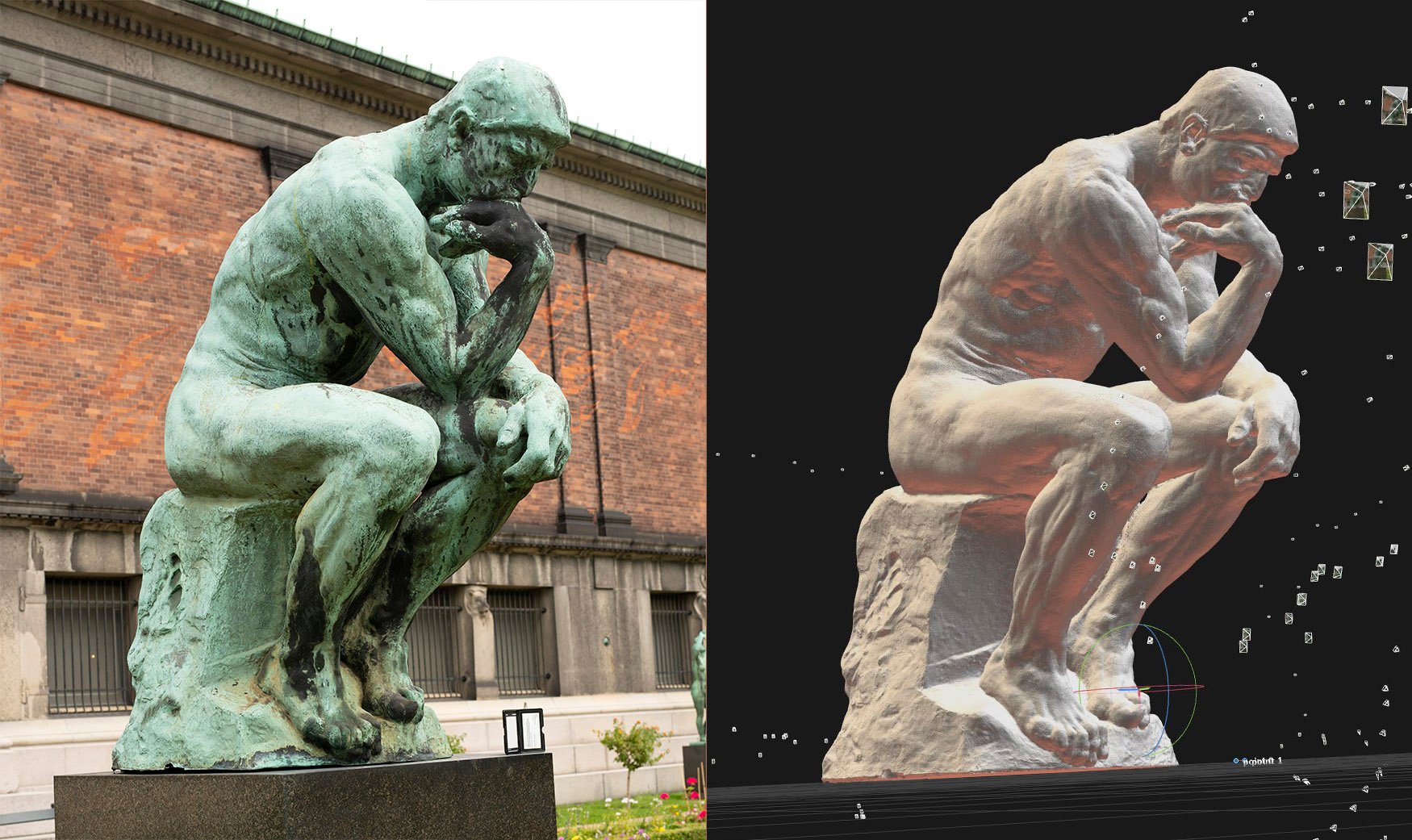 Source: Objaverse 1.0 / Sketchfab
rodin_BALZAC_1897
rodin_BALZAC_1897 address:Hakone, Kanagawa Prefecture, Japan https://goo.gl/maps/PLQv4HBTjYYCvWs17 Source: Objaverse 1.0 / Sketchfab
Auguste Rodin - Preparing for the Calvacade
Unmounted youths preparing for the calvacade. Block from the north frieze of the Parthenon. About 438-432 BC Marble Rodin made two drawings of these figures from the Parthenon From the British Museum Source: Objaverse 1.0 / Sketchfab
Cupid and Psyche: Rodin
A scuplture of Cupid and Psyche created by Auguste Rodin around 1898. **Badly scanned around the top part of the bodies, so needs redoing.** Credit Line: Given to the Victoria and Albert Museum by Rodin in 1914 Museum number: A.49-1914 Gallery location: Sculpture, Room 21, The Dorothy and Michael Hintze Galleries, case FS, shelf WN Source: Objaverse 1.0 / Sketchfab
Rodin: Large Clenched Hand
Grande main crispée - Bronze with dark patina This is the most famous of 450 hands modelled by Auguste Rodin. Source: Objaverse 1.0 / Sketchfab
ScienceDex guides
Understand access before you commit
These curated guides explain access requirements, typical timelines, costs, and reuse considerations for widely used research datasets.
Allen Brain Atlas
Allen Brain Atlas is an Allen Institute collection of brain map atlases, datasets, APIs, and analysis tools covering mouse, human, and non-human primate brain resources.
Annotated Behaviour and Observability Dataset (ABODe)
ABODe is a University of Edinburgh DataShare dataset for behavior classification in group-housed mice using home-cage video, identities, bounding boxes, ground-plate positions, and annotator labels.
DANDI Archive for NWB datasets
DANDI is a BRAIN Initiative archive for publishing and sharing neurophysiology data, including electrophysiology, optophysiology, and behavioral data packaged as NWB and related standards.
International Brain Laboratory public data
The International Brain Laboratory public data releases expose standardized mouse decision-making experiments, including Neuropixels recordings, widefield calcium imaging, behavior, and session metadata accessed through the ONE API.
OpenNeuro
OpenNeuro is a free, open platform for sharing neuroimaging datasets, with public search, dataset pages, and download paths for web, S3, DataLad, and the OpenNeuro CLI.