
Find research datasets worth reusing
Search datasets from major research repositories and use ShareScore to quickly assess how well each record supports discovery, access, and reuse.
133
datasets available to search
ShareScore release 0.9.0
Dataset results
133 results for “woodpeckers”
FIGURE 8 in New feather mites of the subfamily Pterodectinae (Acari: Proctophyllodidae) from passerines and woodpeckers (Aves: Passeriformes and Piciformes) in Vietnam
FIGURE 8. Montesauria pellornei sp. n., female. A—dorsal view, B—ventral view.
FIGURE 5 in New feather mites of the subfamily Pterodectinae (Acari: Proctophyllodidae) from passerines and woodpeckers (Aves: Passeriformes and Piciformes) in Vietnam
FIGURE 5. Montesauria macronoi sp. n., female. A—dorsal view, B—ventral view.
FIGURE 4 in New feather mites of the subfamily Pterodectinae (Acari: Proctophyllodidae) from passerines and woodpeckers (Aves: Passeriformes and Piciformes) in Vietnam
FIGURE 4. Montesauria macronoi sp. n., male. A—dorsal view, B—ventral view.
FIGURE 7 in New feather mites of the subfamily Pterodectinae (Acari: Proctophyllodidae) from passerines and woodpeckers (Aves: Passeriformes and Piciformes) in Vietnam
FIGURE 7. Montesauria pellornei sp. n., male. A—dorsal view, B—ventral view.
Data from: Woodpeckers in the city: abundances are highest in large green spaces with complex understories
<p>We documented occurrence and relative abundance (henceforth abundance) of five woodpecker species in 36 forested green spaces in Portland, Oregon (USA), to estimate minimum area requirements (MAR; 0.5 probability of occurrence) and to test for potential influences of green space area and type (heavily treed manicured green spaces versus undeveloped natural forests), habitat features, and landscape composition on the abundance of woodpeckers. Abundances of all species increased with green space area. Manicured and natural green spaces did not differ in canopy cover or total basal area, but woodpecker abundances were greater in natural than manicured green spaces for all species except Northern Flickers (<em>Colaptes</em> <em>auratus</em>). Flickers and Downy Woodpeckers (<em>Picoides</em> <em>pubescens</em>) were most abundant; MAR of both were under 1.5 ha, and both were found in essentially all green spaces. Hairy (<em>P. villosus</em>) and Pileated (<em>Dryocopus</em> <em>pileatus</em>) woodpeckers were least abundant, and with MAR of 34 and 51 ha, respectively, exhibited pronounced area-sensitivity. Red-breasted Sapsuckers (<em>Sphyrapicus</em> <em>ruber</em>) were intermediate in abundance and MAR to the two former and two latter species. The most important habitat variables associated with variation in abundance among green spaces were the contribution of deciduous trees to the canopy (Downy Woodpecker [+], Pileated Woodpecker [+] and Northern Flicker [-]), canopy cover (Hairy Woodpecker [+] and Northern Flicker [+]), and log density (Hairy Woodpecker [+], Red-breasted Sapsucker [-]). At the landscape level, lower woodpecker abundance was associated with increased urbanization (Red-breasted Sapsucker and Northern Flicker), while increasing forest cover influenced abundance of Northern Flicker (-) and Pileated Woodpecker (+). Highest woodpecker abundances were thus found in large green spaces with complex understories that were embedded in relatively undeveloped treed landscapes. Management of forested urban green spaces should prioritize needs of the area-sensitive species because ensuring their continued presence benefits the entire avian community.</p>
Data for: Nest cavity reuse by the cooperatively breeding Acorn Woodpecker
Open the record for dataset details and reuse information.
Data from: Woodpeckers in the city: abundances are highest in large green spaces with complex understories
Open the record for dataset details and reuse information.
Estimates of dispersal propagule loads on woodpecker natural history collection specimens
Open the record for dataset details and reuse information.
DNA metabarcoding reveals broad woodpecker diets in fire-maintained forests
Open the record for dataset details and reuse information.
Synthesis of Red-cockaded Woodpecker management strategies and suggestions for regional specificity in future management
Open the record for dataset details and reuse information.
Коричневополосый флеоцеастес|Powerful woodpecker
ГДМ КП ОФ-3256 Название предмета: Чучело. Коричневополосый флеоцеастес. Campephilus pollens Bp.,1845. Классификация: Хордовые Chordata, Позвоночные Vertebrata, Птицы Aves, Дятлообразные Piciformes, Дятловые Picidae, Коричневополосый королевский дятел Campephilus pollens (Bonaparte,1845) Фонд хранения: Птицы-чучела Размеры: 27х19х10 см Год создания: до 1919 Краткое описание: Пол: самец Фотограмметрию выполнил Ахтамзян Амир 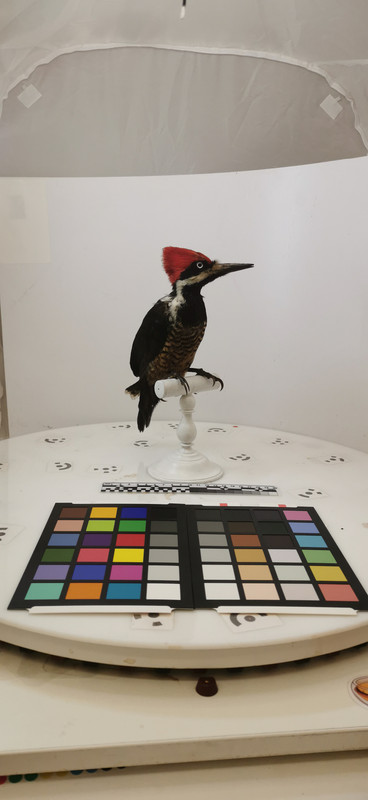 Source: Objaverse 1.0 / Sketchfab
FIGURE 5 in A taxonomic review of the Golden-green Woodpecker, Piculus chrysochloros (Aves: Picidae) reveals the existence of six valid taxa
FIGURE 5. Results of the Principal Components Analysis (Eigenvalue 75.04%). The six proposed taxa are represented by each of the symbols. Factor 1 responds to bill, wing and tarsus length, and factor 2 to tail length.
FIGURE 3 in A taxonomic review of the Golden-green Woodpecker, Piculus chrysochloros (Aves: Picidae) reveals the existence of six valid taxa
FIGURE 3. Details of the heads of males of (A) P. xanthochloros, with plain golden throat, scarlet head and light olive ear coverts; (B) P. capistratus, with barred chin and poppy red head; (C) P. paraensis, with plain golden throat and scarlet red head (this specimen lacks red malar stripe), (D) P. laemostictus, with dark spots on throat and poppy red head, (E) P. chrysochloros, with plain throat and poppy red head; and (F) P. polyzonus, with plain throat and poppy red head.
ScienceDex guides
Understand access before you commit
These curated guides explain access requirements, typical timelines, costs, and reuse considerations for widely used research datasets.
Allen Brain Atlas
Allen Brain Atlas is an Allen Institute collection of brain map atlases, datasets, APIs, and analysis tools covering mouse, human, and non-human primate brain resources.
Annotated Behaviour and Observability Dataset (ABODe)
ABODe is a University of Edinburgh DataShare dataset for behavior classification in group-housed mice using home-cage video, identities, bounding boxes, ground-plate positions, and annotator labels.
DANDI Archive for NWB datasets
DANDI is a BRAIN Initiative archive for publishing and sharing neurophysiology data, including electrophysiology, optophysiology, and behavioral data packaged as NWB and related standards.
International Brain Laboratory public data
The International Brain Laboratory public data releases expose standardized mouse decision-making experiments, including Neuropixels recordings, widefield calcium imaging, behavior, and session metadata accessed through the ONE API.
OpenNeuro
OpenNeuro is a free, open platform for sharing neuroimaging datasets, with public search, dataset pages, and download paths for web, S3, DataLad, and the OpenNeuro CLI.