
Find research datasets worth reusing
Search datasets from major research repositories and use ShareScore to quickly assess how well each record supports discovery, access, and reuse.
20
datasets available to search
ShareScore release 0.9.0
Dataset results
20 results for “Beethoven”
Beethoven in the House: Selective Encodings of Arrangements of Beethoven's opp. 91, 92, and 93.
<p>This dataset contains selective MEI encodings of a number of arrangements of Beethoven's Opp. 91, 92, and 93. These encodings were prepared in the context of the Beethoven in the House project, jointly funded by AHRC and DFG from 2020 to 2023. It is a slight update on v1.0.0 in better organizing the release assets.</p>
Piano sonatas and Beethoven works in Hans Georg Nägelis catalogues
<p>This dataset (in two csv files) collects the references to piano sonatas, and to works by Ludwig van Beethoven, in the catalogues published by Hans Georg Nägeli as a bookseller in Zurich between 1792 and 1805.</p> <p>The data was used by the author in his paper "Hans Georg Nägeli as Publisher and Bookseller of Piano Music", presented at the conference <a href="https://www.hkb-interpretation.ch/beethoven2020">Beethoven and the Piano</a>, 4–7 November 2020.</p> <p>The printed version of the article is at present in preparation.</p>
Beethoven's Indications of Tempo and Expression
<p><strong>Database: Beethoven’s Indications of Tempo and Expression</strong></p> <p>This data set was created during 2012-2016 as a tool for my doctorate research on Beethoven’s tempo indications at the University of Manchester. It provides an unprecedented overview of Beethoven’s entire published oeuvre, both with opus numbers and without, by documenting the time signature, tempo indication, indicators of expression, and metronome marks for each individual section of each piece. This data set has been used for my doctoral project and its spin-off publications to achieve the following objectives:</p> <p>The first objective was to create an understanding of how Beethoven thought about tempo through the consideration of the surviving documentary evidence. This was achieved by combining the theoretical principles of tempo that Beethoven was familiar with and subscribed to earlier in his life and observing how these principles played out in the context of his entire oeuvre. Here, Beethoven’s own metronome marks served as benchmarks of the indicative speeds, with the later editorial speeds by Czerny, Moscheles, and Holz also being considered relevant in the absence of authoritative indications. (Admittedly, subsequent research has somewhat complicated the connection between these later editorial indications and Beethoven's practices.) The result is not only a detailed overview of how Beethoven used different combinations of note values, metres, and tempo indications to indicate the desired speed — or, in a small number of cases, how he used this system inconsistently or erroneously — but also exposed a number of longstanding errors in the literature. A relevant example of the latter is the metronome mark for the <em>Schreckensfanfare</em> that opens the last movement of the Ninth Symphony. The sources for this metronome mark show a discrepancy that in all literature had hitherto been resolved in favour of dotted minim = 66, but using the database I have been able to show that a reading of dotted minim = 96 is actually more plausible in the context of Beethoven's use.</p> <p> The second objective was to provide some overview of how Beethoven used expressive indications, and what they may have intended to convey. This was achieved by studying the definitions of the different expressive indications that Beethoven used (<em>dolce</em>, <em>espressivo</em>, <em>cantabile</em>, etc.), as well as the specific contexts in which these expressions occur within Beethoven’s oeuvre. This was originally planned to be the secondary focus of my doctoral project, but it was ultimately excised from my thesis for reasons of space, and has since been the focus of an independent study. </p> <p> </p> <p><strong>About the database</strong></p> <p>The database consists of four different layers, which in the file represented as individual worksheets. <strong>Opus numbers</strong> contains all of the opus numbers and WoO numbers of the compositions included in the database. In order to not overcomplicate the data, the same variable <em>Opus</em> has been used for Opus numbers and WoO numbers, with the former using 1-138 and the latter 1001-1158. Not included are arrangements made of Beethoven’s works without his involvement or works that are clearly spurious, such as the arrangements opp. 63-4 and the canon WoO 162, respectively. In cases of opus number being used multiple times, such opus 81 or 121, rather than use letters to indicate the different versions as is most common, this dataset represents these as a decimal number (i.e. 72,1; 81,2, etc.). Also included are the place and publisher of the first edition used to obtain the indications in the rest of the dataset, as well as any relevant comments on the publication.</p> <p> The worksheet <strong>Movements</strong> breaks the opus numbers down into individual pieces, and adds the variables <em>Number</em>, <em>Work title</em>, and <em>Movement</em>, as well as another layer of commentary. The most useful worksheet is <strong>Sections</strong>, which includes the <em>Time Signature</em>, <em>Tempo Markings</em>, <em>Metronome Mark</em>, and localised <em>Indicators of Tempo and Expression</em>. (Should the note values in the metronome marks not display correctly on your computer, please install the Bach Font.) Using Microsoft Excel’s Filter and Sort feature, it is possible to get a complete overview of Beethoven’s uses of these elements for all works included in the database. There is also a <em>Sorting number</em> which can be used to bring the records back into the original order.</p> <p> </p> <p> </p> <p>This database has been used as a research tool in the preparation of the following publications:</p> <p> </p> <p>Noorduin, Marten, <em>Beethoven’s Tempo Indications</em>, PhD thesis, University of Manchester, 2016. <a href="https://www.escholar.manchester.ac.uk/uk-ac-man-scw:302884">https://www.escholar.manchester.ac.uk/uk-ac-man-scw:302884</a></p> <p> </p> <p>——————— , ‘Re-examining Czerny’s and Moscheles’s Metronome Marks for Beethoven’s Piano Sonatas’, <em>Nineteenth-Century Music Review</em>, 15/2 (August 2018), 209–235. <a href="https://doi.org/10.1017/s1479409817000027">https://doi.org/10.1017/s1479409817000027</a></p> <p> </p> <p>——————— , ‘The Metronome Marks for Beethoven’s Ninth Symphony in Context’, <em>Early Music</em>, 49/1 (February 2021), 129–145. <a href="https://doi.org/10.1093/em/caab005">https://doi.org/10.1093/em/caab005</a></p> <p> </p> <p>——————— , ‘Beethoven’s Indicators of Expression in his Piano Works’, in <em>Beethoven and the Piano</em> (Musikforschung der Hochschule der Künste Bern), ed. Leonardi Miucci, Claudio Bacciagaluppi, Daniel Allenbach and Martin Skamletz (Edition Argus, 2023), pp. 118-136. <a href="https://doi.org/10.26045/kp64-6180-006">https://doi.org/10.26045/kp64-6180-006</a></p> <p> </p> <p>——————— , ‘Transcending Slowness in Beethoven’s Late Works’, in <em>Manchester Beethoven Studies</em>, ed. Barry Cooper and Matthew Pilcher (Manchester University Press, 2023), pp. 214-43. <a href="https://doi.org/10.7765/9781526155696.00015" target="_blank" rel="noopener">https://doi.org/10.7765/9781526155696.00015</a></p> <p> </p> <p>The above list is continuously updated. Users of this database are kindly invited to notify me at martennoorduin@gmail.com with comments, questions, or to add their publications to the above list.</p> <p> </p> <p> </p> <p>Marten Noorduin, Berlin, August 2023.</p>
Beethoven's Grave
Low poly model of Ludwig Van Beethoven's grave in Vienna Austria. Originally made for paper modelling purposes. Source: Objaverse 1.0 / Sketchfab
Haydn-Mozart-Beethoven Memorial
artist: [Rudolf Siemering](https://en.wikipedia.org/wiki/Rudolf_Siemering) architect: Wolfgang Siemering foundry: [Fa. Gladenbeck](https://www.friedrichshagen.net/historisches/zeit-fenster/bronzegiesserei-gladenbeck/) (Walther und Paul Gladenbeck, Friedrichshagen bei Berlin) foundry: [Württembergische Metallwaren-Fabrik Geislingen](https://www.wmf.com/en/) (Puttenfiguren der Bekrönung) engineer: [Möbius](https://www.moebius-ingenieure.de/) (eight meter concrete base) chemist: [Friedrich Wilhelm Rathgen](https://en.wikipedia.org/wiki/Friedrich_Rathgen) (tone of marble) source: [Bildhauerei in Berlin](https://bildhauerei-in-berlin.de/bildwerk/haydn-mozart-beethoven-denkmal-5236/) Source: Objaverse 1.0 / Sketchfab
Ludwig van Beethoven – Piano Sonatas (A corpus of annotated scores)
No description provided.
Beethoven, busto
Beethoven, busto, que se encuentra sobre un piano de granito en el parque de Berlín en Madrid. Es propiedad municipal, está en la vía pública, el busto tiene una altura de unos 50 cm, está hecho en bronce y su autor es Franz Rotter (1981). En la fotogrametría la cabeza esta puesta en una base que no es la real. Source: Objaverse 1.0 / Sketchfab
Ludwig van Beethoven
The bronze figure of Ludwig van Beethoven is part of the Beethoven Monument in Vienna. The monument was ceremonially unveiled on May 1, 1880 and is dedicated to the German composer who worked in Vienna. The sculptor Caspar von Zumbusch realized the monument, the figures were cast by Carl Turbain the Elder. 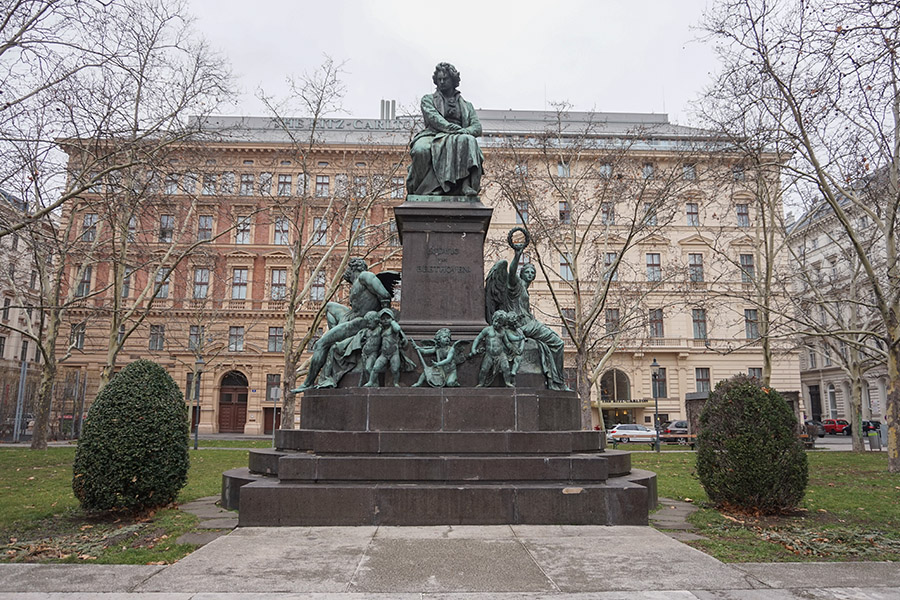 Source: Objaverse 1.0 / Sketchfab
Tempo data from 50 performances of Beethovens Appassionata (Op. 57)
<p>This database holds tempo data from 50 performances of Beethoven’s famous piano sonata Op. 57, also known as the Appassionata. Different versions of the score are for example freely available from the Petrucci Music Library (http://imslp.org). For further study, we recommend to either use the edition from Heinrich Schenker including bar numbers, or the edition from Artur Schnabel including his tempo annotation.</p>
Tempo in Recordings of Beethoven's V. and IX. Symphony and Tchaikowsky's Violin Concerto
<p>This set contains tempo data of:</p> <ul> <li>142 recordings (1910–2020) of Beethoven's Fifth Symphony op. 67 (two versions: one containing the data as extracted from Laubhold's 2014 thesis, comprising 108 recordings 1910–2009 ["MIT_DATENLAUBHOLD"]; one adding data of another 34 recordings 2010–2020) </li> <li>78 recordings (1923–2021) of Beethoven's Ninth Symphony op. 125</li> <li>100 recordings (1988–2017) of Tchaikowsky's Violin Concerto op. 35 </li> </ul> <p>This dataset is part of the upcoming publication:</p> <ul> <li>Caskel, Julian: [Von Mutter bis Nelsons (Generation 1960–1980)], in: Loesch, Heinz von, Wolf, Rebecca, Ertelt, Thomas (Ed.), <em>Geschichte der musikalischen Interpretation im 19. und 20. Jahrhundert</em>. Bd. 4: <em>Personen – Stile – Konzepte</em>, Heidelberg: J.B. Metzler 2024, pp. tba. </li> <li>Laubhold's Beethoven V. data have been extracted from: Lars Laubhold, <em>Von Nikisch bis Norrington. Beethovens 5. Sinfonie auf Tonträger. Ein Beitrag zur Geschichte der musikalischen Interpretation im Zeitalter ihrer technischen Reproduzierbarkeit</em>, München 2014. </li> </ul>
BPSD: A Coherent Multi-Version Dataset for Analyzing the First Movements of Beethoven's Piano Sonatas
<p>-- Full paper: <strong><a href="https://doi.org/10.5334/tismir.196" target="_blank" rel="noopener noreferrer">https://doi.org/10.5334/tismir.196</a></strong> --</p> <p>This repository contains the Beethoven Piano Sonata Dataset (BPSD), a multi-version dataset focusing on the first movements of Beethoven's 32 piano sonatas. Recognized as pivotal works in classical music, Beethoven's piano sonatas have profoundly shaped Western classical music, holding a significant place in cultural history.<br><br>The BPSD includes sheet music in different machine-readable formats and audio recordings from eleven performances, with four of them being in the public domain and freely accessible for research purposes. A key feature of BPSD is its coherence, ensuring alignment of all versions on a unified musical timeline and enforcing consistent structures through careful editing of both score and audio representations.<br><br>The focus and main motivation for the design choices made in BPSD are on the technical and computational level. In particular, BPSD facilitates the assessment of algorithmic approaches in tasks like harmony analysis, structure analysis, music transcription, beat and downbeat estimation, and score following. The dataset's coherence makes it an ideal platform for systematically training and evaluating deep learning methods, shedding light on their robustness and uncovering data biases across different data splits using cross-version strategies for evaluation. <br><br>To ease applicability for computational approaches, the BPSD is based on various simplifications that may be disputable from a musicological perspective. Rather than providing novel musicological annotations, the main conceptual contribution of BPSD with its measure annotations is to provide a framework for transferring existing annotations from the symbolic to the audio domain. We hope that, as such, BPSD is also useful for the systematic analysis and exploration of Beethoven's piano sonatas, providing insights into their influence on the development of harmony and structure in Western classical music. Beyond research applications, the dataset also holds educational potential, aiding in the preparation and presentation of Beethoven's work to a broader audience through interactive multimedia experiences.</p>
Genomic analyses of hair from Ludwig van Beethoven
<p><span>Ludwig van Beethoven (1770–1827) remains among the most influential and popular classical music composers. Health problems significantly impacted his career as a composer and pianist, including progressive hearing loss, recurring gastrointestinal complaints and liver disease. In 1802, Beethoven requested that following his death, his disease be described and made public. Medical biographers have since proposed numerous hypotheses, including many substantially heritable conditions. Here we attempt a genomic analysis of Beethoven in order to elucidate potential underlying genetic and infectious causes of his illnesses. We incorporated improvements in ancient DNA methods into existing protocols for ancient hair samples, enabling the sequencing of high-coverage genomes from small quantities of historical hair. We analyzed eight independently sourced locks of hair attributed to Beethoven, five of which originated from a single European male. We deemed these matching samples to be almost certainly authentic and sequenced Beethoven's genome to 24-fold genomic coverage. Although we could not identify a genetic explanation for Beethoven's hearing disorder or gastrointestinal problems, we found that Beethoven had a genetic predisposition for liver disease. Metagenomic analyses revealed furthermore that Beethoven had a hepatitis B infection during at least the months prior to his death. Together with the genetic predisposition and his broadly accepted alcohol consumption, these present plausible explanations for Beethoven's severe liver disease, which culminated in his death. Unexpectedly, an analysis of Y-chromosomes sequenced from five living members of the Van Beethoven patrilineage revealed the occurrence of an extra-pair paternity event in Ludwig van Beethoven's patrilineal ancestry.</span></p>
Genomic analyses of hair from Ludwig van Beethoven
Open the record for dataset details and reuse information.
The Annotated Beethoven Corpus (ABC) (A corpus of annotated scores)
Annotated Beethoven Corpus (ABC): A dataset of harmonic analyses with standardized labels
Beethoven IOS scan
scanned with Reality Scan ios on iPhone 11 Source: Objaverse 1.0 / Sketchfab
Beethoven Bust (3D printable)
Artist: Loewental, Artur Period: 20th Century Material: Bronze Location: The Collection, Lincoln Object Number: 1927/901 Physical Dimensions: Object height: 38cm Object length: 19cm Object width: 21cm Credit: The Collection, Lincoln & Oliver Laric Source: Objaverse 1.0 / Sketchfab
Dresden Beethoven Apotheke
<p>Historical questionnaire/s 1924/1948 and index cards, partly selected enclosures regarding the history of a <br>German pharmacy, catalogued via Kalliope portal (Historischer Fragebogen 1924/1948 und Karteikarten, ggf. <br>gemeinfreie Anlagen zur Apothekengeschichte; als Katalog dient das Nachlassportal Kalliope): <br>https://kalliope-verbund.info/DE-611-BF-70963<br>[Funktion: Im Findbuch anzeigen]<br>Please note: The Kalliope catalogue entry might indicate related material in the archival folder which cannot <br>be published due to copyright or other legal restrictions (NB: Das Katalogisat bei Kalliope kann auch auf <br>Materialien - teils erheblichen Umfangs - verweisen, die aus archiv- oder urheberrechtlichen Gründen nicht <br>veröffentlicht werden dürfen).</p>
Frankfurt /Main Beethoven-Apotheke
<p>Historical questionnaire/s 1924/1948 and index cards, partly selected enclosures regarding the history of a German pharmacy, catalogued via Kalliope portal (Historischer Fragebogen 1924/1948 und Karteikarten, ggf. gemeinfreie Anlagen zur Apothekengeschichte; als Katalog dient das Nachlassportal Kalliope): https://kalliope-verbund.info/DE-611-BF-70963 [Funktion: Im Findbuch anzeigen]<br>Please note: The Kalliope catalogue entry might indicate related material in the archival folder which cannot be published due to copyright or other legal restrictions (NB: Das Katalogisat bei Kalliope kann auch auf Materialien - teils erheblichen Umfangs - verweisen, die aus archiv- oder urheberrechtlichen Gründen nicht veröffentlicht werden dürfen).</p>
Bonn & Beethoven
<u>Source</u>: Flickr <br><u>4DCity URL</u>: <a href="https://4dcity.org/imgupload/1665393207.3846.jpg">https://4dcity.org/imgupload/1665393207.3846.jpg</a> <br><u>Original Image URL</u>: <a href="https://live.staticflickr.com/65535/52358821142_82c90a82d9_m.jpg">https://live.staticflickr.com/65535/52358821142_82c90a82d9_m.jpg</a> <br><br><u>Image-Metadata:</u><br>Filename: 1665393207.3846.jpg<br>Image Dimensions: 164x240<br>Megapixels: 0.04 MP<br>Filesize: 19.30 KB<br><br>ExifOffset: 26
Ludwig van Beethoven
Ludwig van Beethoven monument from 1862 in Vienna Döbling. The bust of the composer was made by Anton Dominik Fernkorn. Source: Objaverse 1.0 / Sketchfab
ScienceDex guides
Understand access before you commit
These curated guides explain access requirements, typical timelines, costs, and reuse considerations for widely used research datasets.
Allen Brain Atlas
Allen Brain Atlas is an Allen Institute collection of brain map atlases, datasets, APIs, and analysis tools covering mouse, human, and non-human primate brain resources.
Annotated Behaviour and Observability Dataset (ABODe)
ABODe is a University of Edinburgh DataShare dataset for behavior classification in group-housed mice using home-cage video, identities, bounding boxes, ground-plate positions, and annotator labels.
DANDI Archive for NWB datasets
DANDI is a BRAIN Initiative archive for publishing and sharing neurophysiology data, including electrophysiology, optophysiology, and behavioral data packaged as NWB and related standards.
International Brain Laboratory public data
The International Brain Laboratory public data releases expose standardized mouse decision-making experiments, including Neuropixels recordings, widefield calcium imaging, behavior, and session metadata accessed through the ONE API.
OpenNeuro
OpenNeuro is a free, open platform for sharing neuroimaging datasets, with public search, dataset pages, and download paths for web, S3, DataLad, and the OpenNeuro CLI.