
Find research datasets worth reusing
Search datasets from major research repositories and use ShareScore to quickly assess how well each record supports discovery, access, and reuse.
5
datasets available to search
ShareScore release 0.9.0
Dataset results
5 results for “Sylvia curruca”
Curruca cabecinegra (Sylvia melanocephala)
**Ejemplar**: *Sylvia melanocephala* **Nombre común**: Curruca cabecinegra. **Descripción**: Cráneo con pico fino y alargado que permite atrapar con precisión artrópodos. Bastante generalista en cuanto a la selección de hábitats, prefiere zonas arbustivas, de matorral o de árboles frutales. **Sigla museo, colección y entidad**: VER0000634. Colección del Dpto. de Zoología (Facultad Ciencias Biológicas). MUVHN. **Técnica digitalización/modelo**: escaneado superficial 3D Einscan Pro. **Software empleado**: einscan v3.1.0.2, modo manual con plataforma giratoria, calidad media. **Autor digitalización**: Natalia Conejero-Ortega. **Cita ejemplar**: modelo 3D Colección cráneos de aves del Dpto. de Zoología. Museo Universitat de València de Historia Natural (MUVHN). 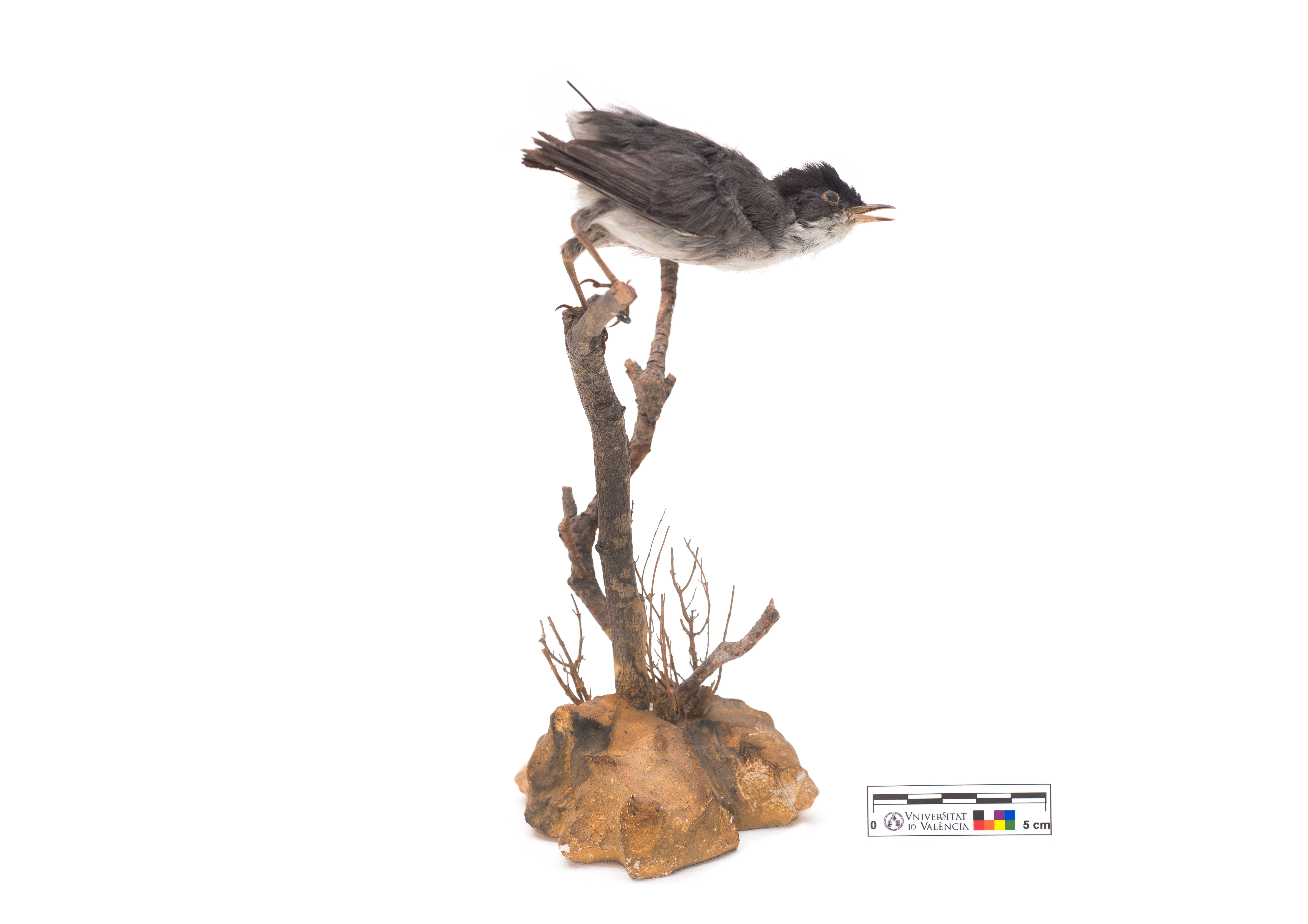 VER0000019. Ejemplar macho taxidermizado de la misma especie. Colección Histórica de Aves (MUVHN). Previo 1950 Source: Objaverse 1.0 / Sketchfab
Evolutionary patterns in Sylvia curruca complex species
<p class="BodyA">Determining the limits of species is still a major area of contention, particularly when diagnostic differentiating characters are subtle and there is a contradiction between morphological and genetic data. The Lesser Whitethroat (LWT) complex <em>Curruca</em> <em>curruca</em> represents an interesting study system to address this issue. Here, we use phylogeny-, admixture- and principal component analysis- (PCA-) based analyses on whole-genome sequence data of the parapatric LWT taxa <em>C. c. curruca, C. c. halimodendri,</em> <em>C. c. zagrossiensis</em> and <em>C. c. althaea</em> to investigate the prevalence and importance of gene flow in a geographical area where morphological evidence suggests a clinal transition between populations. The results suggest that LWT populations of the Zagros Mts <em>zagrossiensis</em> may represent a lineage historically diverged from topotypical <em>curruca</em>, the two lineages later coming into secondary contact with extensive gene flow as a result. There is no evidence of a hybrid zone or cline between <em>zagrossiensis</em> and althaea in the Zagros Mts. On the other hand, there is evidence for gene flow between <em>althaea</em> and <em>halimodendri</em>. The results also show possible evidence of admixture from other populations in the LWT complex, extralimital to the sampled area, but the nature of this needs to be evaluated based on a larger data set.</p>
Evolutionary patterns in Sylvia curruca complex species
Open the record for dataset details and reuse information.
Data from: February precipitation in the wintering grounds of the lesser whitethroat, Sylvia curruca: is it a cue for migration onset?
Numerous studies report shifts in bird migration phenology, presumably owing to global warming. However, most studies focus on migration patterns in the Northern Hemisphere. In this study, we investigated associations between weather conditions in African wintering grounds of the lesser whitethroat, Sylvia curruca, and spring arrival time in Eilat, Israel. Using multivariate regression models, we analysed a 30-year dataset in order to examine correlations between median springtime arrival and 46 climate variables of the wintering quarters. The model obtained exhibited a highly statistical fit, involving mean precipitation in February and March with negative effects and number of wet days during November–February. February precipitation levels were also the major factor associated with the interquartile range of arrival time. Interestingly and contrary to published results, annual or seasonal precipitation showed no correlation with spring arrival time, nor did temperature. Moreover, winter in this region falls into dry season with negligible rainfall quantities. Hence, it is unlikely that precipitation effect on habitat productivity is a driving force of migration, as suggested by other studies. Instead, we propose that precipitation in February acts as a cue for the birds, indicating the approach of spring and migration time.
Data from: February precipitation in the wintering grounds of the lesser whitethroat, Sylvia curruca: is it a cue for migration onset?
Open the record for dataset details and reuse information.
ScienceDex guides
Understand access before you commit
These curated guides explain access requirements, typical timelines, costs, and reuse considerations for widely used research datasets.
Allen Brain Atlas
Allen Brain Atlas is an Allen Institute collection of brain map atlases, datasets, APIs, and analysis tools covering mouse, human, and non-human primate brain resources.
Annotated Behaviour and Observability Dataset (ABODe)
ABODe is a University of Edinburgh DataShare dataset for behavior classification in group-housed mice using home-cage video, identities, bounding boxes, ground-plate positions, and annotator labels.
DANDI Archive for NWB datasets
DANDI is a BRAIN Initiative archive for publishing and sharing neurophysiology data, including electrophysiology, optophysiology, and behavioral data packaged as NWB and related standards.
International Brain Laboratory public data
The International Brain Laboratory public data releases expose standardized mouse decision-making experiments, including Neuropixels recordings, widefield calcium imaging, behavior, and session metadata accessed through the ONE API.
OpenNeuro
OpenNeuro is a free, open platform for sharing neuroimaging datasets, with public search, dataset pages, and download paths for web, S3, DataLad, and the OpenNeuro CLI.