
Find research datasets worth reusing
Search datasets from major research repositories and use ShareScore to quickly assess how well each record supports discovery, access, and reuse.
79
datasets available to search
ShareScore release 0.9.0
Dataset results
79 results for “triads”
Data from "Tracking the Vector Acceleration with a Hybrid Quantum Accelerometer Triad"
<p>This upload includes data shown in the figures of the Paper "Tracking the Vector Acceleration with a Hybrid Quantum Accelerometer Triad".</p>
Audio Piano Triad Dataset
<p>Created by: Agustín Macaya Valladares<br> Date: May 5th, 2021</p> <p>- Dataset contains 43.200 examples of piano triads in .wav format.<br> - Second Version: The audios are the same as the first version, but the octave number in the names were corrected from (2, 3, 4) to (3, 4, 5), respectively.</p> <p>Details:<br> - Sample rate: 16000 Hz.<br> - Data type: 16-bit PCM (int16).<br> - File size: Each example has a file size of 128 kB (5.53 GB for complete dataset).<br> - Duration: 4 seconds.<br> - Sound: Piano (digital).<br> - Chords were played by a human on a velocity-sensitive piano keyboard.<br> - 3 seconds pressed, 1 second released.</p> <p>- 3 octaves (3, 4, 5).<br> - 12 base notes per octave: Cn, Df, Dn, Ef, En, Fn, Gf, Gn, Af, An, Bf, Bn. (n is natural, f is flat).<br> - 4 triad types per note: major (j), minor (n), diminished (d), augmented (a). No inversions.<br> - 3 volumes per triad: forte (f), metsoforte (m), piano (p).</p> <p><br> - 10 original examples per combination of octave, base note, triad type, and volume. (10*3*12*4*3 = 4.320 examples).<br> - x10 data augmentation for each example (4.320 * 10 = 43.200 total examples).<br> - Data augmentation through random temporal and amplitude shifts.<br> - Metadata is in the name of the chord. For example: "piano_4_Af_d_m_45.wav" is a piano chord, (4) 4th octave, (Af) A flat base note, (d) diminished, (m) metsoforte, 45th example.</p> <p>Note:<br> - The audios are in 16-bit PCM (int16) data type to reduce the file size. This means that the dynamic range of values in the array is -32768 to 32768, integers. To normalize the audios in the range -1 to 1 (float) just divide by 32768.</p> <p>Second Version: The audios are the same as the first version, but the octave number in the names were corrected from (2, 3, 4) to (3, 4, 5), respectively.</p>
Text-fig. 13. Scanning electron microscope (SEM) images of pollen or spore clump with pollen grains or spores of unknown affinity that occur separately or adhering together in dyads, triads and tetrads; Torres Vedras locality, Portugal. a) Clump of pollen or spores that yielded the pollen or spores in this Text-figure; b–f) Grains adhering together in twos, threes or fours (b–e) or occurring singly and apparently with a proximal trilete mark (f); note that the adhering grains are connected by a smooth bandlike covering, perhaps remains of the microspore mother cell; note also abundant orbicules of various sizes among and over the grains. Specimen, TV44-S148149. Scale bars 300 Μm (a), 30 Μm (b–f). in The Early Cretaceous Mesofossil Flora Of Torres Vedras (Ne Of Forte Da Forca), Portugal: A Palaeofloristic Analysis Of An Early Angiosperm Community
Text-fig. 13. Scanning electron microscope (SEM) images of pollen or spore clump with pollen grains or spores of unknown affinity that occur separately or adhering together in dyads, triads and tetrads; Torres Vedras locality, Portugal. a) Clump of pollen or spores that yielded the pollen or spores in this Text-figure; b–f) Grains adhering together in twos, threes or fours (b–e) or occurring singly and apparently with a proximal trilete mark (f); note that the adhering grains are connected by a smooth bandlike covering, perhaps remains of the microspore mother cell; note also abundant orbicules of various sizes among and over the grains. Specimen, TV44-S148149. Scale bars 300 Μm (a), 30 Μm (b–f).
Data from: Fractal triads efficiently sample ecological diversity and processes across spatial scales
<p>The relative influence of ecological assembly processes, such as environmental filtering, competition, and dispersal, vary across spatial scales. Changes in phylogenetic and taxonomic diversity across environments provide insight into these processes, however, it is challenging to assess the effect of spatial scale on these metrics. Here, we outline a nested sampling design that fractally spaces sampling locations to concentrate statistical power across spatial scales in a study area. We test this design in northeast Utah, at a study site with distinct vegetation types (including sagebrush steppe and mixed conifer forest), that vary across environmental gradients. We demonstrate the power of this design to detect changes in community phylogenetic diversity across environmental gradients and assess the spatial scale at which the sampling design captures the most variation in empirical data. We find clear evidence of broad-scale changes in multiple features of phylogenetic and taxonomic diversity across aspect. At finer scales, we find additional variation in phylodiversity, highlighting the power of our fractal sampling design to efficiently detect patterns across multiple spatial scales. Thus, our fractal sampling design and analysis effectively identify important environmental gradients and spatial scales that drive community phylogenetic structure. We discuss the insights this gives us into the ecological assembly processes that differentiate plant communities found in northeast Utah.</p>
Data from: Fractal triads efficiently sample ecological diversity and processes across spatial scales
Open the record for dataset details and reuse information.
Triad Statue of King Menkaure
This is a triad depicting King Menkaure of the 4th Dynasty, Ancient Egypt in the presence of two Egyptian dieties, the goddess Hathor and a nome diety. It is one of three triads of Menkaure on display in the Egyptian Museum, Cairo, Egypt (JE40678). It was discovered in the Valley Temple of the king's pyramid complex at Giza. The other two triads can be seen here: [https://skfb.ly/6OOxw](https://skfb.ly/6OOxw) [https://skfb.ly/6OOBW](https://skfb.ly/6OOBW) Created using 88 photographs (Canon EOS Rebel T7i) using Metashape 1.5.5. Photographed in October 2019. Source: Objaverse 1.0 / Sketchfab
Triad
Triad Seated statue group of the gods Isis, Osiris, and Horus with an attachment point to insert it into a different base, likely also granite. Egypt, provenance not known Late New Kingdom, 1292-1075 BC Black granite Harvard Semitic Museum 1902.16.1 Source: Objaverse 1.0 / Sketchfab
Two sets of Amitabha Triad (japan)
# 県指定重要文化財 双式浮彫阿弥陀三尊石塔婆 To place Amida-Nyorai(Amitabha) in the center for the religion, and place Kannon-Bosatsu(Avalokitesvara) and Seishi-Bosatsu(Mahasthamaprapta) on both sides of Amida-Nyorai, the form is called Amaida-Sanzon(Amitabha Triad). Amida-Nyorai a Buddha leading the dead to paradise. Kannon-Bosatsu represents "mercy" of Buddha, and Seishi-Bosatsu represents "wisdom" of Boddha. To sculpt empossing Amitabha Triad with bordered inward by processing the stone into a plate shape is unique to the stone Buddha found in a part of Fukushima region. Period/Century : - Cultural property designation : Prefecture designated important cultural property 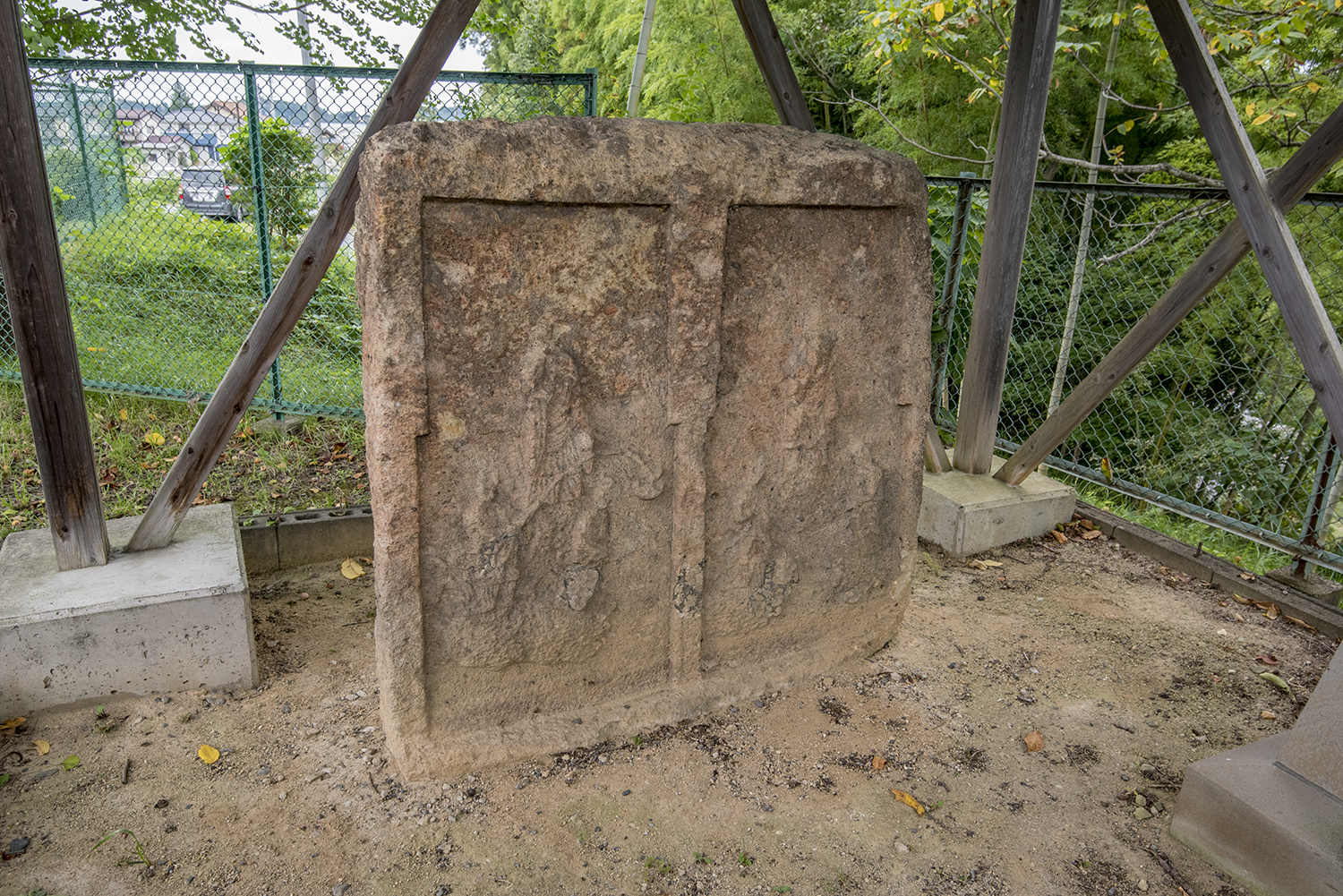 3D digitizing methods : Photogrammetry Software : Reality Capture Equipment : Nikon D750,NIKKOR 16-35mm f/4G Images: 323 photos Date : Sep.2019 Address : Sukagawa-City, Fukushima-prefecture.Japan. GoogleMap : https://goo.gl/maps/eBymdA2FWYd7Xjbk7 掲載確認済 Source: Objaverse 1.0 / Sketchfab
Fragmentary triad of Menkaure
Fragmentary triad of Menkaure, Hathor and Nome god Egyptian Old Kingdom, Dynasty 4, reign of Menkaure, 2490–2472 B.C. Findspot: Egypt, Giza, Valley Temple of Menkaure Overall: 81.5 x 62.5 x 33 cm, 204.1 kg (32 1/16 x 24 5/8 x 13 in., 450 lb.) Case (Painted wooden pedestal ): 77.5 x 51.1 x 63.5 cm (30 1/2 x 20 1/8 x 25 in.) Mount (Two flat stock rods): 5.1 x 73.7 x 1.3 cm (2 x 29 x 1/2 in.) Museum of Fine Arts, Boston 11.3147 Greywacke https://www.mfa.org/collections/object/fragmentary-triad-of-menkaura-hathor-and-nome-god-140084 Photography and photogrammetry by Zhejiang University. This model should be used for non-commercial, study purposes only. Source: Objaverse 1.0 / Sketchfab
1918.501 Amitabha Triad
You can copy, modify, and distribute this work, even for commercial purposes, all without asking permission. Learn more about The Cleveland Museum of Art's Open Access initiative: http://www.clevelandart.org/open-access-faqs *Amitabha Triad*, 1400s. Korea, Joseon dynasty (1392-1910). Bronze with traces of gilding; overall: 40.6 x 16.5 x 54.6 cm (16 x 6 1/2 x 21 1/2 in.). The Cleveland Museum of Art, Worcester R. Warner Collection 1918.501 Learn more on The Cleveland Museum of Art's Collection Online: https://www.clevelandart.org/art/1918.501 Source: Objaverse 1.0 / Sketchfab
Anti-PD-L1/TGF-beta Trap (M7824) Alone and in Combination With TriAd Vaccine and N-803 for Resectable Head and Neck Squamous Cell Carcinoma Not Associated With Human Papillomavirus Infection
ClinicalTrials.gov study NCT04247282. IPD Sharing: YES. Countries: 1. Publications: 3.
TRIAD - Treatment of Insomnia and Depression
ClinicalTrials.gov study NCT00767624. IPD Sharing: NO. Countries: 1. Publications: 5.
A perilous Malagasy triad: a spider (Vigdisia praesidens, gen. and sp. nov.) and an ant compete for termite food
Open the record for dataset details and reuse information.
Figure 4: The Pacer RH domain basic triad controls subcellular localization [FINAL]
Open the record for dataset details and reuse information.
Triad Statue of King Menkaure
This is a triad depicting King Menkaure of the 4th Dynasty, Ancient Egypt in the presence of two Egyptian goddesses. It is one of three triads of Menkaure on display in the Egyptian Museum, Cairo, Egypt. It was discovered in the Valley Temple of the king's pyramid complex at Giza. The other two triads in Cairo can be seen here: [https://skfb.ly/6OOyK](https://skfb.ly/6OOyK) [https://skfb.ly/6OOxw](https://skfb.ly/6OOxw) Created using 124 photographs (Canon EOS Rebel T7i) using Metashape 1.5.5. Photographed in October 2019. Source: Objaverse 1.0 / Sketchfab
FIGURE 3. Chrysopogon narayanii A. Habit. B. Inflorescence. C. Spikelet triad. D. Pedicelled spikelet. E in A new species of Chrysopogon (Poaceae: Andropogoneae) from India
FIGURE 3. Chrysopogon narayanii A. Habit. B. Inflorescence. C. Spikelet triad. D. Pedicelled spikelet. E. Lower glume of sessile spikelet—dorsal view. F. Lower glume of pedicelled spikelet—dorsal view.
FIGURE 1. Chrysopogon narayanii A. Habit. B. Spikelet triad. C–G. Sessile spikelet. C. Sessile spikelet. D. Lower glume. E. Upper glume. F. Lower lemma. G in A new species of Chrysopogon (Poaceae: Andropogoneae) from India
FIGURE 1. Chrysopogon narayanii A. Habit. B. Spikelet triad. C–G. Sessile spikelet. C. Sessile spikelet. D. Lower glume. E. Upper glume. F. Lower lemma. G. Upper lemma. Drawn by T. Shaju from live specimens.
FIGURE 22. Hydriastele flabellata. A–B. Habit. C. Inflorescence with triads. D. Infructescences. A, C in A monograph of Hydriastele (Areceae, Arecaceae) in New Guinea and Australia
FIGURE 22. Hydriastele flabellata. A–B. Habit. C. Inflorescence with triads. D. Infructescences. A, C from Baker et al. 879; B from Baker et al. 1448 (cultivated specimen); D from Timika, western New Guinea. All photos: W.J. Baker.
FIGURE 2. Hydriastele wendlandiana. A. Habit. B. Leaf apex. C. Mid-leaf portion. D. Leaf base. E. Infructescence. F. Triad. G in A monograph of Hydriastele (Areceae, Arecaceae) in New Guinea and Australia
FIGURE 2. Hydriastele wendlandiana. A. Habit. B. Leaf apex. C. Mid-leaf portion. D. Leaf base. E. Infructescence. F. Triad. G. Staminate flower in longitudinal section. H. Pistillate flower whole. I. Pistillate flower in longitudinal section. J. Portion of rachilla with fruit. K, L, M. Fruit in longitudinal section (K. Homogeneous endosperm. L. Shallowly ruminate endosperm. M. Ruminate endosperm). Scale bar: A = 70 cm; B–D = 8 cm; E = 6 cm; F–G = 5 mm; H–I = 2.5 mm; J = 1.5 cm; K–M = 7 mm. A, F–I from Baker et al. 1106; B–E, M from Klappa 151; J–K from Baker et al. 1065; L from Baker et al. 573. Drawn by Lucy T. Smith.
FIGURE 10 in The triad of knowledge: Systematic, diversity and conservation status of the Mexican species of Tabernaemontana (Apocynaceae; Rauvolfioideae: tribe Tabernaemontaneae)
FIGURE 10. Comparison of flowers and fruits of Tabernaemontana donnell–smithii (a–f) and T. ochoterenae (g–l).
ScienceDex guides
Understand access before you commit
These curated guides explain access requirements, typical timelines, costs, and reuse considerations for widely used research datasets.
Allen Brain Atlas
Allen Brain Atlas is an Allen Institute collection of brain map atlases, datasets, APIs, and analysis tools covering mouse, human, and non-human primate brain resources.
Annotated Behaviour and Observability Dataset (ABODe)
ABODe is a University of Edinburgh DataShare dataset for behavior classification in group-housed mice using home-cage video, identities, bounding boxes, ground-plate positions, and annotator labels.
DANDI Archive for NWB datasets
DANDI is a BRAIN Initiative archive for publishing and sharing neurophysiology data, including electrophysiology, optophysiology, and behavioral data packaged as NWB and related standards.
International Brain Laboratory public data
The International Brain Laboratory public data releases expose standardized mouse decision-making experiments, including Neuropixels recordings, widefield calcium imaging, behavior, and session metadata accessed through the ONE API.
OpenNeuro
OpenNeuro is a free, open platform for sharing neuroimaging datasets, with public search, dataset pages, and download paths for web, S3, DataLad, and the OpenNeuro CLI.