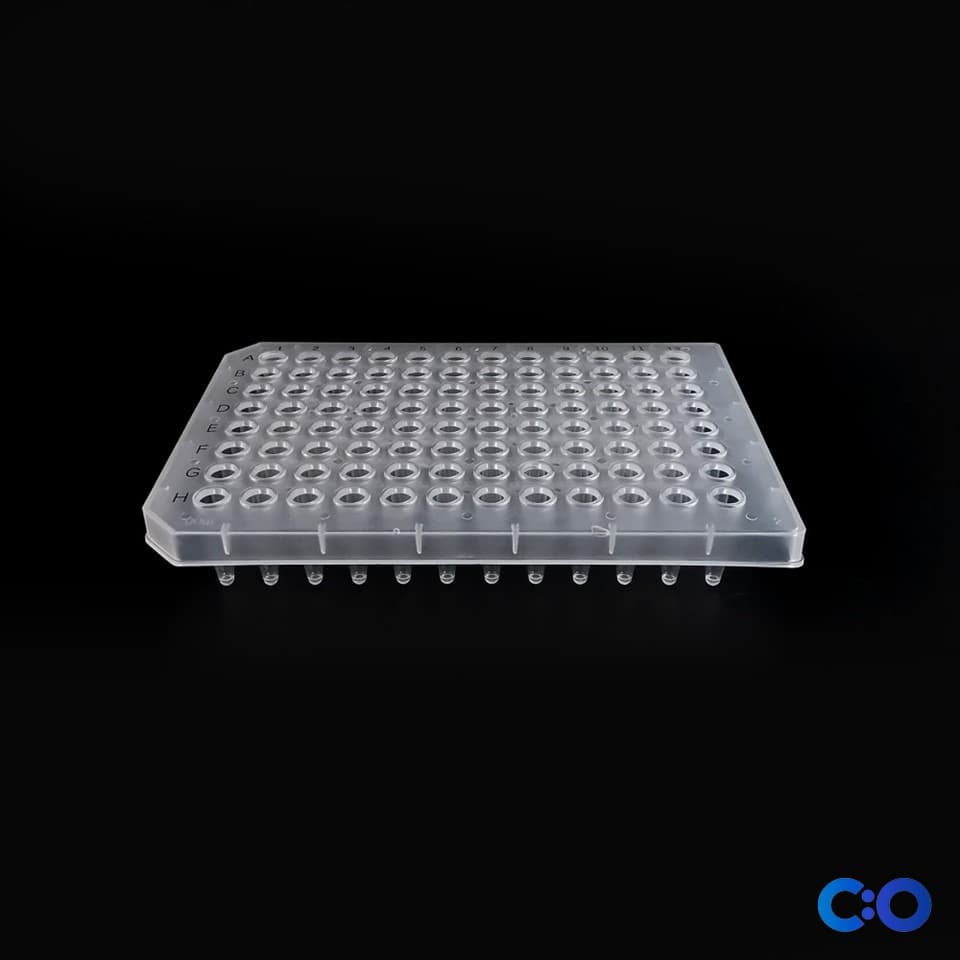
ConductScience 96-Well PCR Plates, Full Skirt (50/case)
$12.50 per unit | 50 units per pack 96-well PCR plates with full skirt design for automated handling, featuring thin-wall polypropylene construction for optimal thermal transfer in DNA amplification workflows.
| Automation Level | semi-automated |
96-well PCR plates with full-skirt design engineered for automated liquid handling systems and thermal cycling applications. Constructed from clear polypropylene with thin-wall architecture to optimize thermal conductivity during amplification cycles. The full skirt provides mechanical stability and precise positioning in robotic systems while maintaining compatibility with standard thermal cyclers.
These plates support DNA amplification, qPCR, and RT-PCR protocols across molecular biology workflows. The clear polypropylene construction enables visual inspection of samples while providing chemical resistance to common PCR reagents and solvents. Supplied in cases of 50 plates for laboratory inventory management.
How It Works
PCR plates facilitate polymerase chain reaction by providing individual reaction vessels that maintain sample integrity during thermal cycling. The thin-wall design minimizes thermal mass, enabling rapid and uniform heat transfer from the thermal cycler block to reaction mixtures. This design reduces temperature lag and improves cycling efficiency across all wells.
The full-skirt architecture provides mechanical rigidity and precise dimensional tolerances required for automated liquid handling systems. Robotic pipetting systems rely on consistent well positioning and plate stability during aspiration and dispensing operations. The clear polypropylene material allows optical detection systems to monitor fluorescence signals during real-time PCR applications while maintaining chemical compatibility with Taq polymerases, buffers, and common PCR additives.
Sample containment is achieved through precision-molded well geometry that minimizes dead volume and prevents cross-contamination between adjacent wells. The plate format supports standard 96-well spacing (9mm centers) for compatibility with multichannel pipettes, plate readers, and automated workstations used in molecular biology protocols.
Features & Benefits
Automation Level
- semi-automated
Research Domain
- Clinical Diagnostics
- Environmental Monitoring
- Food Science
- Microbiology
- Molecular Biology
- Pharmaceutical QC
Weight
- 223.66 lbs
Dimensions
- L: 83.6 in
- W: 69.7 in
- H: 55.7 in
Comparison Guide
| Feature | This Product | Typical Alternative | Advantage |
|---|---|---|---|
| Skirt Design | Full skirt for enhanced mechanical stability | Semi-skirted or unskirted designs with reduced automation compatibility | Provides more reliable positioning and handling in automated liquid handling systems. |
| Wall Thickness | Thin-wall construction for optimal thermal transfer | Standard wall thickness with slower heat transfer | Reduces thermal cycling time and improves temperature uniformity across samples. |
| Material Clarity | Clear polypropylene for optical compatibility | Varies by manufacturer with different optical properties | Enables visual sample inspection and real-time PCR detection without signal interference. |
| Packaging | 50 plates per case | Varies from 25-100 plates per package | Provides efficient inventory management for medium to high-throughput laboratories. |
This product offers full automation compatibility through complete skirt design while maintaining optimal thermal properties via thin-wall construction. The clear polypropylene material supports both visual inspection and optical detection applications in a cost-effective case format.
Practical Tips
Allow plates to reach room temperature before use if stored in cold conditions to prevent condensation during sample loading.
Why: Temperature equilibration prevents vapor formation that can interfere with pipetting accuracy and sample integrity.
Store unused plates in original protective packaging and avoid exposure to direct sunlight or extreme temperatures.
Why: Proper storage maintains plate dimensional stability and prevents warping that affects automation performance.
Use consistent pipetting technique and verify volume accuracy when transferring samples to maintain experimental reproducibility.
Why: Volume variations between wells can introduce systematic bias in quantitative PCR measurements and amplification efficiency.
If plates do not seat properly in thermal cycler, check for warping or debris on plate bottom and clean contact surfaces.
Why: Poor thermal contact reduces heat transfer efficiency and can cause temperature gradients across the plate.
Handle plates with powder-free gloves and avoid touching well interiors to prevent contamination and maintain assay specificity.
Why: Contamination can introduce false positives or inhibit PCR reactions, compromising experimental results.
Pre-cool plates when working with temperature-sensitive reagents or samples requiring cold storage during preparation.
Why: Temperature control during sample loading preserves enzyme activity and prevents premature reaction initiation.
Setup Guide
What’s in the Box
- 50 x 96-well PCR plates with full skirt
- Protective packaging materials
- Product documentation (typical)
Warranty
ConductScience provides standard warranty coverage for manufacturing defects with technical support for optimal product performance in laboratory applications.
Compliance
What is the maximum recommended sample volume per well?
Consult product datasheet for specific well volume specifications. Standard 96-well PCR plates typically accommodate 10-200μL depending on application requirements and thermal cycler specifications.
Are these plates compatible with real-time PCR instruments?
Yes, the clear polypropylene construction enables optical detection systems to monitor fluorescence signals during qPCR applications while maintaining thermal cycling performance.
What sealing options work with these plates?
Compatible with optical adhesive films, heat-sealing films, and individual tube caps depending on application requirements. Optical films are recommended for real-time PCR to maintain signal transmission.
Can these plates withstand multiple freeze-thaw cycles?
Polypropylene construction provides chemical resistance and temperature stability, though repeated freeze-thaw cycling may affect plate integrity. Store samples at appropriate temperatures to minimize thermal stress.
Are the plates sterile or do they require sterilization?
Consult product specifications for sterility status. If non-sterile, plates can be sterilized using appropriate methods compatible with polypropylene before use in sensitive applications.
What thermal cycling temperature range is supported?
Polypropylene construction supports standard PCR temperature ranges including denaturation temperatures up to 95°C. Consult product datasheet for specific thermal specifications and cycling limits.
How do these compare to semi-skirted alternatives?
Full skirt design provides enhanced mechanical stability and more reliable automated handling compared to semi-skirted plates, making them preferable for robotic liquid handling applications.
Have a question about this product?
Accessories
Enhance your setup with compatible accessories
Frequently Bought Together