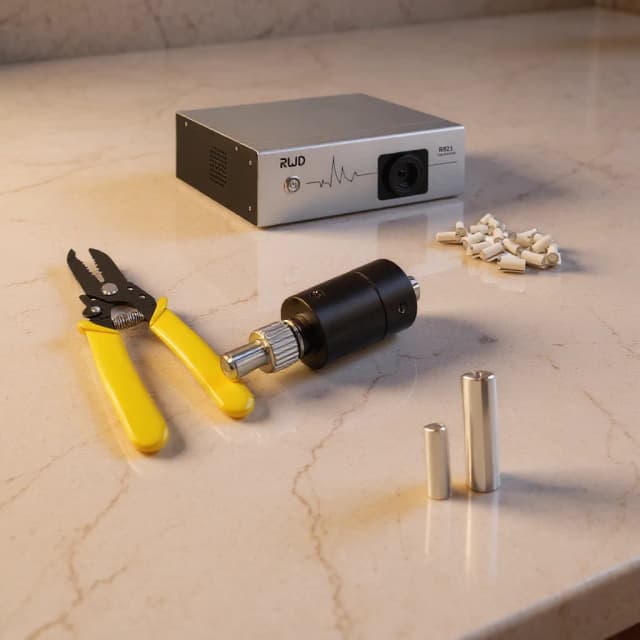
Laser Power Meter
Laser power meters are extensively used in laser-equipped laboratories to measure laser powers and observe the continuous wave (CW laser).
They are used to analyze lasers within a particular wavelength and intensity range. The silicon photodiode-based LP1 laser power meter has a spectral range of 400nm to 1100nm. It uses 633nm of He-Ne laser as a reference wavelength. The spectral sensitivity conversion table given with the apparatus is used for the characteristic measurement of wavelengths between 400-1100nm. It can be installed conveniently, has a small volume, and shuts down automatically after half an hour to facilitate power saving. ConductScience offers rodent laser power meters.

Louise Corscadden, PhD
Director of Science · ConductScience
Ask Louise about Laser Power Meter fit, setup, configuration, or quote prep.
Already working with us? Sign in to connect this with My Scientist.
Key Specifications
Full details →- Model fit
- Configured during quote
- SKU family
- RWD-LP-200
- Shipping box
- 34.0 x 39.0 x 33.0 cm
- Ordering
- Online checkout and quote request available
- Category
- Optogenetics & Photometry
- Build notes
- Confirm accessories, station layout, and support needs before purchase
Specifications
| Spectral Range | 400-1100nm |
| Models | LP-1 |
| Measure Range | 0-40μW、0-400μW、0-4mW、0-40mW optional |
| Measurement Accuracy | 0.01μW |
| Probe Caliber | Silicon photodiode (Φ 9mm) |
| Measurement Error | ± 5% |
Features:
- Adopt pyroelectric probe, applicable to multiband measurement with a broad-spectrum range.
- Short response time, good thermal stability, small volume, convenient installation, and fixed.
- Convenient operation with a digital display, applicable to the measurement on a variety of laser power.
- Automatic shutdown (about 30 minutes later) facilitates saving battery power.
Documentation
Introduction
Laser power meters are extensively used in laser-equipped laboratories to measure laser powers and observe the continuous wave (CW laser). They are used to analyze lasers within a particular wavelength and intensity range. These power meters are available in a wide range of wavelengths and customized as per the experimenter's needs.
Laser power meters can possess two types of detectors:
- Thermal detectors
- Quantum detectors
Thermal detector-based laser power meters contain thermopile discs or pyroelectric sensors. A thermopile sensor receives the radiation and converts it into thermal energy. A temperature gradient is established across the 'hot,' and 'cold' junctions present on the thermopile disc. An array of thermocouples measures this temperature difference in the form of voltage and, the measured voltage is directly proportional to the coming laser rays. The power meters based on thermal transducers are expensive with slow responsivity; however, they generate a flat spectral response.
Quantum detector-based laser power meters employ the use of photodiodes (PDs), photomultipliers, and photo-conductors. Generally, photomultipliers require high voltage for operation, whereas photodiodes (PDs) can work well on low voltages. Photodiodes are usually used to measure low laser powers due to their high quantum efficiency and the fact that they generate accurately linear output from the incident light intensity. Silicon photodiodes are the most widespread form of quantum detectors used because of the wide range of advantages they present.
Principle
A silicon photodiode-based laser power meter works by converting incident laser light into a proportionate current. Photodiodes (PDs) are responsible for this conversion. An operational amplifier then transforms this proportionate current into a voltage. The current monitoring circuit must offer zero impedance to the photodiode in the current mode of operation. The input of the operational amplifier is inverted with the virtual ground to ensure the maintenance of zero bias across the photodiode. This ‘high input impedance’ from the operational amplifier ensures that all photodiode current flows through the feedback resistor. Photodiode's responsivity data (presented in the datasheet) helps estimate the current flowing through PD for available laser power. In a nutshell, the laser light incident on the photodiode generates current through it, and the feedback resistor yields an output equal to PD current multiplied by the feedback resistance, i.e., "Vout = IIn.R”.
Apparatus and Equipment
The silicon photodiode-based LP1 laser power meter has a spectral range of 400nm to 1100nm. It uses 633nm of He-Ne laser as a reference wavelength. The spectral sensitivity conversion table given with the apparatus is used for the characteristic measurement of wavelengths between 400-1100nm. It can be installed conveniently, has a small volume, and shuts down automatically after half an hour to facilitate power saving. Moreover, it has a pyroelectric probe and multiband measurement ability for a broad-spectrum range. It has a measurement accuracy of 0.01ꭒW, and the measurement range varies between 0-40ꭒW, 0-400ꭒW, 0-4mW, and 0-40mW.
Applications
Laser power meters effectively monitor the power of laser radiations directed from a source to induce ophthalmic diseases in rodent models.
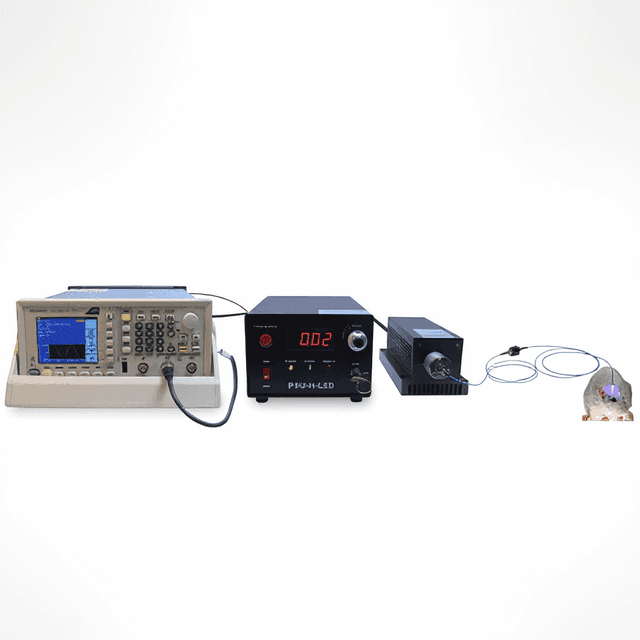
Researchers use laser power meters along with Optogenetics Laser to induce various diseases in rodent models (rats/mice) and study their mechanisms. The laser power meter help monitor the laser power coming out of the laser source. Guo et al. (2016) examined a rodent model of an ophthalmic disease Nonarteritic Anterior Ischemic Optic Neuropathy (rNAION), i.e., a focal ischemic lesion of the optic nerve. They induced the disorder by illuminating Rose Bengal (RB), a photoactive dye with 532nm wavelength laser light, targeting the anterior optic nerve. The researchers used a laser power meter to monitor the laser power output regularly. This experimental setup enabled them to study and analyze the mechanism of white matter ischemia.
Strengths and Limitations
Photodiode-based laser power meters are durable, compact, and lightweight. They have a high quantum efficiency and a high responsivity rate. They have adopted a pyroelectric probe, designed specifically to function at a low voltage, reduce mechanical stress and measure laser lights of low power levels. However, a prospective disadvantage of photodiodes is that they do not respond uniformly across the entire area, which lessens measurement repeatability while working with non-uniform laser beams.
Summary
- Laser power meters are used to measure the laser power in laser-equipped labs.
- There are two kinds of laser power meters based on the type of detectors used. The detectors can be thermal as well as quantum detectors.
- The most commonly used quantum detectors are photodiodes. Photodiodes are preferred over thermal sensors because of several reasons.
- A silicon photodiode-based laser power meter works by converting incident laser light into a proportionate current.
- Silicon PDs have high quantum efficiency and, therefore, can measure low laser powers.
- Photodiode-based laser power meters are durable, compact, and lightweight.
References
- Guo, Y., Mehrabian, Z., & Bernstein, S. L. (2016). The rodent model of nonarteritic anterior ischemic optic neuropathy (rNAION). JoVE (Journal of Visualized Experiments), (117), e54504.
How It Works
The RWD-LP-200 operates on pyroelectric detection principles, where incident laser radiation creates temperature changes in the detector material. The 9mm silicon photodiode pyroelectric probe converts absorbed optical energy into measurable electrical signals proportional to the incident laser power. When photons strike the detector surface, they generate heat that creates a temperature gradient across the pyroelectric element, producing a voltage output directly proportional to the optical power.
The instrument's spectral response covers 400-1100nm through the silicon photodiode's inherent sensitivity characteristics. Internal signal conditioning electronics amplify and digitize the detector output, providing real-time power measurements on the digital display. The four selectable measurement ranges (0-40μW to 0-40mW) are achieved through electronic gain switching, allowing optimal sensitivity across the full dynamic range while maintaining 0.01μW resolution at the lowest range.
Automatic range selection and digital signal processing ensure stable readings with short response times. The pyroelectric detection method provides excellent thermal stability and broad spectral response compared to thermopile-based alternatives, making it suitable for multiband laser characterization and continuous monitoring applications.
Features & Benefits
Spectral Range
- 400nm to 1100nm
Reference Wavelength
- 633nm He-Ne laser
Measurement Ranges
- 0-40μW, 0-400μW, 0-4mW, 0-40mW
Detector Type
- Pyroelectric probe
Auto Shutdown
- 30 minutes
Measurement Capability
- Multiband measurement with broad-spectrum range
Automation Level
- manual
Brand
- RWD
Accuracy
- 0.01μW
Display Type
- Digital
Research Domain
- Analytical Chemistry
- Clinical Diagnostics
- Materials Science
- Neuroscience
- Optogenetics
- Pharmaceutical QC
Shipping weight
- 8.27 lb
Shipping box
- L: 34.0 cm
- W: 39.0 cm
- H: 33.0 cm
| Feature | This Product | Typical Alternative | Advantage |
|---|---|---|---|
| Spectral Range | 400-1100nm with pyroelectric detection | Thermopile meters often cover broader ranges but with slower response times | Optimized range covers common research lasers from blue optogenetic sources to near-infrared diodes with fast thermal response. |
| Measurement Resolution | 0.01μW accuracy with ±5% measurement error | Entry-level meters often provide 0.1μW resolution with higher uncertainty | High resolution enables precise calibration of low-power optogenetic stimulation sources critical for dose-response studies. |
| Dynamic Range | Four ranges from 0-40μW to 0-40mW | Single-range meters require separate instruments for different power levels | Wide range coverage eliminates need for multiple meters across research applications from cellular stimulation to material processing. |
| Detector Aperture | 9mm silicon photodiode probe | Smaller apertures require precise beam alignment and limit beam size compatibility | Large aperture accommodates various beam profiles and reduces alignment sensitivity for routine measurements. |
| Power Management | Automatic 30-minute shutdown | Manual power control increases battery drain during extended use | Automatic shutdown prevents battery depletion during long experimental sessions while protecting detector from thermal damage. |
The RWD-LP-200 combines pyroelectric detection's fast response with four-decade dynamic range coverage. The 9mm detector aperture and 400-1100nm spectral range address common research laser measurement needs in a portable, battery-conserving design suitable for both laboratory and field calibration work.
Practical Tips
Zero the meter with the laser blocked before each measurement session to compensate for thermal drift and ambient temperature changes.
Why: Pyroelectric detectors are sensitive to temperature gradients and require baseline correction for accurate absolute power measurements.
Allow 30 seconds for thermal equilibration after initial laser exposure before recording final power readings.
Why: The pyroelectric response requires thermal stabilization to achieve the specified ±5% measurement accuracy.
Clean the detector surface with lens tissue and isopropanol monthly or when contamination is visible.
Why: Surface contamination absorbs laser energy and causes measurement errors by altering the detector's thermal response characteristics.
Never exceed the maximum power rating for each range (40μW, 400μW, 4mW, 40mW) to prevent detector damage.
Why: Pyroelectric detectors can suffer permanent damage from thermal overload if exposed to excessive laser power above their design limits.
Record ambient temperature during measurements for documentation and to identify potential thermal drift effects.
Why: Temperature variations can introduce systematic errors in pyroelectric measurements that may require post-processing correction.
If readings fluctuate, check for air currents across the detector and shield the probe from ambient temperature variations.
Why: Pyroelectric sensors respond to any thermal changes, not just laser-induced heating, making them sensitive to environmental conditions.
Position the probe perpendicular to the beam path and ensure complete beam capture within the 9mm aperture area.
Why: Angular incidence and partial beam clipping introduce measurement errors that cannot be corrected through calibration procedures.
Setup Guide
What’s in the Box
- RWD-LP-200 laser power meter with pyroelectric probe
- Battery or power adapter (typical)
- Protective probe cap (typical)
- User manual and calibration certificate (typical)
- Carrying case (typical)
Warranty
ConductScience provides a standard one-year manufacturer warranty covering defects in materials and workmanship, with technical support for calibration procedures and measurement protocols.
Compliance
References
Background reading relevant to this product:
What is the minimum detectable power and measurement stability?
The instrument provides 0.01μW measurement accuracy with ±5% error specification. Thermal stability of the pyroelectric probe ensures stable readings within this tolerance range during typical measurement sessions.
How does spectral response vary across the 400-1100nm range?
The silicon photodiode pyroelectric probe provides broad spectral coverage from 400-1100nm. For precise quantitative work, consult the spectral response curve in the product datasheet to apply wavelength-specific correction factors.
What beam size limitations exist with the 9mm detector aperture?
The 9mm silicon photodiode accommodates beam diameters up to approximately 8mm while maintaining measurement accuracy. Larger beams require beam reduction optics or may result in clipping losses affecting measurement accuracy.
How frequently does this meter require calibration?
Pyroelectric-based power meters typically maintain calibration for 12-24 months under normal laboratory use. Annual calibration verification against NIST-traceable standards is recommended for quantitative research applications.
Can this meter measure pulsed laser sources?
The pyroelectric detection method responds to average power rather than instantaneous power. It can measure pulsed sources if the pulse repetition rate is sufficiently high to provide stable thermal response, typically >1kHz.
What factors affect measurement accuracy in practice?
Measurement accuracy depends on beam alignment (perpendicular incidence), complete beam capture within the detector aperture, thermal equilibration time (30 seconds), and ambient temperature stability during measurement.
How does this compare to thermopile-based power meters?
Pyroelectric detection offers faster response times and better thermal stability than thermopile sensors, but with slightly more limited dynamic range. The four selectable ranges (0-40μW to 0-40mW) provide good coverage for most research applications.
Have a question about this product?
Have a question? Just ask.
Send it over and we'll email you a personalized answer — no call, no scheduling.
Prefer to talk it through?