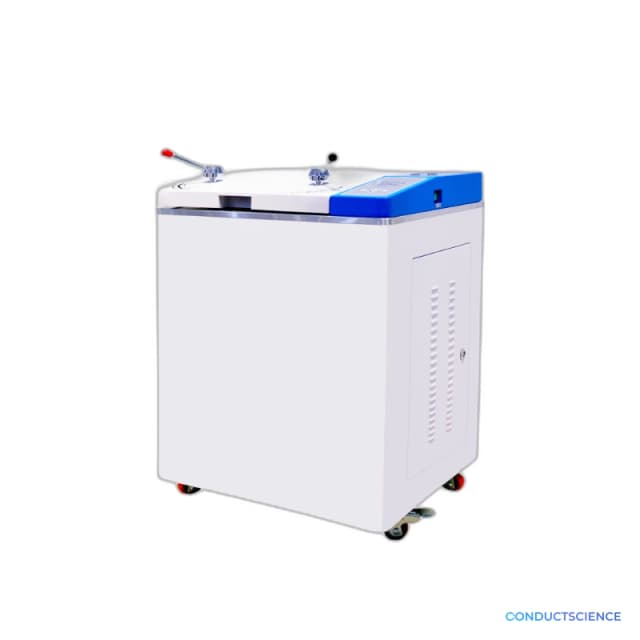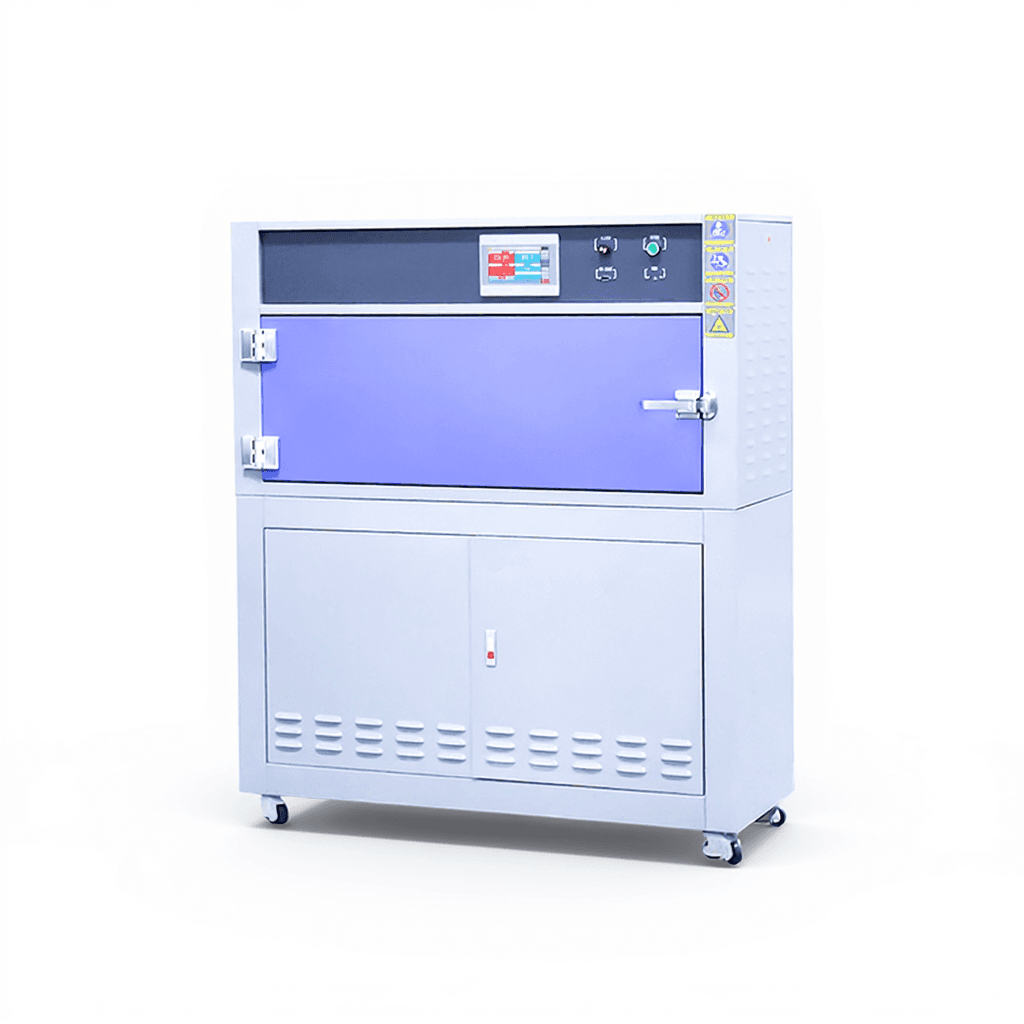
UV Aging Test Chamber
Controlled environmental chamber for accelerated UV weathering studies with programmable lighting, condensation, and spray cycles for material degradation research.
| Automation Level | semi-automated |
| BJPX-UATC2 | BJPX-UATC3 |
| Function | Lighting |
| lighting-condensation | Lighting+condensation+raining |
| Lighting Temp. Range | 50~70℃(Temp. deviation: ±3℃) |
| Condensation | 40~60℃(Temp. deviation: ±3℃) |
The UV Aging Test Chamber is a controlled environmental testing system designed for accelerated weathering studies of materials and coatings. The chamber combines UV irradiation, condensation, and spray cycles to simulate outdoor weathering conditions under laboratory conditions. With precise temperature control during lighting (50-70°C) and condensation phases (40-60°C), the system enables reproducible aging studies for material degradation research.
The chamber features adjustable UV radiation intensity up to 1.2 W/m²/340nm with specimen positioning 50mm from the lamp surface. The 1130×500×400mm internal chamber accommodates multiple test specimens simultaneously. An integrated water management system with automatic feed controller maintains consistent condensation conditions throughout extended test protocols. Lamp life ranges from 1800-2500 hours depending on usage patterns.
How It Works
The UV Aging Test Chamber operates through controlled photochemical degradation using UV lamps positioned 50mm from test specimens. UV radiation at wavelengths around 340nm initiates polymer chain scission, cross-linking reactions, and oxidative processes that mirror natural weathering mechanisms. The adjustable radiation intensity up to 1.2 W/m²/340nm allows acceleration factors to be calibrated against outdoor exposure data.
Temperature cycling between lighting phases (50-70°C) and condensation phases (40-60°C) simulates diurnal temperature variations that affect degradation rates. During condensation cycles, water vapor condenses on specimen surfaces, enabling hydrolysis reactions and washing effects. The spray function adds mechanical stress from water impact while providing surface cleaning that exposes fresh material to continued UV attack.
Blackboard temperature monitoring (30-80°C range) provides reference temperature measurement independent of air temperature, enabling correlation with standard weathering protocols. The automated water feed system maintains consistent humidity and condensation conditions throughout multi-week exposure studies.
Features & Benefits
Automation Level
- semi-automated
BJPX-UATC2
- BJPX-UATC3
Function
- Lighting
lighting-condensation
- Lighting+condensation+raining
Lighting Temp. Range
- 50~70℃(Temp. deviation: ±3℃)
Condensation
- 40~60℃(Temp. deviation: ±3℃)
Blackboard Temp. Range
- 30~80℃(Temp. deviation: ±1℃)
Center Distance of Light
- 70mm
Distance
- 50mm(The closest parallel distance between the specimen and the lamp surface)
Max. Radiation Intensity
- Within 1.2W/m2/340nm adjustable
Indication Resolution
- 0.1℃
Tank
- Water depth ≤25mm, with automatically feed water controller
Lamp Life
- About 1800~2500h(Depends on actual usage time)
Inner Size(W*D*H)
- 1130*500*400mm
Brand
- ConductScience
Research Domain
- Analytical Chemistry
- Environmental Monitoring
- Food Science
- Industrial Hygiene
- Materials Science
- Pharmaceutical QC
Power/Voltage
- AC380V, 50/60Hz; 220V, 50/60Hz; 110V, 50/60Hz(Standard)
Weight
- 150.0 lbs
Dimensions
- L: 40.0 in
- W: 113.0 in
- H: 50.0 in
Comparison Guide
| Feature | This Product | Typical Alternative | Advantage |
|---|---|---|---|
| Internal Chamber Volume | 1130×500×400mm (225.4 liters) | Smaller benchtop models often provide 100-150 liters | Accommodates larger specimen sets for statistical validity and comparative material studies. |
| UV Irradiance Control | Adjustable up to 1.2 W/m²/340nm | Fixed irradiance models offer limited acceleration factor options | Enables optimization of acceleration factors and correlation with specific outdoor environments. |
| Temperature Control Precision | ±1°C blackboard temperature, 0.1°C resolution | Basic models typically provide ±3-5°C control accuracy | Improves test reproducibility and enables precise temperature-dependent degradation studies. |
| Exposure Functions | Combined lighting, condensation, and spray cycles | Entry-level chambers often provide UV and condensation only | Simulates complete weathering environment including mechanical stress from water impact and surface washing. |
| Lamp Life Expectancy | 1800-2500 hours depending on usage | Standard fluorescent UV lamps typically last 1500-2000 hours | Reduces maintenance frequency and provides consistent UV output over extended test campaigns. |
The chamber provides comprehensive weathering simulation with precise temperature control and adjustable UV intensity in a spacious test volume. The integrated spray function and extended lamp life distinguish this system from basic UV-only chambers, enabling more realistic outdoor weathering simulation.
Practical Tips
Calibrate UV irradiance measurement at the specimen plane using a traceable radiometer before each test campaign.
Why: Ensures accurate acceleration factor calculations and enables correlation with outdoor weathering data.
Clean internal surfaces weekly with deionized water to remove condensation residue and prevent mineral buildup.
Why: Maintains consistent environmental conditions and prevents contamination of test specimens.
Document specimen orientation and position within the chamber using photographs and coordinate measurements.
Why: Enables correlation of degradation patterns with local environmental conditions and ensures reproducible specimen placement.
Monitor and record chamber temperature continuously using external dataloggers in addition to internal controls.
Why: Provides independent verification of exposure conditions and supports regulatory documentation requirements.
Wear UV-protective eyewear and minimize skin exposure when accessing the chamber during lamp operation.
Why: UV radiation at test intensities can cause eye and skin damage even with brief exposure.
If condensation is uneven, verify specimen mounting does not block air circulation and check water feed system operation.
Why: Uniform condensation is essential for consistent hydrolytic degradation across all test specimens.
Include control specimens that remain in dark storage at room temperature throughout the exposure period.
Why: Distinguishes UV-induced degradation from thermal aging and storage-related changes in material properties.
Setup Guide
What’s in the Box
- UV aging test chamber main unit
- UV fluorescent lamps (installed)
- Specimen mounting hardware (typical)
- Water supply connection kit (typical)
- Temperature calibration certificate (typical)
- Power cord (region-specific)
- User manual and protocol guides (typical)
Warranty
ConductScience provides a standard one-year manufacturer warranty covering defects in materials and workmanship. Technical support includes protocol development assistance and troubleshooting guidance for optimal test results.
Compliance
References
Background reading relevant to this product:
How do I correlate chamber exposure time with outdoor weathering periods?
Correlation requires parallel outdoor exposure studies using the same materials. Typical acceleration factors range from 3-8x depending on UV intensity settings, material type, and geographic reference location. Establish correlation through mechanical property measurements at multiple time points.
What specimen preparation is required before UV exposure testing?
Specimens should be clean, dry, and free of surface contaminants. Pre-condition at 23°C/50% RH for 48 hours minimum. Document initial properties including color, gloss, mechanical strength, and molecular weight for comparison with post-exposure measurements.
How often should UV lamp output be verified during testing?
Monitor UV irradiance weekly using calibrated radiometer at 340nm. Replace lamps when output drops below 80% of initial intensity or after 2000 hours of operation. Maintain irradiance logs for data quality assurance and regulatory documentation.
Can I test temperature-sensitive materials that might degrade above 60°C?
Yes, adjust lighting phase temperature to the lower end of the 50-70°C range and monitor specimen surface temperature with thermocouples. Consider reduced UV intensity with longer exposure times to minimize thermal effects while maintaining photochemical activation.
What water quality is required for the condensation system?
Use deionized or distilled water to prevent mineral deposits on specimens and internal surfaces. Water conductivity should be <10 μS/cm to minimize ionic contamination effects on degradation pathways. Replace water weekly during active testing.
How do I handle specimen sampling during extended exposure studies?
Plan sampling intervals before starting exposure to minimize chamber opening. Remove specimens during condensation phase when temperature is lower. Document cumulative exposure hours and immediately store samples in dark, dry conditions pending analysis.
What analytical methods work best for monitoring UV degradation progress?
FTIR spectroscopy tracks functional group changes, GPC monitors molecular weight distribution, and colorimetry quantifies appearance changes. DSC reveals crystallinity shifts while tensile testing measures mechanical property retention. Select methods based on expected degradation mechanisms.
What is the temperature range of the UV Aging Test Chamber?
The chamber has three independently controlled temperature zones. During UV lighting cycles, the temperature range is 50-70°C (±3°C). During condensation cycles, the range is 40-60°C (±3°C). The blackboard thermometer operates from 30-80°C with ±1°C precision and 0.1°C display resolution.
Does the UV Aging Test Chamber include UV lamps?
Yes. UV fluorescent lamps come pre-installed in the chamber. The lamps provide adjustable UV radiation intensity up to 1.2 W/m² at 340nm. Typical lamp life is 1,800-2,500 hours depending on usage patterns. Replacement lamps are available separately.
Can the chamber control humidity levels for moisture exposure testing?
This chamber uses condensation and spray cycles to produce moisture exposure rather than a controlled-humidity environment with a set percentage range. During condensation phases, water vapor condenses directly on specimen surfaces at 40-60°C, simulating dew and rain exposure. The integrated spray function adds direct water contact. This approach follows ASTM G154 and ISO 4892-3 weathering protocols. If your application requires precise relative humidity control (e.g., 20-95% RH), a dedicated environmental test chamber with humidity regulation would be more appropriate.
Have a question about this product?