
Find research datasets worth reusing
Search datasets from major research repositories and use ShareScore to quickly assess how well each record supports discovery, access, and reuse.
7,195
datasets available to search
ShareScore release 0.9.0
Dataset results
7,195 results for “SET”
Data from: Patterns of biodiverse, understudied groups do not mirror those of the surrogate groups that set conservation priorities: a case study from the Mid-Atlantic Coastal Plain of eastern North America
We conducted biodiversity inventories of lichens, woody plants, and sedges at 32 sites on the Mid-Atlantic Coastal Plain of eastern North America between November 2012 and June 2015. Each site comprised a single, uniform habitat, and sites were classified as: Coastal Plain Floodplain forest, Coastal Plain Flatwood swamp, Coastal Plain Oak-Pine forest, Maritime forest, Mixed Mesic Hardwood forest, or Tidal forest. We compared alpha diversity and community assemblages of each organismal group across the sites, and compared selected minimal reserve sets in order to visualize biodiversity patterns and assess whether specific components of vascular plants (sedges and woody plants) serve as an effective surrogate for lichens. Woody plants provide a direct substrate for lichen growth, but there was no significant correlation between the alpha diversity of these groups. For conserving maximal species richness among the studied groups, lichens outperformed the sedges and woody plants as the better surrogate group for building minimum reserve sets, even though vascular plants are more commonly used as a surrogate. Likewise, sedge alpha diversity was not correlated with lichens, or with woody plants. Although no group was an effective indicator for high alpha diversity sites of other organisms, a significant correlation between the community assemblages of lichens and woody plants suggests that protecting varied types of plant communities might serve as a workable surrogate for protecting lichens. The lack of congruence between species richness patterns across organismal groups suggests that the mechanisms that shape patterns of diversity are not identical, and that identifying and incorporating specific biodiversity indicators for understudied groups into conservation policy is necessary to ensure their protection.
Low Poly Rome Set
Rome Assets I modeled a while back. I used it for some rome renders, has low poly people and buildings, built from concept art from some textbooks I found. Source: Objaverse 1.0 / Sketchfab
Set of nested weights
ID no.: KGZ 3918 Museum: The Museum of Pharmacy at the Jagiellonian University Medical College in Kraków https://muzea.malopolska.pl/en/objects-list/1955 Digitalisation: RDW MIC, Virtual Małopolska project Source: Objaverse 1.0 / Sketchfab
Set of Khachkars - Lake Sevan, Armenia
[Khachkars](https://en.wikipedia.org/wiki/Khachkar) (cross-stones) found by the Sevanavank monastery by Lake Sevan, Armenia. Images captured with an iPhone 13 Pro and reconstructed using RealityCapture. Source: Objaverse 1.0 / Sketchfab
A set of drinking horn fittings and a chain No.1
Metal elements of the equipment from the so-called ducal tomb: A set of drinking horn fittings and a chain No.1 ID no.: SZA7/ 00/704, SZA7 / 00/705, SZA7 / 00/706 Archaeological Museum in Kraków https://muzea.malopolska.pl/en/objects-list/1573 Digitalisation: RDW MIC, Virtual Małopolska project Source: Objaverse 1.0 / Sketchfab
Crown Set Collection FBX Low Poly FREE
Introducing the Crown Set Collection made by ACBRadio, the programs used to make this object are as follows: Blender 2.92.0, & G.I.M.P 2.10.4…The 'Textures' inclued in this object are the following: Normal, Diffuse, Roughness, Metal, Displasment…Textures are obtained from https://cc0textures.com/list?sort=Popular …free of Charge 360 backdrop's total poly count: Triangles: 4k Vertices: 2k Crown Set Collection: Triangles: 40.6k Vertices: 19.6k (Temp: May be less) Crown (Far Left) Triangles: 2.95k Vertices: 1.48k Crown (Left) Triangles: 14.4k Vertices: 6.89k Crown (Right) Triangles: 12.1k Vertices: 5.7k Crown (Far Right) Triangles: 11.2k Vertices: 5.58k :D Source: Objaverse 1.0 / Sketchfab
Set for a blacksmith. Low poly model.
Set for a blacksmith. Anvil, oven, table, chairs, tool, whetstone, barrel. Low poly model. Source: Objaverse 1.0 / Sketchfab
Redoubt-5-setting-untxt
Redoubt-5-setting untextured - Redoubt 5, Maker Heights: Aerial Photogrammetric survey. Makers Heights on the Rame Peninsula in Cornwall, UK. Source: Objaverse 1.0 / Sketchfab
Two sets of Amitabha Triad (japan)
# 県指定重要文化財 双式浮彫阿弥陀三尊石塔婆 To place Amida-Nyorai(Amitabha) in the center for the religion, and place Kannon-Bosatsu(Avalokitesvara) and Seishi-Bosatsu(Mahasthamaprapta) on both sides of Amida-Nyorai, the form is called Amaida-Sanzon(Amitabha Triad). Amida-Nyorai a Buddha leading the dead to paradise. Kannon-Bosatsu represents "mercy" of Buddha, and Seishi-Bosatsu represents "wisdom" of Boddha. To sculpt empossing Amitabha Triad with bordered inward by processing the stone into a plate shape is unique to the stone Buddha found in a part of Fukushima region. Period/Century : - Cultural property designation : Prefecture designated important cultural property 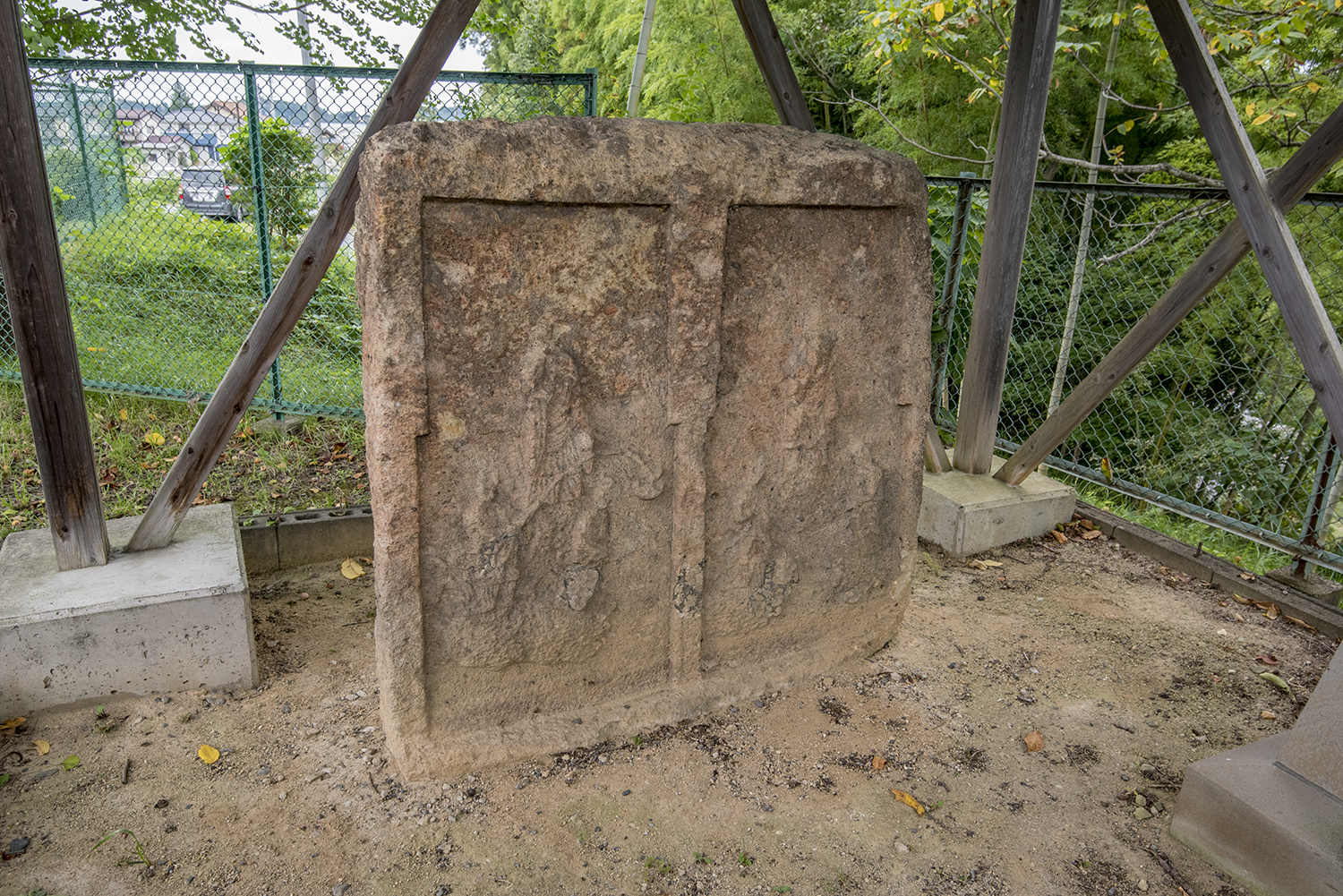 3D digitizing methods : Photogrammetry Software : Reality Capture Equipment : Nikon D750,NIKKOR 16-35mm f/4G Images: 323 photos Date : Sep.2019 Address : Sukagawa-City, Fukushima-prefecture.Japan. GoogleMap : https://goo.gl/maps/eBymdA2FWYd7Xjbk7 掲載確認済 Source: Objaverse 1.0 / Sketchfab
3December - Day 7 - Train Set
This is my entry for the last day of week one of the **3December** challenge. The topic was **Train Set** and I somehow wasn't really in the mood of creating a train set we all know from our childhood. So I thought I stretch the topic a little bit and create this instead. I guess it could still be count as a childs train set, or more like a single train part ;) * I didn't had time to texture it, but maybe I have time to update it later sometimes... Source: Objaverse 1.0 / Sketchfab
A Set of 72 Kinase Inhibitors
<p>A set of 72 known kinase inhibitors was assembled from ChEMBL release 18. For each inhibitor, MACCS and ECFP4 representations are provided. Both fingerprints were calculated using an in-house implementation based upon OpenEye's OEChem toolkit. For MACCS, we used SMARTS patterns adapted from RDKit.</p>
datasets for set containment join
<ul> <li>flickr, photo id as tuple, tag as set.</li> <li>orkut, people id as tuple, community as set.</li> <li>twitter, partition id as tuple, signature as set.</li> <li>webbase, page id as tuple, outlinks as set.</li> </ul> <p> </p>
Detailed data sets of MMP-cliffs, SAR transfer series, RECAP-MMPs and compound activities
<p>An up-to-date version of three MMP-based data sets derived from compounds included in the latest release of ChEMBL is presented. These data sets include activity cliffs, structure-activity relationship (SAR) transfer series, and second generation MMPs based upon retrosynthetic rules. The structural data and information are provided in eight different files comprising the data sets of MMP-cliffs, SAR transfer series, and RECAP-MMPs. Compound activities are incorporated in files of RECAP-MMPs. For transfer series, substituted fragments are also provided. All MMP-cliffs, SAR transfer series with approximate or regular potency progression, and RECAP-MMPs are provided in canonical SMILES representation on a per-target basis separately for the Ki and IC50 subsets. The corresponding files are clearly designated.</p>
31 ChEMBL data sets for regression modeling
<p>From ChEMBL version 17, 31 compound data sets have been selected for regression modeling. Compounds had to be active against human targets in a direct inhibition/binding assay with highest ChEMBL confidence score and Ki values below 100 micromolar. Multiple Ki values for the same compound were averaged if they fell into the same order of magnitude, or else they were disregarded. Duplicates, known pan-assay interference, and other reactive molecules were removed. Only sets with at least 500 compounds were considered.</p> <p> </p> <p>Note: The SD files contain a field "pKi"; note however that this field contains the Ki value in nM units, not the logarithmic value.</p>
CMOP 2012 AUV-WP Columbia River estuary benchmark data set
<p>Observational data set from the Columbia River estuary North Channel. The data were collected during two campaigns during May and October-November 2012.</p> <p>Included are Automated Underwater (AUV) mission, and ship-mounted whiched profiler (WP) data sets. Outputs from numerical circulation model are also included.</p> <p>See the README.txt in each zip file for further information.</p>
An MRI DICOM data set of the head of a normal male human aged 52
<p>This zip file contains a DICOM data set of magnetic resonance images a normal male mathematics professor aged 52. The experimental subject is the author. The MRI scans are T2 weighted turbo-spin-echo (T2W TSE) and T1 weighted Fast Field Echo (T1W FFE).</p> <p>The subject suffers from a small vertical strabismus (hypertropia), a misalignment of the eyes, which is visible in this data set.</p> <p>The author would like to thank the Radiology Department at the Macclesfield General Hospital for performing the scan.</p> <p> </p>
Data set of CA1 pyramidal cell models using an intact whole hippocampus preparation
<p>The frequency-current (f-I) profiles of pyramidal cells are presented. Each .abf file contains the f-I curve data for the respective cell (as labelled PYR1, PYR2, PYR3 and PYR4 for Pyramidal cell 1, Pyramidal cell 2, Pyramidal cell 3 and Pyramidal cell 4). That is, they contain the cell's response to the application of a series of depolarizing current steps of 1 s duration while the cells are held in current clamp, as well as the current clamp data itself. Each recording is 2 s total. Amplitudes of the input were increased incrementally with step sizes of 10 pA for PYR1, PYR3, and PYR4, and a step size of 25 pA for PYR 2. PYR1 first spikes on the 5th of 30 steps with 38.7 pA of depolarizing input. PYR2 first spikes on the 3rd of 13 steps with 1.2 pA of input. PYR3 first spikes on the 7th of 34 steps with 62.0 pA of input, and PYR4 first spikes on the 7th of 30 steps with 12.1 pA of input.</p>
Data set of CA1 pyramidal cell recordings using an intact whole hippocampus preparation, including recordings of rebound firing (V2)
<p>The frequency-current (f-I) profiles and an example of rebound firing of pyramidal cells are presented. Four .abf files contain the f-I curve data for the respective cell (as labelled PYR1, PYR2, PYR3 and PYR4 for Pyramidal cell 1, Pyramidal cell 2, Pyramidal cell 3 and Pyramidal cell 4). That is, they contain the cell's response to the application of a series of depolarizing current steps of 1 s duration while the cells are held in current clamp, as well as the current clamp data itself. Each recording is 2 s total. Amplitudes of the input were increased incrementally with step sizes of 10 pA for PYR1, PYR3, and PYR4, and a step size of 25 pA for PYR 2. PYR1 first spikes on the 5th of 30 steps with 38.7 pA of depolarizing input. PYR2 first spikes on the 3rd of 13 steps with 1.2 pA of input. PYR3 first spikes on the 7th of 34 steps with 62.0 pA of input, and PYR4 first spikes on the 7th of 30 steps with 12.1 pA of input. In the .abf file labelled PYR5_rebound, an example of rebound firing of a pyramidal cell following hyperpolarizing input is given. While the cell was held at -52 mV in current clamp, as series of 1 s hyperpolarizing steps (10 steps, 25 pA increments) were used to record the post- hyperpolarization rebound spiking. For the figure showing this rebound spiking (Figure 1), the first two hyperpolarizing steps and the respective firing are shown. For visualization purposes, the spike artifact in the current clamp input trace was removed and replaced with the mean current in the Figure. </p>
Sets of ChEMBL compounds with high or low confidence activity data
<p>Two sets of compounds assembled from ChEMBL release 20 that were annotated with high or low confidence activity data were provided in separate files. For each compound in a file, the unique compound identifier (i.e., molregno), the number of targets in individual years (from 1976 to 2014) and the list of target annotations (if any) was given.</p>
Data set of CA1 pyramidal cell models using an intact whole hippocampus preparationV2
<p>The frequency-current (f-I) profiles and an example of rebound firing of pyramidal cells are presented. Four .abf files contain the f-I curve data for the respective cell (as labelled PYR1, PYR2, PYR3 and PYR4 for Pyramidal cell 1, Pyramidal cell 2, Pyramidal cell 3 and Pyramidal cell 4). That is, they contain the cell's response to the application of a series of depolarizing current steps of 1 s duration while the cells are held in current clamp, as well as the current clamp data itself. Each recording is 2 s total. Amplitudes of the input were increased incrementally with step sizes of 10 pA for PYR1, PYR3, and PYR4, and a step size of 25 pA for PYR 2. PYR1 first spikes on the 5th of 30 steps with 38.7 pA of depolarizing input. PYR2 first spikes on the 3rd of 13 steps with 1.2 pA of input. PYR3 first spikes on the 7th of 34 steps with 62.0 pA of input, and PYR4 first spikes on the 7th of 30 steps with 12.1 pA of input. In the .abf file labelled PYR5_rebound, an example of rebound firing of a pyramidal cell following hyperpolarizing input is given. While the cell was held at -52 mV in current clamp, as series of 1 s hyperpolarizing steps (10 steps, 25 pA increments) were used to record the post- hyperpolarization rebound spiking. For the figure showing this rebound spiking (Figure 1), the first two hyperpolarizing steps and the respective firing are shown. For visualization purposes, the spike artifact in the current clamp input trace was removed and replaced with the mean current in the Figure.</p>
ScienceDex guides
Understand access before you commit
These curated guides explain access requirements, typical timelines, costs, and reuse considerations for widely used research datasets.
Allen Brain Atlas
Allen Brain Atlas is an Allen Institute collection of brain map atlases, datasets, APIs, and analysis tools covering mouse, human, and non-human primate brain resources.
Annotated Behaviour and Observability Dataset (ABODe)
ABODe is a University of Edinburgh DataShare dataset for behavior classification in group-housed mice using home-cage video, identities, bounding boxes, ground-plate positions, and annotator labels.
DANDI Archive for NWB datasets
DANDI is a BRAIN Initiative archive for publishing and sharing neurophysiology data, including electrophysiology, optophysiology, and behavioral data packaged as NWB and related standards.
International Brain Laboratory public data
The International Brain Laboratory public data releases expose standardized mouse decision-making experiments, including Neuropixels recordings, widefield calcium imaging, behavior, and session metadata accessed through the ONE API.
OpenNeuro
OpenNeuro is a free, open platform for sharing neuroimaging datasets, with public search, dataset pages, and download paths for web, S3, DataLad, and the OpenNeuro CLI.