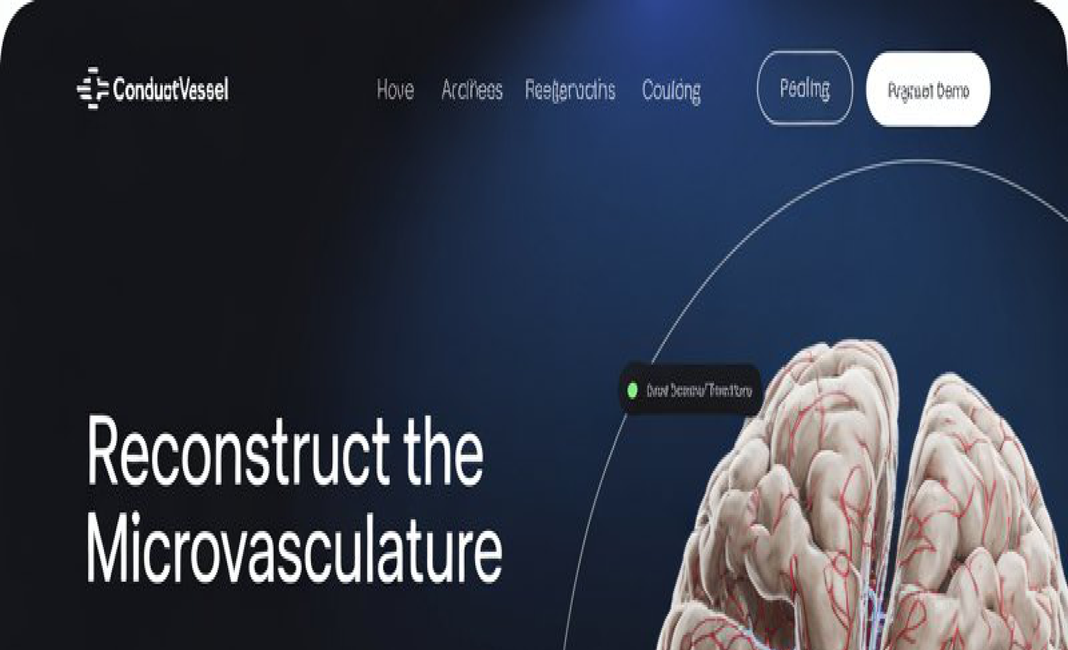
Reconstruct the Microvasculature
ConductVessel converts confocal and light-sheet microscopy stacks into flow-ready vascular graphs with automated loop detection, diameter mapping, and large-volume reconstruction.
- Automatic vascular loop detection
- Diameter-aware vessel reconstruction
- Terabyte-scale light-sheet support
Why Vascular Tracing Is Different
The Loop Problem
Neuron tracers fail when structures reconnect. Blood vessels form anastomosis loops that require specialized topology detection. ConductVessel automatically detects and reconstructs closed vascular loops.
The Diameter Challenge
A vessel is more than a line. Accurate vascular analysis requires diameter tracking along the entire vessel path to distinguish arteries, capillaries, and veins.
The Big Data Problem
Cleared tissue datasets from light-sheet microscopy can exceed 1 terabyte. ConductVessel processes large volumes block-by-block using the ConductPrep engine.
Map Every Branch, Measure Every Diameter
Anastomosis Detection
Automatically detect vascular loops and closed circuits within dense microvascular networks. Ideal for quantifying collateral circulation in stroke models.
Auto-Classify Arteries and Veins
Track vessel caliber at every node. Automatically color-code networks based on diameter thresholds.
Quantify Vascular Disorder
Measure tortuosity index, fractal dimension, and branching irregularity in tumor vasculature.
Flow Simulation Ready
Export reconstructed networks for Computational Fluid Dynamics (CFD) modeling. Supports graph and mesh formats for vascular flow simulation.
Built for Vascular Research
- Quantify vascular density and abnormal branching in tumor microenvironments.
- Evaluate anti-angiogenic drug effects on tumor vasculature.
- Map vascular damage and recovery after stroke or traumatic brain injury.
- Visualize microvascular remodeling in brain tissue.
- Analyze retinal vasculature in diabetic retinopathy models.
- Detect capillary dropout and abnormal neovascularization.
From Clearing to Quantification
ConductPrep
Preprocess large light-sheet datasets and stitch tiled volumes.
ConductVessel
Trace and reconstruct the vascular network in 3D.
Analytics
Export quantitative metrics: branching index, vessel density, segment length, volume fraction.
Built for Vascular Imaging
- Modalities: Light Sheet (LSFM), Confocal, Two-Photon, Micro-CT
- Common Stains: Lectin, Anti-CD31, Endomucin, Ink perfusion
- Metrics: Vessel Length Density (VLD), Bifurcation Index, Lacunarity, Tortuosity
- Export Formats: SWC (Modified), VTK, OBJ, CSV
Part of the ConductScience Pipeline
ConductVessel works with ConductPrep for preprocessing and integrates with downstream analytics tools.

Map the Lifeblood of Your Research
Compatible with iDISCO, CLARITY, and expansion microscopy.
