4 Layer Laboratory Aquarium Rack
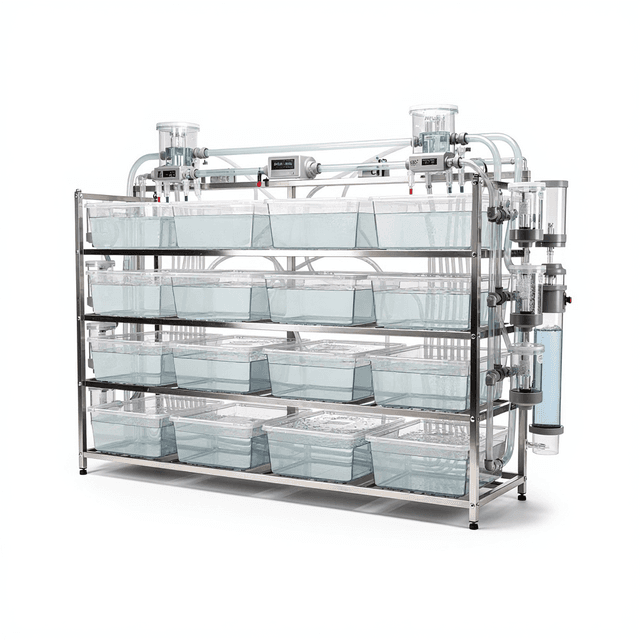
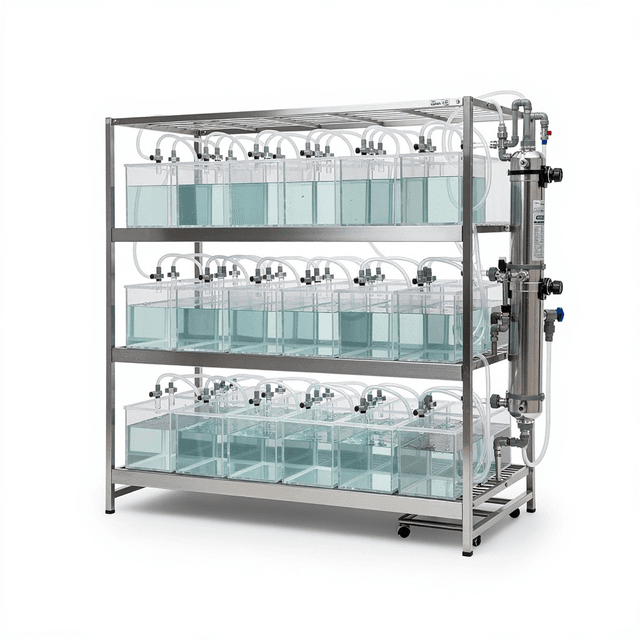
4-layer single-side laboratory zebrafish aquaculture rack system with 50 polycarbonate cages, 304 stainless steel frame, integrated filtration, UV sterilization, and aeration. Complete turnkey aquatic housing solution for zebrafish research facili...
| Model | LAQ-4-Single |
| Configuration | Single Side |
| Rack Dimensions | 1540 x 450 x 1880 mm (60.6 x 17.7 x 74.0 in) |
| Frame Material | 304 Stainless Steel |
| Tank Material | Polycarbonate (PC) |
| Tier Count | 4 Layers |
The 4 Layer Laboratory Aquarium Rack (LAQ-4) is a specialized housing system designed for research-grade zebrafish facilities and aquatic model organism studies. The system features a stainless steel frame construction (1540 × 450 × 1880 mm) supporting four tiers of polycarbonate (PC) aquarium units, providing controlled aquatic environments for behavioral studies, developmental biology research, and toxicological assessments.
The rack's modular design accommodates multiple experimental cohorts while maintaining individual tank isolation, supporting standardized protocols in zebrafish research facilities. The eco-friendly plastic construction ensures chemical compatibility with standard aquaculture solutions and cleaning protocols. Each tier provides independent access for routine maintenance, feeding schedules, and experimental interventions without disturbing adjacent housing units.
How It Works
The laboratory aquarium rack operates on a multi-tier modular system that provides standardized aquatic environments for research organisms. The stainless steel frame structure distributes weight evenly across four levels, with each tier supporting independent polycarbonate aquarium units. The irregular-shaped tank design optimizes space utilization while maintaining adequate swimming volume for behavioral observations.
Water circulation and environmental control depend on external filtration and monitoring systems connected to individual tanks or integrated manifold systems. The polycarbonate tank construction provides optical clarity for behavioral recording and morphological assessment while resisting chemical degradation from standard aquaculture treatments. The modular design allows researchers to configure tank arrangements based on experimental protocols, group sizes, and developmental stages.
Features & Benefits
Model
- LAQ-4-Single
Configuration
- Single Side
Rack Dimensions
- 1540 x 450 x 1880 mm (60.6 x 17.7 x 74.0 in)
Frame Material
- 304 Stainless Steel
Tank Material
- Polycarbonate (PC)
Tier Count
- 4 Layers
Layer 1
- 20x 1.5L PC Cages
Layer 2
- 12x 3L PC Cages
Layer 3
- 12x 3L PC Cages
Layer 4
- 6x 10L PC Cages
Total Cages
- 50
Filter System
- PP Material Filter Box (700 x 450 x 380 mm)
UV Sterilization
- 24W UV Disinfection Apparatus
Aeration
- V-30 Aerated Machine
Included Systems
- Filtration, Pump, Air Systems
Weight
- 350.0 lbs
Dimensions
- L: 65.0 in
- W: 22.0 in
- H: 78.0 in
Comparison Guide
| Feature | This Product | Typical Alternative | Advantage |
|---|---|---|---|
| Frame Construction | Stainless steel frame with polycarbonate tanks | Basic models often use plastic or aluminum frames with lower corrosion resistance | Provides long-term structural stability in humid laboratory environments with reduced maintenance requirements |
| Vertical Configuration | Four-tier vertical arrangement | Entry-level systems may offer only 2-3 tiers or horizontal layouts | Maximizes housing capacity within limited laboratory floor space for multi-cohort experimental designs |
| Tank Material | Polycarbonate construction with irregular geometry | Standard systems may use acrylic or glass tanks with rectangular designs | Combines optical clarity with chemical resistance while optimizing space utilization for behavioral observations |
| Modular Design | Independent tier access with flexible tank configuration | Fixed configurations may limit experimental flexibility | Supports diverse experimental protocols and group sizes without system reconfiguration |
The LAQ-4 system combines stainless steel durability with polycarbonate tank clarity in a space-efficient four-tier configuration. The modular design supports flexible experimental arrangements while maintaining structural integrity for long-term research facility operations.
Practical Tips
Label each tier and tank position with permanent identification for consistent experimental tracking and data recording.
Why: Maintains experimental integrity and simplifies data management in multi-cohort studies.
Inspect stainless steel frame joints monthly for loosening and polycarbonate tanks for stress cracking or chemical damage.
Why: Prevents structural failures and maintains optimal housing conditions for research organisms.
Ensure adequate floor drainage and slip-resistant surfaces around the rack system during water changes and maintenance procedures.
Why: Prevents accidents and water damage in laboratory environments with frequent aquaculture operations.
Verify level installation using a precision bubble level on each tier before introducing water systems.
Why: Ensures proper drainage function and prevents uneven water distribution that could affect experimental conditions.
Document water parameters and environmental conditions for each tier separately to identify position-dependent variations.
Why: Enables statistical analysis of potential rack effects on experimental outcomes and supports data validity assessments.
Monitor for algae growth patterns that may indicate uneven lighting or water circulation across tiers.
Why: Early detection of environmental gradients prevents confounding variables in behavioral and physiological studies.
Setup Guide
What’s in the Box
- Stainless steel frame components (typical)
- Four polycarbonate aquarium units (typical)
- Mounting hardware and fasteners (typical)
- Assembly instructions
- Warranty documentation
Warranty
ConductScience provides a one-year manufacturer warranty covering structural components, frame materials, and tank units against manufacturing defects, with technical support for setup and operation protocols.
Compliance
What tank volume does each tier accommodate and how does this affect stocking density calculations?
Tank volume specifications should be confirmed from the product datasheet. Stocking density should follow established guidelines for zebrafish research, typically 1-2 adult fish per liter depending on experimental duration and water quality management.
Is the polycarbonate material compatible with standard aquaculture disinfectants and cleaning protocols?
The PC tank construction is designed for aquaculture applications and should be compatible with standard quaternary ammonium disinfectants and chlorine-based sanitizers. Consult material specifications for specific chemical resistance data.
Can the rack system accommodate external filtration and water circulation systems?
The modular design supports connection to external water management systems. Plumbing connections and manifold integration depend on facility infrastructure and should be planned during installation.
What are the weight loading specifications for each tier when fully stocked with water and organisms?
Total weight capacity per tier should be verified from engineering specifications. Calculate total load including water volume, substrate, equipment, and safety margins for seismic considerations.
How does the irregular tank shape affect water flow patterns and dead zone formation?
The irregular geometry is designed to optimize space utilization. Water circulation effectiveness depends on inlet/outlet positioning and flow rates, which should be validated during system commissioning.
Is the frame height compatible with standard laboratory bench and equipment configurations?
At 1880 mm height, the system requires adequate ceiling clearance and may extend above standard bench height. Verify compatibility with existing laboratory furniture and overhead utilities.
What maintenance protocols are recommended for the stainless steel frame and polycarbonate components?
Regular cleaning with appropriate aquaculture-safe detergents and periodic inspection of frame joints and tank mounting hardware. Establish preventive maintenance schedules based on facility usage intensity.
Have a question about this product?
Accessories
Enhance your setup with compatible accessories
Frequently Bought Together
Upgrade Options