5 Layer Laboratory Zebrafish Rack - Double Side
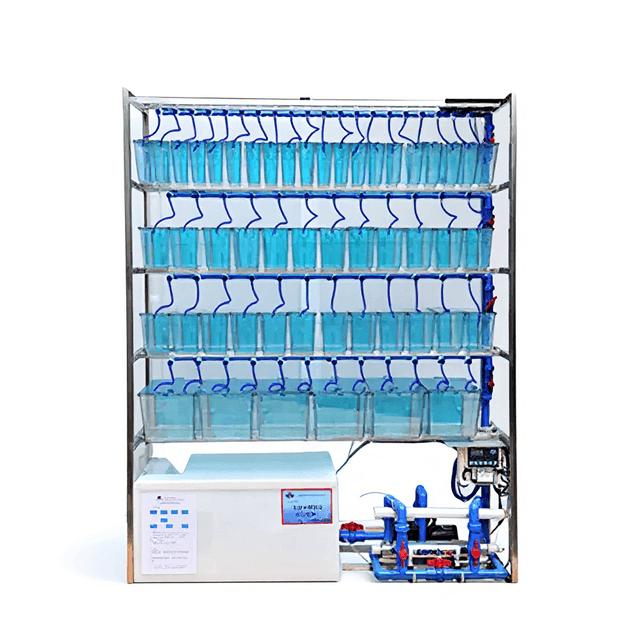
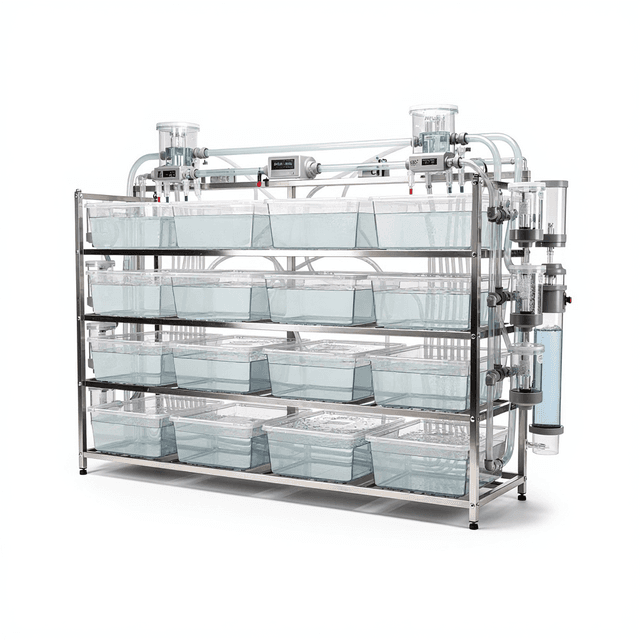
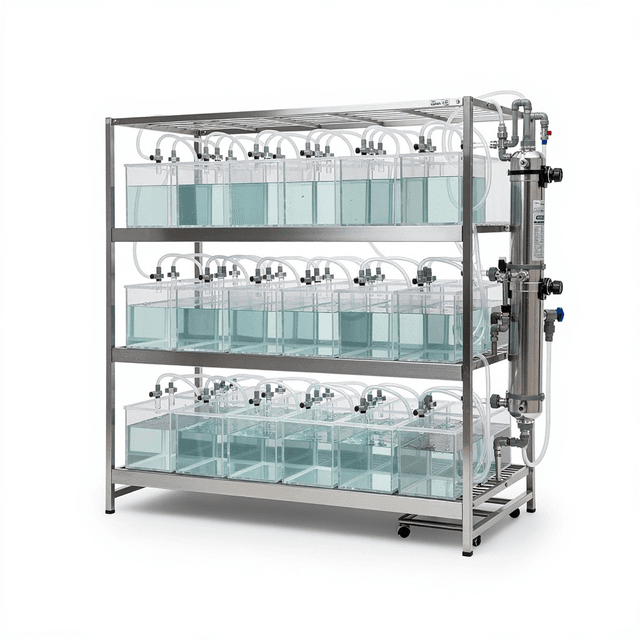
High-capacity dual-access zebrafish housing system with 124 polycarbonate cages across 5 tiers, featuring integrated recirculating filtration, UV sterilization, and mixed cage volumes for complete lifecycle management.
| Model | LAQ-5-Double |
| Configuration | Double Side |
| Rack Dimensions | 1540 x 700 x 1980 mm |
| Frame Material | 304 Stainless Steel |
| Tank Material | Polycarbonate (PC) |
| Tier Count | 5 Layers |

The LAQ-5 Double Side zebrafish rack represents a high-capacity aquaculture solution designed for large-scale zebrafish research programs. This dual-access system accommodates 124 polycarbonate cages across five tiers, supporting complete zebrafish lifecycle management from embryonic development through adult breeding. The integrated recirculating filtration system maintains water quality parameters across all cage volumes while the 304 stainless steel construction provides corrosion resistance and structural integrity for continuous operation.
The system's mixed cage configuration includes 1.5L cages for embryonic and larval stages, 3L cages for juvenile and adult fish, and 10L cages for breeding pairs or small groups. UV sterilization (24W) and V-30 aeration systems maintain biosecurity and dissolved oxygen levels throughout the water circulation network. This configuration enables researchers to maintain large breeding colonies while supporting diverse experimental protocols requiring different developmental stages and group sizes.
How It Works
The LAQ-5 system operates through a centralized recirculating aquaculture approach where water flows continuously through all 124 cages before returning to a centralized filtration unit. The 700 x 450 x 380 mm polypropylene filter box contains biological and mechanical filtration media that process metabolic waste products and particulates from the entire system. A 24W UV sterilization unit provides pathogen control by exposing recirculated water to germicidal ultraviolet radiation at 254 nm wavelength.
Water circulation is maintained through an integrated pump system that delivers filtered, UV-treated water to each cage tier through a gravity-fed distribution network. The V-30 aeration system provides dissolved oxygen supplementation and creates water movement within individual cages to prevent stratification. This design maintains consistent water quality parameters across all cage volumes while allowing independent population management within each housing unit.
The tiered cage configuration accommodates different space requirements throughout zebrafish development: 1.5L cages support high-density embryonic and larval rearing, 3L cages house juvenile and adult fish for experimental protocols, and 10L cages provide breeding space for reproductive pairs or small social groups. The dual-side access allows simultaneous husbandry operations and reduces handling time for large colony management.
Features & Benefits
Model
- LAQ-5-Double
Configuration
- Double Side
Rack Dimensions
- 1540 x 700 x 1980 mm
Frame Material
- 304 Stainless Steel
Tank Material
- Polycarbonate (PC)
Tier Count
- 5 Layers
Total Cages
- 124
UV Sterilization
- 24W
Aeration
- V-30
Automation Level
- semi-automated
Research Domain
- Cancer Research
- Developmental Biology
- Environmental Monitoring
- Neuroscience
- Pharmaceutical QC
- Toxicology
Species
- Zebrafish
Weight
- 650.0 kg
Dimensions
- L: 65.0 mm
- W: 32.0 mm
- H: 82.0 mm
Comparison Guide
| Feature | This Product | Typical Alternative | Advantage |
|---|---|---|---|
| Total Cage Capacity | 124 cages across 5 tiers | Entry-level systems typically offer 20-60 cages | Supports large-scale breeding programs and multi-investigator facilities without requiring multiple rack systems. |
| Access Configuration | Dual-side access to all tiers | Most systems provide single-side access only | Enables simultaneous husbandry operations and reduces handling time for large colony management tasks. |
| Cage Volume Variety | Three cage sizes (1.5L, 3L, 10L) in single system | Many systems use uniform cage volumes | Accommodates complete zebrafish lifecycle from embryonic development through adult breeding without transferring between systems. |
| Frame Construction | 304 stainless steel throughout | Some systems use coated metal or plastic components | Provides superior corrosion resistance and structural integrity for continuous operation in high-humidity environments. |
| UV Sterilization Power | 24W integrated UV system | Lower-capacity systems often use 8-15W UV units | Provides more effective pathogen control for the larger water volume and higher bioload in high-capacity systems. |
| Vertical Space Utilization | 5 tiers in 1980 mm height | Compact systems typically offer 2-3 tiers | Maximizes colony density within limited laboratory floor space while maintaining accessibility for routine procedures. |
This system offers the highest capacity configuration in zebrafish housing with 124 cages, dual-access design, and mixed cage volumes supported by robust 304 stainless steel construction and 24W UV sterilization. The five-tier configuration maximizes colony density while the integrated recirculating system maintains consistent water quality across all housing units.
Practical Tips
Verify water flow rates to each cage tier monthly using a flow meter to ensure uniform distribution throughout the system.
Why: Uneven flow can create water quality gradients that affect fish health and experimental reproducibility across different cage locations.
Rotate UV bulb replacement schedule with biological filter media changes to minimize system disruption during maintenance periods.
Why: Coordinated maintenance reduces stress on fish populations and prevents temporary compromises to both pathogen control and water quality.
Maintain detailed cage location records with breeding line information and use consistent cage numbering systems across both sides of the rack.
Why: Systematic organization prevents line mixing errors and enables efficient location of specific breeding pairs during husbandry or experimental procedures.
Install individual cage flow restrictors if uneven water distribution develops, particularly in upper tier positions.
Why: Gravity-fed systems can develop preferential flow patterns that compromise water quality in specific cage positions over time.
Monitor and record daily water quality parameters from both sides of the system to detect any circulation or filtration asymmetries.
Why: Early detection of system imbalances prevents fish health issues that could compromise experimental data integrity across large colony populations.
Install ground fault circuit interrupters (GFCI) on all electrical connections and maintain clear emergency shutdown procedures.
Why: High-capacity aquaculture systems involve significant electrical loads in wet environments, requiring enhanced electrical safety precautions.
Implement a staged cleaning schedule where different cage sections are cleaned on rotating days rather than entire system cleaning.
Why: Distributed maintenance reduces system shock and maintains stable biological filtration while ensuring all areas receive regular attention.
Establish backup protocols for critical breeding lines by maintaining redundant populations in separate tier locations.
Why: Distributed colony management protects against localized system failures or contamination events that could affect entire genetic lines.
Setup Guide
What’s in the Box
- 304 stainless steel rack frame components
- 124 polycarbonate cages (40 x 1.5L, 72 x 3L, 12 x 10L)
- PP filter box (700 x 450 x 380 mm)
- 24W UV sterilization unit
- V-30 aeration system
- Integrated pump system
- Water distribution plumbing (typical)
- Assembly hardware and fittings (typical)
- Installation and operation manual (typical)
Warranty
ConductScience provides a one-year manufacturer warranty covering defects in materials and workmanship, with technical support for system setup, operation, and maintenance procedures.
Compliance
What water quality parameters must be maintained across all 124 cages?
The recirculating system maintains consistent temperature (26-28°C), pH (6.5-7.5), dissolved oxygen (>5 mg/L), ammonia (<0.25 mg/L), and nitrite (<0.25 mg/L) across all cage volumes through centralized filtration and UV sterilization. Monitor these parameters daily during initial setup and weekly during stable operation.
How does the mixed cage configuration support different experimental protocols?
The 1.5L cages accommodate high-density embryonic and larval development studies, 3L cages house juvenile and adult fish for behavioral or pharmacological assays, and 10L cages support breeding pairs for genetic crosses. This allows concurrent multi-stage experiments within a single system.
What is the maximum fish density recommended for each cage size?
Follow standard zebrafish density guidelines: 1.5L cages support up to 15 adult fish or higher larval densities, 3L cages accommodate 5-8 adult zebrafish comfortably, and 10L cages house 1-2 breeding pairs or up to 15 adults for social behavior studies. Consult facility protocols for specific research requirements.
How often should the UV sterilization unit and filter media be maintained?
Replace UV bulbs annually or every 9000 operating hours to maintain germicidal effectiveness. Clean mechanical filter media weekly and replace monthly, while biological filter media should be rinsed bi-weekly and replaced quarterly to prevent system disruption.
Can individual cages be isolated if disease is detected?
While the system uses shared recirculation, individual cages can be temporarily isolated by blocking water flow connections. However, permanent quarantine requires moving affected fish to separate systems to prevent pathogen transmission through the shared filtration network.
What backup systems are recommended for critical colony protection?
Install backup aeration systems, emergency power supplies for pumps and UV sterilization, and redundant heating systems. Consider automatic water level monitoring and alarm systems to prevent catastrophic losses during equipment failures or power outages.
How does this system compare to smaller zebrafish housing solutions?
This high-capacity system is designed for major research programs requiring 100+ breeding lines or large-scale screening studies. Smaller facilities may find 2-3 tier systems more appropriate for colony sizes under 50 lines, while this configuration suits core facilities supporting multiple research groups.
What floor space and utility requirements are needed for installation?
The system requires approximately 2m x 1m floor space plus service clearance. Electrical requirements include standard laboratory power for pumps, UV sterilization, and aeration. Water supply and drainage access are essential for system maintenance and water changes.
Have a question about this product?