ConductScience Cell Culture Flasks T25, Vented Cap (Case of 5)
$115.00 per unit | 5 units per pack Bulk pricing: Case of 5 at $575.00 ($115.00 per unit)
| Automation Level | manual |
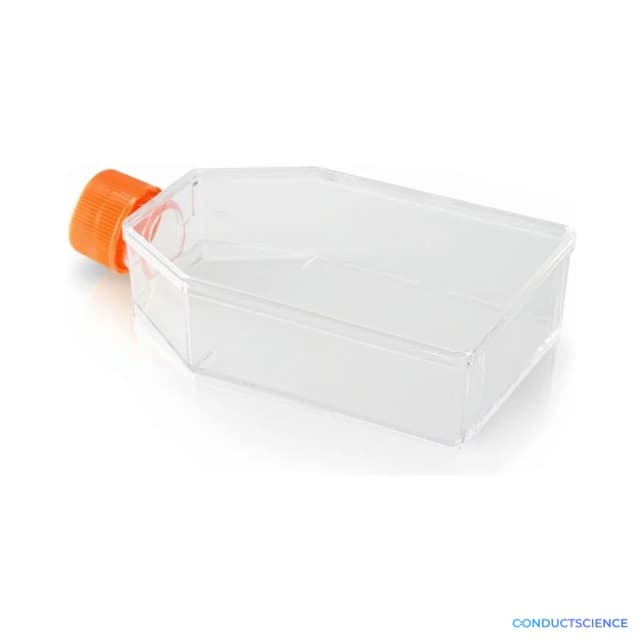
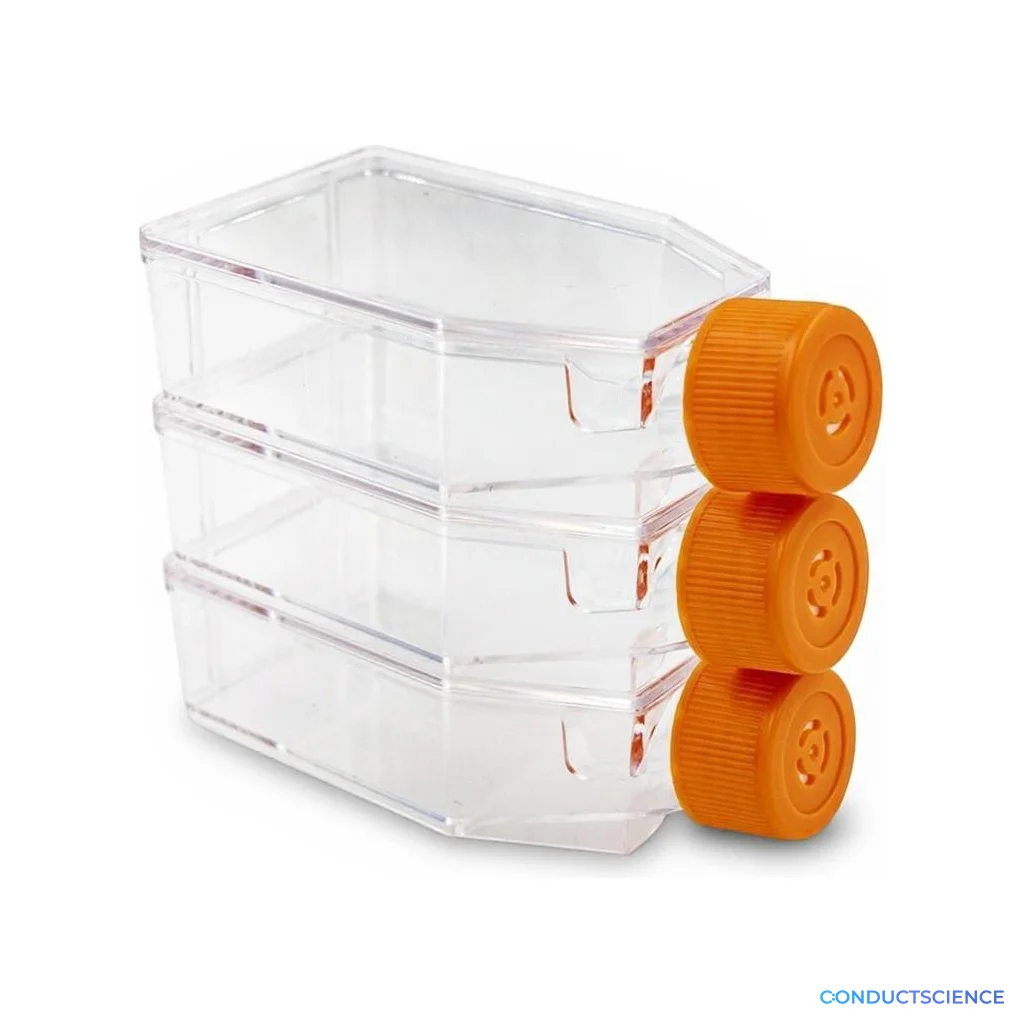
T25 cell culture flasks provide 25 cm² of tissue culture-treated growth surface for adherent cell cultivation. Each flask features a vented screw cap that maintains sterile gas exchange while preventing contamination during routine cell culture procedures. The tissue culture-treated polystyrene surface promotes optimal cell attachment and growth for mammalian cell lines.
These single-use flasks are manufactured under sterile conditions and are non-pyrogenic, eliminating the need for pre-use sterilization. The standardized T25 format ensures compatibility with standard incubators and provides sufficient surface area for maintaining cell lines, performing transfections, and conducting small-scale experiments requiring adherent cell cultures.
How It Works
Cell culture flasks utilize tissue culture-treated polystyrene surfaces that have been modified through plasma treatment or chemical coating to enhance cell adhesion. This treatment creates a hydrophilic surface with optimal wettability and charge distribution that promotes protein adsorption and subsequent cell attachment through integrin-mediated interactions.
The vented cap system incorporates a 0.2-micron hydrophobic membrane that allows sterile gas exchange while maintaining a barrier against bacterial and fungal contamination. This design enables CO₂ equilibration necessary for pH buffering in bicarbonate-based media systems while preserving sterile conditions during extended culture periods.
The 25 cm² growth surface provides standardized culture conditions with defined surface area-to-volume ratios for reproducible experimental results. The flask geometry allows uniform media distribution and facilitates microscopic observation of cell morphology and confluence assessment.
Features & Benefits
Automation Level
- manual
Research Domain
- Cancer Research
- Cell Biology
- Developmental Biology
- Immunology
- Microbiology
- Pharmaceutical QC
Weight
- 632.15 lbs
Dimensions
- L: 30.0 in
- W: 25.0 in
- H: 20.0 in
Comparison Guide
| Feature | This Product | Typical Alternative | Advantage |
|---|---|---|---|
| Surface Area | 25 cm² tissue culture-treated surface | Entry-level flasks often provide 12.5 cm² while larger formats offer 75-175 cm² | Provides optimal balance between culture scale and resource efficiency for routine cell maintenance |
| Cap Ventilation | Vented screw cap with sterile membrane | Some models use standard caps requiring manual loosening for gas exchange | Maintains sterile conditions while allowing continuous gas exchange during incubation |
| Surface Treatment | Tissue culture-treated polystyrene | Untreated surfaces require additional coating steps for cell adhesion | Ready-to-use surface eliminates preparation time and coating variability |
| Sterility Assurance | Sterile and non-pyrogenic manufacturing | Some products require pre-use sterilization or endotoxin testing | Eliminates sterilization protocols and reduces endotoxin-related experimental interference |
These T25 flasks provide standardized cell culture conditions with tissue culture-treated surfaces and vented cap systems for sterile gas exchange. The ready-to-use sterile format eliminates preparation steps while the 25 cm² surface area offers versatile scaling for various experimental applications.
Practical Tips
Pre-warm culture media to 37°C before adding to flasks to minimize thermal shock to newly seeded cells.
Why: Temperature equilibration prevents cellular stress that can affect attachment efficiency and viability.
Monitor cell confluence daily and passage before reaching 90% confluence to maintain healthy growth characteristics.
Why: Over-confluent cultures experience contact inhibition and nutrient depletion that can alter cellular behavior.
Allow flasks to equilibrate in the incubator for 15-30 minutes before seeding to stabilize pH and temperature.
Why: Environmental stability improves initial cell attachment and reduces variability in culture establishment.
If cells fail to attach, verify the tissue culture treatment by testing surface wettability with sterile media.
Why: Surface treatment quality directly affects cell adhesion through protein adsorption and integrin binding.
Always handle flasks within a biological safety cabinet using sterile technique to prevent contamination.
Why: Cell cultures are susceptible to microbial contamination that can compromise experimental results and pose safety risks.
Document passage numbers and culture conditions to ensure reproducibility across experimental replicates.
Why: Cellular characteristics can change with extended passaging, affecting experimental consistency and data interpretation.
Setup Guide
What’s in the Box
- T25 cell culture flasks with vented caps (quantity as specified in product configuration)
- Individual sterile packaging (typical)
- Product documentation and certificates (typical)
Warranty
ConductScience provides standard warranty coverage against manufacturing defects. Technical support is available for product specifications and application guidance.
Compliance
What cell densities are recommended for T25 flask seeding?
Seeding densities typically range from 1-5 × 10⁴ cells/cm², depending on cell type growth characteristics and experimental timeline. Fast-growing cell lines may require lower initial densities to prevent over-confluence.
How does the vented cap system maintain sterility during gas exchange?
The vented cap incorporates a 0.2-micron hydrophobic membrane that allows CO₂ and oxygen exchange while providing a sterile barrier against microbial contamination during extended culture periods.
What is the recommended media volume for T25 flasks?
Optimal media volume is 5-7 mL, providing approximately 2-3 mm depth for adequate nutrient distribution while maintaining proper surface area-to-volume ratios for gas exchange.
Can these flasks be used for suspension cell cultures?
While designed for adherent cells, T25 flasks can accommodate suspension cultures, though specialized suspension culture vessels may provide better mixing and oxygenation for non-adherent cell types.
How long can cells be maintained in T25 flasks before passaging?
Culture duration depends on cell type and growth rate. Most adherent cells reach confluence requiring passage within 3-7 days, though this varies significantly with cell line characteristics and culture conditions.
Are these flasks compatible with automated cell culture systems?
The standard T25 format is compatible with many automated liquid handling and incubation systems, though specific compatibility should be verified with individual automation platforms.
Have a question about this product?