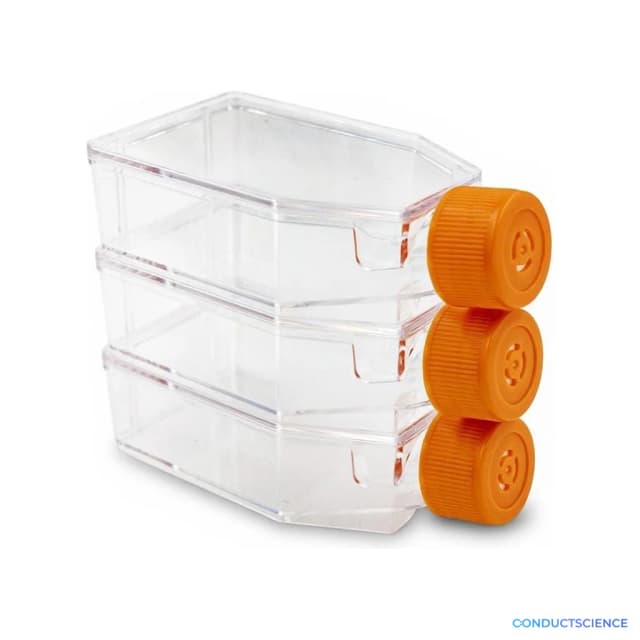
ConductScience Cell Culture Flasks T175, Vented Cap (Case of 5)
$125.00 per unit | 5 units per pack Bulk pricing: Case of 5 at $625.00 ($125.00 per unit)

Louise Corscadden, PhD
Director of Science · ConductScience
Ask Louise about ConductScience Cell Culture Flasks T175, Vented Cap (Case of 5) fit, setup, configuration, or quote prep.
Already working with us? Sign in to connect this with My Scientist.
Key Specifications
Full details →- Model fit
- Configured during quote
- SKU family
- CS-CCF-T175V-30
- Shipping box
- 30.0 x 25.0 x 20.0 cm
- Ordering
- Online checkout and quote request available
- Category
- Cell Culture
- Build notes
- Confirm accessories, station layout, and support needs before purchase
ConductScience T175 cell culture flasks provide 175 cm² of growth surface area for large-scale cell expansion applications. These flasks feature TC-treated polystyrene surfaces optimized for cell attachment and proliferation, with vented screw caps that maintain sterile gas exchange while preventing contamination. Manufactured under sterile conditions and tested for non-pyrogenic properties, these flasks support primary cell cultures, cell line maintenance, and scale-up protocols requiring expanded surface area.
The vented cap design incorporates a 0.2 μm hydrophobic membrane that allows CO₂/O₂ exchange while maintaining sterility throughout extended culture periods. The flat-bottom geometry provides uniform cell distribution and facilitates microscopic observation, while the angled neck design enables ergonomic handling and reduces contamination risk during media changes and cell harvesting procedures.
How It Works
Cell culture flasks provide a controlled microenvironment for cell growth through surface chemistry optimization and atmospheric regulation. The TC-treated polystyrene surface undergoes plasma oxidation to introduce polar functional groups that enhance protein adsorption and cell attachment. This treatment modifies the surface energy and hydrophilicity, promoting integrin-mediated cell adhesion and spreading.
The vented cap system maintains optimal culture conditions through selective membrane permeability. The 0.2 μm hydrophobic membrane allows bidirectional gas exchange (CO₂, O₂, N₂) while blocking microbial contamination and preventing media evaporation. This creates a semi-open system that supports pH buffering through CO₂ equilibration with bicarbonate-buffered media while maintaining sterility.
The 175 cm² surface area accommodates approximately 1.75 × 10⁷ cells at confluence for typical mammalian cell lines, based on standard cell density calculations of ~1 × 10⁵ cells/cm². The flat-bottom geometry ensures uniform media distribution and consistent nutrient/waste exchange across the culture surface.
Features & Benefits
Automation Level
- manual
Research Domain
- Cancer Research
- Cell Biology
- Developmental Biology
- Immunology
- Microbiology
- Pharmaceutical QC
Shipping weight
- 632.15 lb
Shipping box
- L: 30.0 cm
- W: 25.0 cm
- H: 20.0 cm
| Feature | This Product | Typical Alternative | Advantage |
|---|---|---|---|
| Growth Surface Area | 175 cm² TC-treated surface | Entry-level flasks often provide 25-75 cm² surface area | Enables large-scale cell expansion with fewer vessels, reducing handling time and contamination risk. |
| Cap Ventilation System | 0.2 μm membrane vented cap | Standard caps require manual loosening for gas exchange | Maintains sterile gas exchange automatically without risk of over-loosening or contamination during handling. |
| Surface Treatment | TC-treated polystyrene for optimal cell attachment | Untreated surfaces may require additional coating steps | Ready-to-use surface chemistry eliminates pre-coating procedures and ensures consistent cell adhesion. |
| Sterility Assurance | Sterile, non-pyrogenic construction | Some products may not include non-pyrogenic testing | Eliminates endotoxin interference in sensitive applications and reduces experimental variability. |
These T175 flasks combine large-scale growth capacity with convenient vented cap technology and ready-to-use TC-treated surfaces. The 175 cm² format enables efficient cell expansion while the membrane ventilation system maintains optimal culture conditions without manual intervention.
Practical Tips
Pre-warm flasks to 37°C before cell seeding to prevent thermal shock and improve attachment efficiency.
Why: Temperature equilibration prevents cell membrane stress and ensures optimal metabolic activity during the critical attachment phase.
Inspect vented cap membranes regularly for integrity and replace if blocked or damaged.
Why: Compromised membranes can lead to inadequate gas exchange and pH drift, affecting culture viability.
Validate media volume distribution by checking coverage uniformity across the flask surface before cell seeding.
Why: Proper volume ensures consistent nutrient availability and prevents edge effects that can cause uneven cell growth.
Document flask lot numbers and culture passage numbers to track performance variations across experiments.
Why: Batch-to-batch consistency monitoring helps identify sources of experimental variability in long-term studies.
If cells appear stressed or show poor attachment, verify TC treatment integrity by testing with known responsive cell lines.
Why: Surface treatment degradation during storage can significantly impact cell adhesion and growth characteristics.
Handle flasks with appropriate PPE and maintain sterile technique throughout all manipulations to prevent contamination.
Why: Large-volume cultures represent significant time and resource investment, making contamination prevention critical for experimental success.
Setup Guide
What’s in the Box
- T175 cell culture flasks with vented caps (quantity as ordered)
- User instructions for proper handling (typical)
- Certificate of sterility and non-pyrogenic testing (typical)
Warranty
ConductScience provides a standard warranty covering manufacturing defects and sterility assurance. Technical support includes cell culture protocols and troubleshooting guidance for optimal culture performance.
Compliance
What cell density range is optimal for T175 flask seeding?
Seed at 1-5 × 10⁶ cells for expansion cultures or 0.5-1 × 10⁶ cells for maintenance cultures. Final confluence accommodates approximately 1.75 × 10⁷ cells based on standard mammalian cell density calculations.
How does the vented cap affect CO₂ equilibration compared to standard caps?
The 0.2 μm membrane allows continuous gas exchange, enabling proper pH buffering in CO₂-bicarbonate systems. This maintains physiological pH without requiring cap loosening in humidified incubators.
What media volume provides optimal culture conditions in T175 flasks?
Use 25-35 mL for standard applications. This provides adequate nutrient supply and waste dilution while maintaining proper surface tension for uniform distribution across the 175 cm² surface.
Are these flasks compatible with automated cell culture systems?
Yes, the standard T175 format fits most automated liquid handling and incubation systems. The vented cap design accommodates robotic manipulation while maintaining sterility.
How long can cultures be maintained before media change is required?
Typically 2-3 days depending on cell density and metabolic rate. Monitor pH indicator color change and cell morphology to determine optimal media exchange intervals for your specific cell line.
What sterilization methods are compatible with these flasks?
Flasks are pre-sterilized by gamma irradiation. Do not autoclave or use chemical sterilization as this may compromise the polystyrene integrity and TC treatment.
Can these flasks be used for suspension culture applications?
While designed for adherent cell culture, they can accommodate suspension cultures that don't require specialized agitation. The flat bottom may cause cell settling compared to dedicated suspension culture vessels.
Have a question about this product?
Have a question? Just ask.
Send it over and we'll email you a personalized answer — no call, no scheduling.
Prefer to talk it through?
Replacement Parts & Consumables
Related Products