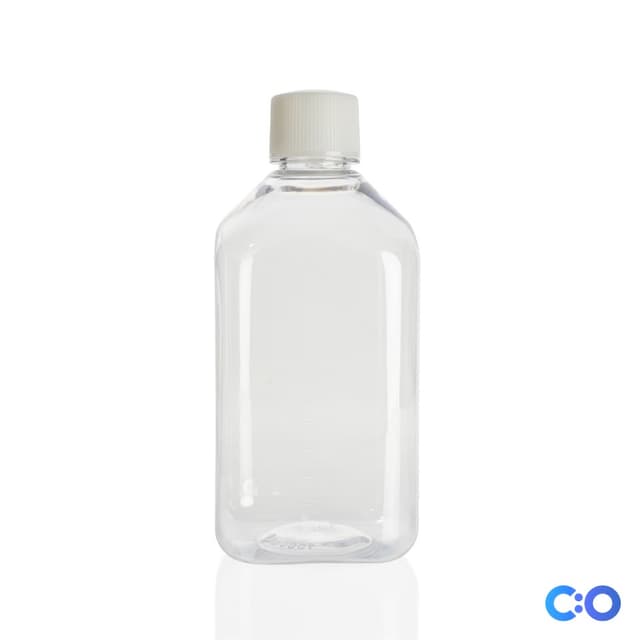
ConductScience Reagent Bottles, HDPE, 1000mL, Wide Mouth (Pack of 20)
$25.00 per unit | 20 units per pack Bulk pricing: Pack of 20 at $500.00 ($25.00 per unit)

High-density polyethylene reagent bottles designed for reliable chemical storage and handling in research laboratories. These 1000mL wide-mouth bottles feature autoclavable HDPE construction that resists chemical corrosion and thermal stress while maintaining dimensional stability across repeated sterilization cycles.
The wide-mouth design facilitates efficient filling, sampling, and cleaning procedures, making these bottles suitable for storing reagents, buffer solutions, and laboratory-prepared media. HDPE material provides excellent chemical resistance to most acids, bases, and organic solvents commonly used in analytical and preparative chemistry workflows.
How It Works
HDPE (high-density polyethylene) provides chemical resistance through its non-polar polymer structure, which resists interaction with most laboratory chemicals. The material's linear polymer chains create a dense, crystalline structure that maintains integrity when exposed to acids, bases, and many organic solvents at room temperature.
The wide-mouth opening (typically 83mm diameter) reduces surface tension effects during pouring and enables efficient cleaning with standard laboratory brushes. Autoclave compatibility stems from HDPE's thermal properties, maintaining structural integrity at 121°C sterilization temperatures while allowing thermal expansion without cracking.
The screw-cap closure creates a secure seal through threaded engagement and gasket compression, minimizing vapor loss and contamination risk during storage periods.
Features & Benefits
Research Domain
- Analytical Chemistry
- Cell Biology
- Environmental Monitoring
- Materials Science
- Microbiology
- Pharmaceutical QC
Weight
- 30.92 kg
Dimensions
- L: 43.2 mm
- W: 36.0 mm
- H: 28.8 mm
Comparison Guide
| Feature | This Product | Typical Alternative | Advantage |
|---|---|---|---|
| Material Construction | HDPE with chemical resistance and autoclave compatibility | Entry-level bottles often use lower-grade plastics with limited chemical compatibility | Ensures reliable performance with a broader range of laboratory chemicals and sterilization procedures |
| Opening Design | Wide-mouth configuration for efficient access | Standard bottles may feature narrow-neck designs | Simplifies filling, cleaning, and sampling procedures while accommodating standard laboratory tools |
| Volume Capacity | 1000mL working volume | Smaller capacity bottles require more frequent preparation cycles | Optimizes workflow efficiency for bulk reagent storage and reduces container inventory requirements |
| Sterilization Compatibility | Autoclavable at standard laboratory temperatures | Some plastic bottles cannot withstand autoclave sterilization | Enables sterile applications and contamination control in microbiological workflows |
These HDPE reagent bottles provide reliable chemical storage with autoclave sterilization capability and wide-mouth access design. The 1000mL capacity optimizes laboratory workflow efficiency while maintaining chemical compatibility across diverse research applications.
Practical Tips
Leave 10-15% headspace when filling bottles to accommodate thermal expansion during storage or temperature changes.
Why: Prevents over-pressurization and potential cap failure during thermal cycling.
Inspect caps regularly for wear and replace if threading becomes loose or gaskets show signs of degradation.
Why: Maintains proper sealing to prevent evaporation and contamination of stored reagents.
Use appropriate chemical-resistant labels and ensure compatibility with stored solvents to prevent label degradation.
Why: Maintains clear identification of contents and prevents safety hazards from illegible or missing labels.
Verify volume markings with calibrated measuring devices if precise volumes are critical for your application.
Why: Ensures accurate reagent preparation when bottle graduations are used for volume estimation.
Implement first-in-first-out rotation for reagent stocks and maintain preparation logs with date and batch information.
Why: Prevents degradation of stored chemicals and maintains traceability for experimental reproducibility.
If caps become difficult to remove, check for chemical crystallization around threads and clean with appropriate solvents.
Why: Prevents damage to bottle threads and ensures continued access to stored materials.
Setup Guide
What’s in the Box
- 1000mL HDPE reagent bottle (typical)
- Wide-mouth screw cap (typical)
- Product documentation (typical)
Warranty
ConductScience provides standard manufacturer warranty coverage for material defects and workmanship. Technical support available for proper use and chemical compatibility guidance.
Compliance
What chemicals are incompatible with HDPE material?
HDPE shows limited compatibility with strong oxidizing agents, aromatic hydrocarbons at elevated temperatures, and halogenated solvents under certain conditions. Consult chemical compatibility charts for specific reagents and storage conditions.
Can these bottles be used for long-term storage of biological samples?
HDPE is suitable for many biological applications, but protein adsorption and permeability to small molecules should be considered. Autoclave sterilization capability supports sterile sample storage protocols.
What is the maximum autoclaving temperature and duration?
HDPE typically withstands standard autoclave cycles at 121°C for 15-20 minutes. Repeated autoclaving may cause gradual material degradation; monitor for changes in flexibility or opacity.
How do I prevent contamination during repeated sampling?
Use aseptic technique with sterile pipettes or sampling tools. Consider dedicating specific bottles to single-use applications or implementing aliquoting strategies for frequently accessed reagents.
Are these bottles suitable for storing light-sensitive compounds?
HDPE provides minimal UV protection compared to amber glass. Store light-sensitive materials in dark conditions or use secondary light-blocking containers when necessary.
What cleaning agents are recommended for HDPE bottles?
Standard laboratory detergents, dilute acids, and bases are compatible. Avoid abrasive cleaners that may scratch surfaces. Thorough rinsing with deionized water removes cleaning residues effectively.
Have a question about this product?
Accessories
Enhance your setup with compatible accessories
Frequently Bought Together