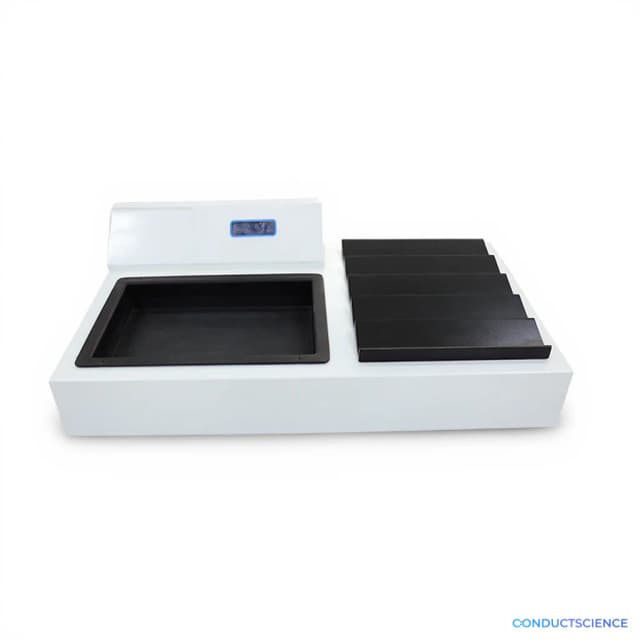
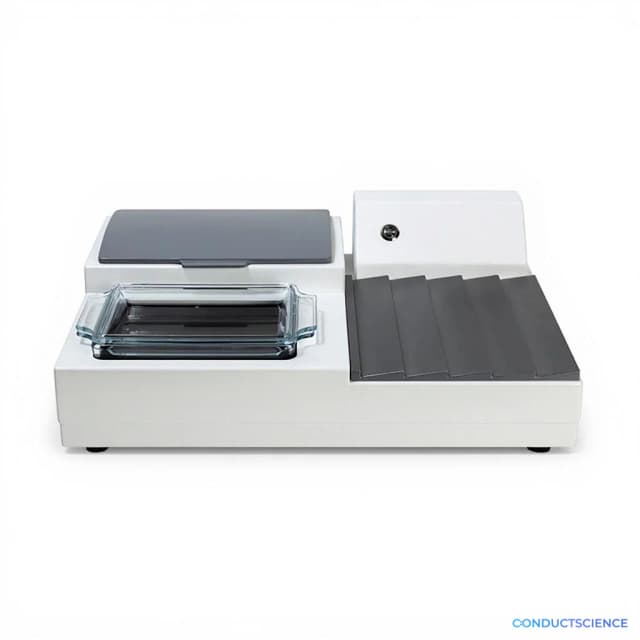
H&E Slide Stainer
Automated 20-station H&E slide stainer with 6-slide capacity per holder, programmable timing (0-59 minutes per station), and continuous processing capability for high-throughput histopathology workflows.

The H&E Slide Stainer is an automated histological processing system designed for routine hematoxylin and eosin staining protocols in pathology laboratories. This 20-station automated stainer processes up to 6 slides per holder in continuous batch mode, providing precise timing control (0-59 minutes, 0-59 seconds per station) and programmable staining sequences. The system features dynamic progress monitoring via LED touch interface and integrated water protection systems to prevent reagent contamination.
The stainer accommodates flexible workflow requirements through configurable repeat stations for extended processing steps and adjustable cleaning protocols across stations 2-17. With 10 programmable staining protocols and real-time fault monitoring, the system supports high-throughput histopathology workflows while maintaining consistent staining quality for diagnostic applications.
How It Works
The H&E slide stainer operates through sequential immersion of slide holders in reagent stations containing hematoxylin, eosin, alcohols, and clearing agents. The mechanical arm system transfers slide holders between the 20 stations according to programmed protocols, with precise dwell times controlled by digital timers. Each station contains 135ml of reagent, sufficient for continuous processing while maintaining reagent concentration.
The staining process follows standard H&E protocols: nuclear staining with hematoxylin (basic dye binding to nucleic acids), differentiation in acid alcohol, bluing in alkaline solutions, cytoplasmic counterstaining with eosin (acidic dye binding to proteins), followed by dehydration through graded alcohols and clearing in xylene. The 10-second transfer time between stations minimizes carryover while preventing slide drying.
Dynamic progress monitoring displays current station positions and remaining processing times via the LED touch interface. Water protection sensors prevent contamination by automatically shutting off water flow if blockages occur, while adjustable cleaning cycles maintain reagent purity across stations 2-17.
Features & Benefits
Model
- RF-0114 ($4500)
- RF-0040 ($7000)
- RF-0039 ($12000)
Weight
- 21.0 kg
Dimensions
- L: 46.5 mm
- W: 44.0 mm
- H: 35.5 mm
Comparison Guide
| Feature | This Product | Typical Alternative | Advantage |
|---|---|---|---|
| Number of Processing Stations | 20 stations with configurable repeat and cleaning functions | Entry-level systems often provide 10-15 stations | More stations allow complete H&E protocols including multiple differentiation and rinse steps without external processing. |
| Slide Capacity per Cycle | 6 slides per holder with continuous sample addition | Basic models typically handle 1-4 slides per batch | Higher capacity reduces processing bottlenecks during peak workflow periods in busy pathology laboratories. |
| Timing Control Precision | Adjustable 0-59 minutes and 0-59 seconds per station | Fixed timing or coarser adjustment increments | Precise timing control enables optimization for different tissue types and staining intensities. |
| Protocol Storage | 10 programmable protocols with fault monitoring | Limited protocol memory or manual programming | Multiple stored protocols eliminate reprogramming time when switching between tissue types or research applications. |
| Contamination Prevention | Integrated water protection with automatic shutoff and adjustable cleaning | Manual water management or basic overflow protection | Automated contamination prevention protects expensive reagents and maintains staining quality. |
| User Interface | LED touch interface with dynamic progress monitoring | Basic displays or indicator lights | Real-time progress visualization improves workflow management and reduces operator monitoring requirements. |
This automated stainer provides comprehensive H&E processing capability with 20 stations, precise timing control, and advanced monitoring features. The combination of high slide capacity, programmable protocols, and contamination prevention systems addresses the requirements of high-volume pathology workflows while maintaining staining consistency.
Practical Tips
Verify timing accuracy by running empty cycles and measuring actual dwell times at each station before processing valuable specimens.
Why: Accurate timing ensures consistent staining results and prevents over- or under-staining of tissue sections.
Replace reagents in stations based on slide throughput rather than time intervals, and monitor reagent color changes for depletion indicators.
Why: Reagent exhaustion affects staining quality and can result in poor nuclear or cytoplasmic contrast.
Program repeat stations for hematoxylin when processing tissues with high nuclear density or thick sections.
Why: Extended nuclear staining ensures adequate penetration and contrast in challenging tissue preparations.
Use water protection fault codes to identify specific blockage locations and clear obstructions before resuming cleaning cycles.
Why: Water system faults can lead to reagent contamination and poor staining results if not addressed promptly.
Document protocol parameters and reagent lot numbers for each staining run to maintain traceability for diagnostic applications.
Why: Protocol documentation enables troubleshooting of staining inconsistencies and supports laboratory accreditation requirements.
Ensure adequate ventilation around the stainer and use fume extraction for xylene-containing stations to minimize solvent exposure.
Why: Organic solvents used in H&E protocols pose inhalation and fire hazards requiring proper engineering controls.
Schedule cleaning cycles during low-activity periods to maximize stainer availability during peak workflow hours.
Why: Automated cleaning maintains reagent quality while minimizing impact on laboratory productivity.
Inspect mechanical arm movement weekly and lubricate transfer mechanisms according to manufacturer specifications.
Why: Proper mechanical maintenance prevents slide damage and ensures reliable station-to-station transfer timing.
Setup Guide
What’s in the Box
- H&E Slide Stainer main unit
- 20 reagent station containers (135ml each)
- Slide holders for 6-slide capacity
- Power cable and adapter
- Water connection tubing
- LED touch interface display
- User manual and protocol guide (typical)
- Calibration certificate (typical)
Warranty
ConductScience provides standard 1-year manufacturer warranty covering parts and labor, with technical support for protocol optimization and troubleshooting. Extended service plans available for high-volume laboratory environments.
Compliance
References
Background reading relevant to this product:
What is the maximum slide capacity for continuous processing?
The system accommodates 6 slides per holder with multiple holders for continuous processing. New samples can be added during operation without interrupting ongoing staining cycles.
How precise is the timing control for each staining step?
Each station provides timing adjustment from 0-59 minutes and 0-59 seconds, with 10-second transfer intervals between stations for precise protocol control.
Can different H&E protocols be programmed and stored?
The system stores 10 programmable protocols with fault monitoring, allowing multiple staining sequences for different tissue types or research applications.
What prevents reagent contamination during operation?
Integrated water protection automatically detects blockages and shuts off water flow to prevent contamination. Cleaning protocols for stations 2-17 maintain reagent purity.
How is staining progress monitored during operation?
Dynamic progress display via LED touch interface shows current station positions, remaining processing times, and fault conditions in real-time.
What reagent volume is required for each station?
Each of the 20 stations holds 135ml reagent capacity, sufficient for continuous processing while maintaining staining consistency.
Can processing stations be configured for extended staining times?
Repeat stations can be configured for tissues requiring longer processing times, and any station can be designated as an end station with completion alert.
What maintenance is required for consistent performance?
Regular reagent replacement, cleaning cycle execution for stations 2-17, and water system maintenance ensure optimal staining quality and system reliability.
Have a question about this product?