
Find research datasets worth reusing
Search datasets from major research repositories and use ShareScore to quickly assess how well each record supports discovery, access, and reuse.
79
datasets available to search
ShareScore release 0.9.0
Dataset results
79 results for “Valladolid”
Pollinator species increase in Valladolid City
<p>Ecological surveys of selected taxa at NBS pre-intervention and year 1 and 2 post intervention. Comparison of pollinator species richness/abundance/seasonal spread at NBS pre and post intervention. Analysis of survey data using standard software (Excel/R).</p>
Nox Trends in Valladolid city
<p>This indicator is included in the list of indicators for Challenge 5. Air Quality. See table below with the total set of KPIs related to Air Quality (AQ) Challenge.</p> <p>Other indicators are defined to assess a general impact of a NBS on AQ at building, district or city scale. However, this indicator is focused on the impact of specific NBS on a polluted gaseous stream before being released into the urban atmosphere.</p> <p>This indicator has been mainly defined for Urban Garden BioFilter but in future can be used for other NBS to be installed in outdoor pipes to capture pollutants. At lab scale, the impact of this NBS has been measured by a setup with air characterization upstream and downstream of the filter. However at real scale measurements of AQ are more complicated. The system is going to be installed in the underground car park “Plaza Zorrilla”. Inlet air can be measured by installing a sensor in the area where air is going to be extracted or inside of the inlet pipe. However, outlet air cannot be capture directly, it is a very high surface to cover. Thus, it is going to be installed two measure points before and after the implementation of the BioFilter. One of them next to the outdoor area and the other one far away but in the Zorrilla Sq. too. These three measure point will count with PM, NOX and O3 sensors.</p>
Recreational Value of the NBS for Valladolid city
<p>Key Performance Indicator calculated for the H2020 UrbanGreenUP project for Valladolid city. </p>
Eldery People Life Quality in Valladolid City
<p>Calculated for the H2020 UrbanGreenUP </p>
Connectivity Perception in Valladolid City
<p>Indicator calculated for the H2020 UrbanGreenUP project by GMV</p>
Volume of water removed from the sewage water system in Valladolid City
<p>Green infrastructure can prevent rainfall from entering the water treatment system by allowing it to soak into the soil or to evaporate back into the air. GI-Val tool 2.1 can be used to model the volume and percentage of rainfall that is affected in these ways, and to put a monetary value on part of the benefit: the energy and carbon emission savings.</p> <p>In the case of Valladolid, storm water, domestic sewage and industrial wastewater are collected through a combined sewers system which transports all the wastewater to a sewage treatment plant. The wastewater treatment plant (WWTP) of Valladolid has a treatment capacity for 570,000 population equivalent (future extension up to 750,000 pe) and a maximum flow rate 3 m<sup>3</sup>/s. The foreseen reduction in the surface runoff by the implementation of the different NBS in Valladolid city will reduce the total volume of wastewater collected though the sewers system and, therefore, the volume of water to be treated at the WWTP. Thus, will suppose an important economic savings.</p>
Nutrient Abatment (BOD) in Valladolid city
<p>In the H2020 UrbanGreenUP some NBS related to water management, such as the NTWP and the Electrowetlands, are designed for the removal of organic compounds and nutrients from the wastewater. The treatment of wastewater by means of green solutions supposes the discharge of low loads of organic matter, nutrients, and other pollutants (such as heavy metals or emerging contaminants) to the environment. Therefore, the safety discharge to the environment or later reuse for different purposes (such as irrigation of green areas) is ensured.</p> <p>This KPI aims at determining the organic matter, nutrients, and other pollutants removal in the NBS. For that purpose, the concentration of the specific contaminants to be monitored are determined both in the influent (raw wastewater) and the final effluent of the NBS. The reduction observed in the concentration is the abatement reached in the monitored system. This KPI involves sampling and analytical determinations in a lab. </p>
Nutrient abatement COD in Valladolid city
<p>In the H2020 UrbanGreenUP some NBS related to water management, such as the NTWP and the Electrowetlands, are designed for the removal of organic compounds and nutrients from the wastewater. The treatment of wastewater by means of green solutions supposes the discharge of low loads of organic matter, nutrients, and other pollutants (such as heavy metals or emerging contaminants) to the environment. Therefore, the safety discharge to the environment or later reuse for different purposes (such as irrigation of green areas) is ensured.</p> <p>This KPI aims at determining the organic matter, nutrients, and other pollutants removal in the NBS. For that purpose, the concentration of the specific contaminants to be monitored are determined both in the influent (raw wastewater) and the final effluent of the NBS. The reduction observed in the concentration is the abatement reached in the monitored system. This KPI involves sampling and analytical determinations in a lab. </p>
Nutrient Abatement Total Solids in Valladolid city
<p>This KPI aims at determining the organic matter, nutrients, and other pollutants removal in the NBS. For that purpose, the concentration of the specific contaminants to be monitored are determined both in the influent (raw wastewater) and the final effluent of the NBS. The reduction observed in the concentration is the abatement reached in the monitored system. This KPI involves sampling and analytical determinations in a lab. </p>
Savings in treatment of stormwater in Valladolid city
<p>Green infrastructure can prevent rainfall from entering the water treatment system by allowing it to soak into the soil or to evaporate back into the air. GI-Val tool 2.1 can be used to model the volume and percentage of rainfall that is affected in these ways, and to put a monetary value on part of the benefit: the energy and carbon emission savings.</p> <p>In the case of Valladolid, storm water, domestic sewage and industrial wastewater are collected through a combined sewers system which transports all the wastewater to a sewage treatment plant. The wastewater treatment plant (WWTP) of Valladolid has a treatment capacity for 570,000 population equivalent (future extension up to 750,000 pe) and a maximum flow rate 3 m<sup>3</sup>/s. The foreseen reduction in the surface runoff by the implementation of the different NBS in Valladolid city will reduce the total volume of wastewater collected though the sewers system and, therefore, the volume of water to be treated at the WWTP. Thus, will suppose an important economic savings.</p>
Intercepted rainfall in Valladolid city
<p>When rain falls on to a vegetated surface (gross rainfall), a part is intercepted by the canopy and evaporated directly back into the atmosphere (interception loss). The remainder of the rainfall reaches the ground (net rainfall) both through gaps and by dripping from the canopy (through fall), or by running down the main stem (stem flow). The canopy storage capacity is the minimum amount of water necessary to completely saturate the canopy surface. The maximum storage capacity of a leaf ranges from 1 to 2 l/m<sup>2</sup>. </p> <p>In case of a low rainfalls (<5 mm/m<sup>2</sup>), the intercepcion capacity and the rainfall are similar. For a heavier rainfall, the interception is about 10% of the precipitation. In a simplified mode, the interception can be calculated as the product of the rainfall and a coefficient α, which depends on the type of vegetation cover. In wet areas with a huge vegetated cover, α varies from 0.1 to 0.2 and its is 0 in arid regions. </p>
Energy Savings Related to Green Infrastructure in Valladolid city
<p>Improved green infrastructure results in energy savings through a variety of mechanisms. These include:</p> <ul> <li>Reducing the need to heat buildings by insulating them against the cold</li> <li>Reducing the need to cool buildings by insulating them against the heat</li> <li>Reducing the volume of stormwater entering the sewer system, thus reducing energy consumption in sewage processing</li> </ul> <p>The energy savings resulting from these three mechanisms are estimated by GI-Val <a href="#_ftn1">[</a><a href="https://www.merseyforest.org.uk/gi-val/">https://www.merseyforest.org.uk/gi-val/</a><a href="#_ftn1">]</a> tools 1.1, 1.5 and 2.1 respectively. </p>
Crime Reduction by the NBS during the UrbanGreenUP project in Valladolid city
<p>This indicator is included in the list of indicators <em>Challenge 8. Social Justice and Social Cohesion</em>.</p> <p>According to Oxford dictionary, crime is an action or omission which constitutes an offence and is punishable by law.</p> <p>The installation of urban furniture as a measure of protection against crime, vandalism and terrorist acts has been developing successfully since the 70s and it is called “Crime Prevention Through Environmental Design (CPTE)”. The main technique is to reduce crime opportunities through modification and manipulation of the built environment that make it more difficult (Massoomeh et al, 2016).</p> <p>Green Infrastructures can help to reduce the causes and opportunities crime and vandalism because the structures that look well cared for discourage crime and increase social justice and cohesion. It is a measure that through well planning, designing and managing of the built environment (Massoomeh et al, 2016).</p>
Mudejar vaults (low poly), Valladolid Cathedral.
Mudejar vaults (first quarter of fifthteen siecle) at [chapel of San Llorente](http://artevalladolid.blogspot.com.es/2013/07/las-cupulas-mudejares-de-la-capilla-de.html), Cathedral museum. Part of the ancient collegiate church of Valladolid, remains only a small part and ruins because of the construction of the new cathedral, never finished, in s. XVI. Today is part of the diocesan museum. Lowpoly model.[ See a high poly model here.](https://skfb.ly/6vSvQ) 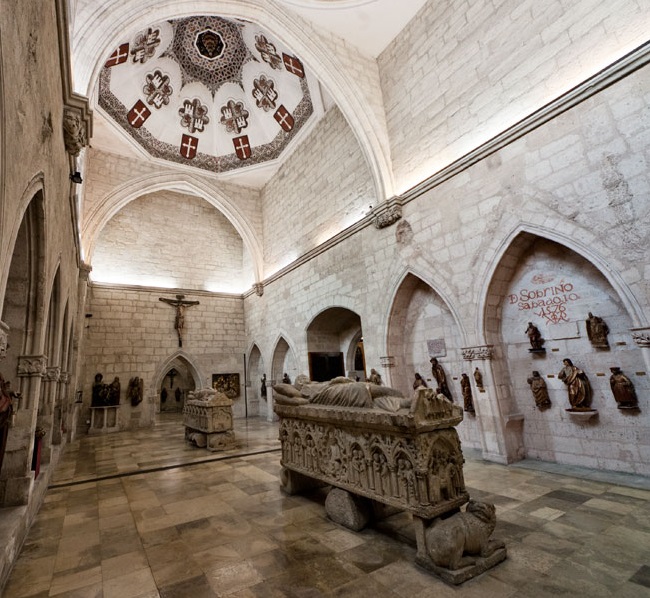 Source: Objaverse 1.0 / Sketchfab
«Recepción de Cristóbal de Morales en Valladolid (ca. 1530-1550): una opinión, una tablatura, un inventario y el manuscrito 5 (E-V5)». Anuario musical 78 (2023), pp. 31-57.
<p>Abstract;<br>This paper deals with the reception of Cristóbal de Morales`s<br>music in the vibrant city of Valladolid during the 1530s and 1540s,<br>a period that covers the years before his establishment in Rome<br>(1535) and those immediately after his definitive return to Spain<br>(1545). It is supported by four primary evidences: the assessment of<br>the author by Professor Cristóbal de Villalón, an intabulation, an<br>inventory made in 1547 in the Collegiate Church of Valladolid, and<br>the unique Manuscript 5 (E-V5). A detailed study of this «white<br>book» has made it possible to offer its complete and complex structure,<br>a piece of information which, combined with that provided by<br>the inventory and other documentary sources, allows us to better<br>understand its chronology and functionality. They also allow us to<br>present the person responsible for copying it, an essential mediator<br>in the dissemination of the music of Cristóbal de Morales, at least in<br>the Valladolid Collegiate Church.</p>
Foto 2 in Contribución al conocimiento de los macroheteróceros (Lepidoptera) de la provincia de Valladolid (Castilla y León, España).
Foto 2.- Macrothylacia digramma (Meade-Waldo, 1905) X
Absorption Capacity of Trees in Valladolid City
<p>Calculated for the H2020 Project UrbanGreenUP for the City of Valladolid by CENTA. </p>
Absorption Capacity m2 in Valladolid City
<p>Calculated by CENTA for the H2020 UrbanGreenUP project</p>
Benefits from interventions for Valladolid city
<p>This is a global indicator which aims to analyze the urban regeneration (metropolitan or urban scale) considering the typology, functionality and benefits. The results will show the potential of a Nature Based solution to protect, improve, and regenerate the urban spaces.</p> <p>This KPI called “Assessment of typology, functionality and benefits provided” is a complex indicator, which is compound by individual performance indicator (parameters). This KPI has multiple natures, composed, grouped and integrative. There have been defined a composed and weighted methodology to calculate this global KPI, through the addition of single KPI.</p>
FIGURE 12 in The Rhyacophila fasciata Group in Croatia and Bosnia and Herzegovina: Rhyacophila f. fasciata Hagen 1859 and the description of two new subspecies, Rhyacophila fasciata delici Kučinić & Valladolid (ssp. nov.) from Croatia and Bosnia and Herzegovina and Rhyacophila fasciata viteceki Valladolid & Kučinić
FIGURE 12. Distribution of Rhyacophila fasciata delici Kučinić & Valladolid ssp. nov., R. fasciata viteceki Valladolid & Kučinić ssp. nov., and R. f. fasciata Hagen 1859 in Croatia and in Bosnia and Herzegovina. Colour scale: altitude (m a.s.l.). Circle: species and subspecies present in Croatia, Triangle: species and subspecies present in Bosnia-Herzegovina. Green: R. fasciata delici, black: R. fasciata viteceki, red: R. f. fasciata.
ScienceDex guides
Understand access before you commit
These curated guides explain access requirements, typical timelines, costs, and reuse considerations for widely used research datasets.
Allen Brain Atlas
Allen Brain Atlas is an Allen Institute collection of brain map atlases, datasets, APIs, and analysis tools covering mouse, human, and non-human primate brain resources.
Annotated Behaviour and Observability Dataset (ABODe)
ABODe is a University of Edinburgh DataShare dataset for behavior classification in group-housed mice using home-cage video, identities, bounding boxes, ground-plate positions, and annotator labels.
DANDI Archive for NWB datasets
DANDI is a BRAIN Initiative archive for publishing and sharing neurophysiology data, including electrophysiology, optophysiology, and behavioral data packaged as NWB and related standards.
International Brain Laboratory public data
The International Brain Laboratory public data releases expose standardized mouse decision-making experiments, including Neuropixels recordings, widefield calcium imaging, behavior, and session metadata accessed through the ONE API.
OpenNeuro
OpenNeuro is a free, open platform for sharing neuroimaging datasets, with public search, dataset pages, and download paths for web, S3, DataLad, and the OpenNeuro CLI.