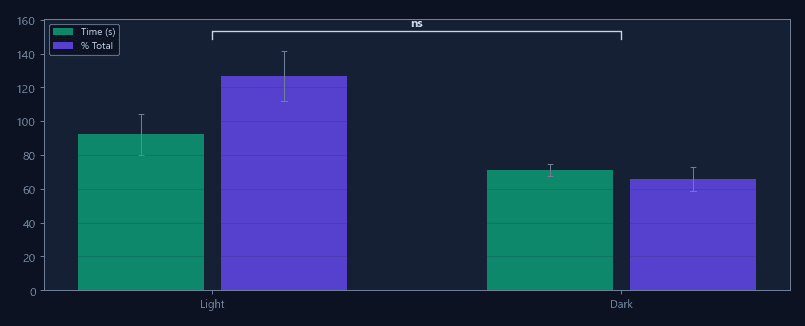
Compartment occupancy
Total time in light compartment, total time in dark compartment, and percentage split across the full session and per time bin.
CSVJSON
Automated anxiety phenotyping in the light/dark box
Quantify light/dark transitions, latency to enter the dark compartment, and proportional dwell time — the standard anxiety assay, fully automated.
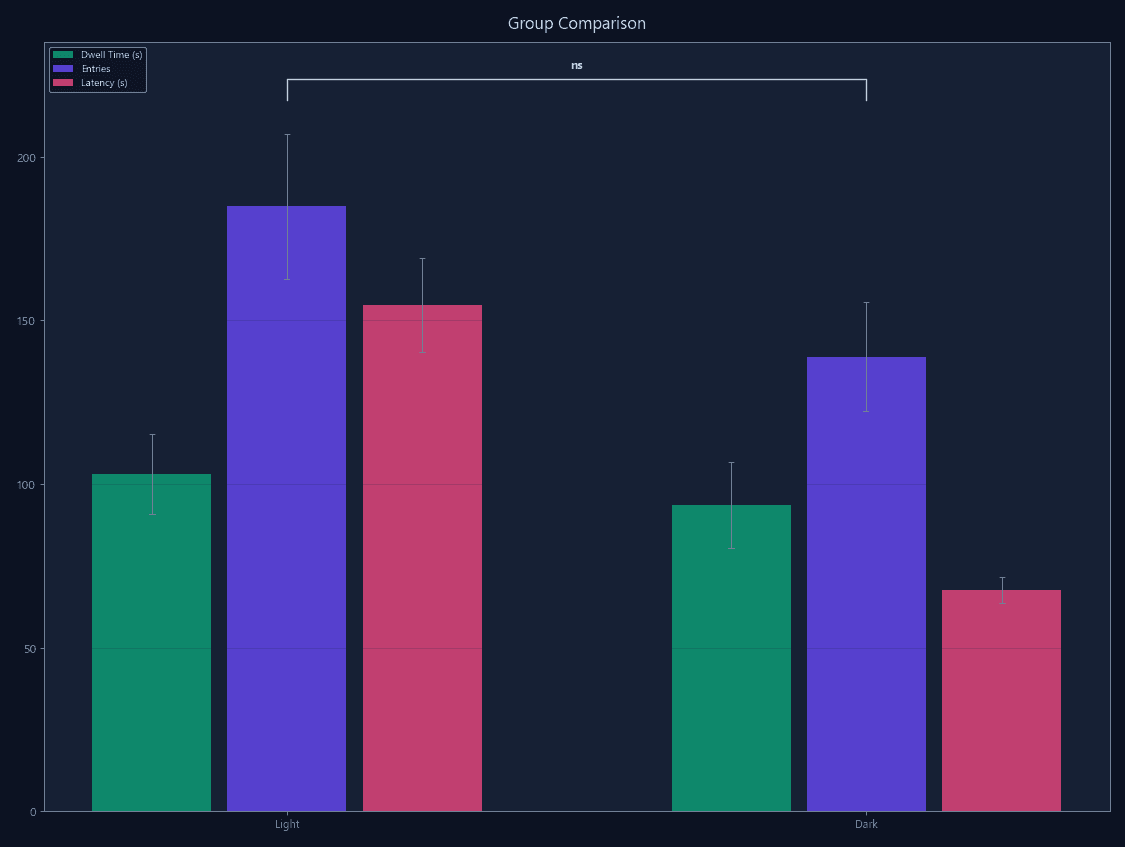
Counting transitions and timing compartment occupancy sounds straightforward, but at scale — dozens of animals per cohort, multiple time bins — manual scoring produces inconsistent transition criteria and timing drift.
ConductVision tracks the animal centroid relative to the light/dark boundary. Transitions are logged when the body center crosses the boundary line, and all temporal measures are frame-accurate.
Total time in light compartment, total time in dark compartment, and percentage split across the full session and per time bin.
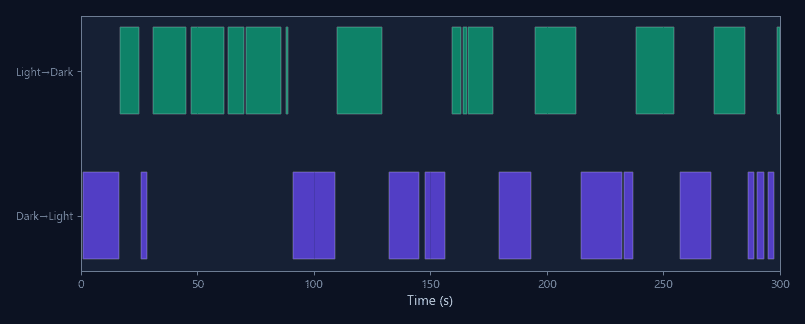
Every light-to-dark and dark-to-light transition with timestamp, direction, and inter-transition interval.
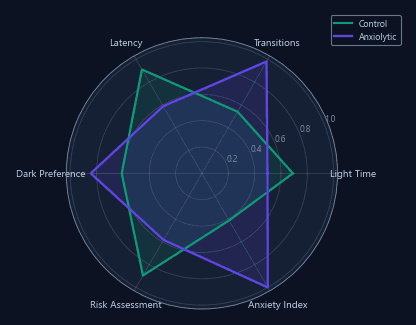
Latency to first dark entry, total transitions, light dwell ratio, and risk assessment (entries into light from dark).
Light/dark test is a standard primary screen for anxiolytic compounds. Automated scoring enables consistent dose-response curves across large cohorts.
Compare light/dark profiles across genotypes with identical scoring criteria — no inter-rater confound.
Pre- and post-stress light/dark testing quantifies stress-induced anxiety with objective, repeatable measures.
Testing at different zeitgeber times reveals circadian modulation of light aversion.
| Feature | ConductVision | Typical systems |
|---|---|---|
| Transition criterion | Configurable (center, nose, % body) | Fixed or undefined |
| Latency precision | Frame-accurate (33 ms) | Stopwatch (200-500 ms error) |
| Time-binned analysis | Automatic at any interval | Requires re-scoring |
| Batch cohort processing | Unlimited parallel | Sequential manual |
| Risk assessment scoring | Built-in (light entries from dark) | Custom calculation required |
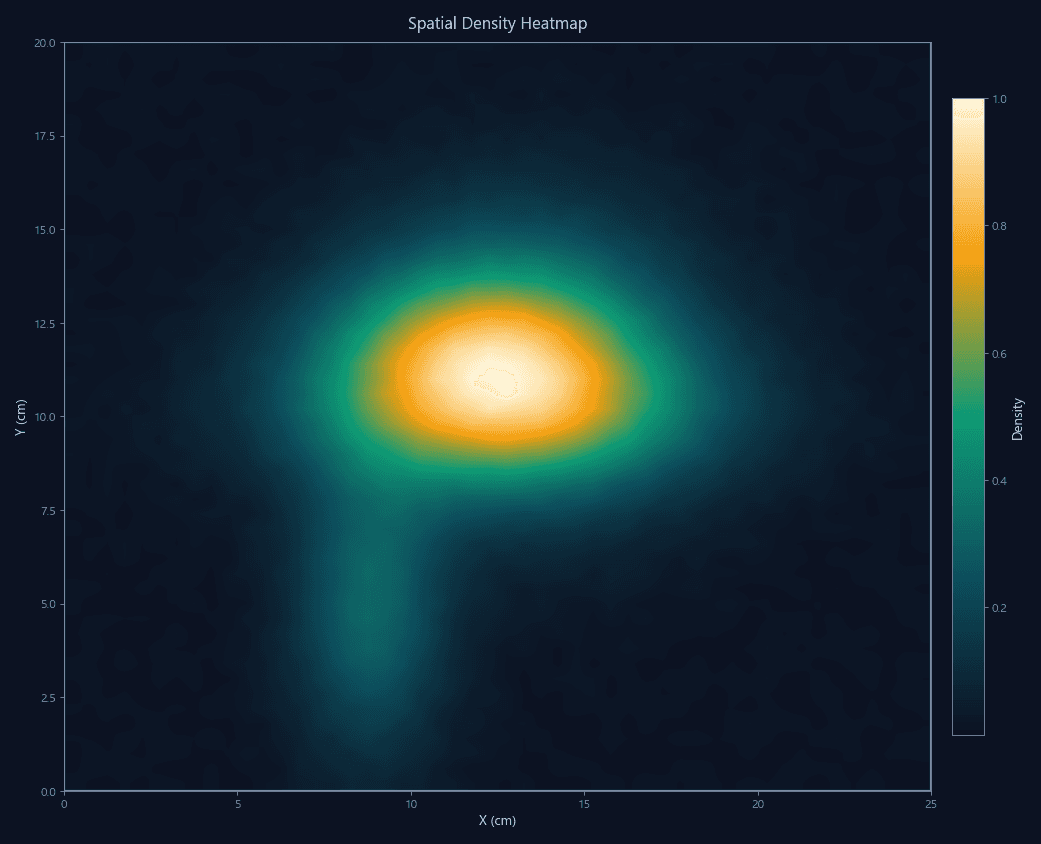
Configurable spatial zones with automated dwell time, entry count, and heatmap analysis for any arena.
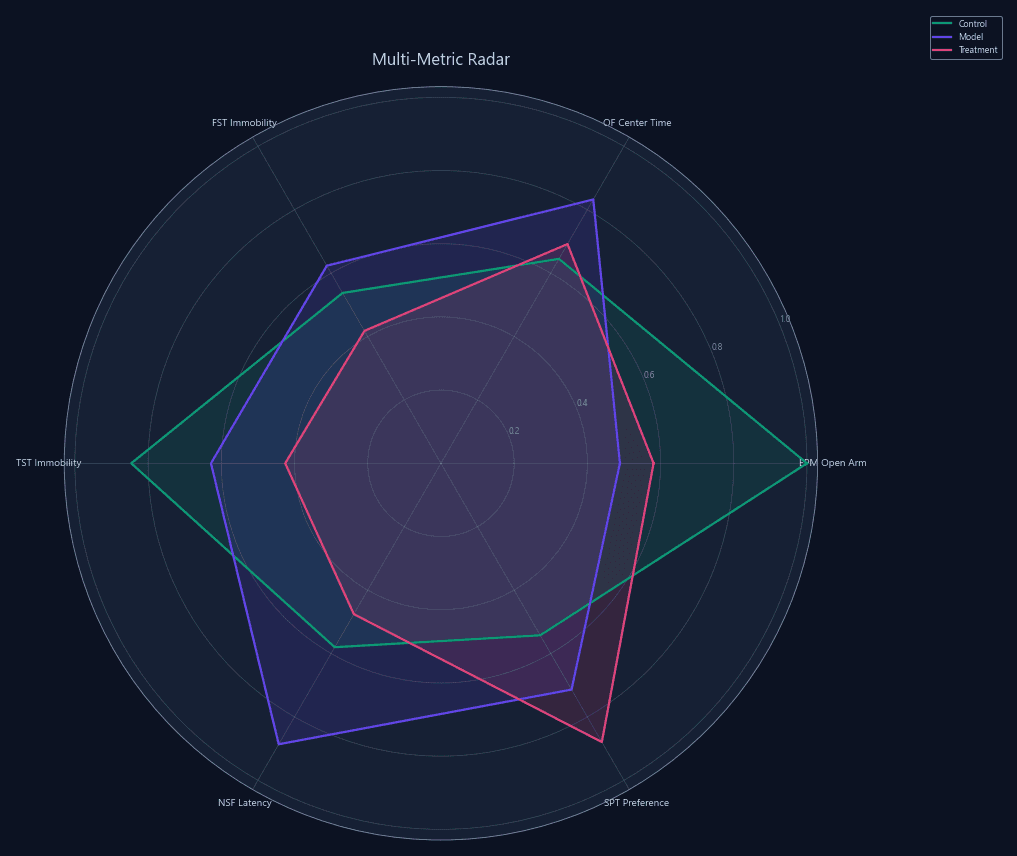
Composite behavioral indices with Z-score normalization across anxiety and depression test batteries.
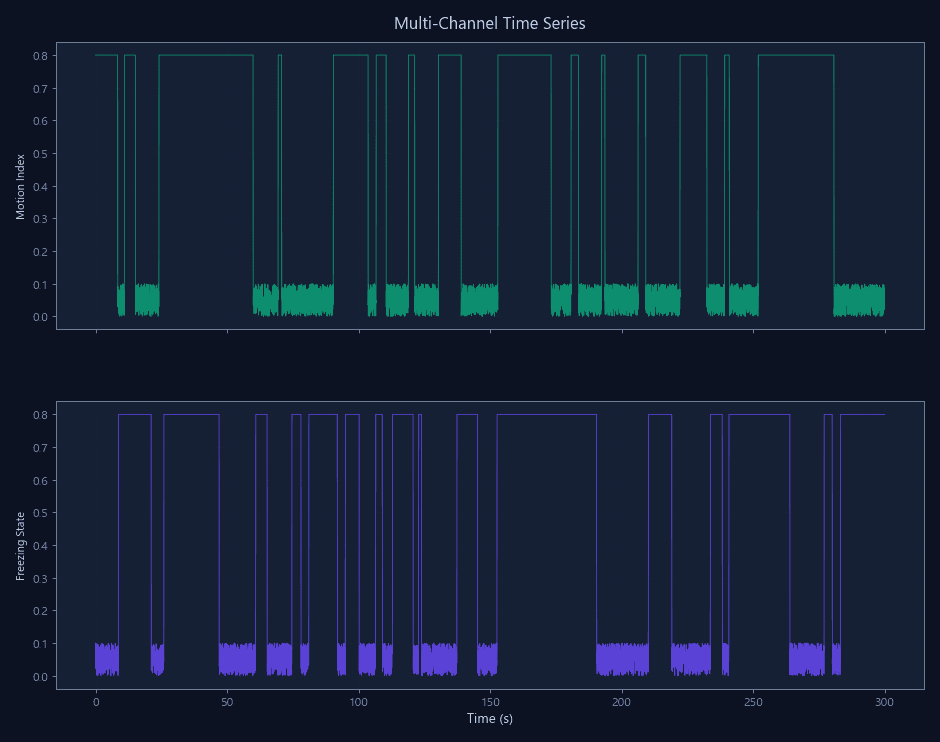
Dual-mode automated freezing scoring with TTL/serial apparatus integration for fear conditioning paradigms.
Upload light/dark box recordings and compare automated metrics to your manual scores.
