4 Layer Laboratory Zebrafish Rack - Double Side
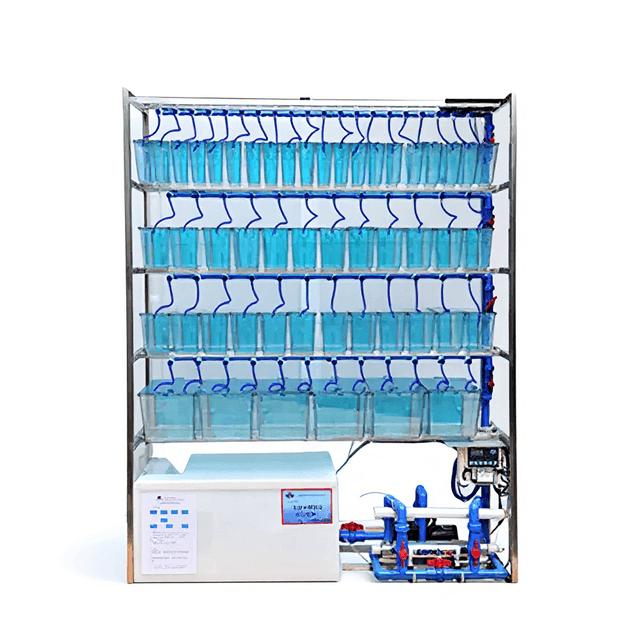
High-density 4-layer zebrafish housing system with 100 polycarbonate cages in dual-access configuration, featuring integrated filtration and UV disinfection.
| Model | LAQ-4-Double |
| Configuration | Double Side |
| Rack Dimensions | 1540 x 700 x 1880 mm |
| Frame Material | 304 Stainless Steel |
| Tank Material | Polycarbonate (PC) |
| Tier Count | 4 Layers |
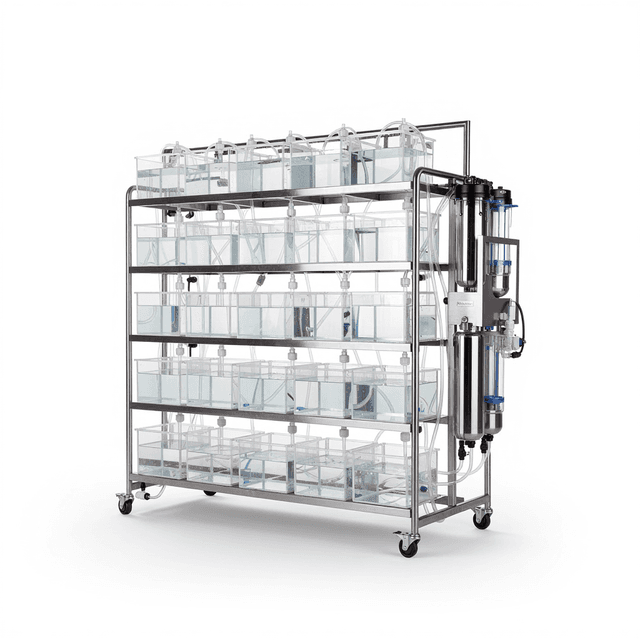
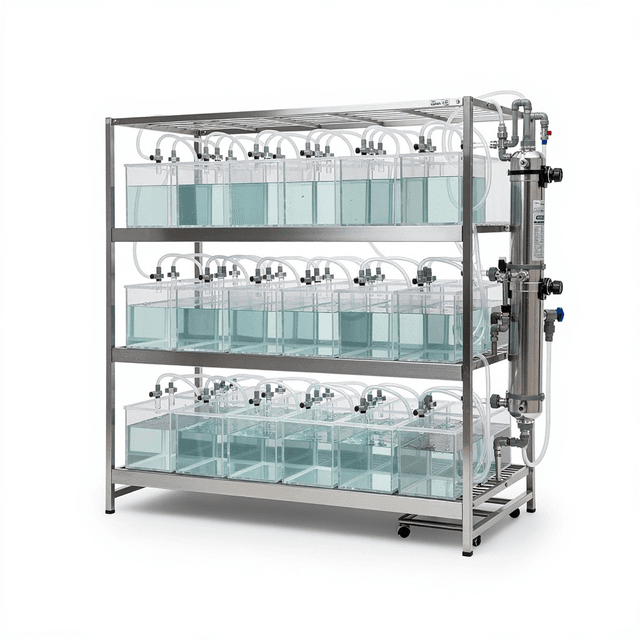
The LAQ-4 Double Side Laboratory Zebrafish Rack provides high-density aquaculture housing in a space-efficient configuration. This dual-access system features 100 polycarbonate cages distributed across 4 layers on both sides of a shared 304 stainless steel frame, served by a single integrated life support system. The configuration includes graduated cage sizes from 1.5L to 10L to accommodate different developmental stages and colony management needs.
The integrated life support system includes a PP material filter box, 24W UV disinfection apparatus, and V-30 aeration system to maintain water quality parameters critical for zebrafish health and experimental reproducibility. The dual-sided design maximizes housing capacity within limited laboratory floor space while providing independent access to each side for routine husbandry and experimental procedures.
How It Works
The LAQ-4 Double Side operates as a recirculating aquaculture system where water flows through each cage before returning to the central filtration unit. The integrated pump circulates water from the PP filter box through distribution lines to each of the 100 cages, providing continuous water exchange. The filtration system removes particulates and metabolic waste products while the 24W UV sterilization unit eliminates pathogenic microorganisms.
The V-30 aeration system maintains dissolved oxygen levels throughout the system by injecting air into the water circulation loop. Water quality is maintained through this combination of mechanical filtration, biological processing in the filter media, and UV disinfection. The graduated cage sizing allows researchers to house different life stages appropriately, from early larvae in 1.5L cages to breeding adults in 10L cages.
The dual-sided configuration utilizes a single life support system to serve cages on both sides of the rack, with independent access points allowing researchers to manage colonies on each side separately while maintaining system-wide water quality control.
Features & Benefits
Model
- LAQ-4-Double
Configuration
- Double Side
Rack Dimensions
- 1540 x 700 x 1880 mm
Frame Material
- 304 Stainless Steel
Tank Material
- Polycarbonate (PC)
Tier Count
- 4 Layers
Total Cages
- 100
UV Sterilization
- 24W
Aeration
- V-30
Automation Level
- semi-automated
Research Domain
- Cancer Research
- Cardiovascular
- Developmental Biology
- Environmental Monitoring
- Neuroscience
- Pharmaceutical QC
Species
- Zebrafish
Weight
- 550.0 kg
Dimensions
- L: 65.0 mm
- W: 32.0 mm
- H: 78.0 mm
Comparison Guide
| Feature | This Product | Typical Alternative | Advantage |
|---|---|---|---|
| Total Cage Capacity | 100 polycarbonate cages across dual sides | Single-sided systems typically offer 50-60 cages | Higher capacity enables larger experimental groups or multiple concurrent studies within the same floor space. |
| Cage Size Variety | Four different sizes: 1.5L, 3L, 3L, and 10L across layers | Many systems use uniform cage sizing | Accommodates different life stages and experimental requirements without requiring separate housing systems. |
| Frame Construction | 304 stainless steel frame with dual-access design | Standard systems often use single-sided access | Dual access allows independent colony management while maximizing space efficiency in laboratory settings. |
| Integrated Life Support | Single system with UV sterilization, filtration, and aeration serving all cages | Some systems require separate filtration units per section | Reduces maintenance complexity and operational costs while ensuring consistent water quality across all cages. |
| Layer Configuration | 4 layers with optimized cage distribution per layer | Systems vary from 3-6 layers with different configurations | Four-layer design balances accessibility for routine husbandry with efficient vertical space utilization. |
The LAQ-4 Double Side offers high-density zebrafish housing with 100 cages served by a single integrated life support system. The dual-access configuration and graduated cage sizing provide operational efficiency for large-scale zebrafish facilities requiring diverse housing options.
Practical Tips
Monitor water quality parameters daily during initial system conditioning and adjust UV exposure time based on bioload.
Why: Proper calibration ensures optimal pathogen control without over-sterilization that could affect beneficial bacteria.
Clean and inspect UV sterilizer sleeve weekly and replace UV bulb according to manufacturer schedule.
Why: UV effectiveness decreases with biofilm buildup and bulb aging, compromising pathogen control.
Use the smallest appropriate cage size for each life stage to optimize water quality and behavioral observations.
Why: Proper cage sizing improves water circulation efficiency and reduces stress on fish while facilitating experimental observations.
Rotate filter media cleaning schedule to maintain continuous biological filtration capacity.
Why: Simultaneous cleaning of all filter media can disrupt established bacterial colonies essential for waste processing.
Record cage positions and fish movements to maintain experimental group integrity across the dual-sided system.
Why: Systematic record keeping prevents cross-contamination of experimental groups and ensures data traceability.
Ensure UV sterilizer safety switches are functional and never bypass UV unit safety interlocks.
Why: UV exposure can cause eye and skin damage; proper safety systems protect personnel during maintenance procedures.
Check aeration distribution to all cages if fish show signs of stress, as uneven airflow can create dead zones.
Why: The V-30 aeration system must provide adequate dissolved oxygen throughout the entire 100-cage network.
Implement quarantine protocols for new fish before introducing them to the main system population.
Why: Shared life support systems can rapidly distribute pathogens throughout all 100 cages if introduced through infected stock.
Setup Guide
What’s in the Box
- 304 stainless steel rack frame components
- 100 polycarbonate cages (40 x 1.5L, 48 x 3L, 12 x 10L)
- PP material filter box (700 x 450 x 380 mm)
- 24W UV disinfection apparatus
- V-30 aeration system
- Water circulation pump
- Distribution plumbing and fittings
- Assembly instructions and system manual (typical)
Warranty
ConductScience provides a standard 1-year manufacturer warranty covering frame construction and life support components. Technical support includes system setup guidance and maintenance protocols.
Compliance
What water exchange rate does the system provide per cage?
Consult product datasheet for specific flow rates. The single integrated circulation system serves all 100 cages with continuous recirculation through the central filtration unit.
Can the dual sides operate independently with different water parameters?
No, both sides share a single life support system, so water quality parameters will be consistent across all 100 cages.
What is the recommended stocking density per cage size?
Stocking density depends on fish age and experimental requirements. Generally, 1.5L cages suit larvae and juveniles, 3L cages accommodate small adults, and 10L cages house breeding pairs or larger groups.
How is the UV sterilizer integrated into the water circulation?
The 24W UV unit treats water in the main circulation loop before distribution to cages, providing system-wide pathogen control.
What filtration media is used in the PP filter box?
Consult product datasheet for specific filter media specifications. The 700 x 450 x 380 mm filter box accommodates biological and mechanical filtration media.
Can individual cages be isolated from the system for quarantine?
The system is designed as an integrated recirculating unit. Individual cage isolation would require manual disconnection from the water circulation system.
What are the electrical requirements for the complete system?
Consult product datasheet for power specifications. The system includes UV sterilizer, aeration system, and circulation pump electrical requirements.
Have a question about this product?