5 Layer Laboratory Zebrafish Rack - Single Side
Professional 5-tier zebrafish housing system with 62 polycarbonate cages, integrated filtration, UV sterilization, and aeration for comprehensive Danio rerio colony management.
| Model | LAQ-5-Single |
| Configuration | Single Side |
| Rack Dimensions | 1540 x 450 x 1980 mm |
| Frame Material | 304 Stainless Steel |
| Tank Material | Polycarbonate (PC) |
| Tier Count | 5 Layers |
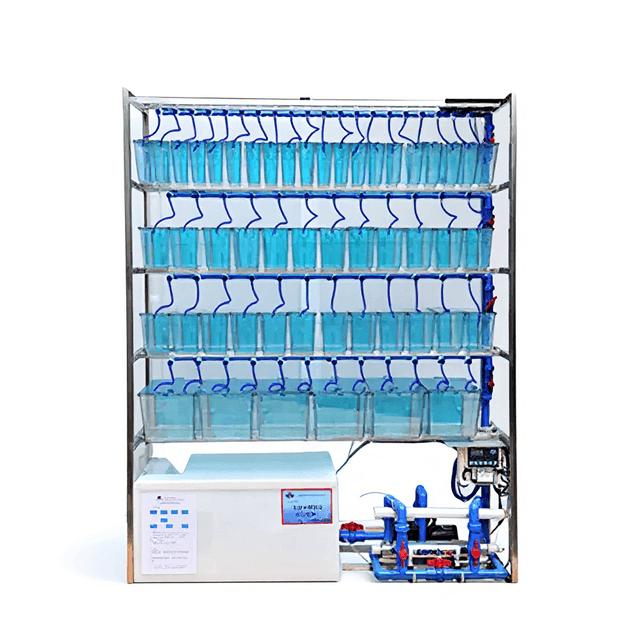
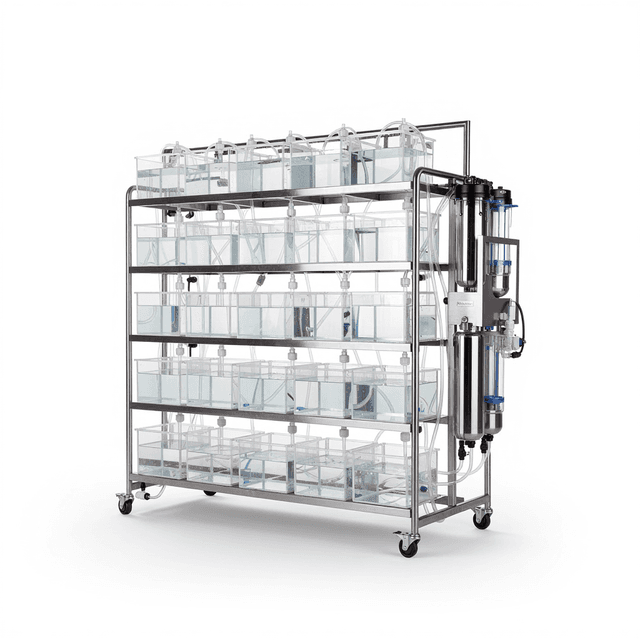
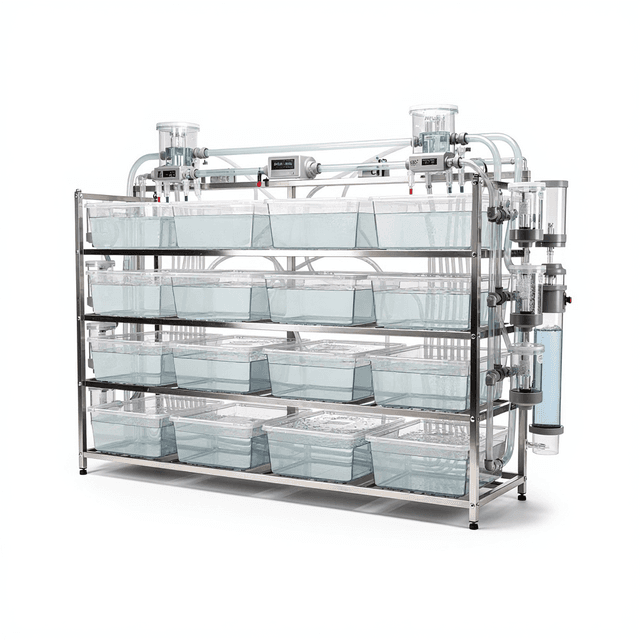
The 5 Layer Laboratory Zebrafish Rack - Single Side (LAQ-5S) is a professional aquaculture housing system designed for research laboratories maintaining Danio rerio colonies. Constructed with a 304 stainless steel frame measuring 1540 x 450 x 1980 mm, this single-sided configuration accommodates 62 polycarbonate cages across five tiers, providing diverse housing volumes from 1.5L to 10L to support zebrafish throughout all life stages from larvae to breeding adults.
The integrated recirculating system includes mechanical and biological filtration through a PP filter box (700 x 450 x 380 mm), 24W UV sterilization for pathogen control, and V-30 aeration for dissolved oxygen management. The polycarbonate cages are autoclavable and optically clear, enabling direct observation of fish behavior and development while maintaining sterile culture conditions. This configuration supports up to 20 small-volume cages for larvae/juveniles, 36 adult housing cages, and 6 large breeding tanks.
The system is particularly suited for genetics research, developmental biology studies, drug screening protocols, and behavioral assays where consistent water quality parameters and organized colony management are critical for experimental reproducibility.
How It Works
The LAQ-5S operates as a closed-loop recirculating aquaculture system where water continuously circulates through mechanical and biological filtration stages before returning to the fish cages. The integrated pump system draws water from the bottom collection manifold through the PP filter box, which contains both mechanical filtration media for particulate removal and biological filtration media supporting beneficial bacterial colonies that convert toxic ammonia and nitrite to less harmful nitrate.
Following biological filtration, water passes through the 24W UV sterilization chamber where ultraviolet irradiation at germicidal wavelengths (typically 254 nm) disrupts pathogen DNA and RNA, reducing bacterial, viral, and fungal contamination. The V-30 aeration system then introduces atmospheric oxygen into the treated water while facilitating CO2 removal through surface agitation before water returns to the cage distribution system.
The five-tier configuration provides environmental stratification where different life stages can be housed under optimized conditions. The 1.5L cages on the top tier provide appropriate volumes for larvae and juveniles, while the 10L cages on the bottom tier accommodate breeding pairs and provide sufficient space for courtship behaviors and egg deposition.
Features & Benefits
Model
- LAQ-5-Single
Configuration
- Single Side
Rack Dimensions
- 1540 x 450 x 1980 mm
Frame Material
- 304 Stainless Steel
Tank Material
- Polycarbonate (PC)
Tier Count
- 5 Layers
Total Cages
- 62
UV Sterilization
- 24W
Aeration
- V-30
Automation Level
- semi-automated
Research Domain
- Cancer Research
- Cell Biology
- Developmental Biology
- Neuroscience
- Pharmaceutical QC
- Toxicology
Species
- Zebrafish
Weight
- 400.0 kg
Dimensions
- L: 65.0 mm
- W: 22.0 mm
- H: 82.0 mm
Comparison Guide
| Feature | This Product | Typical Alternative | Advantage |
|---|---|---|---|
| Total Cage Capacity | 62 cages across multiple volumes | Smaller systems often provide 12-36 cages | Supports larger experimental groups and comprehensive breeding programs within a single system footprint. |
| Cage Volume Range | 1.5L to 10L across five tiers | Many systems use uniform cage sizes | Accommodates all zebrafish life stages from larvae to breeding adults without requiring separate housing systems. |
| Filtration Integration | PP filter box with mechanical and biological filtration plus 24W UV sterilization | Basic systems may lack UV sterilization or advanced biological filtration | Provides comprehensive water treatment to maintain pathogen-free environments and stable water chemistry. |
| Frame Construction | 304 stainless steel frame | Some systems use plastic or painted metal frames | Offers superior corrosion resistance and structural durability in humid aquatic laboratory environments. |
| Aeration System | V-30 integrated aeration | Entry-level systems may have basic air stones or limited aeration | Ensures consistent dissolved oxygen levels across all cage tiers for optimal fish health and experimental consistency. |
The LAQ-5S distinguishes itself through high-capacity housing with 62 cages, comprehensive water treatment including UV sterilization, and graduated cage volumes supporting complete zebrafish life cycles. The 304 stainless steel construction and integrated V-30 aeration system provide laboratory-grade durability and performance for demanding research applications.
Practical Tips
Establish biological filtration for 2-4 weeks before introducing zebrafish populations, monitoring ammonia and nitrite levels until they consistently process to nitrate.
Why: Mature biological filtration is essential for nitrogen cycle processing and fish health in recirculating systems.
Clean mechanical filter media weekly but avoid complete replacement of biological filtration media to preserve beneficial bacterial colonies.
Why: Maintaining established biological filtration prevents system crashes and maintains stable water chemistry.
Test UV lamp output every 3 months using UV meter and replace lamps every 6-12 months regardless of apparent function.
Why: UV effectiveness decreases over time even when lamps appear operational, compromising pathogen control.
Install ground fault circuit interrupters (GFCI) on all electrical connections and maintain backup aeration for critical fish lines.
Why: Aquatic systems present electrical hazards and equipment failures can rapidly compromise fish welfare.
Maintain detailed records of water quality parameters, feeding schedules, and fish behavior observations for each cage tier.
Why: Systematic record keeping enables detection of system changes and supports experimental reproducibility.
If fish show stress behaviors, immediately check dissolved oxygen levels and verify aeration system function before investigating other parameters.
Why: Oxygen depletion is often the first and most critical parameter to fail in recirculating systems.
Autoclave polycarbonate cages between experiments and quarantine new fish acquisitions in separate systems before introduction.
Why: Preventing pathogen introduction is more effective than treating established infections in recirculating systems.
Inspect and clean the V-30 aeration system monthly, checking for clogs in air distribution lines and cleaning air stones.
Why: Reduced aeration efficiency can cause localized oxygen depletion and compromise fish health across multiple cages.
Setup Guide
What’s in the Box
- 304 stainless steel rack frame components
- 62 polycarbonate cages (20x 1.5L, 36x 3L, 6x 10L)
- PP filter box (700 x 450 x 380 mm)
- 24W UV sterilization apparatus
- V-30 aeration machine
- Integrated pump system
- Water distribution manifolds
- Assembly hardware and fasteners
- Installation manual (typical)
- System operation guide (typical)
Warranty
ConductScience provides a standard one-year manufacturer warranty covering defects in materials and workmanship, with technical support available for system setup, operation, and maintenance procedures.
Compliance
What water quality parameters can this system maintain, and how frequently should they be monitored?
The integrated filtration and UV sterilization system maintains stable pH, dissolved oxygen above 5 mg/L, and low ammonia/nitrite levels. Monitor temperature, pH, dissolved oxygen, ammonia, nitrite, and nitrate weekly during normal operation, with daily monitoring during system establishment or after fish additions.
How many adult zebrafish can be housed per 3L cage for optimal welfare?
Standard housing density is 2-3 adult zebrafish per 3L cage, allowing adequate swimming space and territorial establishment. Higher densities may be acceptable for short-term studies but require more frequent water quality monitoring and potential feeding adjustments.
Can the UV sterilizer operate continuously, and when should the lamp be replaced?
The 24W UV lamp can operate continuously and should be replaced every 6-12 months depending on usage intensity. UV effectiveness decreases over time even if the lamp appears functional, so scheduled replacement maintains optimal pathogen control.
What filtration media should be used in the PP filter box for optimal biological filtration?
Use mechanical pre-filtration (foam or floss) followed by biological media such as ceramic rings, bio-balls, or sintered glass. Maintain biological media without complete replacement to preserve beneficial bacterial colonies essential for nitrogen cycle processing.
How long does biological filter maturation take before introducing zebrafish?
Allow 2-4 weeks for complete biological filter establishment, cycling the system with ammonia source or bacterial inoculation. Monitor ammonia and nitrite levels until they consistently process to nitrate, indicating mature biological filtration capable of supporting fish populations.
Are the polycarbonate cages compatible with automated feeding systems?
The polycarbonate cages can accommodate most automated feeding systems, though specific compatibility depends on feeder design and cage access requirements. Consult product datasheet for specific mounting options and feeding port configurations.
What backup systems should be considered for critical zebrafish colonies?
Install backup aeration systems, temperature monitoring with alarms, and consider redundant pump systems for irreplaceable genetic lines. Emergency protocols should include battery backup for aeration and procedures for temporary housing during system maintenance.
Can individual cages be isolated from the main circulation system if needed?
Cage isolation capabilities depend on specific plumbing configuration - consult installation specifications. Some configurations allow individual cage valving for quarantine or specialized treatment protocols while maintaining system operation for other cages.
Have a question about this product?