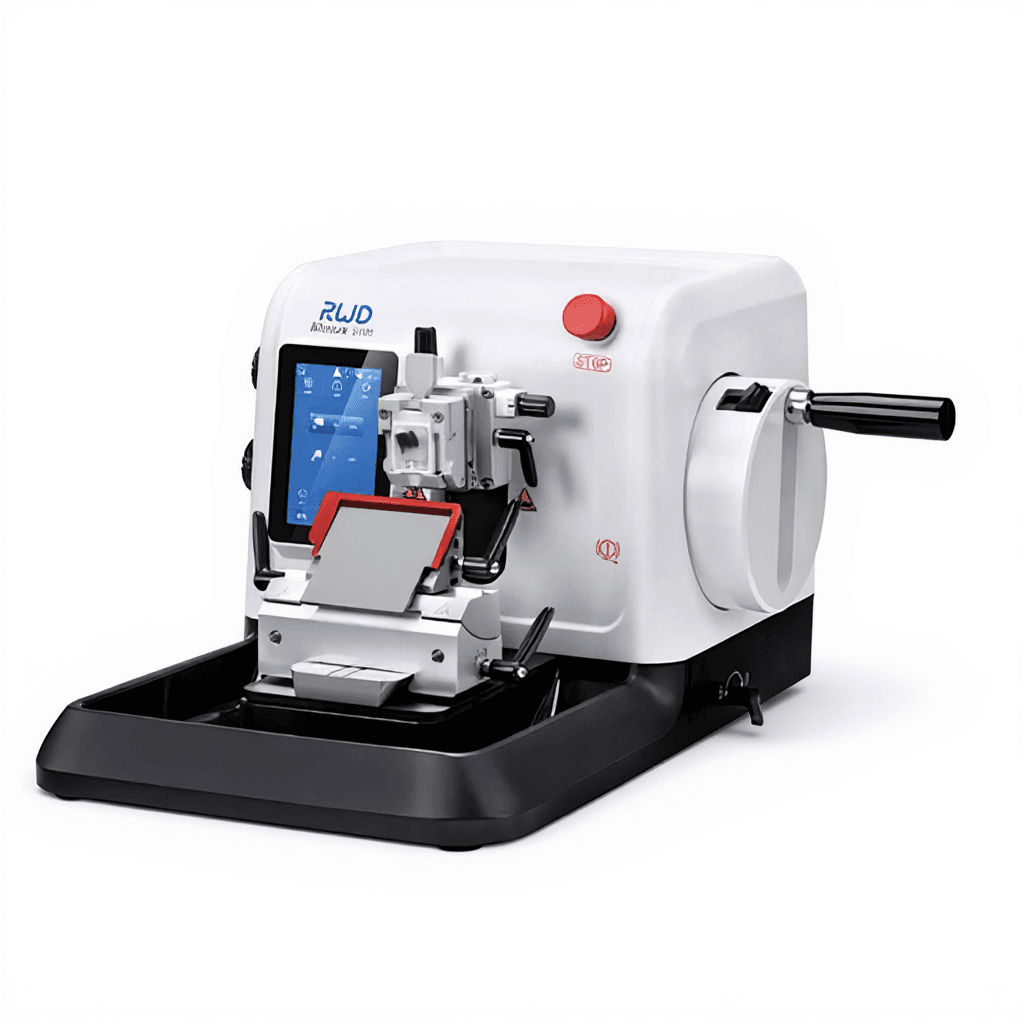
AccuSection Rotary Microtome
Our AccuSection Rotary microtome is an automatic, semi-automatic, and manual Microtome that meets the different needs of microtomists that cuts the sections of biological specimens into thin slices for use in microscopy. It is used to prepare thin...
| pa_equipment-type | 4950 |
| pa_automation-level | semi-automated |
| pa_pathology-application | 4968 |
| pa_section-thickness | 4973 |
| pa_tissue-compatibility | 4976 |
| section_thickness_range | 1 micron to 60 microns |
Specifications
| S700 Semi-Auto microtome | S700A Fully-auto microtome | |
|---|---|---|
| Section thickness range: 0.5 - 100 μm | √ | √ |
| Trimming section thickness range: 1 - 800 μm | √ | √ |
| Electric coarse feed: 0 - 1800μm/s adjustable | √ | √ |
| Specimen retraction: 0 - 250μm adjustable | √ | √ |
| Horizontal feed: 28mm | √ | √ |
| Vertical stroke: 70mm | √ | √ |
| Specimen orientation: X/Y axis 8° | √ | √ |
| Maximum specimen size: 60*50*40mm | √ | √ |
| W x Dx H: 470*553*305mm | √ | √ |
| Machine Weight | 28 KG | 36.4 KG |
| Rock mode | √ | √ |
| Position memory function | √ | √ |
| Fully auto and manual section mode switch | √ | |
| Emergency stop button | √ | |
| Cut window | √ | |
| Auto section speed adjustable | √ | |
| 4 auto section modes: Cont., Int., Single, Multi. | √ | |
| Pedals (optional ) | √ |
Standard configuration
| S700 Semi-Auto Microtome | S700A Fully-Auto Microtome | |
|---|---|---|
| Host of Microtome | √ | √ |
| Blade holder assembly | √ | √ |
| Universal clamp | √ | √ |
| Tool set | √ | √ |
| Easy of cleaning section waste tray (Large) | √ | √ |
| User manual | √ | √ |
| Power cable | √ | √ |
| Dust cover | √ | √ |
| Dummy plug | √ |
Features
Precision
- Precise injection
-
- Top-level cross guide rails and precision screw rods, together with a five-phase high-resolution sampling motor and a horizontal sampling slider made of aviation aluminum, form a high-precision sampling system to ensure the quality of slices.
- Precision motor and encoder ensure stable and smooth automatic slicing.
- Precision tool holder
-
- Precise tool holder lateral movement. The position of the same sample changes very little after changing the knife edge by moving laterally, and the sample can be cut within 5 knives.
- The knife holder base has scales for easy positioning of the knife holder.
Safety
- Handwheel double locking system
-
- At the same time, it is equipped with a double locking system of handwheel lock and any position lock and has its own beep sound, which significantly reduces the risk of hand injury during the sample block replacement operation, allowing you to change samples with peace of mind.
Knife guards and retractors
- Knife guards and retractors
-
- The knife guard covers the full length of the blade, avoiding the potential risk of injury during operation.
- When changing the blade, the ejector easily pushes out the blade for safe removal.
- Electronic brake and emergency stop button
-
- The electronic brake with stable performance keeps the handwheel in a stable state (after the automatic slicing is completed) to protect the safety of the operator.
- To quickly eliminate the danger, press the red emergency stop button to immediately stop the automatic sectioning.
Efficiency
- Rapid positioning
-
- With the patented visual pointer mark, the angle adjustment data is intuitive and visible, when adjusting the tissue angle of different inclined planes, the direction of the sample head is accurately controlled to avoid waste of tissue samples.
- Quickly adjust multiple devices to the same angle to keep the same sample at the same angle when slicing different devices, reducing sample waste caused by rough trimming.
- Easy to operate
-
- The side injection knob is integrated with the fuselage, and the ergonomic design is more comfortable to operate.
- The injection speed can be freely adjusted between 0-1800um/s, and the operation is more efficient.
- It adopts military-grade components, which are strong and durable, with an active life of more than 20 million times.
- Easy to clean
-
- Large-capacity waste tray with magnetic suction function for easy disassembly and installation.
- Anti-static, non-waxing, easy to clean, and the cleaning time is greatly shortened.
Intelligence
- Smart slice
-
- No need to spend time practicing slicing techniques, the machine automatically cuts out high-quality slices.
Automatic sectioning is stable and can maintain sectioning consistency. Whole-cut specimens such as embryos, brains, etc., the amount of sectioning are large and the task is heavy. Using automatic sectioning can relieve your sectioning pressure. - Four automatic slicing modes to meet the needs of different slicing scenarios. The window cutting function ensures the quality of slices and improves the efficiency of automatic slices.
- No need to spend time practicing slicing techniques, the machine automatically cuts out high-quality slices.
- Information tracking
-
- The 5-inch touch screen has a history recording system, which is convenient for information retrospective tracking and quick problem-solving.

Introduction
A Rotary microtome cuts the sections of biological specimens into thin slices for use in microscopy. It gets its name because of the rotary action of the handwheel used for slicing samples. It is used to prepare thin layers of bone, mineral, teeth, and hair with section thicknesses ranging from 1-micron to 60 microns. For hard materials that use synthetic resins, they can slice up to 0.5 microns.
Parts of Rotary Microtome
- Knife Holder Base
The knife holder base holds the holder in place on the microtome stage. It can be moved to or away from the block, but it must remain fixed and secured during microtomy.
- Knife Holder
The knife holder comprises various parts, including the blade clamp, which holds the blade, the knife tilt, which adjusts the knife angle, and the faceplate, which directs the ribbons away from the blade and toward the operator.
- Microtome Body
The microtome body is a platform with rails that keeps the knife holder base in place.
- Cassette clamp or block holder
The block holder or cassette clamp holds the paraffin block in place. The block usually slides up and down with each revolution while the blade remains stationary. The block holder may be equipped with knobs that enable the operator to move the block face in different directions to line the tissue with the blade.
- Advancement Handwheel
The advancement handwheel rotates in one direction, moving the block closer to the knife at the preset microns.
- Coarse Handwheel
The coarse handwheel moves the block closer or away from the knife.
- Micron Adjustment
Micron adjustment is used to adjust settings for slice thickness that vary from 1 to 60 microns.
- Safety Lock
The handwheel includes a safety lock that prevents the wheel from loosening and the block holder from falling towards the blade when inserting or removing a block.
Types Of Rotary Microtome
- A Manual Rotary Microtome entirely depends on the operator, is hard to use, and is time-consuming.
- A Semi-Automatic Rotary Microtome comes with one motor, either coarse or fine wheels.
- A Fully Automatic Rotary Microtome has two coarse and advanced handwheel motors.
Principle
The Rotary microtome uses a staged rotary action where the specimen is cut with the circular motion of the handwheel. The cutting procedure is done with a knife or disposable blade placed within the instrument.
Protocol
- Embed the sample in a paraffin cartridge.
- Mount it on the paraffin block/sample holder.
- Set the distance between your knife blade and paraffin block using the coarse handwheel.
- Carefully install the blade and fix it in the knife holder.
- Set the required microns size by using the micron adjustment knob.
- Unlock the handle-equipped wheel by pushing the pin button-down located on its top.
- Revolve the handle-equipped wheel to operate the rotary microtome.
- Continue to cut until you get your desired sample.
Applications
The rotary microtome is used in various microbiological labs, including histopathology/anatomical pathology labs.
It can be used for histological examination of various organs. Frimiano et al. (2022) used a rotary microtome to cut 5mm sections of the liver of the collared lizard Tropidurus torquatus to conduct a histological examination. Another study conducted by Muhd-Farouk, Amin-Safwan, Mahsol, and Ikhwanuddin (2017) used a rotary microtome to investigate the histological characteristics and sexual maturity sizes of the testes of mud spiny lobsters. The testes were dissected and fixed in a 10% buffered formalin solution for 11 hours, then dehydrated in 70% alcohol before being processed in a tissue processor for 18±1 hours at 60°C. On a rotary microtome, the tissues blocks were sliced at a thickness of 4 microns.
A study conducted by Tosney and Landmesser (1986) used the rotary microtome to easily visualize individual growth cones of axonal guidance in developing vertebrates. They used the rotary microtome to cut neuron slices quickly and as small as 25 microns to be visualized in an electron microscope, without laborious reconstruction. This was impossible before and hindered research in this area for a long time.
The rotatory microtome is also used in biobanking. In biobanking, formalin-fixed, paraffin-embedded tissue (FFPE) is essential. It is relatively easy to acquire and store compared to fresh frozen tissue. While preparing formalin-fixed, paraffin-embedded tissue for biobanking, the correct microtomy technique is critical to get accurate results and conduct the correct microtomy. Sy and Ang (2018) used the rotary microtome to cut the formalin-fixed, paraffin-embedded sections.
Strengths and Limitations
The Rotary microtome is used to cut biological specimens according to the desired thickness ranging from 1 to 60 microns. It may be adapted to various types of tissue sectioning (hard, brittle, or fatty). However, it is not suitable for large tissue sectioning. Technological advancements in the rotary microtome have enhanced section quality, boosted production, and improved the technologist's occupational safety.
The incidence of repetitive motion disorders, a frequent occupational health concern in the histology laboratory, may be reduced by eliminating the manual hand-wheel operation of the microtome. Disposable blades are used, eliminating the need for sharpening and increasing sample size accuracy. Additionally, knives can be used in place of blades; they are thick and large and produce fewer vibrations during microtomy. A high-resolution motor makes a stable and smooth automatic slicing system. Its heavier size makes it stable, and it is crucial to avoid undulations in the paraffin sections. A double locking system makes it secure and prevents injuries during block handling. An emergency button is used to stop the operation in danger. It is anti-static, non-waxing, and is very easy to clean. It has four different automatic slicing modes that cover a lot of sampling situations. Daily cleaning from paraffin residue maintains a microtome cutting ideally for many years.
The heavy size of the rotary microtome makes it less portable. The disposable blades are expensive and need to be handled with care to avoid accidents. Moreover, the knives get dull if they aren't used on decalcified tissue that hasn't been cleaned.
Summary
- The Rotary microtome uses a rotary motion to cut the sections of samples used in microscopy. It is used to prepare thin layers of bone, mineral, teeth, and hair with section thicknesses ranging from 1-micron to 60 microns.
- It uses a staged rotary action where the specimen is cut with the circular motion of the handwheel. The cutting procedure is done with a knife or disposable blade placed within the instrument.
- It has various parts: knife holder base, knife holder, microtome body, cassette clamp or block holder, advancement handwheel, coarse handwheel, micron adjustment knob, and safety lock.
- It has thick and large knives that produce fewer vibrations. A high-resolution motor is used that creates a high-precision, stable, and smooth automatic slicing system.
- The rotary microtome is used in various microbiological labs, including histopathology/anatomical pathology labs.
- The blades of the rotary microtome should be handled with care. Always use cut-resistant gloves to remove the blades. Before cleaning, remove the blades from the holder and lock the rotary machine.
References
- Tosney, K. W., & Landmesser, L. T. (1986). Neurites and growth cones in the chick embryo. Enhanced tissue preservation and visualization of HRP-labeled subpopulations in serial 25-microns plastic sections cut on a rotary microtome. Journal of Histochemistry & Cytochemistry, 34(7), 953–957. https://doi.org/10.1177/34.7.3519758
- Sharma, R. (2022). Microtomy. Retrieved February 5, 2022, from Slideshare.net website: https://www.slideshare.net/candysharma777/microtomy-67236029
- Frimiano, E M S, N, C. N., A, V. D., Sales, A., Mendes, & A, N. A. (2022). Histological study of the liver of the lizard Tropidurus torquatusWied 1820, (Squamata: Tropiduridae)(AU). Braz. J. Morphol. Sci, 165–170. Retrieved from https://pesquisa.bvsalud.org/portal/resource/pt/lil-644137
- Muhd-Farouk, H., Amin-Safwan, A., Mahsol, H., & Ikhwanuddin, M. (2017). Histological Characteristics on the Testes of Mud Spiny Lobster, Panulirus polyphagus (Herbst, 1793). Pakistan Journal of Biological Sciences: PJBS, 20(7), 365-371. https://doi.org/10.3923/pjbs.2017.365.371
- Sy, J., & Ang, L.-C. (2018). Microtomy: Cutting Formalin-Fixed, Paraffin-Embedded Sections. Methods in Molecular Biology, 269–278. https://doi.org/10.1007/978-1-4939-8935-5_23
How It Works
The rotary microtome operates through a precision mechanical cutting mechanism where the specimen holder advances vertically toward a fixed knife blade through controlled rotation of the handwheel system. The five-phase high-resolution sampling motor provides precise specimen advancement in increments as small as 0.5 micrometers, ensuring consistent section thickness across the cutting stroke. During each cutting cycle, the specimen moves through the 70mm vertical stroke while the blade holder maintains optimal knife angle and position.
The cutting process utilizes controlled specimen retraction (0-250 micrometers adjustable) to prevent tissue compression and blade damage during the return stroke. The horizontal feed mechanism (28mm range) allows for proper specimen positioning relative to the knife edge, while the X/Y axis specimen orientation capability (8° adjustment) accommodates irregularly shaped tissue blocks. The electronic coarse feed system (0-1800 micrometers/second) enables rapid specimen positioning for initial trimming operations.
Safety and precision are maintained through the handwheel double locking system, which prevents uncontrolled specimen advancement, and the electronic brake system that ensures immediate stopping when required. The fully automated model incorporates programmable cutting modes that maintain consistent sectioning speed and rhythm, reducing operator fatigue and improving section quality reproducibility.
Features & Benefits
pa_equipment-type
- 4950
pa_automation-level
- semi-automated
pa_pathology-application
- 4968
pa_section-thickness
- 4973
pa_tissue-compatibility
- 4976
section_thickness_range
- 1 micron to 60 microns
section_thickness_hard_materials
- up to 0.5 microns
injection_speed_range
- 0-1800um/s
display_size
- 5-inch
motor_type
- five-phase high-resolution sampling motor
component_life
- more than 20 million times
knife_positioning_accuracy
- sample can be cut within 5 knives
automatic_slicing_modes
- 4 modes
safety_features
- ['handwheel double locking system', 'knife guards and retractors', 'electronic brake', 'emergency stop button']
special_features
- ['patented visual pointer mark', 'magnetic waste tray', 'anti-static', 'history recording system']
Device Type
- Fully-motorized Microtomes
- Semi-motorized Microtome
Material
- aviation aluminum
Display Type
- Touch Screen
Brand
- RWD
Research Domain
- Cancer Research
- Cardiovascular
- Clinical Diagnostics
- Developmental Biology
- Histopathology
- Neuroscience
- Pathology
- Toxicology
Weight
- 123.46 lbs
Dimensions
- L: 62.0 in
- W: 57.0 in
- H: 79.0 in
Comparison Guide
| Feature | This Product | Typical Alternative | Advantage |
|---|---|---|---|
| Section Thickness Range | 0.5-100 μm sectioning with 1-800 μm trimming capability | Most entry-level models limited to 1-60 μm range | Extended range accommodates both ultra-thin sections for specialized protocols and thick trimming cuts for rapid specimen preparation. |
| Motor Technology | Five-phase high-resolution sampling motor with 20+ million cycle lifespan | Standard stepper motors with shorter operational life | Higher precision and reliability reduce maintenance requirements and ensure consistent performance over extended laboratory use. |
| User Interface | 5-inch touch screen with position memory and history recording | Basic mechanical controls with limited parameter storage | Intuitive operation reduces training time and enables consistent protocol execution across multiple operators. |
| Safety Systems | Handwheel double locking, electronic brake, knife guards, and emergency stop | Basic mechanical locks and manual safety features | Comprehensive safety integration minimizes operator risk and prevents accidental specimen or blade damage. |
| Specimen Capacity | 60×50×40mm maximum with ±8° X/Y orientation adjustment | Smaller capacity with limited orientation control | Accommodates larger tissue blocks and irregular specimens while maintaining optimal cutting angles for diverse research applications. |
| Automation Options | Choice of semi-automated or fully automated with four cutting modes | Single automation level per model | Laboratory can select appropriate automation level based on throughput requirements and budget considerations while maintaining upgrade path. |
The AccuSection Rotary Microtome provides comprehensive sectioning capability with advanced motor technology, extensive safety features, and flexible automation options that support both routine diagnostic workflows and specialized research applications requiring precision tissue sectioning.
Practical Tips
Verify section thickness accuracy weekly using precision calibration standards and adjust the sampling motor parameters if measurements deviate beyond ±0.5 micrometers.
Why: Thickness accuracy directly affects morphological assessment and quantitative measurements in research applications.
Clean and lubricate the handwheel mechanism monthly and inspect knife holder alignment to prevent excessive wear on the five-phase motor system.
Why: Proper maintenance extends the 20+ million cycle motor lifespan and maintains cutting precision over time.
Use the rock mode feature for difficult or brittle tissues that tend to fragment, and adjust specimen retraction based on tissue hardness to minimize compression artifacts.
Why: Optimized cutting parameters improve section quality and reduce tissue waste in valuable research specimens.
Always engage the handwheel double locking system before blade changes and use the emergency stop function on the S700A when unexpected cutting resistance occurs.
Why: Safety protocols prevent operator injury and protect expensive specimens from damage due to mechanical failures.
Document cutting parameters in the history recording system for each specimen type and review settings periodically to optimize protocols for consistent results.
Why: Systematic parameter documentation enables protocol standardization and troubleshooting of section quality issues.
If sections show thickness variations, check specimen block temperature, knife sharpness, and specimen retraction settings before adjusting motor parameters.
Why: Most sectioning problems result from mechanical factors rather than motor calibration issues, making systematic troubleshooting more efficient.
Utilize position memory function to store optimal settings for different tissue types and embedding media to reduce setup time and improve reproducibility.
Why: Standardized positioning parameters eliminate operator variability and ensure consistent section quality across multiple cutting sessions.
Clean the anti-static magnetic waste tray daily and inspect the touch screen for responsiveness to prevent contamination affecting system operation.
Why: Regular cleaning maintains hygiene standards and prevents debris accumulation that can interfere with precision cutting mechanisms.
Setup Guide
What’s in the Box
- AccuSection Rotary Microtome host unit
- Blade holder assembly
- Universal specimen clamp
- Tool set for maintenance and adjustment
- User manual and operation guide
- Power cord and electrical connections
- Magnetic waste tray
- Safety guards and protective equipment (typical)
Warranty
ConductScience provides a standard one-year manufacturer warranty covering parts and labor with comprehensive technical support for installation, training, and troubleshooting assistance.
Compliance
References
Background reading relevant to this product:
What is the minimum achievable section thickness and how does it compare between tissue types?
The system achieves 0.5 micrometers minimum thickness for hard materials embedded in synthetic resins, while standard paraffin-embedded tissues typically section at 1-60 micrometers depending on tissue hardness and embedding quality.
How does the specimen retraction system prevent tissue compression artifacts?
The adjustable specimen retraction (0-250 micrometers) withdraws the tissue block slightly during the return stroke, preventing blade contact and tissue compression that can cause section thickness variations and morphological distortion.
What maintenance schedule is required for the five-phase sampling motor?
The motor system is designed for over 20 million cycles with routine lubrication and calibration checks recommended every 6 months or per institutional maintenance protocols to ensure precision accuracy.
Can the instrument handle both paraffin and plastic-embedded specimens?
Yes, the 0.5-800 micrometer thickness range accommodates both standard paraffin blocks and harder plastic-embedded specimens, with the rock mode providing enhanced cutting control for difficult materials.
How does the position memory function improve workflow efficiency?
The system stores optimal knife position, specimen orientation, and cutting parameters for different tissue types, reducing setup time and ensuring consistent results when switching between specimen protocols.
What safety features distinguish the S700A fully automated model?
The S700A includes emergency stop button, protective cut window, four automated sectioning modes, and optional pedal controls that enhance operator safety while maintaining precise cutting control.
How does the anti-static waste tray system benefit section handling?
The magnetic waste tray with anti-static properties prevents section adhesion and static buildup that can interfere with section mounting and transfer to slides, particularly important for thin sections.
What specimen size limitations should be considered for experimental design?
Maximum specimen dimensions are 60×50×40mm with ±8° orientation adjustment capability, requiring tissue blocks to be trimmed appropriately during embedding procedures for optimal sectioning results.
Have a question about this product?
Accessories
Enhance your setup with compatible accessories