Analytical Balance - External Calibration
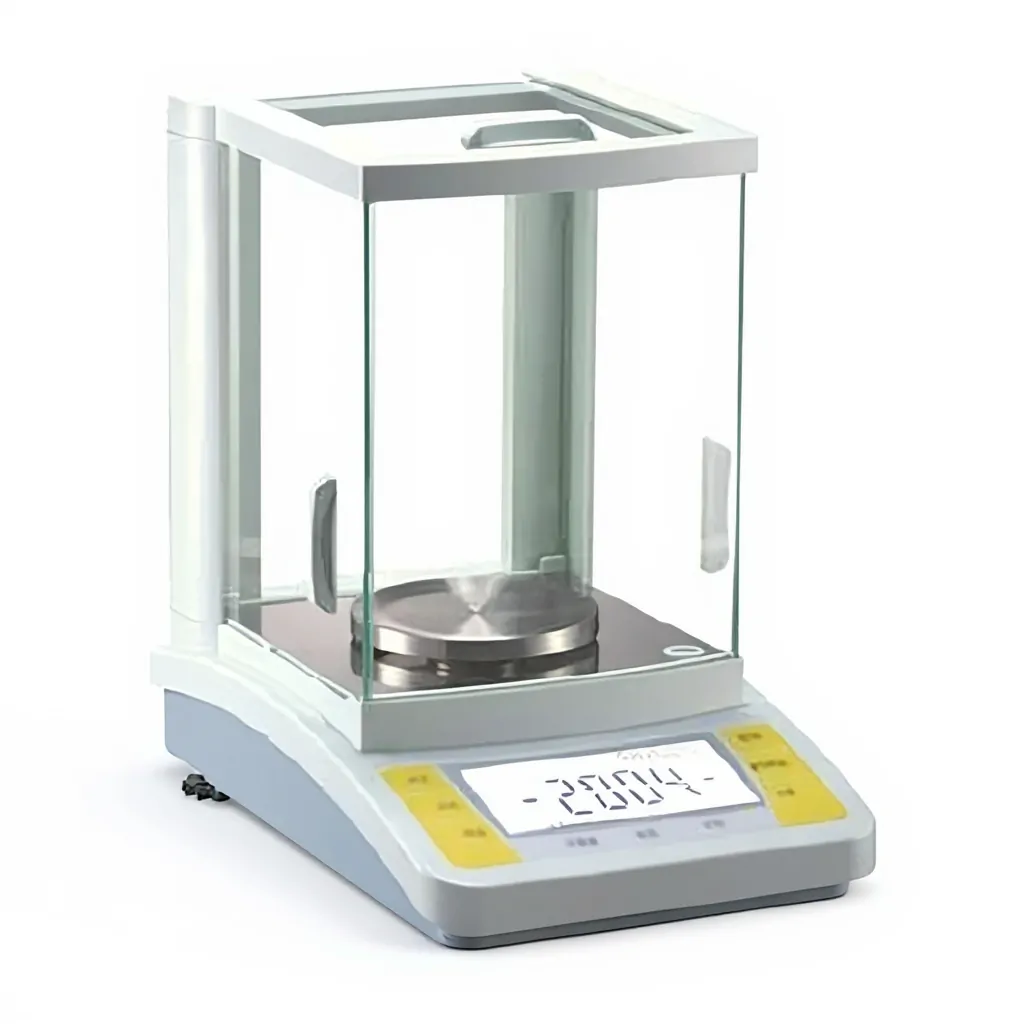
Electromagnetic analytical balance with 0.1 mg readability and magnetic force restoration technology for precision mass measurement in laboratory applications.
| readability | 0.1mg |
| repeatability | 0.2mg |
| calibration_type | Internal or External |
| pan_size | 9cm |
| measuring_accuracy | up to 1x10⁻⁴ grams |
| windshield | five-side full-transparent |
This electromagnetic analytical balance employs magnetic force restoration principles to deliver precision mass measurement with 0.1 mg readability and 0.2 mg repeatability across capacity options from 60g to 220g. The instrument measures the downward force on the weighing pan through an advanced electromagnetic balance weight sensor, where an internal electromagnet generates a counteracting force proportional to the sample weight, with the required current serving as the measurement parameter.
The balance features a five-side full-transparent windshield for environmental protection while maintaining sample visibility, paired with an ultra-large LCD display for clear readout. Internal or external calibration capabilities support laboratory quality assurance protocols, while built-in protection features include automatic fault detection, four-point linear calibration, and overload protection. The RS232C output interface enables direct data transfer to computers and printers for documentation and analysis workflows.
How It Works
The balance operates on electromagnetic force restoration principles, utilizing an electromagnetic balance weight sensor that measures the downward force exerted by samples on the weighing pan. When a sample is placed on the pan, it creates a downward force that displaces the weighing mechanism from its equilibrium position.
An internal electromagnet responds by generating a counteracting upward force that is precisely proportional to the sample weight. The electrical current required to maintain this equilibrium state serves as the measurement parameter, which is then converted to mass units and displayed. This electromagnetic approach eliminates mechanical spring systems and provides superior sensitivity compared to traditional mechanical balances.
The four-point linear calibration system ensures measurement accuracy across the full weighing range, while automatic fault detection monitors system performance and alerts users to potential measurement errors or environmental disturbances.
Features & Benefits
readability
- 0.1mg
repeatability
- 0.2mg
calibration_type
- Internal or External
pan_size
- 9cm
measuring_accuracy
- up to 1x10⁻⁴ grams
windshield
- five-side full-transparent
sensor_type
- electromagnetic balance weight sensor
interface
- RS232C output
weighing_hook
- built-in lower weighing hook
units
- grams, pounds, ounces, carats, metric caret, gold ounce
protection_features
- automatic fault detection, four-point linear calibration, over-load protection
additional_functions
- auto-counting, unit conversion, stability, full-scale faring, zero-memory
Capacity
- 60g
- 100g
- 110g
- 120g
- 160g
- 200g
- 210g
- 220g
Automation Level
- semi-automated
Material
- stainless-steel
Accuracy
- 0.1mg
Display Type
- LCD
Research Domain
- Analytical Chemistry
- Clinical Diagnostics
- Environmental Monitoring
- Food Science
- Materials Science
- Pharmaceutical QC
Weight
- 9.5 lbs
Dimensions
- L: 48.0 in
- W: 37.5 in
- H: 51.5 in
Comparison Guide
| Feature | This Product | Typical Alternative | Advantage |
|---|---|---|---|
| Readability Resolution | 0.1 mg readability with 0.2 mg repeatability | Entry-level models often provide 1 mg readability with lower precision | Enables quantitative analysis requiring sub-milligram precision for pharmaceutical and analytical chemistry applications |
| Calibration Options | Internal and external calibration capabilities | Basic models typically offer external calibration only | Provides flexibility for different quality assurance protocols and reduces dependency on external reference weights |
| Capacity Range | Eight capacity options from 60g to 220g | Most models offer 2-3 fixed capacity options | Allows precise capacity matching to sample requirements for optimal measurement range utilization |
| Environmental Protection | Five-side full-transparent windshield | Standard models use 3-4 side enclosures with limited visibility | Provides comprehensive draft protection while maintaining complete sample observation during critical weighing procedures |
| Measurement Technology | Electromagnetic force restoration sensor | Lower-cost models use mechanical spring systems | Eliminates mechanical wear and drift for consistent long-term measurement accuracy |
| Data Connectivity | RS232C output interface with multiple unit conversions | Basic models often lack data output capabilities | Enables integration with laboratory information systems and automated data logging for regulatory compliance |
This electromagnetic analytical balance combines high precision measurement with practical laboratory features including multiple calibration options, comprehensive environmental protection, and data connectivity. The force restoration technology provides measurement stability superior to mechanical systems while maintaining the precision required for analytical applications.
Practical Tips
Perform calibration verification daily using certified reference weights within the middle range of your selected capacity model.
Why: Mid-range verification provides the best assessment of overall measurement linearity and system performance.
Clean the weighing pan and chamber weekly with isopropyl alcohol and antistatic brushes to remove sample residues and static buildup.
Why: Contamination and static charges can introduce measurement errors and affect repeatability performance.
Allow samples and containers to equilibrate to room temperature before weighing to minimize convection effects.
Why: Temperature differences create air currents that can cause measurement instability and reduce accuracy.
Use the auto-counting function for repetitive weighing of similar items by establishing piece weight from a known quantity sample.
Why: Reduces manual counting errors and speeds up inventory and quality control procedures.
Monitor repeatability by performing multiple measurements of the same reference standard throughout the day.
Why: Trending repeatability data helps identify environmental changes or system drift requiring attention.
If readings drift or appear unstable, check for air currents around the balance and ensure the windshield is properly closed.
Why: Even minor air movement can cause significant measurement variation at 0.1 mg resolution levels.
Use the built-in overload protection by staying within 90% of maximum capacity to prevent damage from accidental overloading.
Why: Operating near capacity limits can stress the electromagnetic sensor and compromise measurement accuracy.
When switching between internal and external calibration modes, verify agreement between methods using traceable reference weights.
Why: Calibration method validation ensures measurement consistency and supports quality assurance requirements.
Setup Guide
What’s in the Box
- Analytical balance main unit
- Five-side transparent windshield assembly
- Stainless steel weighing pan (9 cm)
- Power adapter
- RS232C interface cable
- User manual and operation guide
- Calibration certificate (typical)
- Protective cover (typical)
Warranty
ConductScience provides a standard one-year manufacturer warranty covering defects in materials and workmanship, with technical support available for calibration procedures and operational guidance.
Compliance
References
Background reading relevant to this product:
What calibration procedures are required for maintaining measurement accuracy?
The balance supports both internal and external calibration. Internal calibration uses built-in reference standards, while external calibration requires certified reference weights. Calibration frequency depends on usage patterns and quality requirements, typically daily for critical applications or weekly for routine use.
How does environmental conditions affect measurement performance?
The five-side windshield protects against air currents, but temperature fluctuations and vibrations can impact accuracy. Maintain stable room temperature (±2°C), avoid direct sunlight, and ensure vibration-free mounting for optimal performance.
What data output formats are available through the RS232C interface?
The RS232C output provides standard ASCII data transmission compatible with most laboratory computers and printers. Consult product datasheet for specific data format protocols and baud rate settings.
Can the balance perform density determination measurements?
Yes, the built-in lower weighing hook enables density measurements using the buoyancy method by weighing samples both in air and immersed in a reference liquid.
What maintenance procedures are required for long-term performance?
Regular cleaning of the weighing pan and chamber, periodic calibration verification, and protection from corrosive chemicals. The electromagnetic sensor requires minimal maintenance compared to mechanical balance systems.
How does this compare to microbalances for ultra-trace analysis?
This analytical balance offers 0.1 mg readability suitable for most quantitative analysis, while microbalances typically provide 0.01 mg or better readability for ultra-trace work requiring higher sensitivity.
What capacity should I select for my application?
Choose capacity based on your largest expected sample size with safety margin. The 120-220g models accommodate most analytical chemistry needs, while 60-100g models are suitable for pharmaceutical and materials applications with smaller samples.
Have a question about this product?
Frequently Bought Together