Automated Tissue Slide H&E Stainer
Automated tissue slide stainer with 15-station capacity, processing up to 24 slides simultaneously with programmable H&E protocols and precise temperature control.
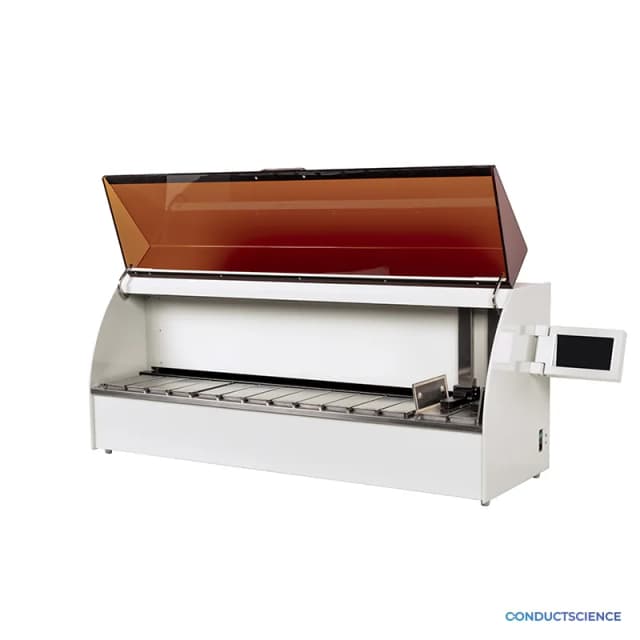
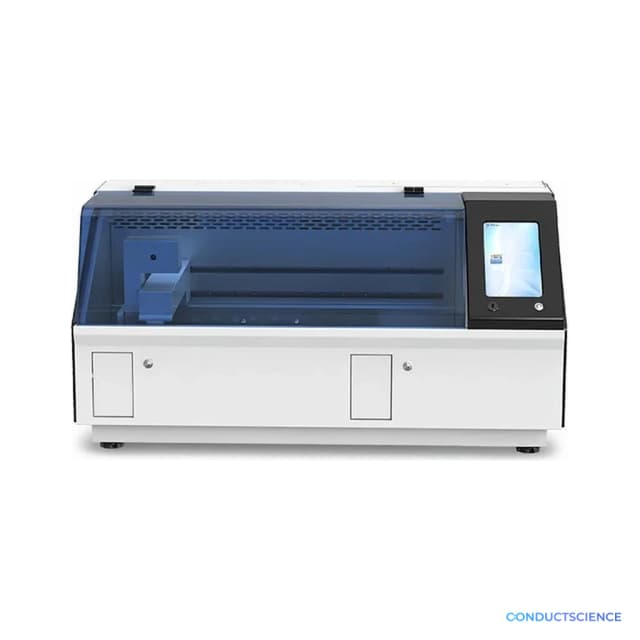
The Automated Tissue Slide H&E Stainer (Model RS-3) is a programmable histological processing instrument designed for standardized hematoxylin and eosin staining protocols. The system accommodates up to 24 slides simultaneously across 15 stations, including 13 reagent stations, one washing station, and one drying station, with each reagent cup holding approximately 350 mL.
The instrument features touchscreen operation with 25 programmable protocols, each supporting up to 30 editable steps. Processing parameters include adjustable immersion times (0-59 minutes and 0-59 seconds per station), temperature control with ±1% precision, variable dripping time (0-60 seconds), and adjustable stirring frequency (0-6 times/minute). The system operates on 220V AC power (400W) with CE certification.
How It Works
The automated H&E staining process relies on sequential immersion of tissue sections through a series of reagent solutions following standard histological protocols. The instrument moves slide carriers through programmed sequences of alcohols, xylenes, hematoxylin, and eosin solutions with precise timing control.
Temperature regulation maintains optimal staining conditions while programmable stirring enhances reagent penetration and color development uniformity. The washing station removes excess reagents between steps, and the drying station prepares slides for mounting. Each protocol step can be customized for immersion time, temperature, and agitation parameters to accommodate different tissue types and staining requirements.
The touchscreen interface allows protocol selection and real-time monitoring of processing status, with dripping time control preventing reagent carryover between stations.
Features & Benefits
Weight
- 27.0 kg
Dimensions
- L: 925.0 mm
- W: 250.0 mm
- H: 260.0 mm
Comparison Guide
| Feature | This Product | Typical Alternative | Advantage |
|---|---|---|---|
| Slide Processing Capacity | 24 slides simultaneously | Entry-level models often process 10-15 slides per batch | Higher throughput reduces processing time for large specimen batches common in research studies. |
| Reagent Station Count | 15 total stations (13 reagent + washing + drying) | Basic models typically offer 8-12 stations | More stations accommodate complex H&E protocols with multiple alcohol grades and differentiation steps without reagent sharing. |
| Protocol Programming Capacity | 25 protocols with 30 steps each | Limited models often restrict protocols to 5-10 with fewer steps | Extensive programming capability allows optimization for different tissue types and research-specific staining requirements. |
| Temperature Control Precision | ±1% precision | Standard models may offer ±2-5% temperature variation | Precise temperature control ensures consistent hematoxylin and eosin uptake critical for quantitative image analysis. |
| User Interface | Touchscreen operation | Basic models often use button panels or require computer connection | Intuitive touchscreen interface simplifies protocol selection and real-time monitoring without external equipment. |
| Timing Control Resolution | Adjustable to 1-second precision (0-59 min, 0-59 sec) | Entry models typically offer minute-level timing only | Fine timing control enables optimization of differentiation steps critical for high-quality morphological visualization. |
The RS-3 offers high-capacity processing with extensive protocol customization capabilities and precise environmental control. The touchscreen interface and 15-station design provide operational flexibility for research laboratories requiring consistent, reproducible H&E staining with minimal manual intervention.
Practical Tips
Verify temperature accuracy monthly using calibrated thermometers at each heated station during equilibration.
Why: Temperature drift affects hematoxylin uptake and can cause batch-to-batch staining variation.
Replace staining solutions according to slide count and time exposure rather than volume appearance alone.
Why: Exhausted reagents produce weak staining even when solutions appear visually unchanged.
Run blank slides through new protocols before processing experimental specimens to verify staining quality.
Why: Protocol testing prevents loss of irreplaceable research specimens due to incorrect timing or reagent sequencing.
Group specimens by tissue type and processing requirements to maximize protocol efficiency.
Why: Similar tissues often require identical staining parameters, reducing protocol switching and setup time.
Check reagent levels and quality if staining appears weak or uneven across the slide batch.
Why: Insufficient reagent volume or exhausted solutions cause inconsistent staining within the same processing run.
Document protocol parameters and reagent lot numbers for each staining run to ensure reproducibility.
Why: Comprehensive records enable protocol troubleshooting and support publication requirements for methodology.
Ensure adequate ventilation around the instrument and use appropriate personal protective equipment when handling reagents.
Why: Xylene and alcohol vapors require proper ventilation to maintain safe laboratory working conditions.
Clean reagent stations with appropriate solvents between different solution types to prevent contamination.
Why: Cross-contamination between acidic and basic solutions can alter staining characteristics and pH balance.
Setup Guide
What’s in the Box
- RS-3 automated stainer main unit
- 15 reagent cups (350 mL capacity each)
- Slide carriers for 24-slide capacity
- Power cord and adapter
- User manual and protocol guide
- Installation and setup documentation
- CE certification documentation
- Reagent level indicators (typical)
- Maintenance kit with basic tools (typical)
Warranty
ConductScience provides a standard one-year manufacturer warranty covering parts and technical support. Extended warranty options and on-site service agreements are available for high-volume laboratories requiring minimal downtime.
Compliance
References
Background reading relevant to this product:
What is the maximum processing capacity per run?
The system processes up to 24 slides simultaneously through 15 stations, with complete protocol execution in a single automated run without manual intervention.
Can I customize staining protocols for different tissue types?
Yes, the system stores 25 programmable protocols, each with up to 30 editable steps. You can adjust timing (0-59 minutes per station), temperature, and stirring frequency for each protocol step.
How precise is the temperature control for optimal staining?
Temperature control maintains ±1% precision across all heated stations, ensuring consistent hematoxylin and eosin uptake and color development.
What reagent volumes are required for operation?
Each of the 13 reagent stations holds approximately 350 mL, providing sufficient volume for extended batch processing while minimizing reagent waste.
Is the system suitable for high-throughput laboratory environments?
Yes, with 24-slide simultaneous processing and fully automated operation, the system is designed for laboratories requiring consistent, reproducible H&E staining with minimal manual handling.
What maintenance is required for consistent performance?
Regular cleaning of reagent stations, replacement of staining solutions according to usage protocols, and periodic calibration of temperature and timing systems ensure optimal performance.
Can the system handle different slide sizes and carrier configurations?
The system accommodates standard microscope slides through its 24-slide carrier system; consult product specifications for specific slide dimensions and carrier compatibility.
Have a question about this product?
Accessories
Enhance your setup with compatible accessories