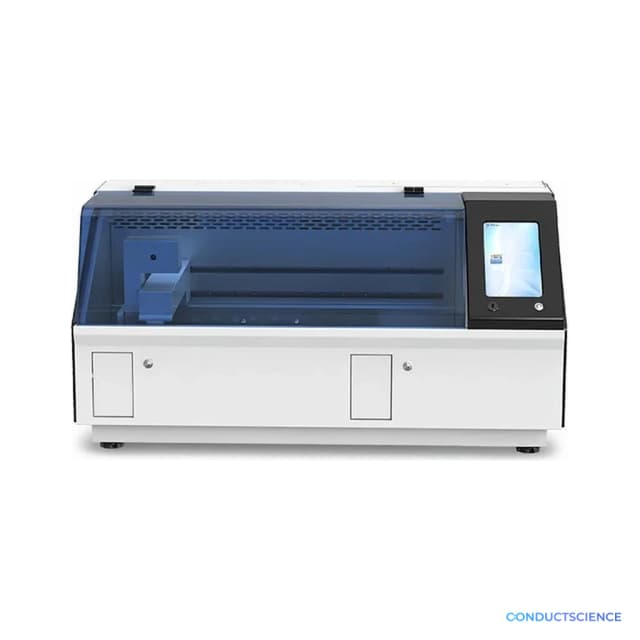
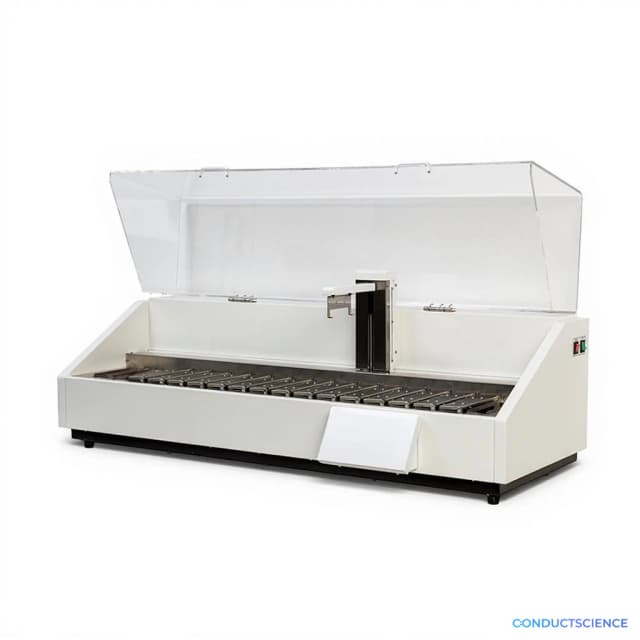
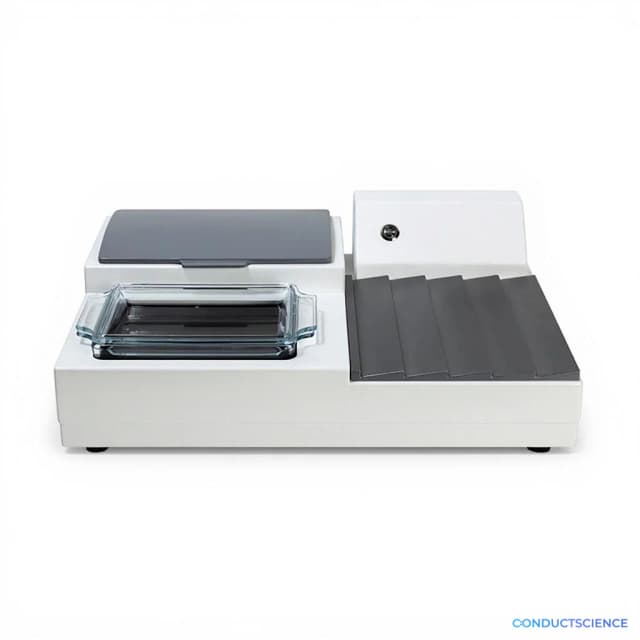
Digital Tissue Flotation Water Bath, 4L, 75°C
Temperature-controlled flotation bath for histological section processing with 4L capacity and precise heating from ambient to 75°C.
| Automation Level | manual |
| Outside Demensions | ∅270mm , H210mm |
| Bath Demensions | ∅210mm , Depth 65mm |
| Bath temperature range | ambient -75℃ |
| Relative humidity | Less then 85% |
| Brand | ConductScience |

The Tissue Flotation Bath provides controlled warm water environment for section flotation during histological processing. This instrument maintains precise temperature control from ambient to 75°C with a 4L capacity bath, supporting routine sectioning workflows in research and diagnostic laboratories.
The unit features a 210mm diameter working bath with 65mm depth, accommodating standard slide formats and section handling protocols. Digital temperature control ensures consistent flotation conditions critical for tissue section integrity and mounting quality.
How It Works
The flotation bath operates by maintaining a controlled warm water environment that facilitates proper section handling during histological processing. When paraffin sections are placed on the water surface, the controlled temperature causes gentle expansion of the tissue, eliminating compression artifacts and wrinkles that occur during microtomy.
The heating element provides uniform temperature distribution throughout the 4L water volume, while the digital control system maintains stable thermal conditions. The 210mm working diameter accommodates multiple sections simultaneously, with the 65mm depth providing adequate water volume for consistent heat transfer. Temperature regulation from ambient to 75°C allows optimization for different tissue types and processing protocols.
Features & Benefits
Automation Level
- manual
Outside Demensions
- ∅270mm , H210mm
Bath Demensions
- ∅210mm , Depth 65mm
Bath temperature range
- ambient -75℃
Relative humidity
- Less then 85%
Brand
- ConductScience
Research Domain
- Cancer Research
- Cell Biology
- Clinical Diagnostics
- Developmental Biology
- Histopathology
- Neuroscience
Capacity
- 4L
Power/Voltage
- 400W
Weight
- 10.0 kg
Dimensions
- L: 8.27 mm
- W: 2.56 mm
- H: 2.56 mm
Comparison Guide
| Feature | This Product | Typical Alternative | Advantage |
|---|---|---|---|
| Bath Capacity | 4L working volume | Entry-level models often provide 1-2L capacity | Higher capacity enables batch processing and reduces workflow interruptions in busy laboratories. |
| Temperature Range | Ambient to 75°C precision control | Basic units may lack digital control or have limited range | Wide temperature range accommodates diverse tissue types and processing protocols. |
| Heating Power | 400W heating element | Lower-power units may have slower response times | Rapid temperature equilibration and stable conditions during high-throughput processing. |
| Working Dimensions | 210mm diameter, 65mm depth | Smaller units may limit section handling space | Adequate workspace for multiple sections and standard slide formats. |
| Voltage Options | 110V/220V dual compatibility | Single voltage models require specific electrical systems | Flexible installation across different laboratory electrical configurations. |
This flotation bath combines substantial 4L capacity with precise temperature control from ambient to 75°C. The 400W heating system provides rapid equilibration and stability, while dual voltage compatibility ensures flexible laboratory installation.
Practical Tips
Verify temperature accuracy monthly using a calibrated thermometer placed at section-handling depth.
Why: Temperature precision directly affects section expansion and mounting quality.
Change water weekly or when visible contamination appears, and descale heating elements monthly in hard water areas.
Why: Clean water and scale-free elements maintain optimal heat transfer and prevent contamination.
Allow 15-20 minutes warm-up time before processing critical specimens to ensure thermal stability.
Why: Temperature fluctuations during warm-up can cause inconsistent section behavior and mounting artifacts.
Position unit away from air currents and maintain stable ambient conditions to prevent temperature variations.
Why: Environmental factors can affect surface temperature uniformity and section handling consistency.
Document temperature settings and water change dates for quality assurance and troubleshooting records.
Why: Systematic record-keeping supports protocol reproducibility and identifies sources of section quality issues.
If sections wrinkle despite proper temperature, check for water surface contamination or inadequate heating time.
Why: Surface tension changes and thermal gradients are common causes of section handling problems.
Use distilled water exclusively and replace after processing infectious or heavily stained specimens.
Why: Water quality directly affects section behavior and prevents cross-contamination between specimens.
Setup Guide
What’s in the Box
- Tissue Flotation Bath main unit
- Power cord with regional plug adapter
- Temperature probe and calibration certificate (typical)
- User manual and operation guide (typical)
- Cleaning protocol documentation (typical)
Warranty
ConductScience provides a standard one-year manufacturer warranty covering parts and labor, with technical support for installation and operation guidance.
Compliance
What temperature range is optimal for different tissue types?
Most paraffin sections float optimally at 45-50°C, though dense tissues may require up to 60°C. The ambient to 75°C range accommodates various protocols and tissue characteristics.
How long does temperature equilibration take?
Initial heating from ambient to 50°C typically requires 15-20 minutes. The 400W heating element provides rapid response for temperature adjustments during use.
Can the bath handle continuous operation?
Yes, the system is designed for extended use periods typical in high-volume histology laboratories. Monitor water level and quality during prolonged operation.
What water quality is recommended?
Use distilled or deionized water to prevent mineral deposits and contamination. Replace water regularly based on usage frequency and visible contamination.
How do I calibrate the temperature display?
Use a calibrated thermometer to verify bath temperature against display reading. Consult product datasheet for calibration adjustment procedures if available.
What maintenance is required?
Regular water changes, periodic cleaning of heating elements, and temperature calibration verification. Descaling may be needed in hard water areas.
Can I process multiple section types simultaneously?
The 210mm diameter accommodates multiple sections, but avoid cross-contamination between different specimen types. Consider dedicated baths for specialized applications.
Is the unit compatible with different laboratory electrical systems?
Yes, dual voltage compatibility supports both 110V 60Hz and 220V 50Hz electrical systems for international laboratory use.
What prevents tissue adhesion during flotation?
The non-stick coating on bath surfaces minimizes tissue adhesion and facilitates cleaning between samples, preventing cross-contamination.
What environmental conditions are required for proper operation?
The unit operates in laboratory environments with relative humidity below 85%, supporting standard histopathology laboratory conditions.
How does this compare to manual water bath methods?
Digital temperature control provides more consistent conditions than manual methods, while the larger capacity and non-stick coating improve efficiency and reduce contamination risk.
Have a question about this product?