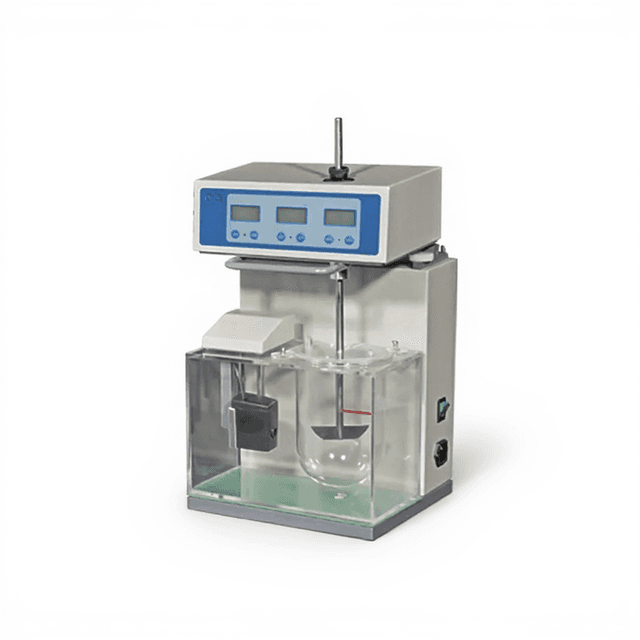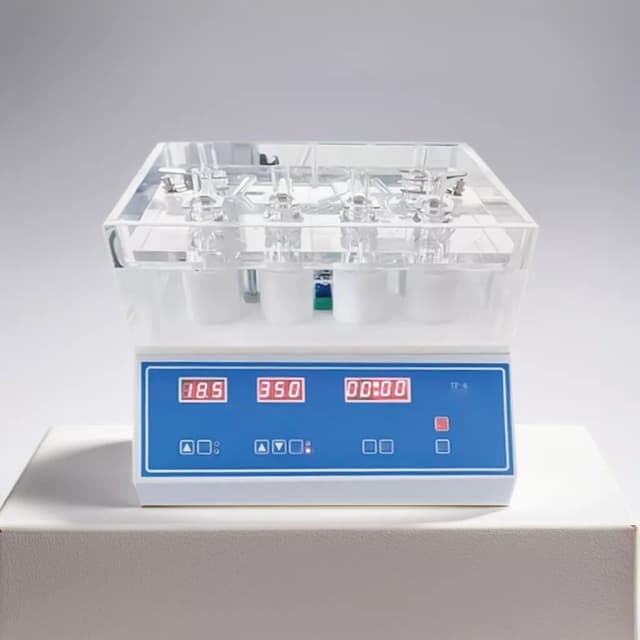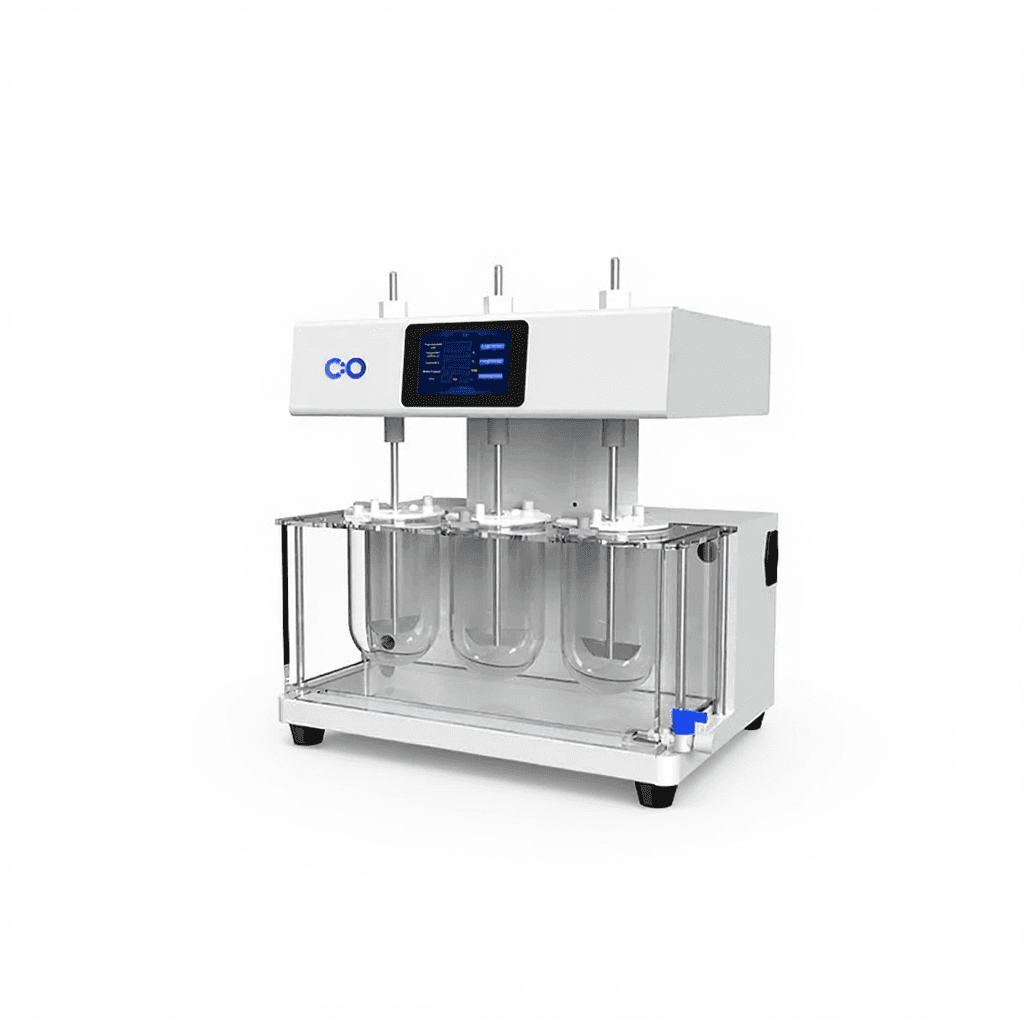
Dissolution Tester
Three-basket dissolution tester with dual-function electric lifting, high-precision rotation control, and integrated temperature management for USP pharmacopeial dissolution testing of solid dosage forms.
| lifting_mechanism | Dual-function electric lifting and tilting of test head |
| parameter_storage | Pre-settable parameters with automatic storage |
| rotation_control | High-precision rotation control |
| heating_capability | Rapid heating with high accuracy |
| timer_functions | Independent timer control for start, pause, and reset |
| safety_features | Self-diagnostic alarms and overheat protection |
The BIO-BRC-3 Dissolution Tester is a three-basket USP pharmacopeial testing system designed for precise dissolution profiling of solid dosage forms including tablets, capsules, and controlled-release formulations. This semi-automated instrument combines dual-function electric lifting and tilting mechanisms with high-precision rotation control to maintain consistent hydrodynamic conditions throughout dissolution testing protocols.
The system features integrated temperature control with rapid heating capabilities, independent timer functions for protocol management, and automated parameter storage for method reproducibility. Built-in safety features including self-diagnostic alarms and overheat protection ensure reliable operation during extended testing sequences. The intuitive human-machine interface simplifies operation while maintaining the precision necessary for pharmaceutical quality control and formulation development studies.
How It Works
Dissolution testing operates on the principle of controlled hydrodynamic conditions to simulate gastrointestinal drug release. The BIO-BRC-3 system uses rotating baskets or paddles to create standardized fluid motion patterns around the dosage form, ensuring consistent mass transfer conditions. The high-precision rotation control maintains specified RPM values to generate reproducible hydrodynamic environments that influence boundary layer thickness and dissolution rate.
Temperature control systems rapidly heat and maintain dissolution media at physiological temperatures (typically 37°C), while the dual-function lifting mechanism allows precise positioning of test heads and automated sampling protocols. The three-basket configuration enables simultaneous testing of multiple units or different formulations under identical conditions, improving statistical power and experimental efficiency.
Independent timer functions coordinate test initiation, sampling timepoints, and protocol termination, while automated parameter storage ensures method consistency across testing sessions. The system maintains sink conditions through media volume control and stirring optimization, preventing precipitation and ensuring accurate dissolution kinetics measurement.
Features & Benefits
lifting_mechanism
- Dual-function electric lifting and tilting of test head
parameter_storage
- Pre-settable parameters with automatic storage
rotation_control
- High-precision rotation control
heating_capability
- Rapid heating with high accuracy
timer_functions
- Independent timer control for start, pause, and reset
safety_features
- Self-diagnostic alarms and overheat protection
interface_type
- Intuitive human-machine interface
energy_consumption
- Low energy consumption
temperature_calibration
- Easy temperature calibration
Automation Level
- semi-automated
Research Domain
- Analytical Chemistry
- Materials Science
- Pharmaceutical QC
Weight
- 11.0 lbs
Dimensions
- L: 42.0 in
- W: 43.6 in
- H: 38.0 in
Comparison Guide
| Feature | This Product | Typical Alternative | Advantage |
|---|---|---|---|
| Basket Configuration | Three-basket system enabling simultaneous testing of multiple units | Single or dual-basket configurations may limit throughput | Increased statistical power and experimental efficiency through parallel testing of formulation replicates |
| Lifting Mechanism | Dual-function electric lifting and tilting for precise positioning | Manual lifting systems require operator manipulation | Eliminates handling variability and improves sampling consistency across dissolution timepoints |
| Parameter Storage | Pre-settable parameters with automatic storage capability | Basic models may lack method storage features | Ensures method reproducibility and reduces setup errors between dissolution runs |
| Temperature Control | Rapid heating with high accuracy temperature management | Slower heating systems may require longer equilibration times | Reduces pre-test preparation time and maintains precise thermal conditions for temperature-sensitive formulations |
| Safety Features | Self-diagnostic alarms and overheat protection systems | Entry-level models may have limited safety monitoring | Prevents equipment damage and ensures data integrity during unattended dissolution testing protocols |
| User Interface | Intuitive human-machine interface for method control | Basic manual controls may lack advanced interface features | Simplifies method setup and reduces operator training requirements while maintaining precise parameter control |
The BIO-BRC-3 combines three-basket parallel testing capability with automated lifting mechanisms and integrated temperature control. The system offers enhanced reproducibility through parameter storage and precision rotation control, while built-in safety features ensure reliable operation during extended dissolution protocols.
Practical Tips
Verify temperature accuracy at multiple points within each vessel using calibrated thermometers before initiating dissolution testing.
Why: Temperature uniformity directly affects dissolution kinetics and must meet USP calibration requirements for method validation.
Check rotation speed accuracy monthly using a calibrated tachometer at all vessel positions to ensure consistent hydrodynamic conditions.
Why: Rotation speed variations alter boundary layer thickness and can significantly impact dissolution rate measurements.
Clean all wetted surfaces with appropriate solvents after each test and inspect baskets for wear or deformation that could affect flow patterns.
Why: Residual drug deposits or damaged apparatus components introduce variability in subsequent dissolution measurements.
Allow sufficient equilibration time after media addition before dosage form introduction to ensure stable thermal and hydrodynamic conditions.
Why: Temperature fluctuations during test initiation can cause dissolution artifacts and affect early timepoint accuracy.
Use consistent dosage form placement techniques within baskets to minimize position-dependent dissolution variability between replicates.
Why: Dosage form positioning affects local hydrodynamics and can introduce systematic bias in dissolution rate measurements.
Perform dissolution testing of USP prednisone or salicylic acid reference standards periodically to verify system performance and mechanical calibration.
Why: Reference standard testing provides objective evidence of apparatus suitability and helps identify drift in mechanical performance.
Monitor for air bubble formation on dosage forms or apparatus surfaces, particularly when testing poorly soluble compounds or using degassed media.
Why: Air bubbles alter local hydrodynamics and can cause artificially slow dissolution rates or increased measurement variability.
Ensure adequate ventilation around heating elements and verify overheat protection functionality during initial system qualification.
Why: Proper thermal management prevents equipment damage and maintains safe operating conditions during extended dissolution protocols.
Setup Guide
What’s in the Box
- BIO-BRC-3 main dissolution testing unit
- Three dissolution baskets with mounting hardware
- Paddle attachments for USP Apparatus 2 testing
- Temperature calibration probe
- Power cord and electrical connections
- User manual and operation guide
- Method parameter setup documentation
- Safety and maintenance instructions
Warranty
ConductScience provides a one-year manufacturer warranty covering defects in materials and workmanship, with technical support for method development and troubleshooting assistance.
Compliance
References
Background reading relevant to this product:
What dissolution media volumes can be accommodated in each vessel?
The three-basket system is designed for standard USP dissolution volumes, typically 900 mL per vessel, with capability for alternative volumes based on method requirements and dosage form characteristics.
How is temperature uniformity maintained across all three testing positions?
The rapid heating system with high accuracy provides uniform temperature distribution, though specific temperature uniformity specifications should be verified through calibration documentation.
Can the system accommodate both USP Apparatus 1 and 2 testing?
The system includes both basket and paddle configurations, enabling flexibility between USP Apparatus 1 (baskets) and Apparatus 2 (paddles) testing methods.
What rotation speed range and accuracy can be achieved?
High-precision rotation control is provided, though specific RPM ranges and accuracy tolerances should be confirmed in the technical specifications documentation.
How are sampling timepoints managed during dissolution testing?
Independent timer functions enable precise control of sampling intervals, with programmable start, pause, and reset capabilities for complex dissolution protocols.
What data output and documentation capabilities are available?
The system provides parameter storage and method documentation, though specific data export formats and integration capabilities should be verified in product specifications.
How does the dual-function lifting mechanism improve testing workflow?
Electric lifting and tilting provides precise positioning for sample collection and apparatus changes without manual handling that could introduce measurement variability.
What preventive maintenance is required for consistent performance?
Regular temperature and rotation speed calibration verification is essential, along with cleaning protocols and mechanical component inspection as detailed in maintenance documentation.
Have a question about this product?
Accessories
Enhance your setup with compatible accessories
Frequently Bought Together
Upgrade Options