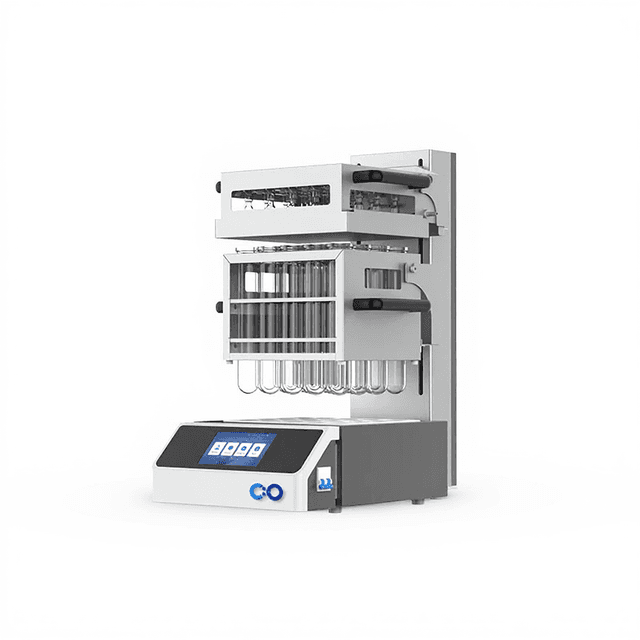
Automatic Capping Machine
Automatic capping machine for opening and closing sample collection tubes in under 1.8 seconds per cycle.
Diffuse reflection sensing requires no manual button press. Compatible with cap diameters 13–36 mm (four gripper options). Safety-cabinet compatible; single-hand operation.

Louise Corscadden, PhD
Director of Science · ConductScience
Ask Louise about Automatic Capping Machine fit, setup, configuration, or quote prep.
Already working with us? Sign in to connect this with My Scientist.
Key Specifications
Full details →- Model fit
- 19.5~29.5mm
- SKU family
- BIO-BK-AC10
- Shipping box
- 36.3 x 29.5 x 16.4 cm
- Ordering
- Online checkout and quote request available
- Category
- Solid Processing
- Build notes
- Confirm accessories, station layout, and support needs before purchase
This automatic capping machine handles the opening and closing of sample collection
tubes across a wide range of cap sizes without requiring a button press — a diffuse
reflection sensor triggers each cycle automatically in under 1.8 seconds. An LCD work
counter tracks throughput. The compact footprint fits inside standard safety cabinets,
and single-hand operation reduces fatigue in high-volume clinical and laboratory
environments.
Applications
Clinical laboratories, emergency departments, disease control centers, primary health
institutions, and third-party medical testing laboratories.
Technical Specifications
| Parameter | Specification |
|---|---|
| Model | BK-AC10 |
| Channel | Single |
| Open Type | Screw capping |
| Cycle Speed | <1.8 s/action |
| Display | LCD1601 |
| Sensing Method | Diffuse reflection (automatic, no button) |
| External Dimensions (W×D×H) | 164 × 295 × 363 mm |
| Net Weight | 7.8 kg |
| Power Supply | AC 100–240 V, 50/60 Hz, 40 VA |
| Package Dimensions (W×D×H) | 320 × 280 × 365 mm |
| Gross Weight | 12.05 kg |
Gripper Options
| Gripper | Cap Diameter Range | Running Distance |
|---|---|---|
| A | 13–18 mm | 0–6 mm |
| B | 19.5–24 mm | 0–6 mm |
| C | 24.5–29.5 mm | 0–6 mm |
| D | 31–36 mm | 0–6 mm |
How It Works
The Automatic Capping Machine operates through a diffuse reflection sensing system that automatically detects tube presence without requiring manual activation. When a capped tube is positioned in the gripper assembly, the optical sensor triggers the motorized mechanism to engage with caps ranging from 19.5 to 29.5mm in diameter. The system applies controlled torque to either tighten or loosen screw caps through a single mechanical operation.
The motorized gripper assembly adapts to different cap sizes through configurable gripper settings, ensuring consistent engagement across various tube types. The LCD display interface provides real-time feedback on operation count and system status, while the compact form factor allows integration into confined spaces such as biological safety cabinets. One-hand operation capability reduces ergonomic stress during repetitive capping tasks, with each complete cycle (cap engagement, rotation, and release) completed in under 1.8 seconds.
Features & Benefits
Tube Cover Diameter Compatibility
- 19.5~29.5mm
Operation Time
- 1.8 seconds to open or close lid
Sensing Method
- Diffuse reflection automatically sensing
Operation Method
- One hand operation
Safety Cabinet Compatible
- Yes
Work Quantity Display
- Yes
Automation Level
- semi-automated
Display Type
- Digital
Research Domain
- Clinical Diagnostics
- Environmental Monitoring
- Immunology
- Microbiology
- Pharmaceutical QC
- Toxicology
Shipping weight
- 8.22 lb
Shipping box
- L: 36.3 cm
- W: 29.5 cm
- H: 16.4 cm
| Feature | This Product | Typical Alternative | Advantage |
|---|---|---|---|
| Operation Speed | Under 1.8 seconds per cap operation | Manual capping typically requires 3-5 seconds per tube | Faster processing enables higher sample throughput during time-sensitive protocols |
| Tube Detection Method | Diffuse reflection automatic sensing | Manual positioning or button-activated systems | Eliminates manual activation steps, reducing operator fatigue and improving workflow consistency |
| Cap Diameter Range | 19.5-29.5mm compatibility | Many systems require separate fixtures for different cap sizes | Single configurable system accommodates multiple tube types without equipment changes |
| Operation Tracking | Integrated LCD work quantity display | Manual counting or separate tracking methods | Built-in counting eliminates separate documentation steps and reduces counting errors |
| Workspace Integration | 164×295×363mm compact design with safety cabinet compatibility | Larger footprints often require dedicated bench space | Fits within sterile work environments without compromising containment protocols |
| Operation Method | One-hand operation capability | Two-handed operation or manual tube holding required | Allows simultaneous tube handling and capping, improving ergonomics and efficiency |
This automated capping machine offers rapid sub-1.8 second operation cycles with automatic tube detection, accommodating a wide range of cap sizes through a single configurable system. The compact design enables integration into biological safety cabinets while providing built-in operation tracking and one-handed operation capability.
Practical Tips
Verify gripper alignment and torque consistency weekly using reference tubes with known cap tightness.
Why: Maintains consistent closure force across different tube types and prevents over-tightening that could damage caps or threads.
Clean the optical sensor window daily with lint-free cloth to prevent false detection signals.
Why: Contamination on the sensor surface can interfere with automatic tube recognition and cause operation delays.
Allow tubes to reach room temperature before capping if coming from refrigerated storage.
Why: Temperature differences can affect cap thread engagement and may cause inconsistent closure torque.
If the sensor fails to detect tubes consistently, check for proper tube positioning and ensure caps are within the 19.5-29.5mm diameter range.
Why: Detection issues often result from incorrect tube placement or attempting to process incompatible cap sizes.
Record the work quantity display reading at the start and end of each batch for documentation purposes.
Why: Provides accurate sample counting for quality control records and helps identify any missed operations during processing.
Ensure fingers are clear of the gripper mechanism before tube insertion to prevent pinching injuries.
Why: The automated operation begins immediately upon tube detection, leaving minimal time to clear hands from the mechanism.
Process tubes in consistent orientation with caps facing the same direction to optimize sensor detection.
Why: Uniform tube positioning reduces detection variability and ensures consistent gripper engagement across all samples.
Lubricate gripper mechanism monthly according to manufacturer specifications to maintain smooth operation.
Why: Regular lubrication prevents mechanical wear and maintains the sub-1.8 second operation timing specification.
Setup Guide
What’s in the Box
- Automatic Capping Machine main unit
- Power adapter and cord
- Gripper configuration tools (typical)
- User manual and operation guide (typical)
- Calibration and setup documentation (typical)
Warranty
ConductScience provides a standard one-year manufacturer warranty covering defects in materials and workmanship, with technical support available for setup, operation, and troubleshooting assistance.
Compliance
References
Background reading relevant to this product:
What tube cap sizes are compatible with the gripper assembly?
The system accommodates screw caps with diameters ranging from 19.5 to 29.5mm through configurable gripper settings, covering most standard laboratory tube types including culture tubes, sample vials, and collection containers.
How does the automatic sensing eliminate manual activation?
The diffuse reflection sensor automatically detects tube presence when positioned in the gripper area, triggering the capping operation without requiring button presses or manual switches during routine use.
Can the unit operate within biological safety cabinets?
Yes, the compact 164×295×363mm design specifically accommodates biological safety cabinet installation, supporting sterile work protocols and containment requirements in clinical and research environments.
What maintenance is required for consistent operation?
Regular cleaning of the gripper assembly and optical sensor, periodic verification of torque consistency, and occasional recalibration of the automatic detection system according to the maintenance schedule.
How accurate is the work quantity tracking?
The LCD display provides precise counting of each completed operation cycle, maintaining an accurate tally for batch documentation, quality control records, and productivity assessment.
What is the difference between this and manual capping methods?
Automated operation reduces repetitive strain, provides consistent torque application, eliminates timing variation between operators, and increases throughput compared to manual cap tightening or loosening.
How quickly can samples be processed during high-throughput workflows?
Each capping operation completes in under 1.8 seconds, enabling processing of approximately 2000 samples per hour under continuous operation conditions.
What power requirements does the system have?
Consult product datasheet for specific electrical requirements and power consumption specifications to ensure compatibility with laboratory power systems.
Have a question about this product?
Have a question? Just ask.
Send it over and we'll email you a personalized answer — no call, no scheduling.
Prefer to talk it through?