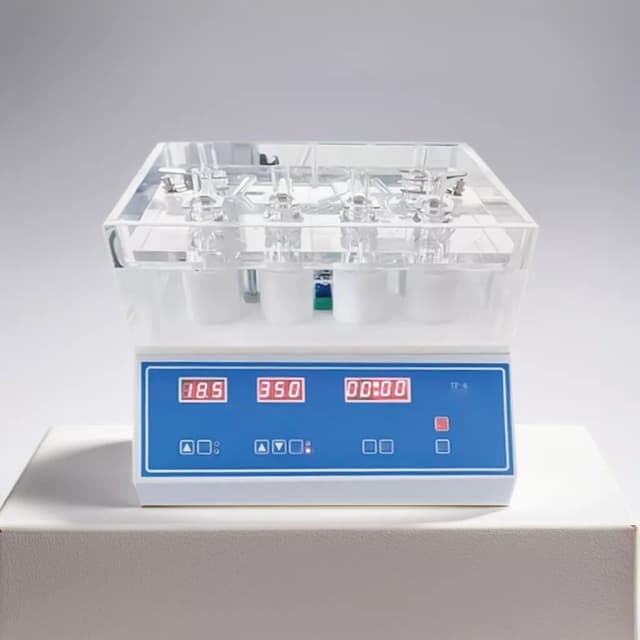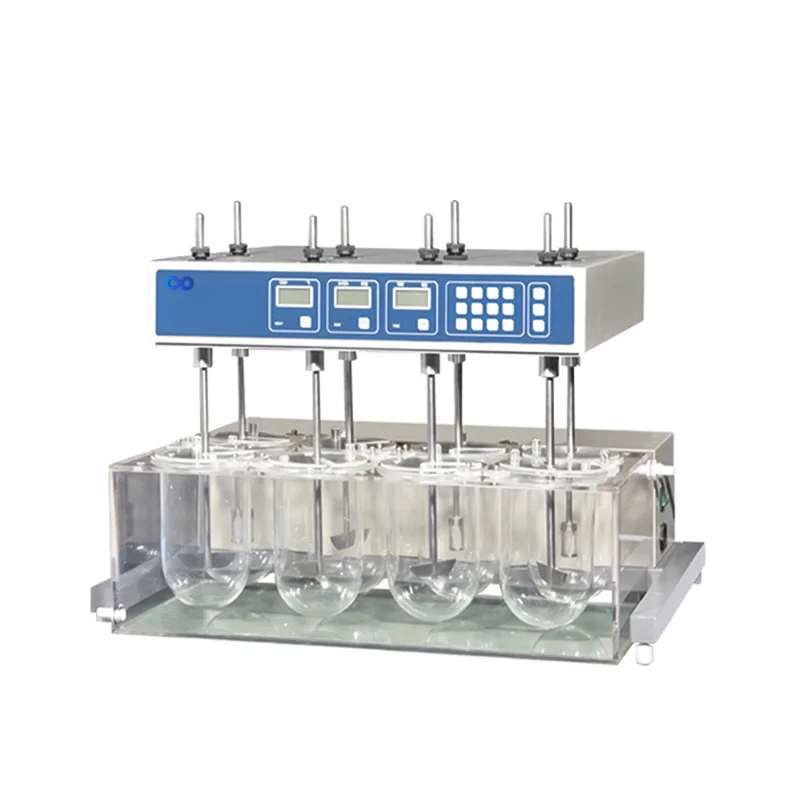
Dissolution Tester RC Series
Multi-position dissolution testing system with microprocessor control, automated diagnostics, and precise temperature/agitation control for pharmaceutical drug release studies.

Louise Corscadden, PhD
Director of Science · ConductScience
Ask Louise about Dissolution Tester RC Series fit, setup, configuration, or quote prep.
Already working with us? Sign in to connect this with My Scientist.
Key Specifications
Full details →- Model fit
- 4 selectable configurations
- SKU family
- CS-958309
- Shipping box
- 18.9 x 11.81 x 10.24 cm
- Ordering
- Online checkout and quote request available
- Category
- Dissolution Testing
- Build notes
- Stainless steel
The Dissolution Tester RC Series provides precise, automated dissolution testing for pharmaceutical formulations across multiple vessel configurations. Available in 1, 3, 6, and 8-position models, the system employs standard USP paddle and basket methods with microprocessor control and LCD display for consistent, reproducible results. The instrument features water circulation with magnetic pump for uniform temperature distribution, stainless steel agitation components, and automated diagnostic capabilities.
Each model accommodates standard 1000 mL dissolution vessels with programmable agitation speeds from 20-200 rpm and temperature control up to 45°C above room temperature. The flexible head assembly allows smooth positioning for vessel access, while precision timing controls support extended dissolution studies up to 24 hours continuous operation. Real-time monitoring of temperature, agitation speed, and timing parameters ensures protocol adherence throughout testing cycles.
How It Works
The dissolution testing process employs controlled agitation of pharmaceutical dosage forms in thermostatted dissolution media to simulate gastrointestinal conditions. The RC Series utilizes either paddle (USP Apparatus 2) or basket (USP Apparatus 1) methods, where constant rotational motion creates reproducible hydrodynamic conditions around the dosage form. Water circulation through the dissolution bath maintains uniform temperature distribution via magnetic pump, while microprocessor control ensures precise agitation speed regulation.
During operation, the dosage form is placed in individual vessels containing 500-1000 mL of dissolution medium. Paddle or basket assemblies rotate at programmed speeds, creating consistent fluid flow patterns that facilitate drug release. Temperature sensors monitor media temperature continuously, with the circulation system maintaining thermal equilibrium across all positions. Automated timing functions coordinate sampling intervals, while diagnostic systems monitor operational parameters and alert users to deviations from programmed conditions.
Features & Benefits
Diagnostic Features
- Auto-diagnose, auto-alarm
Processor Type
- Micro processor
Head Movement
- Can be turned over smoothly and flexibly (Rise and fall for BK-RC8)
Temperature Control
- Water circulating in the bath with magnetic pump
Basket Paddle Material
- Stainless steel
Automation Level
- semi-automated
Material
- Stainless Steel
Display Type
- LCD
Research Domain
- Analytical Chemistry
- Materials Science
- Pharmaceutical QC
Shipping weight
- 40.79 lb
Shipping box
- L: 18.9 cm
- W: 11.81 cm
- H: 10.24 cm
| Feature | This Product | Typical Alternative | Advantage |
|---|---|---|---|
| Vessel Positions | Available in 1, 3, 6, and 8-position configurations | Entry-level models often limited to 1-2 positions | Higher throughput options support batch testing and method development studies requiring multiple replicates. |
| Temperature Control Method | Water circulation with magnetic pump for uniform distribution | Simple heating baths with limited circulation | Maintains consistent temperature across all positions, reducing position-to-position variability in dissolution results. |
| Speed Range and Precision | 20-200 rpm range with ±2 rpm precision | Limited speed ranges or lower precision control | Covers full pharmacopeial speed requirements with precision needed for reproducible hydrodynamic conditions. |
| Control System | Microprocessor control with LCD display and auto-diagnostics | Manual controls with analog displays | Reduces operator error and provides automated monitoring of critical parameters throughout testing cycles. |
| Head Assembly Design | Flexible positioning with smooth turnover capability | Fixed or manually adjusted positioning systems | Facilitates easier vessel access for sample loading and collection without disrupting adjacent test positions. |
| Continuous Operation Time | Greater than 24 hours continuous operation capability | Limited to shorter test durations | Supports extended-release formulation testing and long-duration dissolution studies without interruption. |
The RC Series provides automated control, multi-position scalability, and precision temperature/agitation management for pharmaceutical dissolution testing. The water circulation system and microprocessor control offer advantages in temperature uniformity and operational consistency compared to manual systems.
| Model | SKU | Listed price | Status | Shipping box |
|---|---|---|---|---|
| BIO-BK-RC12 | BIO-BL-RC12 | $14,300.00 | Available | 18.9 x 11.81 x 10.24 cm |
| BIO-BK-RC6 | BIO-BK-RC6 | $7,150.00 | Available | 18.9 x 11.81 x 10.24 cm |
| BIO-BK-RC3 | BIO-BK-RC3 | $3,290.00 | Available | 18.9 x 11.81 x 10.24 cm |
| BIO-BK-RC1 | BIO-BK-RC1 | $1,199.00 | Available | 18.9 x 11.81 x 10.24 cm |
Practical Tips
Perform temperature and speed calibration monthly or after any maintenance using certified reference standards.
Why: Regular calibration ensures measurement accuracy and maintains compliance with validation requirements.
Clean paddle and basket assemblies with appropriate solvents after each use to prevent cross-contamination between formulations.
Why: Residual drug substances or excipients can affect subsequent dissolution test results and compromise data integrity.
Allow 30 minutes temperature equilibration time before starting dissolution tests to ensure uniform thermal conditions.
Why: Temperature equilibration eliminates thermal gradients that could cause initial variability in dissolution profiles.
Check water circulation flow if temperature uniformity problems occur across vessel positions.
Why: Reduced circulation flow from pump issues or line blockages creates temperature variations between vessels.
Document ambient laboratory temperature and humidity conditions during dissolution testing.
Why: Environmental conditions can affect dissolution media temperature stability and evaporation rates during extended tests.
Ensure head assembly is properly secured before starting agitation to prevent accidental movement during operation.
Why: Loose head assemblies can create safety hazards and cause agitation assembly misalignment affecting test results.
Use deaerated dissolution media for tests requiring low oxygen content to prevent bubble formation during agitation.
Why: Air bubbles on dosage form surfaces can create barriers to dissolution and cause erratic release profiles.
Inspect paddle and basket assemblies for wear, corrosion, or dimensional changes during routine maintenance checks.
Why: Agitation assembly degradation affects hydrodynamic conditions and can lead to poor inter-test reproducibility.
Setup Guide
What’s in the Box
- Dissolution tester main unit (typical)
- Stainless steel paddle assemblies (typical)
- Stainless steel basket assemblies (typical)
- Power cord with regional adapter (typical)
- Temperature probe assembly (typical)
- User manual and operation guide (typical)
- Calibration certificate (typical)
- Installation and qualification protocols (typical)
Warranty
ConductScience provides a standard one-year manufacturer warranty covering defects in materials and workmanship, with technical support for installation, calibration, and troubleshooting assistance.
Compliance
What dissolution media volumes are compatible with this system?
The system accommodates standard USP dissolution vessels typically containing 500-1000 mL of dissolution medium, with vessel dimensions optimized for pharmacopeial paddle and basket methods.
How do I verify temperature accuracy across all positions?
Use certified thermometers placed in each vessel position during temperature equilibration, checking that all positions maintain target temperature within ±0.3°C through the water circulation system.
What maintenance is required for the magnetic circulation pump?
Regular inspection of pump impeller and housing for debris, periodic cleaning of circulation lines, and annual replacement of pump seals to maintain consistent water flow and temperature distribution.
Can I switch between paddle and basket methods on the same unit?
Yes, the system accepts both paddle and basket assemblies with quick-change mounting, requiring only agitation assembly replacement and appropriate height adjustment for each method.
What sampling techniques work best with this dissolution tester?
Manual sampling with syringes or automated sampling systems can be integrated, with vessel access facilitated by the flexible head assembly design for minimal disturbance to agitation.
How do I calibrate agitation speed accuracy?
Use a calibrated tachometer or stroboscope to verify rotational speed at multiple setpoints across the 20-200 rpm range, adjusting through microprocessor calibration functions as needed.
What data logging capabilities are available?
Consult product datasheet for specific data output options, as the LCD display shows real-time parameters but additional data recording may require external systems or optional interfaces.
How does this compare to single-position manual dissolvers?
Multi-position design increases throughput for batch testing while automated temperature and speed control reduces operator variability compared to manual adjustment systems.
Have a question about this product?
Have a question? Just ask.
Send it over and we'll email you a personalized answer — no call, no scheduling.
Prefer to talk it through?
Upgrade Options
Related Products