Individually Ventilated Cage System for Guinea Pigs
Individually ventilated cage system with touchscreen control and dual-stage filtration for guinea pig research housing applications.
| Rack Dimensions | 1660 x 500 x 2220 mm |
| Cage Material | Polycarbonate (PC) |
| Rack Material | Stainless Steel SS304, polished surface |
| AHU Control | Touchscreen |
| Air Valves | Automatic closure on cage removal |
| Life Air Window | Filtering film, opens on power off |

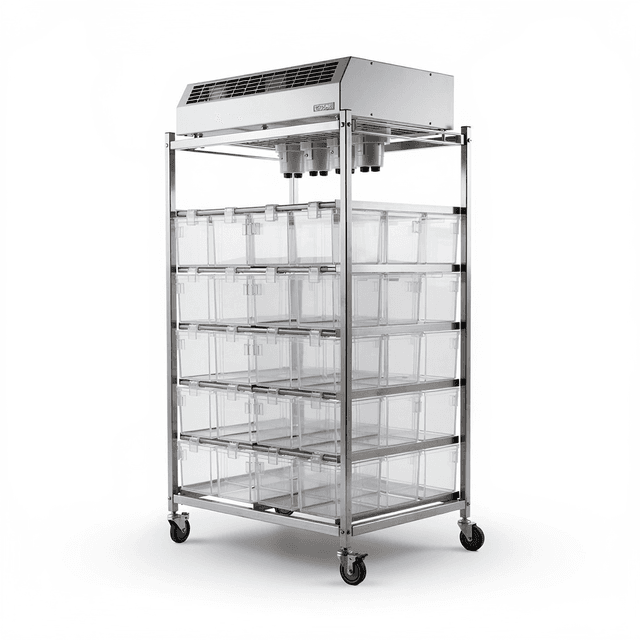
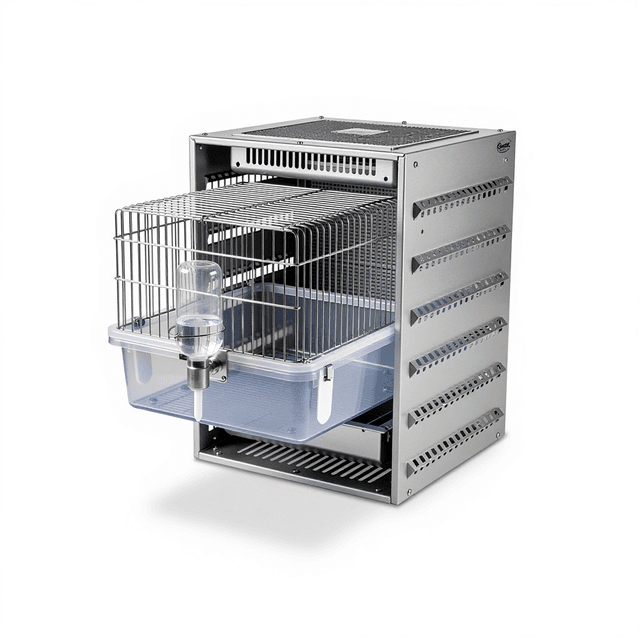
The Individually Ventilated Cage System for Guinea Pigs provides controlled environmental conditions for guinea pig housing in research facilities. This system features polycarbonate cages integrated with a stainless steel rack structure, delivering individual air supply and exhaust to each cage unit through dual-stage filtration. The touchscreen-controlled air handling unit manages airflow parameters while automatic air valve closure prevents environmental contamination during cage handling operations.
The system incorporates safety features including life air windows with filtering film that activate during power interruptions, maintaining ventilation integrity. Each cage position includes a standardized record card slot (96 x 56 mm) for identification and documentation purposes. The system's certifications include CE, ISO, and RoHS compliance, supporting use in regulated research environments.
How It Works
The individually ventilated cage system operates through forced air circulation with individual supply and exhaust for each cage position. Air enters through primary filtration followed by HEPA filtration, removing particles ≥0.3 micrometers before distribution to individual cage units. Each cage receives independently controlled airflow, preventing cross-contamination between animals while maintaining consistent temperature and humidity conditions.
Automatic air valves close immediately upon cage removal, preventing disruption of airflow to adjacent cages and maintaining system pressure balance. During power interruptions, life air windows with integrated filtering film automatically open to provide passive ventilation, preventing hypoxic conditions. The touchscreen air handling unit continuously monitors and adjusts system parameters including airflow rates, temperature, and pressure differentials across the rack assembly.
Features & Benefits
Rack Dimensions
- 1660 x 500 x 2220 mm
Cage Material
- Polycarbonate (PC)
Rack Material
- Stainless Steel SS304, polished surface
AHU Control
- Touchscreen
Air Valves
- Automatic closure on cage removal
Life Air Window
- Filtering film, opens on power off
Record Card Seat
- 96 x 56 mm card slot per cage
Filtration
- Primary + HEPA filters
Warranty
- 1 Year
Species
- Guinea pig
Automation Level
- semi-automated
Brand
- ConductScience
Certifications
- CE, ISO, RoHS
Research Domain
- Behavioral Pharmacology
- Cardiovascular
- Developmental Biology
- Immunology
- Microbiology
- Toxicology
Weight
- 130.0 kg
Dimensions
- L: 65.0 mm
- W: 32.0 mm
- H: 82.0 mm
Comparison Guide
| Feature | This Product | Typical Alternative | Advantage |
|---|---|---|---|
| Filtration System | Primary + HEPA filtration | Basic models often use single-stage filtration or HEPA-only systems | Dual-stage approach extends HEPA filter life while maintaining high air quality standards for sensitive research applications. |
| Control Interface | Touchscreen AHU control | Entry-level systems may use basic digital displays or manual controls | Intuitive touchscreen interface simplifies parameter monitoring and adjustment for facility staff. |
| Safety Features | Life air windows with filtering film | Standard systems may lack emergency ventilation provisions | Passive ventilation backup prevents hypoxic conditions during power failures while maintaining air filtration. |
| Valve Technology | Automatic closure on cage removal | Manual valve systems or basic closure mechanisms | Immediate automatic closure prevents airflow disruption and contamination when accessing individual cages. |
| Construction Materials | Stainless steel SS304 with polished surface | Lower-grade stainless steel or coated metal frameworks | Superior corrosion resistance and cleanability for demanding research facility environments. |
This system combines dual-stage filtration, touchscreen control, and automatic safety features in a stainless steel SS304 construction designed for guinea pig research applications. The integrated emergency ventilation and automatic valve closure provide enhanced operational safety compared to basic IVC systems.
Practical Tips
Monitor differential pressure across filters weekly and maintain replacement log for predictive maintenance scheduling.
Why: Consistent filter performance ensures optimal air quality and prevents system strain from blocked filtration.
Allow 24-hour system stabilization after filter changes before introducing animals to new cage positions.
Why: Air handling systems require equilibration time to establish consistent airflow patterns and environmental conditions.
Verify airflow rates at each cage position annually using calibrated measurement equipment appropriate for low-velocity applications.
Why: Individual cage airflow verification ensures uniform environmental conditions across all animal positions.
Test life air window operation monthly by simulating power interruption and confirming passive ventilation activation.
Why: Emergency ventilation systems must function reliably to prevent animal welfare issues during facility power outages.
Document environmental parameters for each cage position when establishing new study protocols.
Why: Baseline environmental documentation supports data interpretation and regulatory compliance in research studies.
Check air valve seating if individual cage positions show airflow irregularities during routine monitoring.
Why: Proper valve contact is essential for maintaining individual cage pressure and preventing cross-contamination between positions.
Setup Guide
What’s in the Box
- Stainless steel rack assembly
- Polycarbonate cage units (quantity varies by configuration)
- Air handling unit with touchscreen controller
- Primary and HEPA filter sets
- Air valve assemblies
- Life air window components
- Record card slots
- Installation hardware
- User manual and documentation
- Warranty certificate
Warranty
ConductScience provides a standard 1-year manufacturer warranty covering defects in materials and workmanship, with technical support for system commissioning and operational guidance.
Compliance
References
Background reading relevant to this product:
What cage positions are available and what is the maximum capacity per rack?
Cage capacity depends on the specific rack configuration selected. The 1660 x 500 x 2220 mm dimensions accommodate multiple cage positions with individual air supply to each unit.
How is airflow rate controlled and monitored for individual cages?
The touchscreen air handling unit provides centralized control of system airflow parameters, with individual air valves managing distribution to each cage position.
What filter replacement schedule is recommended for optimal performance?
Filter replacement intervals depend on facility air quality and animal load. Monitor pressure differential across filters and replace when manufacturer specifications are exceeded.
Can the system integrate with facility building management systems?
Integration capabilities depend on the specific touchscreen controller model. Consult technical specifications for available communication protocols.
What backup power requirements are needed for continuous operation?
Life air windows provide passive ventilation during power outages. For active airflow maintenance, uninterruptible power supply sizing should be based on air handling unit specifications.
How are temperature and humidity controlled within individual cages?
Environmental control depends on conditioned supply air from the facility HVAC system. The IVC system distributes this conditioned air to individual cage positions.
What cleaning and sterilization protocols are compatible with system materials?
Polycarbonate cages and stainless steel components are compatible with standard laboratory disinfectants and autoclave sterilization. Consult material compatibility charts for specific chemical agents.
Have a question about this product?