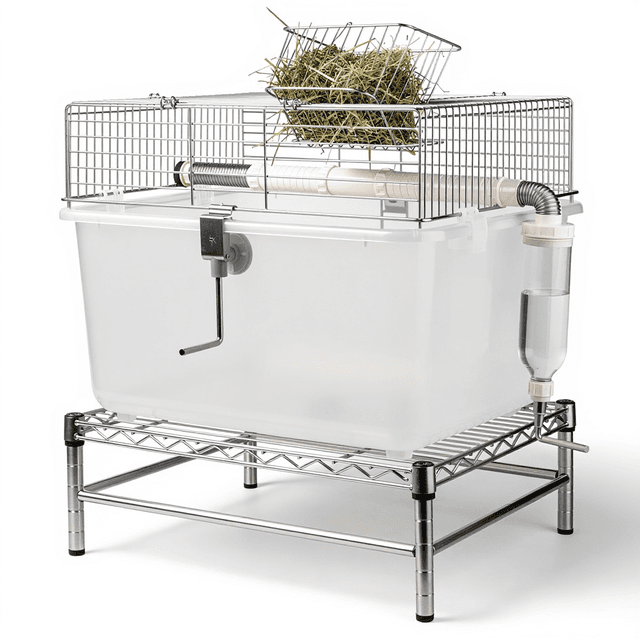
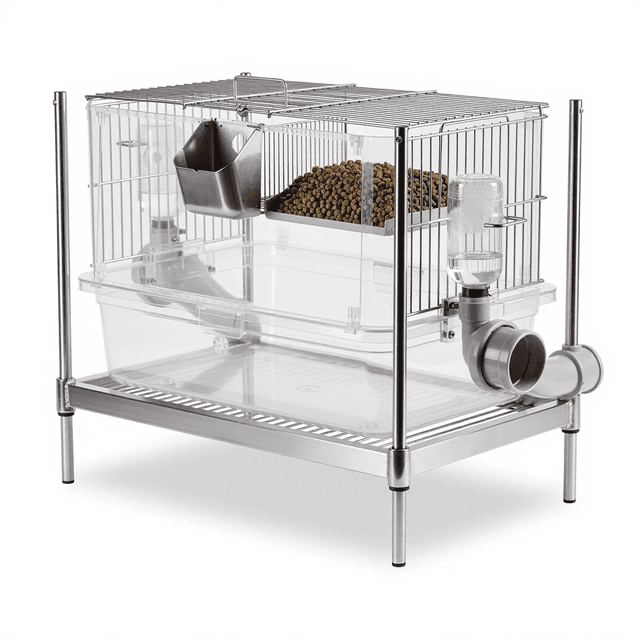
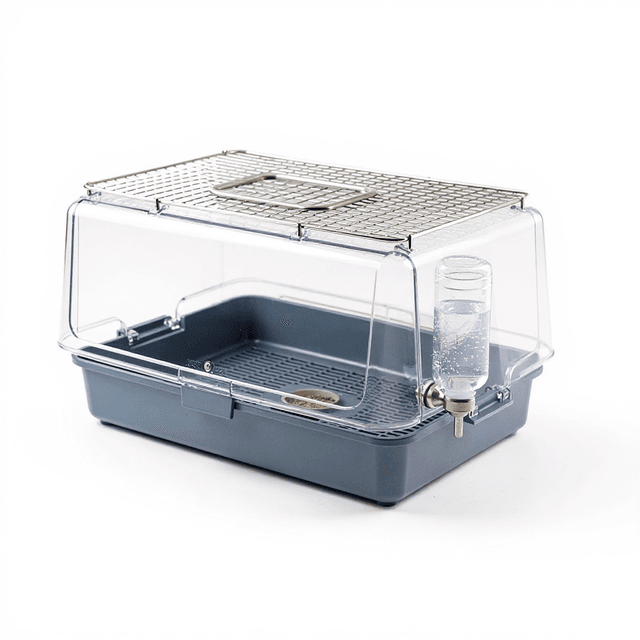
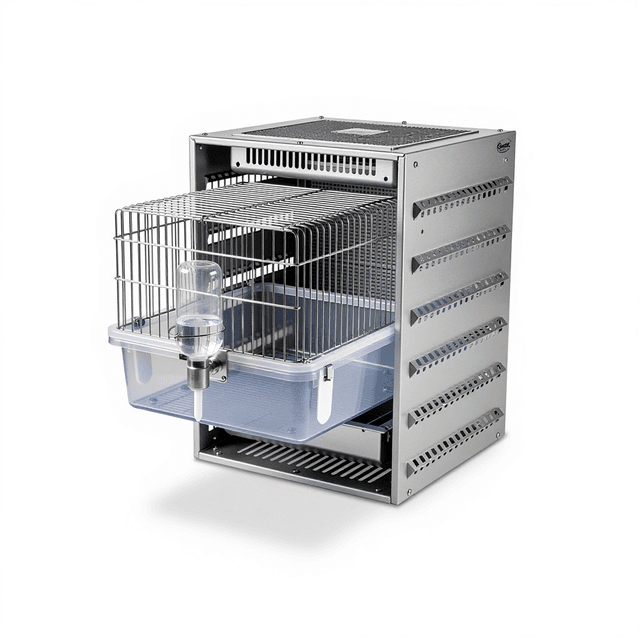
Individually Ventilated Cage System for Rabbits
Individually ventilated cage system providing independent environmental control for rabbit housing with touchscreen-controlled air handling and HEPA filtration to minimize cross-contamination.
| Rack Dimensions | 1565 x 700 x 1760 mm |
| Cage Material | Polycarbonate (PC) or PSU |
| Rack Material | Stainless Steel SS304 |
| AHU Control | Touchscreen, manual or intelligent mode |
| Ventilation Type | Individual supply and exhaust per cage |
| Filtration | Primary + HEPA filters |

The Individually Ventilated Cage System for Rabbits delivers independent environmental control through dedicated supply and exhaust ventilation for each housing unit. The system features polycarbonate or PSU cage construction within a stainless steel SS304 rack framework, providing controlled airflow, temperature, and humidity conditions essential for rabbit research protocols.
The integrated air handling unit operates through touchscreen interface with manual or intelligent control modes, managing primary and HEPA filtration systems that process incoming and exhaust air streams. Individual cage ventilation minimizes cross-contamination risks while maintaining consistent environmental parameters across all housing units, supporting behavioral studies, pharmacological research, and long-term housing protocols where environmental variability must be minimized.
How It Works
The system operates on the principle of directional airflow management, where each cage receives dedicated supply air through HEPA filtration while exhaust air is independently removed. The air handling unit draws ambient air through primary filtration to remove large particulates, then through HEPA filtration achieving 99.97% efficiency for 0.3-micron particles. This processed air is distributed to individual cage supply manifolds, creating positive pressure within each housing unit.
Individual exhaust ports at each cage remove contaminated air, preventing cross-cage airborne transmission of pathogens, allergens, or chemical compounds. The touchscreen control system monitors and adjusts airflow rates, temperature, and humidity parameters in real-time, maintaining consistent environmental conditions regardless of external laboratory fluctuations. This independent ventilation approach eliminates the environmental variability that can introduce experimental confounds in research protocols requiring stable housing conditions.
Features & Benefits
Rack Dimensions
- 1565 x 700 x 1760 mm
Cage Material
- Polycarbonate (PC) or PSU
Rack Material
- Stainless Steel SS304
AHU Control
- Touchscreen, manual or intelligent mode
Ventilation Type
- Individual supply and exhaust per cage
Filtration
- Primary + HEPA filters
Warranty
- 1 Year
Behavioral Construct
- Housing Behavior
- Stress Response
- Social Behavior
Automation Level
- semi-automated
Brand
- ConductScience
Power/Voltage
- 110V-250V
Certifications
- CE, ISO, RoHS
Research Domain
- Behavioral Pharmacology
- Cardiovascular Research
- Developmental Biology
- Immunology
- Pain Research
- Pharmaceutical QC
- Toxicology
Species
- Rabbit
Weight
- 160.0 kg
Dimensions
- L: 65.0 mm
- W: 32.0 mm
- H: 82.0 mm
Comparison Guide
| Feature | This Product | Typical Alternative | Advantage |
|---|---|---|---|
| Ventilation Control | Individual supply and exhaust per cage with touchscreen control | Shared ventilation systems with limited individual cage control | Prevents cross-contamination while allowing independent environmental optimization for different experimental groups. |
| Filtration System | Primary plus HEPA filtration (99.97% at 0.3 microns) | Single-stage filtration with lower efficiency ratings | Provides pathogen-free air supply essential for immunocompromised animals or sterile research conditions. |
| Control Interface | Touchscreen with manual or intelligent operation modes | Basic analog controls or limited digital interfaces | Enables precise parameter adjustment and automated environmental management for consistent research conditions. |
| Construction Materials | Stainless steel SS304 rack with polycarbonate or PSU cages | Coated steel frames with standard plastic cage materials | Provides superior corrosion resistance and chemical compatibility for long-term laboratory use with harsh disinfectants. |
| Power Compatibility | 110V-250V universal voltage compatibility | Fixed voltage requirements specific to regional standards | Simplifies international installation without requiring voltage conversion equipment or electrical modifications. |
This system combines individual cage ventilation with integrated HEPA filtration and touchscreen control, providing superior environmental management compared to shared ventilation approaches. The stainless steel construction and universal power compatibility support long-term laboratory deployment across diverse research facilities.
Practical Tips
Verify airflow rates at each cage position quarterly using calibrated measurement tools to ensure consistent ventilation performance.
Why: Environmental drift can occur over time, affecting research reproducibility and animal welfare.
Replace HEPA filters when differential pressure increases beyond manufacturer specifications or every 6-12 months under normal conditions.
Why: Clogged filters reduce airflow efficiency and can compromise pathogen barrier effectiveness.
Allow 24-48 hours for environmental stabilization after parameter changes before beginning experimental protocols.
Why: Animals require acclimation time to prevent stress-induced physiological changes that could affect research outcomes.
Monitor cage humidity levels during seasonal weather changes as external conditions can affect system performance.
Why: Extreme humidity variations can stress animals and influence experimental variables in physiological studies.
Document environmental parameters daily during critical experimental phases to identify potential confounding variables.
Why: Environmental records support data interpretation and regulatory submission requirements for research validation.
Ensure adequate facility ventilation around the air handling unit to prevent heat buildup and maintain operator safety.
Why: Proper ventilation prevents overheating of system components and maintains comfortable working conditions for animal care staff.
Clean cage supply and exhaust fittings monthly to prevent biofilm formation and maintain optimal airflow distribution.
Why: Accumulated organic matter can harbor pathogens and reduce ventilation effectiveness across individual housing units.
Rotate cage positions periodically during long-term studies to minimize any subtle environmental variations between rack locations.
Why: Even well-controlled systems may have minor position-dependent differences that could introduce experimental bias over extended periods.
Setup Guide
What’s in the Box
- Stainless steel rack assembly with mounting hardware
- Polycarbonate or PSU cage units with ventilation fittings
- Air handling unit with integrated controls
- Primary and HEPA filter cartridges
- Touchscreen control interface
- Power cables and electrical connections (typical)
- Installation and operation manual (typical)
- Warranty documentation (typical)
Warranty
ConductScience provides a 1-year manufacturer warranty covering defects in materials and workmanship, with technical support for installation and operational questions. Extended service contracts available for ongoing maintenance and filter replacement programs.
Compliance
What air exchange rates does the system provide per cage?
Consult product datasheet for specific air change rates per hour. The system provides independent airflow control for each cage through dedicated supply and exhaust manifolds.
How often do the HEPA filters require replacement?
HEPA filter replacement intervals depend on facility air quality and usage intensity. Monitor differential pressure indicators on the touchscreen interface to determine when filtration efficiency drops below acceptable levels.
Can the system accommodate different rabbit sizes or breeding pairs?
Cage dimensions and configuration options should be verified against your specific animal housing requirements. The system supports various cage arrangements within the standard rack framework.
What environmental parameters can be monitored and controlled?
The touchscreen interface manages temperature, humidity, and airflow parameters. Specific ranges and control precision should be confirmed from the technical specifications datasheet.
How does the intelligent control mode function differ from manual operation?
Intelligent mode provides automated adjustment of environmental parameters based on preset conditions, while manual mode requires direct operator input for all parameter changes through the touchscreen interface.
What cleaning and sterilization protocols are compatible with the cage materials?
Polycarbonate and PSU materials resist common laboratory disinfectants and can withstand repeated cleaning cycles. Verify specific chemical compatibility and temperature limits from the material specifications.
Can the system be integrated with facility building management systems?
Integration capabilities with external monitoring or control systems should be confirmed from the technical specifications. The touchscreen interface may support data export or communication protocols.
Have a question about this product?