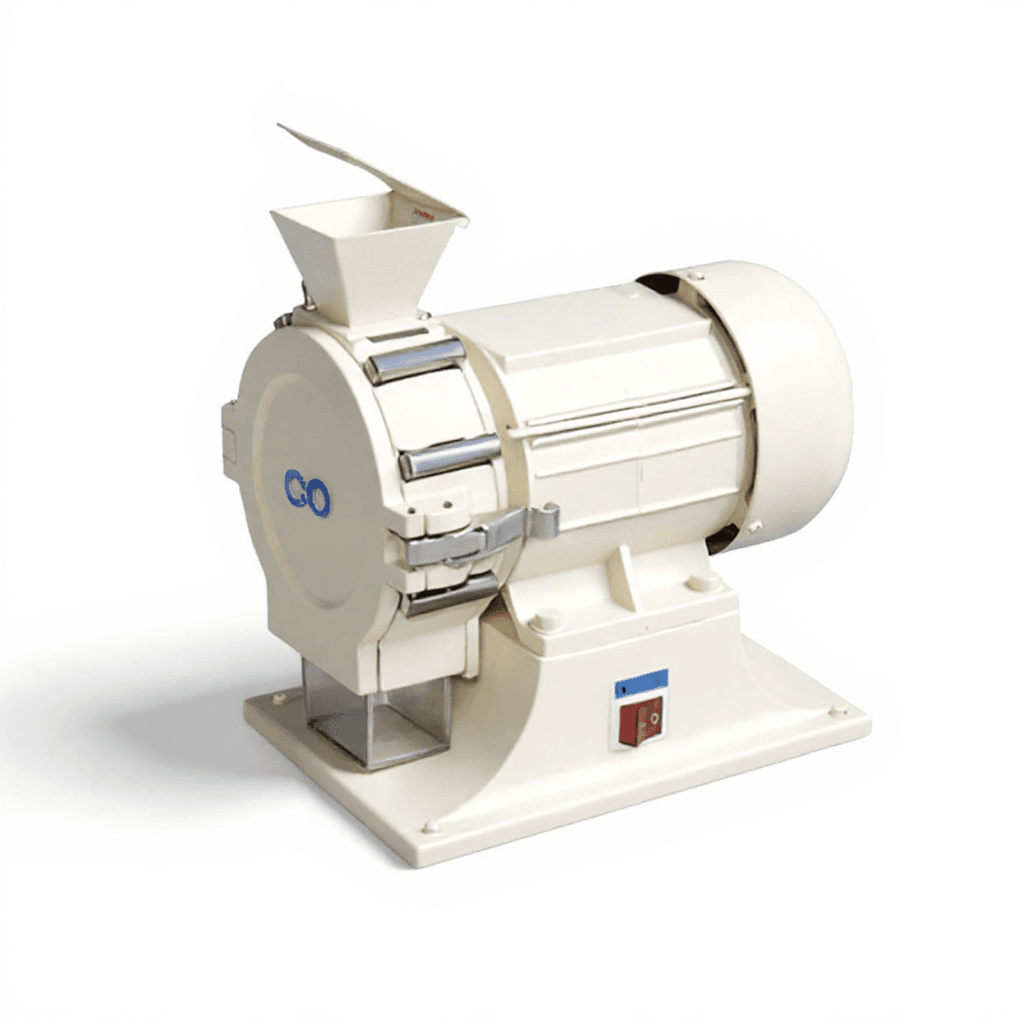
Plant Disintegrator
Specialized mechanical grinder for fine grinding of plant materials with high oil and fiber content using dual-disk mechanism and adjustable blade spacing for consistent particle size reduction.
| grinding_mechanism | rotating disk and fixed disk |
| blade_spacing | adjustable according to material fineness |
| suitable_materials | oiliness and fiber products |
| operation_type | continuous working time |
| design_features | lightweight, small volume, compact structure, attractive appearance, high efficiency |
| Automation Level | manual |
The Plant Disintegrator (BIO-MPD-102) is a specialized mechanical grinder designed for the fine grinding of plant materials, particularly those with high oil and fiber content. The system operates through a dual-disk grinding mechanism featuring a rotating disk working against a fixed disk, providing consistent particle size reduction for botanical samples requiring homogenization or extraction preparation.
This continuous-operation disintegrator features adjustable blade spacing to accommodate varying material fineness requirements, making it suitable for diverse plant processing workflows. The compact benchtop design delivers 180W of grinding power at 1400 rpm, capable of producing 60-120 mesh particle sizes with mesh options of 0.5, 1, and 1.5mm for different applications. The lightweight, compact structure provides high efficiency processing for samples containing oils and fibers that require uniform particle size distribution.
How It Works
The Plant Disintegrator operates on a dual-disk grinding mechanism where a rotating disk works against a fixed disk to achieve particle size reduction. The rotating disk operates at 1400 rpm, creating shear forces that break down plant cell walls and fibrous structures. The adjustable blade spacing allows operators to control the final particle size according to material fineness requirements, with the ability to produce particles ranging from 60-120 mesh.
The continuous operation design enables sustained processing of plant materials without the need for batch loading and unloading. The grinding action is particularly effective for materials with high oil and fiber content, where conventional grinding methods may struggle with material adhesion or clogging. The 180W motor provides sufficient power to process tough plant tissues while maintaining consistent particle size distribution throughout the grinding process.
Interchangeable mesh screens (0.5, 1, and 1.5mm) provide additional control over final particle size, allowing researchers to select the appropriate mesh size for their specific application requirements. The compact benchtop design minimizes vibration and maintains processing efficiency while occupying minimal laboratory space.
Features & Benefits
grinding_mechanism
- rotating disk and fixed disk
blade_spacing
- adjustable according to material fineness
suitable_materials
- oiliness and fiber products
operation_type
- continuous working time
design_features
- lightweight, small volume, compact structure, attractive appearance, high efficiency
Automation Level
- manual
Research Domain
- Analytical Chemistry
- Environmental Monitoring
- Food Science
- Materials Science
- Microbiology
- Pharmaceutical QC
Weight
- 6.37 lbs
Dimensions
- L: 11.02 in
- W: 10.63 in
- H: 7.09 in
Comparison Guide
| Feature | This Product | Typical Alternative | Advantage |
|---|---|---|---|
| Grinding Mechanism | Dual-disk system with rotating disk against fixed disk | Ball mills or blade-type grinders commonly used | Provides controlled shear forces specifically effective for fibrous and oily materials |
| Blade Spacing Control | Adjustable spacing according to material fineness requirements | Fixed blade configurations in most grinders | Allows optimization of particle size for different material characteristics and application needs |
| Operation Mode | Continuous operation capability | Batch processing typical in many grinders | Enables sustained processing without interruptions for large sample volumes |
| Motor Power | 180W at 1400 rpm | Power varies by model and application | Optimized power delivery for plant materials with high oil and fiber content |
| Mesh Options | Interchangeable screens (0.5, 1, and 1.5mm) | Limited mesh options in basic models | Provides flexible particle size control for different analytical requirements |
| Compact Design | Benchtop unit (270×180×280mm) | Larger floor-standing units common | Minimizes laboratory space requirements while maintaining processing efficiency |
This disintegrator provides specialized capabilities for processing challenging plant materials with high oil and fiber content through its dual-disk mechanism and adjustable parameters. The continuous operation design and interchangeable mesh system offer flexibility for various botanical sample preparation requirements.
Practical Tips
Start with wider blade spacing for initial breakdown of tough plant materials, then adjust to closer spacing for final particle size refinement.
Why: This approach prevents overloading the system and ensures consistent grinding throughout the process.
Inspect and clean the dual-disk mechanism regularly to remove accumulated plant residues that may affect grinding efficiency.
Why: Plant materials with high oil content can build up on grinding surfaces, reducing performance over time.
Verify particle size distribution periodically using sieve analysis to ensure consistent performance across different material types.
Why: Material characteristics can affect grinding efficiency, and periodic verification maintains analytical reliability.
Always ensure the unit is properly grounded and stop operation before making any adjustments to blade spacing or mesh screens.
Why: The rotating disk mechanism poses injury risk if accessed during operation.
Process reference materials with known particle size characteristics to establish baseline performance parameters for your specific applications.
Why: This provides quality control benchmarks for routine sample processing and troubleshooting.
If material clogging occurs, check mesh screen size selection and blade spacing adjustment for the specific plant material being processed.
Why: Different plant materials may require parameter optimization to prevent blockages and maintain flow.
Allow processed material to cool before collection, as the grinding action may generate heat in oil-containing samples.
Why: Heat generation can affect material properties and may pose handling risks for certain plant extracts.
Setup Guide
What’s in the Box
- Plant Disintegrator main unit
- Mesh screen set (0.5, 1, and 1.5mm) (typical)
- Power cable
- User manual and operation guide (typical)
- Cleaning brush and tools (typical)
- Safety documentation (typical)
Warranty
ConductScience provides a standard 1-year manufacturer warranty covering defects in materials and workmanship, with technical support available for operation and maintenance guidance.
Compliance
References
Background reading relevant to this product:
What particle size range can this disintegrator achieve with different mesh configurations?
The system produces 60-120 mesh particles with interchangeable screens of 0.5, 1, and 1.5mm. Final particle size depends on the combination of mesh selection, blade spacing adjustment, and material characteristics.
How does the adjustable blade spacing feature work for different plant materials?
Blade spacing can be adjusted according to material fineness requirements. Wider spacing is typically used for initial breakdown of tough materials, while closer spacing provides finer grinding for materials requiring smaller particle sizes.
What types of plant materials are most suitable for this grinding system?
The disintegrator is specifically designed for plant materials with high oil and fiber content, where conventional grinders may experience clogging or adhesion issues. It effectively processes tough botanical specimens that require uniform particle distribution.
How should the unit be cleaned between different sample types to prevent cross-contamination?
All contact surfaces including disks and mesh screens should be thoroughly cleaned between samples. Consult the user manual for recommended cleaning procedures specific to your application requirements.
What is the maximum sample throughput for continuous operation?
The unit operates continuously without batch limitations, but actual throughput depends on material characteristics, desired fineness, and processing parameters. Consult product datasheet for specific throughput specifications.
Can this disintegrator handle wet or moisture-containing plant materials?
The dual-disk mechanism is designed for various plant materials including those with oil content. For specific moisture tolerance limits and wet processing capabilities, consult the technical specifications.
How does this compare to other grinding methods for plant sample preparation?
Unlike ball mills or knife mills, the dual-disk mechanism provides controlled shear forces that are particularly effective for fibrous materials. The continuous operation and adjustable parameters offer advantages over batch-type grinders for consistent particle size distribution.
Have a question about this product?