Vertical Planetary Ball Mill(Square Type)
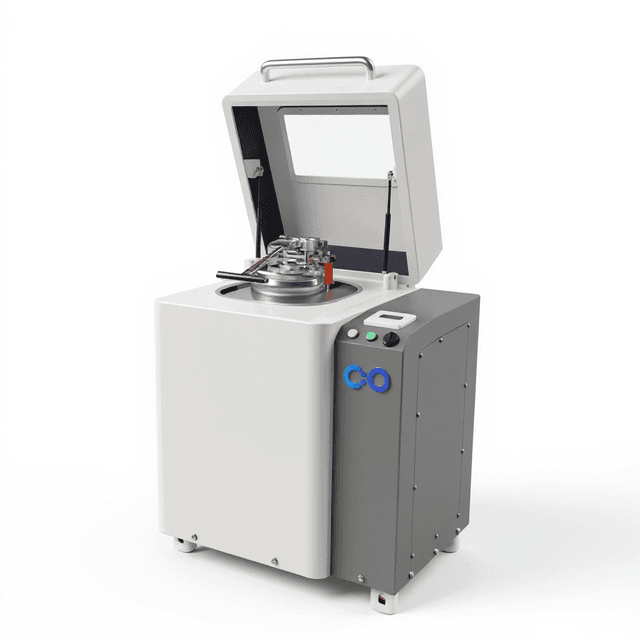
Vertical planetary ball mill with square 3D curve chassis and low-noise gear drive.
2 L total capacity; 4 × 50–500 mL pots; 35–335 rpm revolution / 70–670 rpm rotation; minimum 0.1 µm output; 0.75 kW; supports 2 or 4-pot modes.

Louise Corscadden, PhD
Director of Science · ConductScience
Ask Louise about Vertical Planetary Ball Mill(Square Type) fit, setup, configuration, or quote prep.
Already working with us? Sign in to connect this with My Scientist.
Key Specifications
Full details →- Model fit
- Configured during quote
- SKU family
- BIO-0660
- Shipping box
- 42.0 x 43.6 x 38.0 cm
- Ordering
- Online checkout and quote request available
- Category
- Solid Processing
- Build notes
- Confirm accessories, station layout, and support needs before purchase
This vertical planetary ball mill features a square 3D curve chassis design and
low-noise special gear transmission. Four ball grinding tanks on a rotating turntable
experience counter-rotating planetary motion, generating high-speed impacts that
grind dry or wet samples to a minimum particle size of 0.1 µm. A frequency converter
provides stepless speed regulation from 35 to 335 rpm (revolution) with 1 to 9,999
minute timer and reciprocal (alternating direction) timing. The unit can run with 2 or
4 pots loaded simultaneously.
Technical Specifications
| Parameter | BKBM-V2S |
|---|---|
| Total Capacity | 2 L |
| Individual Pot Volume | 50–500 mL |
| Pot Quantity | 4 |
| Revolution Speed | 35–335 rpm |
| Rotation Speed | 70–670 rpm |
| Noise Level | 60 ±5 dB |
| Timer Range | 1–9,999 min |
| Reciprocal Timer | 1–999 min |
| Feed Size | Soft/crispy <10 mm; other <3 mm |
| Output Granularity | Min 0.1 µm |
| Power Consumption | 0.75 kW |
| Power Supply | AC 110/220 V ±10%, 50/60 Hz |
| Dimensions (W×D×H) | 770 × 470 × 570 mm |
| Net Weight | 93 kg |
| Gross Weight | 113 kg |
How It Works
The planetary ball mill operates on the principle of high-energy mechanical impact and friction. The grinding bowls are mounted on a rotating support disc (sun wheel) that rotates around its own axis while the bowls simultaneously rotate around their individual axes in the opposite direction. This planetary motion creates centrifugal forces that are significantly higher than gravitational acceleration, typically reaching 20-30 times gravity.
During operation, grinding balls inside each bowl are subjected to superimposed rotational movements, creating alternating high-energy impacts and friction between balls and sample material against the bowl walls. The resulting collision energies can reach several times higher than conventional ball mills, enabling efficient size reduction of hard materials and mechanical activation of chemical processes. The vertical square design provides enhanced stability and allows for precise control of grinding parameters while minimizing vibration transfer to surrounding equipment.
The grinding process involves three primary mechanisms: compression of particles between grinding balls and bowl walls, impact fracturing as balls drop from the bowl wall, and attrition through sliding friction. This combination of forces enables processing of materials ranging from soft polymers to hard ceramics while achieving particle sizes from micrometers to nanometers depending on grinding time and conditions.
Features & Benefits
Automation Level
- semi-automated
Research Domain
- Analytical Chemistry
- Environmental Monitoring
- Food Science
- Materials Science
- Microbiology
- Pharmaceutical QC
Shipping weight
- 29.98 lb
Shipping box
- L: 42.0 cm
- W: 43.6 cm
- H: 38.0 cm
| Feature | This Product | Typical Alternative | Advantage |
|---|---|---|---|
| Configuration Design | Vertical square type configuration | Many models use horizontal planetary or conventional vertical designs | Enhanced stability reduces vibration transfer and improves operator accessibility for sample loading. |
| Grinding Mechanism | Planetary ball mill technology | Entry-level systems may use simple tumbling or vibratory mechanisms | Delivers significantly higher impact energies enabling faster processing and finer particle sizes. |
| Operation Mode | Programmable grinding cycles | Basic models often provide only continuous operation | Automated pause intervals prevent overheating and ensure consistent processing conditions. |
| Safety Systems | Integrated safety interlocks | Lower-cost alternatives may have minimal safety features | Prevents operator injury and equipment damage during high-energy grinding operations. |
This vertical planetary ball mill combines high-energy mechanical processing capabilities with enhanced operational stability through its square-type design. The system provides programmable operation control and integrated safety features for reliable sample preparation across diverse research applications.
Practical Tips
Always balance grinding bowls by weight when using multiple bowls to prevent excessive vibration and ensure uniform grinding.
Why: Unbalanced loads can damage the drive mechanism and produce inconsistent results across bowls.
Inspect grinding balls regularly for wear and replace when diameter reduction exceeds 10% of original size.
Why: Worn balls reduce grinding efficiency and may introduce contamination from ball material into samples.
Verify rotational speeds periodically using a tachometer to ensure parameter settings match actual operation.
Why: Speed variations can significantly affect grinding kinetics and reproducibility of results.
Never exceed maximum recommended sample and ball loading volumes to prevent bowl failure under high centrifugal forces.
Why: Overloading can cause catastrophic failure of grinding bowls and create serious safety hazards.
If grinding efficiency decreases suddenly, check for worn seals or loose mounting components before adjusting process parameters.
Why: Mechanical issues often manifest as reduced performance before complete component failure.
Document all grinding parameters including speed, time, pause intervals, and ambient temperature for each sample batch.
Why: Reproducible results require consistent conditions, and parameter tracking enables troubleshooting and method optimization.
Setup Guide
What’s in the Box
- Main ball mill unit (typical)
- Grinding bowls set (typical)
- Grinding balls assortment (typical)
- Safety clamping system (typical)
- Power cable (typical)
- User manual and operation guide (typical)
- Basic tool set for maintenance (typical)
Warranty
ConductScience provides a standard one-year manufacturer warranty covering defects in materials and workmanship, with technical support available for operation and maintenance guidance.
Compliance
What ball-to-sample ratio should I use for optimal grinding efficiency?
Typical ball-to-sample ratios range from 10:1 to 20:1 by weight, depending on material hardness and desired particle size. Start with 15:1 for most applications and adjust based on grinding efficiency and contamination concerns.
How do I prevent contamination from grinding media?
Select grinding bowl and ball materials that are harder than your sample and chemically inert. Common options include hardened steel, stainless steel, tungsten carbide, and zirconia depending on sample composition and analytical requirements.
What factors determine grinding time and speed settings?
Material hardness, initial particle size, desired final size, and heat sensitivity determine parameters. Hard materials may require 30-60 minutes at moderate speeds, while soft materials may need only 5-15 minutes to prevent over-grinding.
How do I monitor temperature during grinding to prevent sample degradation?
Use pause intervals between grinding cycles to allow cooling, monitor bowl temperature manually, and reduce grinding speed if excessive heating occurs. Heat-sensitive materials may require liquid nitrogen cooling or shorter cycle times.
Can this mill handle wet grinding applications?
Consult product specifications for wet grinding capabilities. If supported, use minimal liquid volumes and ensure proper sealing to prevent leakage. Solvent compatibility with bowl materials must be verified.
What particle size range can I achieve with this mill?
Particle sizes typically range from micrometers to nanometers depending on material properties, grinding time, and parameters. Final size distribution should be verified using appropriate particle size analysis methods.
How do I clean grinding bowls between different samples?
Thorough cleaning with appropriate solvents followed by drying is essential to prevent cross-contamination. Some applications may require dedicated bowls for specific sample types or analytical methods.
What grinding media is recommended for ceramic materials such as metal oxides, frit, or clay?
Zirconia pots and balls are recommended for ceramic materials including metal oxides, frit, and clay. Zirconia minimizes contamination and is suitable for achieving fine particle sizes down to 300 nm.
What ball filling amount is recommended for 100 mL pots?
For 100 mL pots, 150 g of balls is the standard recommended filling. Using smaller balls produces finer particles. A mix of large and small balls can also be used to optimize the particle size distribution.
Can the ball mill be used to grind fat-containing materials like milk powder?
Yes, but with caution. Milk powder contains fat and lactose that can melt under the heat generated during grinding, causing the powder to stick to the vessel walls and balls or clump together. Shorter cycles and lower intensities are recommended for fatty materials.
What is the minimum particle size achievable with this ball mill?
The minimum achievable particle size is 0.1 µm (100 nm). However, the actual fineness depends on the material's hardness, brittleness, and processing parameters (dry vs. wet grinding, ball-to-material ratio). Not all materials can reach 0.1 µm — the achievable particle size should be verified experimentally for each material.
What grinding media specification comes with the 100 mL zirconia jar?
The 100 mL zirconia jar includes a standard set of zirconia balls weighing 0.09 kg, with a mixed size distribution from 5 mm to 15 mm. For most materials, a 1:1 volume ratio of material to grinding media is recommended as a starting point.
Have a question about this product?
Have a question? Just ask.
Send it over and we'll email you a personalized answer — no call, no scheduling.
Prefer to talk it through?