Knife Mill
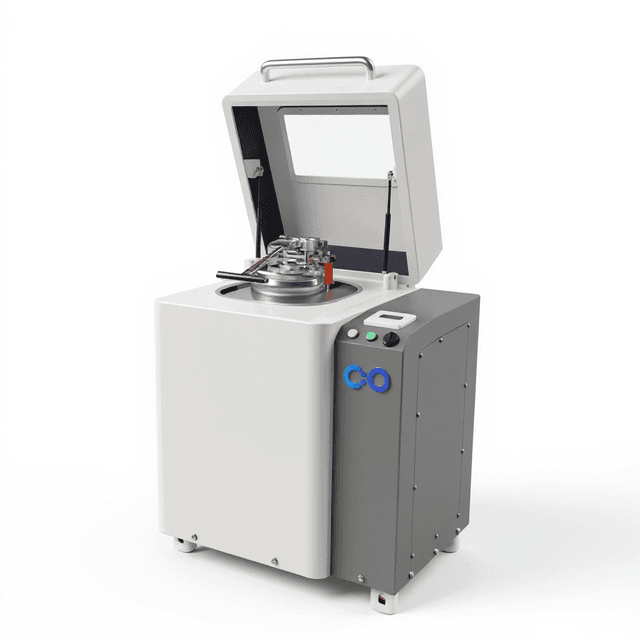
2000 W knife mill for grinding dry, moist, fibrous, and elastic materials to ≤300 µm in seconds.
1,000–15,000 rpm; ≤700 mL sample volume; 20-program memory; forward/reverse and intermittent modes. Multiple knife head options.

Louise Corscadden, PhD
Director of Science · ConductScience
Ask Louise about Knife Mill fit, setup, configuration, or quote prep.
Already working with us? Sign in to connect this with My Scientist.
Key Specifications
Full details →- Model fit
- Configured during quote
- SKU family
- BIO-BK-KM800
- Shipping box
- 42.0 x 43.6 x 38.0 cm
- Ordering
- Online checkout and quote request available
- Category
- Solid Processing
- Build notes
- various materials available
This 2000 W knife mill pulverizes dry, soft, elastic, fibrous, and medium-hard
samples — including materials with high moisture, oil, or fat content — to analytical
fineness of ≤300 µm within seconds. Variable speed from 1,000 to 15,000 rpm and a
20-program memory allow method optimization for different sample types. Forward/reverse
rotation and intermittent modes prevent heat buildup in heat-sensitive samples.
Multiple knife head options (stainless steel, serrated stainless steel, titanium) and
sterilizable accessories (stainless steel, PP, PC) support diverse analytical
workflows in food, agriculture, and biology.
Technical Specifications
| Parameter | BK-KM800 |
|---|---|
| Speed Range | 1,000–15,000 rpm |
| Sample Volume | ≤700 mL |
| Final Particle Size | ≤300 µm |
| Program Memory | 20 programs |
| Grinding Time | 0–9,999 s (adjustable) |
| Power Consumption | 2,000 W |
| Power Supply | AC 220 V, 50/60 Hz (110 V optional) |
| External Dimensions (W×D×H) | 400 × 350 × 550 mm |
| Net Weight | 23 kg |
| Gross Weight | 28 kg |
How It Works
The knife mill operates through direct cutting action using a serrated steel blade positioned at the center of the grinding cup bottom. The 2000-watt industrial motor rotates the blade at high speed, creating shearing forces that cut through sample materials rather than crushing or impacting them. This cutting mechanism is particularly effective for fibrous, elastic, and heterogeneous materials that resist conventional grinding methods.
Forward and reverse rotation modes, combined with intermittent operation capability, optimize processing conditions based on sample characteristics. The programmable control system allows researchers to establish standardized protocols with precise timing and rotation patterns, ensuring reproducible particle size reduction across sample batches. The grinding cup design accommodates various materials and can be equipped with different top cover configurations to handle samples with varying moisture content.
Features & Benefits
Blade Type
- serrated blade
Blade Position
- center of bottom of grinding cup
Motor Type
- industrial motor
Rotation Modes
- forward/reverse rotation modes and intermittent mode
Program Storage
- 20 groups of commonly used programs
Control Features
- click function, program settings, method memory and storage functions
Safety Features
- safety protection lock
Grinding Cup Materials
- various materials available
Sterilization Capability
- high-temperature and high-pressure sterilization for accessories
Top Cover Options
- gravity top cover and weight-reduction top cover available
Overflow Channel
- available on gravity top cover for high liquid content samples
Automation Level
- semi-automated
Material
- Steel
Power/Voltage
- 2000 watts
Display Type
- Digital
Research Domain
- Agricultural Research
- Analytical Chemistry
- Environmental Monitoring
- Food Science
- Materials Science
- Pharmaceutical QC
Shipping weight
- 68.34 lb
Shipping box
- L: 42.0 cm
- W: 43.6 cm
- H: 38.0 cm
| Feature | This Product | Typical Alternative | Advantage |
|---|---|---|---|
| Motor Power | 2000-watt industrial motor | Entry-level models typically offer 500-1000 watts | Higher power enables processing of tougher materials and maintains consistent performance under load |
| Program Storage | 20 commonly used programs with digital memory | Basic models often lack programmable memory | Standardized protocols ensure reproducible sample preparation across research batches |
| Rotation Control | Forward/reverse rotation with intermittent mode | Standard models typically offer single-direction operation | Multiple rotation modes optimize processing for different sample characteristics and prevent material buildup |
| Safety Features | Integrated safety protection lock system | Basic safety interlocks in standard models | Enhanced safety features ensure secure operation in busy laboratory environments |
| Sterilization Capability | High-temperature and high-pressure sterilization for accessories | Limited sterilization options in basic models | Supports sterile sample handling requirements and prevents cross-contamination |
The BIO-BK-KM800 combines high-power industrial motor performance with programmable digital controls and comprehensive safety features. The 2000-watt motor and multiple rotation modes provide versatile sample processing capabilities, while the 20-program memory system enables standardized laboratory protocols.
Practical Tips
Verify blade alignment and grinding cup positioning before each use to ensure consistent cutting performance.
Why: Proper blade alignment directly affects particle size uniformity and processing efficiency.
Inspect and sharpen the serrated blade regularly, especially after processing abrasive materials.
Why: Sharp blades maintain cutting efficiency and prevent excessive heat generation during processing.
Use intermittent operation mode for heat-sensitive samples to prevent thermal degradation.
Why: Intermittent operation allows heat dissipation and preserves sample integrity during processing.
Switch to reverse rotation if material builds up around the blade or cup walls during processing.
Why: Reverse rotation helps redistribute material and prevents clogging in sticky or fibrous samples.
Process duplicate samples using identical stored programs to verify reproducibility of particle size reduction.
Why: Standardized processing parameters ensure consistent results across sample batches and research studies.
Always verify safety lock engagement before loading samples and never attempt to override protection systems.
Why: Safety locks prevent accidental blade contact and ensure secure operation during high-speed processing.
Select grinding cup material based on sample chemistry to prevent contamination and chemical interference.
Why: Appropriate cup material selection maintains sample purity and prevents analytical artifacts.
Clean and sterilize accessories immediately after processing biological samples to prevent cross-contamination.
Why: Prompt cleaning prevents sample residue buildup and maintains sterile processing conditions.
Setup Guide
What’s in the Box
- Knife mill main unit with 2000W motor
- Standard grinding cup with serrated blade
- Digital control interface
- Safety protection system
- Power cable
- Operating manual with program setup guide
- Basic maintenance tools (typical)
Warranty
ConductScience provides a standard one-year manufacturer warranty covering defects in materials and workmanship, with technical support available for operational guidance and troubleshooting assistance.
Compliance
References
Background reading relevant to this product:
What types of materials can be processed effectively with this knife mill?
The cutting action is particularly effective for fibrous materials, preserved foods, plant tissues, and samples with high fat content that resist conventional impact grinding methods.
How do I select appropriate processing parameters for different sample types?
Use forward rotation for most materials, reverse rotation for sticky samples, and intermittent mode for heat-sensitive materials. Store optimized parameters in the 20-program memory.
What grinding cup materials are available for different applications?
Multiple grinding cup materials are available to prevent contamination and chemical interference, though specific materials should be confirmed with product datasheet.
How do I maintain sterile conditions during sample processing?
All accessories can be sterilized using high-temperature and high-pressure sterilization methods, and the safety lock system prevents contamination during operation.
What particle size range can I expect after processing?
Final particle size depends on processing time, sample characteristics, and blade sharpness. Consult product datasheet for specific size reduction capabilities.
How do I handle samples with high moisture content?
Use the gravity top cover with overflow channel for high liquid content samples, and consider intermittent operation to prevent material accumulation.
What routine maintenance is required for consistent performance?
Regular blade inspection and sharpening, grinding cup cleaning, and motor housing maintenance are essential for optimal cutting performance and sample quality.
Have a question about this product?
Have a question? Just ask.
Send it over and we'll email you a personalized answer — no call, no scheduling.
Prefer to talk it through?
Frequently Bought Together