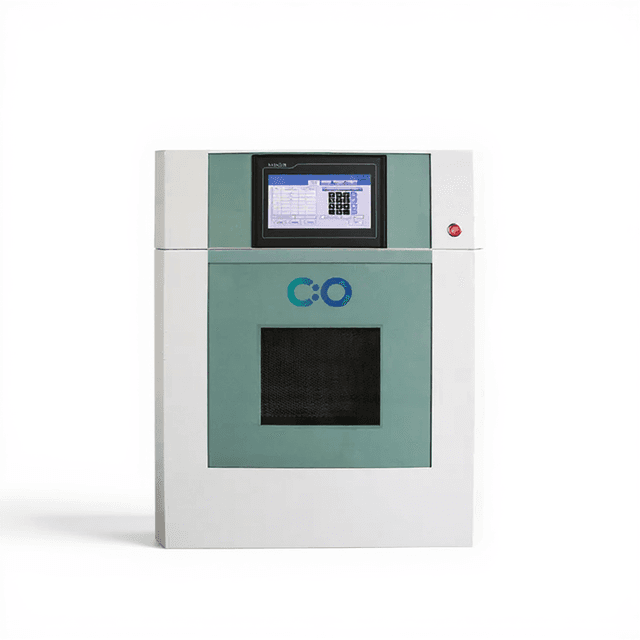
Laboratory Roller Ball Mill
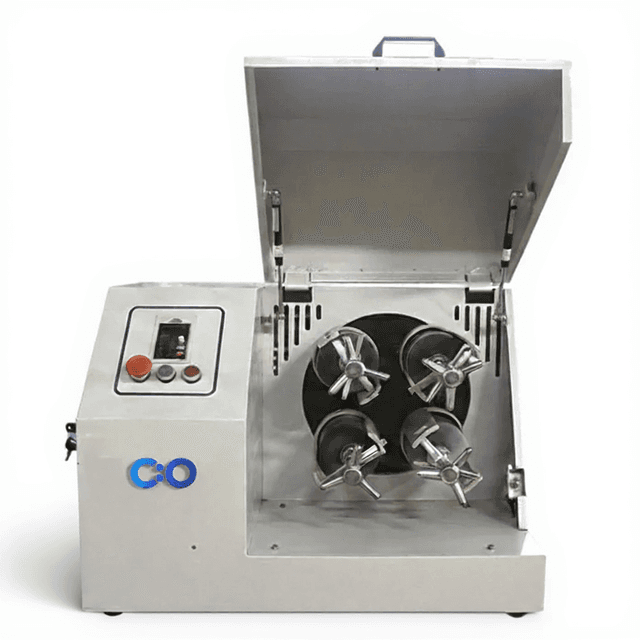
Laboratory roller ball mill for superfine grinding and mixing of laboratory and small-batch production samples.
Accepts jars from 0.5 to 15 L; 60–570 rpm; supports dry and wet grinding. Compatible with stainless steel, corundum, nylon, and PTFE tanks.

Louise Corscadden, PhD
Director of Science · ConductScience
Ask Louise about Laboratory Roller Ball Mill fit, setup, configuration, or quote prep.
Already working with us? Sign in to connect this with My Scientist.
Key Specifications
Full details →- Model fit
- grinding jars with different outer diameters within a certain range
- SKU family
- CS-958319
- Shipping box
- 0.3 x 36.0 x 27.0 cm
- Ordering
- Online checkout and quote request available
- Category
- Solid Processing
- Build notes
- Confirm accessories, station layout, and support needs before purchase
This laboratory roller ball mill provides superfine grinding and mixing for
electronic materials, magnetic materials, ceramic slurries, non-metallic and metal
minerals, and new materials. Pulverization occurs through impact and friction as
grinding media and sample material are lifted and fall within a rotating cylinder.
The adjustable roller shaft accommodates different jar sizes, and both dry and wet
grinding methods are supported. Optional ball mill tanks in stainless steel, corundum,
nylon, or PTFE, with grinding balls in stainless steel, zirconia, alumina, agate,
tungsten carbide, and other materials, allow the system to be configured for specific
material compatibility requirements.
Technical Specifications
| Parameter | BKBM-5 | BKBM-15 |
|---|---|---|
| Jar Capacity | 0.5–5 L | 0.5–15 L |
| Pot Quantity | 1 | 1 |
| Spindle Speed Range | 60–570 rpm ±10 | 60–570 rpm ±10 |
| Effective Roller Shaft Length | 260 mm | 340 mm |
| Adjustable Roller Distance | 120 mm | 140 mm |
| Max Load per Tank | 35 kg | 80 kg |
| Power Consumption | 0.4 kW | 0.75 kW |
| Power Supply | AC 220 V, 50/60 Hz | |
| External Dimensions (W×H×D) | 730 × 415 × 260 mm | 845 × 435 × 270 mm |
| Net Weight | 32 kg | 43 kg |
| Gross Weight | 45 kg | 60 kg |
How It Works
The roller ball mill operates on the principle of compression and attrition between grinding media and the sample material. The grinding jar rotates while being compressed between two parallel rollers, creating a complex motion that combines rotation and revolution. This dual-action generates high-energy impacts and shearing forces throughout the sample volume.
As the jar rotates, grinding balls inside cascade and impact the sample material against the jar walls. The rolling action of the external rollers creates additional compressive forces that enhance the grinding efficiency. The variable speed control (60-570 rpm) allows optimization of grinding energy based on material hardness and desired particle size reduction.
The adjustable roller spacing accommodates different jar diameters within the specified range, enabling use of various grinding media types and volumes. Both dry grinding (for brittle materials) and wet grinding (using liquid media to prevent agglomeration) can be performed using appropriate jar and media selections.
Features & Benefits
Grinding Types
- dry and wet grinding
Jar Compatibility
- grinding jars with different outer diameters within a certain range
Particle Size Uniformity
- uniform fine particle size
Structure
- compact structure
Operation
- easy to operate
Work Efficiency
- high work efficiency
Adjustable Roller
- moving roller adjustment for different jar diameters
Jar Replacement
- convenient jar replacement
Automation Level
- semi-automated
Research Domain
- Analytical Chemistry
- Environmental Monitoring
- Food Science
- Materials Science
- Microbiology
- Pharmaceutical QC
Shipping weight
- 77.16 lb
Shipping box
- L: 0.3 cm
- W: 36.0 cm
- H: 27.0 cm
| Feature | This Product | Typical Alternative | Advantage |
|---|---|---|---|
| Capacity Range | 0.5-15L depending on model (BKBM-5: 0.5-5L, BKBM-15: 0.5-15L) | Entry-level models often limited to 1-5L capacity | Larger capacity options reduce processing time for bulk samples while maintaining laboratory-scale operation. |
| Speed Control Range | 60-570 rpm with ±10 rpm precision | Many models offer narrower speed ranges or less precise control | Wide speed range enables optimization for both soft and hard materials with precise repeatability. |
| Load Capacity | 35kg (BKBM-5) to 80kg (BKBM-15) maximum load per tank | Smaller bench-top models typically handle 10-30kg loads | Higher load capacity accommodates dense materials and larger sample batches for improved throughput. |
| Jar Compatibility | Adjustable roller spacing for different jar diameters within specified range | Fixed roller spacing limits jar size options | Flexible jar compatibility allows optimization of grinding media and sample volume ratios for different applications. |
| Grinding Modes | Both dry and wet grinding supported with uniform results | Some models optimized for either dry or wet grinding exclusively | Dual capability eliminates need for separate equipment when processing diverse sample types. |
This roller ball mill combines high-capacity processing (up to 15L) with precise speed control and flexible jar compatibility. The adjustable roller system and dual grinding capability provide operational versatility for diverse material processing workflows in laboratory environments.
| Model | SKU | Listed price | Status | Shipping box |
|---|---|---|---|---|
| BKBM-15 | BIO-BKBM-15 | $2,890.00 | Available | 0.3 x 36.0 x 27.0 cm |
| BKBM-5 | BIO-BKBM-5 | $2,890.00 | Available | 0.3 x 36.0 x 27.0 cm |
Practical Tips
Verify rotation speed accuracy using a tachometer periodically, especially after extended use or maintenance.
Why: Speed accuracy directly affects grinding energy and particle size reproducibility.
Inspect grinding media for wear and replace when balls become significantly reduced in size or show flat spots.
Why: Worn media reduces grinding efficiency and can introduce contamination into samples.
Pre-break large samples to approximately 5-10mm before ball mill grinding to improve efficiency and prevent media damage.
Why: Starting with smaller particles reduces grinding time and extends media life.
Never exceed maximum load capacity and ensure jar is properly secured before operation.
Why: Overloading can cause mechanical failure and improper securing creates safety hazards.
Document grinding parameters (speed, time, media type, sample size) for each batch to ensure reproducible results.
Why: Consistent documentation enables method validation and troubleshooting of unexpected results.
If grinding efficiency decreases, check for proper jar-to-roller contact and adjust roller spacing if needed.
Why: Poor contact reduces energy transfer and extends processing time unnecessarily.
For wet grinding, use minimal liquid volume sufficient to create a paste-like consistency.
Why: Excess liquid reduces grinding efficiency while insufficient liquid fails to prevent agglomeration.
Setup Guide
What’s in the Box
- Laboratory roller ball mill main unit
- Stainless steel grinding jar (typical)
- Grinding media set (typical)
- Power cable
- User manual and operation guide
- Safety instructions
Warranty
ConductScience provides a standard one-year manufacturer warranty covering defects in materials and workmanship. Technical support includes installation guidance, operational training, and troubleshooting assistance.
Compliance
What factors should I consider when selecting grinding speed for different materials?
Start with lower speeds (60-150 rpm) for soft or temperature-sensitive materials to prevent over-heating. Use higher speeds (300-570 rpm) for hard materials like ceramics or minerals. Monitor temperature and check particle size progression to optimize speed and grinding time.
How do I determine the appropriate ball-to-sample ratio?
Typical ratios range from 1:1 to 1:3 (sample:grinding media) by weight. Use higher ratios for harder materials requiring more grinding energy. Ensure total load does not exceed maximum capacity: 35kg for BKBM-5, 80kg for BKBM-15.
Can I process heat-sensitive materials without degradation?
Yes, use wet grinding with appropriate liquid media to dissipate heat, or employ intermittent grinding cycles with cooling periods. Lower rotation speeds also reduce heat generation during processing.
What maintenance is required for optimal performance?
Clean grinding jars thoroughly between samples to prevent cross-contamination. Inspect and replace grinding media when worn. Check roller alignment and lubricate moving parts according to manufacturer schedule.
How does particle size uniformity compare to other grinding methods?
Roller ball mills typically provide better size uniformity than hammer mills or blade grinders due to the controlled compression and attrition forces. The rolling action creates consistent energy distribution throughout the sample volume.
What jar materials are compatible with different sample types?
Stainless steel jars work for most applications. Consider specialized materials like tungsten carbide for extremely hard samples or zirconia for contamination-sensitive applications. Consult product datasheet for specific compatibility information.
Have a question about this product?
Have a question? Just ask.
Send it over and we'll email you a personalized answer — no call, no scheduling.
Prefer to talk it through?
Frequently Bought Together