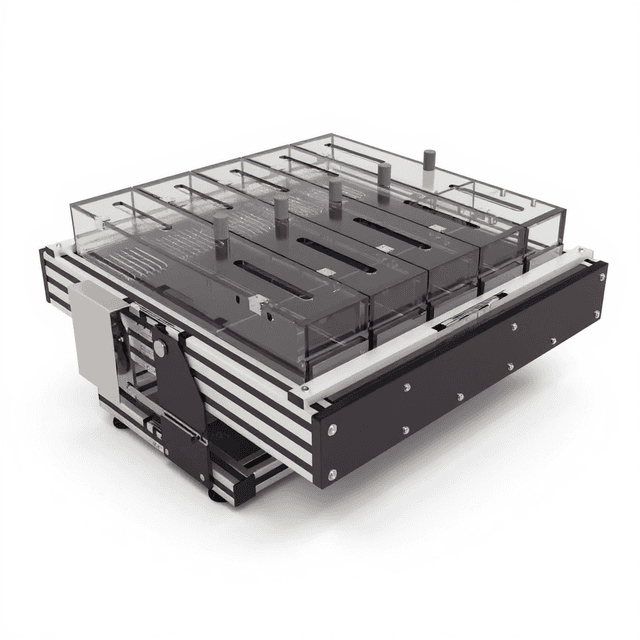
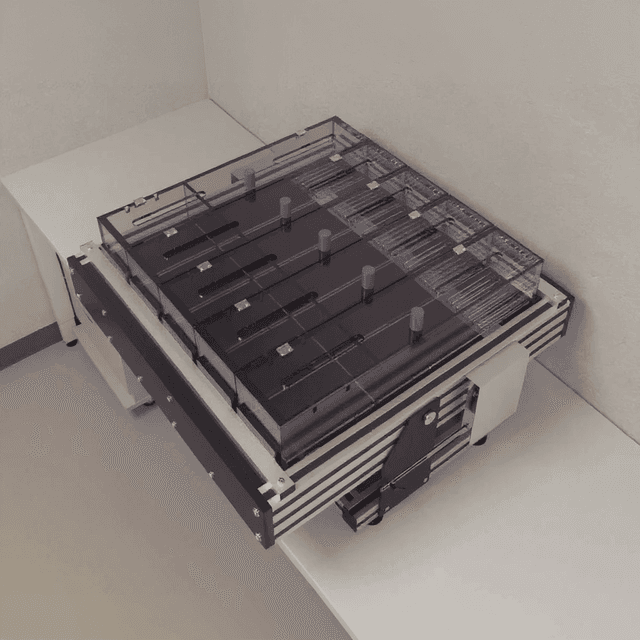
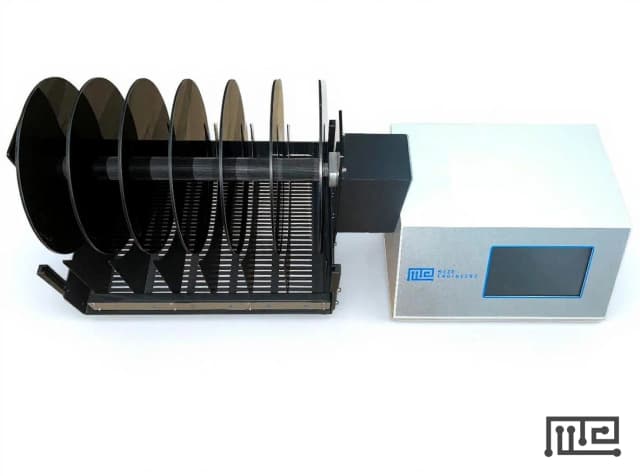
Rodent Metabolic Treadmill
Motorized treadmill system with integrated metabolic monitoring for precise assessment of exercise capacity and physiological responses in laboratory rodents.
| incline_range | 0 to 25 degrees |
| slope_degree | ±35° |
| shock_current | 0-4mA adjustable in 0.1mA units |
| shock_frequency | 1Hz, 2Hz, or 3Hz repetition rate |
| noise_level | Less than 40 dB |
| pump_flow | 1-1000 ml per minute, adjustable |
The Rodent Metabolic Treadmill provides precise measurement of exercise capacity and metabolic parameters in laboratory rodents through controlled forced exercise protocols. This motorized treadmill system combines variable speed control (0-80 meters per minute) with integrated metabolic monitoring capabilities, enabling simultaneous assessment of oxygen consumption, carbon dioxide production, and physiological responses during exercise testing. The system accommodates both mice and rats in individual testing lanes with species-specific dimensions and incorporates adjustable incline (0-25 degrees), electrical motivation grid (0-4mA), and comprehensive environmental monitoring.
Built with acrylic and aluminum construction, the system features touchscreen GUI control, real-time data acquisition with 1ml accuracy for gas measurements, and operates quietly (less than 40 dB) to minimize stress artifacts. The integrated battery system (24v10AH lithium-ion) provides at least 8 hours of operation, while the adjustable pump flow system (1-1000 ml per minute) enables precise control of metabolic chamber conditions for reproducible exercise physiology assessments.
How It Works
The Rodent Metabolic Treadmill operates on the principle of forced exercise combined with indirect calorimetry to measure metabolic parameters during controlled locomotion. The motorized belt system provides precise speed control from 0-80 meters per minute with 0.1 meter/minute increments, while the adjustable incline mechanism (0-25 degrees) enables graded exercise protocols that progressively increase workload demands.
Metabolic measurements utilize indirect calorimetry principles, where oxygen consumption and carbon dioxide production are continuously monitored through the integrated gas analysis system with 1ml accuracy. The sealed metabolic chamber maintains controlled environmental conditions with temperature regulation (5-40°C operating range), humidity control (0-95% operating range), and precise air pressure monitoring (0.075% accuracy). Gas exchange measurements enable calculation of respiratory exchange ratio (RER), energy expenditure, and substrate utilization patterns.
The electrical motivation system employs a shock grid with adjustable current (0-4mA in 0.1mA increments) and selectable frequency (1Hz, 2Hz, or 3Hz) to encourage consistent locomotion. The touchscreen GUI provides real-time monitoring and control of all parameters, while the integrated data acquisition system records physiological responses, exercise performance metrics, and environmental conditions for comprehensive analysis of exercise capacity and metabolic function.
Features & Benefits
incline_range
- 0 to 25 degrees
slope_degree
- ±35°
shock_current
- 0-4mA adjustable in 0.1mA units
shock_frequency
- 1Hz, 2Hz, or 3Hz repetition rate
noise_level
- Less than 40 dB
pump_flow
- 1-1000 ml per minute, adjustable
treadmill_speed
- 0-80 meters per minute
operating_humidity
- 0-95%
battery_capacity
- 24v10AH lithium-ion
battery_runtime
- At least 8 hours
power_system
- Single-phase
lane_configuration
- 1 lane
belt_type
- Single belt texture
Device Type
- 1 lane
Size
- Mouse
- Rat
Behavioral Construct
- Motor coordination
- Exercise capacity
- Endurance
- Locomotor activity
Automation Level
- semi-automated
Material
- Acrylic
- Aluminum
Power/Voltage
- 163V
Temperature Range
- 5-40°C operating, -20-60°C storage
Accuracy
- 0.1 meter/minute acceleration increments, 0.1mA shock current units
- 1ml for O₂ and CO₂ consumption, 0.1℃ temperature, ±1% RH humidity, 0.075% air pressure
Species
- Mouse
- Rat
Display Type
- Touchscreen GUI
Research Domain
- Behavioral Pharmacology
- Cardiovascular
- Metabolic Research
- Motor Function
- Neuroscience
Weight
- 50.0 lbs
Dimensions
- L: 80.0 in
- W: 75.0 in
- H: 45.0 in
Comparison Guide
| Feature | This Product | Typical Alternative | Advantage |
|---|---|---|---|
| Speed Range and Precision | 0-80 meters per minute with 0.1 m/min increments | Entry-level models often provide narrower speed ranges with lower resolution control | Enables precise dose-response exercise protocols and gradual speed adjustments for comprehensive fitness assessment |
| Metabolic Measurement Accuracy | 1ml accuracy for O2 and CO2 measurements with integrated environmental monitoring | Standalone systems may have lower accuracy or require separate environmental monitoring | Provides reliable metabolic calculations with controlled environmental conditions for reproducible results |
| Incline Capability | 0-25 degrees adjustable with ±35° slope range | Fixed-angle or limited incline adjustment in basic models | Supports diverse exercise protocols including uphill/downhill testing for comprehensive motor assessment |
| User Interface | Touchscreen GUI with real-time parameter control | Computer-dependent systems or basic control panels | Simplifies protocol setup and enables immediate parameter adjustments during experiments |
| Power System | 24v10AH lithium-ion battery with 8+ hour runtime | AC-only operation requiring continuous power connection | Enables flexible experimental scheduling and operation during power outages or in remote testing areas |
| Noise Level | Less than 40 dB operation | Higher noise levels in mechanically driven systems | Minimizes acoustic stress artifacts that could confound behavioral and physiological measurements |
This system provides integrated metabolic monitoring with precise exercise control through touchscreen interface and battery operation. The combination of high-accuracy gas measurements, variable incline capability, and quiet operation offers comprehensive metabolic-exercise assessment capabilities in a single unit.
Practical Tips
Perform gas calibration with certified reference gases at the beginning of each experimental day and verify environmental sensor accuracy weekly.
Why: Maintains the 1ml measurement accuracy required for reliable metabolic calculations and ensures data quality across experimental sessions.
Clean the belt surface and shock grid weekly with appropriate disinfectants, and inspect belt tension monthly for optimal traction.
Why: Prevents contamination between subjects and ensures consistent exercise conditions that could affect locomotor performance.
Allow animals 5-10 minutes of low-speed acclimation before beginning experimental protocols, and monitor stress indicators throughout testing.
Why: Reduces stress artifacts in metabolic measurements and improves data reproducibility by establishing baseline conditions.
Record environmental conditions for each session and maintain consistent room temperature and lighting during testing.
Why: Environmental factors significantly influence metabolic rate and exercise performance, requiring standardization for valid comparisons.
Establish baseline metabolic measurements in empty chambers before each session to verify system stability and environmental equilibrium.
Why: Enables detection of system drift or contamination that could affect measurement accuracy and data interpretation.
If animals refuse to exercise, verify shock current settings are appropriate for species and body weight, and check for belt surface contamination.
Why: Inadequate motivation or poor traction conditions can compromise exercise protocols and lead to inconsistent performance data.
Set shock current to the minimum level necessary for consistent locomotion and monitor animals continuously during testing sessions.
Why: Ensures humane treatment while maintaining experimental validity, and enables immediate intervention if adverse reactions occur.
Monitor battery charge levels and recharge after extended sessions to ensure full 8-hour capacity for subsequent experiments.
Why: Prevents power interruptions during critical experimental phases that could compromise data integrity and experimental outcomes.
Setup Guide
What’s in the Box
- Rodent metabolic treadmill main unit
- Metabolic measurement system
- Touchscreen control interface
- Power cables and adapters (typical)
- Gas sampling lines and connections (typical)
- Shock grid assemblies for mouse and rat (typical)
- Calibration gas fittings (typical)
- User manual and setup documentation (typical)
- Software installation media (typical)
Warranty
ConductScience provides a standard one-year manufacturer warranty covering parts and technical support for the Rodent Metabolic Treadmill system. Extended warranty options and on-site service agreements are available for high-throughput research facilities.
Compliance
What is the accuracy and precision of the metabolic measurements during exercise testing?
The system provides 1ml accuracy for both oxygen consumption and carbon dioxide production measurements, with environmental monitoring accuracy of 0.1°C for temperature, ±1% RH for humidity, and 0.075% for air pressure to ensure reliable metabolic calculations.
How does the electrical motivation system work and what current ranges are safe for different species?
The shock grid delivers adjustable current from 0-4mA in 0.1mA increments with selectable frequencies of 1Hz, 2Hz, or 3Hz. Current levels should be set according to species size and institutional IACUC protocols for humane motivation during exercise testing.
Can the system accommodate different experimental protocols and what is the maximum test duration?
The treadmill supports variable speed (0-80 m/min) and incline (0-25°) protocols with 24v10AH battery providing at least 8 hours of operation for extended metabolic testing sessions without AC power dependency.
What data outputs are available and how is metabolic data calculated?
The system records oxygen consumption, carbon dioxide production, environmental parameters, and exercise performance metrics. Consult product datasheet for specific data formats and metabolic calculation algorithms used by the analysis software.
How does this system compare to open-circuit metabolic measurement systems?
This integrated system combines forced exercise with metabolic monitoring in a single unit, whereas separate treadmill and metabolic systems may introduce measurement delays and require complex synchronization for accurate exercise-metabolic correlations.
What calibration procedures are required and how often should they be performed?
Gas analysis calibration using certified reference gases is required before use, with frequency depending on usage intensity and required measurement accuracy. Environmental sensors should be calibrated according to manufacturer specifications.
What are the noise levels and vibration characteristics during operation?
The system operates at less than 40 dB noise level to minimize acoustic stress, with precision construction designed to reduce vibration artifacts that could affect metabolic measurements or animal behavior.
Can the system be used for both acute exercise testing and chronic training protocols?
Yes, the variable speed and incline controls support both single-session maximal testing and repeated training protocols, with battery operation enabling flexible scheduling independent of AC power availability.
Have a question about this product?
Accessories
Enhance your setup with compatible accessories
Upgrade Options