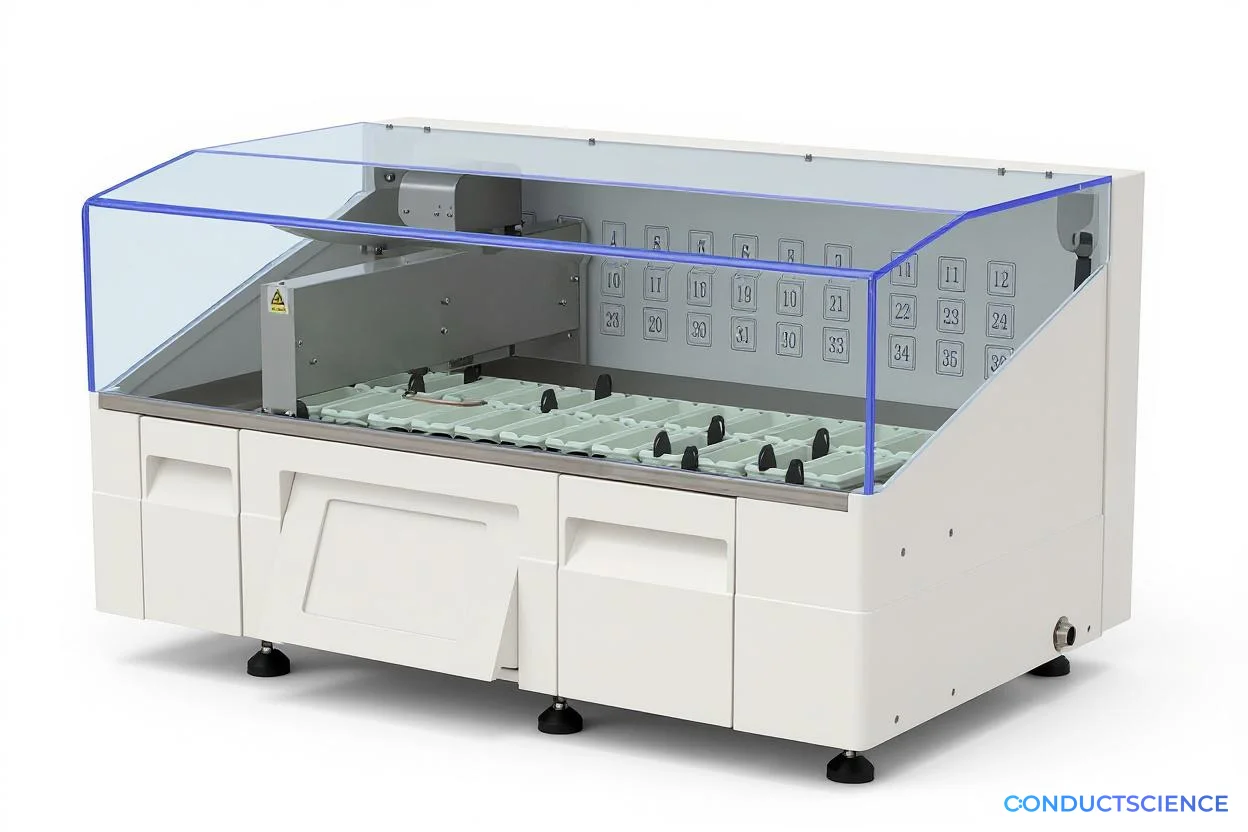
Tissue Slide Stainer
Automated tissue slide stainer with 30-slide capacity, 10.4-inch touchscreen, and simultaneous multi-protocol processing for standardized histopathology staining workflows.
| pa_equipment-type | 4954 |
| pa_automation-level | fully-automated |
| pa_pathology-application | 4971 |
| pa_slide-capacity | 5003 |
| pa_staining-protocols | 5010 |
| pa_reagent-stations | 5019 |

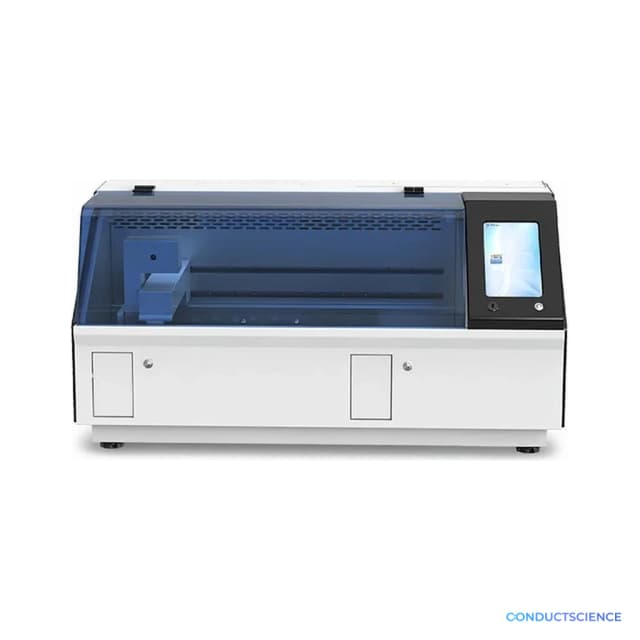
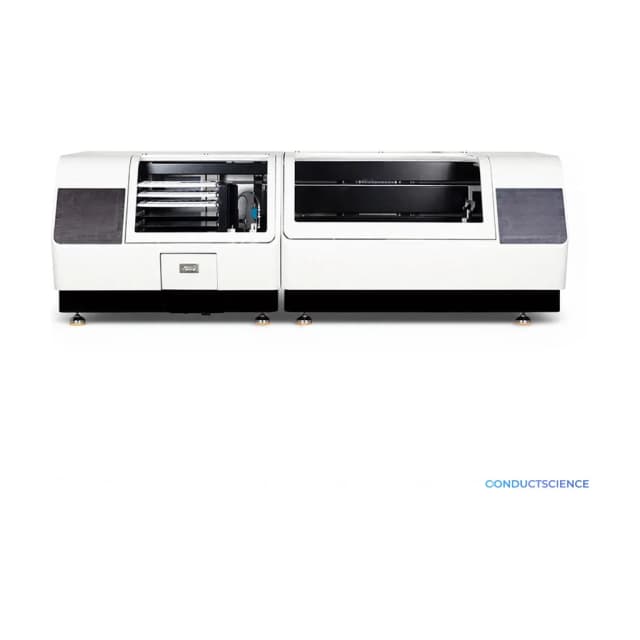
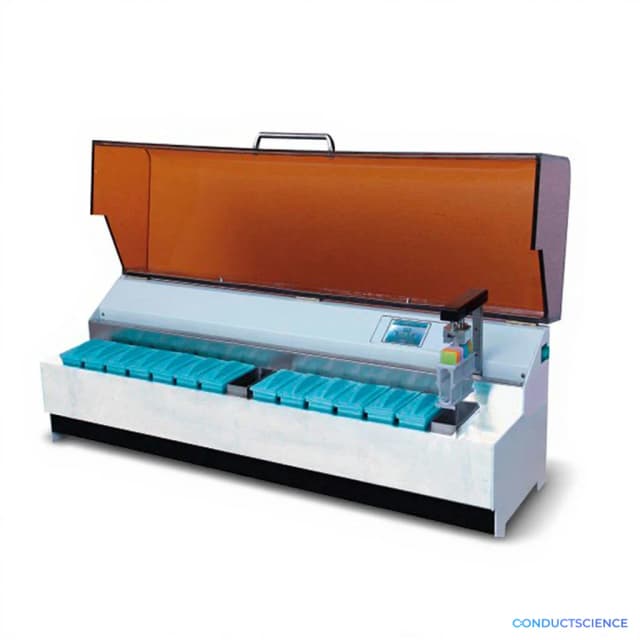
The RF-RS-5 Tissue Slide Stainer is an automated histopathology instrument designed for standardized tissue section staining in research and diagnostic laboratories. The system features a 30-slide rack capacity with simultaneous processing capability for up to 10 different staining protocols, supporting both conventional and specialized staining methods. The instrument utilizes a high-speed mechanical arm for precise slide handling across 36 total sites, including 26 reagent tank stations, 5 wash stations, 2 upload sites, and 3 download sites.
Real-time operation monitoring through a 10.4-inch touchscreen interface provides laboratory personnel with continuous visibility into staining progress and protocol execution. The modular electrical design facilitates maintenance and troubleshooting while ensuring consistent staining performance across multiple simultaneous protocols. Operating temperature range of 5°C to 35°C with relative humidity below 90% accommodates standard laboratory environments.
How It Works
The RF-RS-5 operates through automated mechanical handling of slide racks through precisely timed immersion cycles across designated reagent stations. The high-speed mechanical arm transfers slides between 26 reagent tank sites containing fixatives, stains, counterstains, and clearing agents according to programmed protocols. Each reagent tank holds 500ml volume, providing sufficient capacity for extended operation without frequent refilling.
Staining protocols are executed through sequential immersion timing controlled by the integrated microprocessor system. The touchscreen interface displays real-time progress including current protocol step, remaining time, and station locations. Multiple protocols can run simultaneously as the system independently tracks each of the 10 possible slide racks through their respective staining sequences. Temperature and humidity monitoring ensures consistent reagent performance throughout the staining process.
The integrated wash stations provide intermediate rinsing between reagent exposures to prevent cross-contamination and ensure complete reagent exchange. Upload and download sites allow continuous operation with new slides introduced while completed slides are removed without interrupting ongoing protocols.
Features & Benefits
pa_equipment-type
- 4954
pa_automation-level
- fully-automated
pa_pathology-application
- 4971
pa_slide-capacity
- 5003
pa_staining-protocols
- 5010
pa_reagent-stations
- 5019
touchscreen_size
- 10.4-inch
automation_level
- Automatic
mechanical_arm_type
- High-speed
electrical_design
- Modular
operation_monitoring
- Real-time
staining_methods
- Conventional and specialized
Staining rack capacity
- 30
Loading capacity
- Up to 10 staining racks for different programs can be processed simultaneously
Total number of sites
- 36 pcs
Total number of reagent tank sites
- 26 pcs
Wash the site
- 5 pcs
Reagent tank volume
- 500ml
Upload the site
- 2 pcs
Download the site
- 3 pcs
Touch screen size
- 10.4 inch 22.5*13.5cm
Exhaust air filtration system
- Matching
Oven function
- Matching
Operating temperature/humidity
- Temperature:5℃~35℃;Relative humidity:<90%(25℃)
Working atmosphere
- 86kPa~106kPa
Product dimensions
- Length*width*height=1050mm*615mm*590mm
Fuse
- 5A(5x20)2 pcs
Warranty
- 2 years, lifetime technical support
Customization is accepted:
- OEM
Package Size/weight:
- 114*71.5*85cm 150KG
Display Type
- Touchscreen
Research Domain
- Cancer Research
- Clinical Diagnostics
- Developmental Biology
- Histopathology
- Pharmaceutical QC
- Toxicology
Weight
- 80kg
Power/Voltage
- 200W
Certifications
- CE; ISO 13485
Brand
- Roundfin
Weight
- 80.0 kg
Dimensions
- L: 114.0 mm
- W: 71.5 mm
- H: 85.0 mm
Comparison Guide
| Feature | This Product | Typical Alternative | Advantage |
|---|---|---|---|
| Slide Processing Capacity | 30 slides per rack, up to 10 racks simultaneously (300 total slides) | Entry-level systems often process 12-20 slides per batch with single protocol limitation | Higher throughput enables processing of large tissue cohorts or multiple research projects without batching delays. |
| Reagent Station Configuration | 26 reagent tanks plus 5 wash stations (36 total sites) | Basic models typically offer 15-20 total processing stations | Extended reagent capacity accommodates complex immunohistochemical protocols requiring multiple antibodies and detection steps. |
| User Interface | 10.4-inch color touchscreen with real-time monitoring | Smaller LCD displays or button-based controls common in lower-tier models | Large touchscreen interface improves protocol programming efficiency and provides comprehensive status visibility. |
| Simultaneous Protocol Processing | 10 different protocols can run simultaneously | Most systems process single protocols or limited dual-protocol capability | Laboratory workflow flexibility allows urgent samples to be processed alongside routine batches without protocol interruption. |
| Mechanical System | High-speed mechanical arm with modular electrical design | Standard-speed systems with integrated electrical components | Faster processing cycles and simplified maintenance reduce operational costs and downtime. |
The RF-RS-5 offers high-throughput processing capabilities with 300 total slide capacity and simultaneous multi-protocol operation. The extensive reagent station configuration and large touchscreen interface provide operational flexibility for complex histopathology workflows requiring diverse staining protocols.
Practical Tips
Verify mechanical arm positioning accuracy monthly using test slides to ensure consistent reagent immersion depth and timing.
Why: Mechanical drift can cause uneven staining intensity and protocol reproducibility issues over time.
Replace reagent tanks completely rather than topping off to prevent reagent degradation and cross-contamination.
Why: Fresh reagents ensure consistent staining quality and prevent protocol failures from depleted or contaminated solutions.
Program wash cycles between different reagent types to prevent chemical interactions that could affect staining quality.
Why: Thorough washing eliminates reagent carryover that can cause background staining or reduced primary reagent effectiveness.
Monitor touchscreen alerts for mechanical arm errors and stop processing immediately if irregular movement is detected.
Why: Continued operation with mechanical issues can damage slides and reagent tanks while producing unreliable staining results.
Include positive and negative control slides in each staining run to verify reagent activity and protocol performance.
Why: Control slides provide immediate feedback on staining quality and help identify reagent or protocol issues before processing valuable samples.
Ensure exhaust filtration system is functioning properly before adding volatile reagents like xylene or alcohols.
Why: Proper ventilation prevents hazardous vapor accumulation and maintains safe working conditions in the laboratory environment.
Schedule reagent changes during low-activity periods to minimize interruption of ongoing protocols and maximize instrument utilization.
Why: Coordinated maintenance timing prevents protocol delays and ensures continuous availability for time-sensitive diagnostic work.
Clean wash stations daily with distilled water and mild detergent to prevent mineral deposits and reagent buildup.
Why: Clean wash stations ensure effective rinsing between reagent steps and prevent contamination that could compromise staining quality.
Setup Guide
What’s in the Box
- RF-RS-5 Tissue Slide Stainer main unit
- 10.4-inch touchscreen display (integrated)
- Slide rack set (quantity varies by configuration)
- Reagent tank set (26 tanks, 500ml capacity each)
- Power cable and electrical components
- User manual and protocol programming guide
- Calibration certificate
- Exhaust filtration components
- Maintenance tool kit (typical)
Warranty
ConductScience provides a 2-year manufacturer warranty covering parts and labor with lifetime technical support for troubleshooting and protocol optimization. Extended service contracts are available for high-volume laboratory applications.
Compliance
References
Background reading relevant to this product:
What types of staining protocols can the RF-RS-5 accommodate?
The system supports both conventional staining methods (H&E, trichrome, PAS) and specialized techniques (immunohistochemistry, special stains). The 26 reagent stations provide flexibility for complex multi-step protocols with customizable timing and sequence parameters.
Can different protocols run simultaneously without cross-contamination?
Yes, up to 10 different staining racks can process simultaneously with independent protocol tracking. The 5 dedicated wash stations and controlled mechanical arm movement prevent reagent carryover between different protocols.
What maintenance procedures are required for consistent performance?
Regular maintenance includes daily wash station cleaning, weekly reagent tank inspection and refilling, and monthly mechanical arm calibration verification. The modular electrical design facilitates component access for routine servicing.
How does the real-time monitoring system work?
The 10.4-inch touchscreen displays current protocol progress, remaining time for each step, reagent station status, and any error conditions. Users can monitor multiple simultaneous protocols and receive alerts for completion or intervention requirements.
What are the reagent volume requirements for typical protocols?
Each of the 26 reagent tanks holds 500ml, sufficient for approximately 150-200 slide processing cycles depending on protocol complexity. Standard H&E protocols consume approximately 2-3ml per slide across all reagent steps.
Is the system compatible with standard laboratory slide formats?
The 30-slide rack capacity accommodates standard 75×25mm microscope slides. Slide thickness tolerance and rack configuration should be verified for specialized slide types or coverslipped preparations.
What environmental conditions are required for optimal operation?
The instrument operates optimally at 5-35°C with relative humidity below 90% and atmospheric pressure 86-106kPa. Adequate ventilation is required for the exhaust filtration system managing chemical vapors.
Have a question about this product?