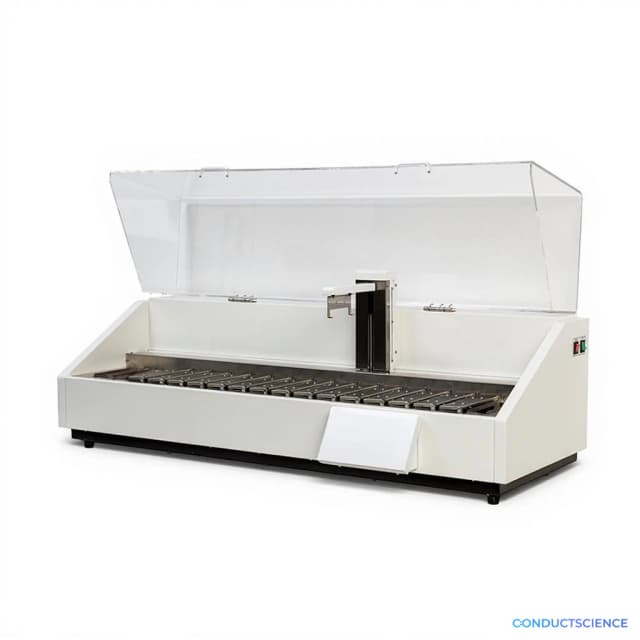
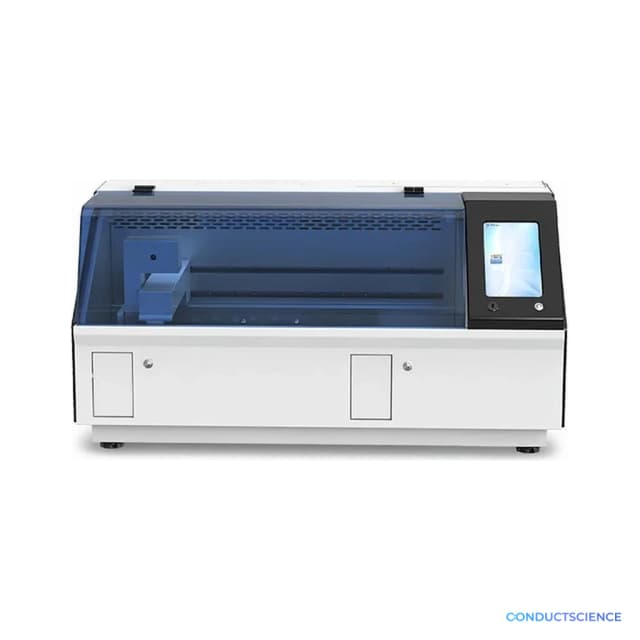
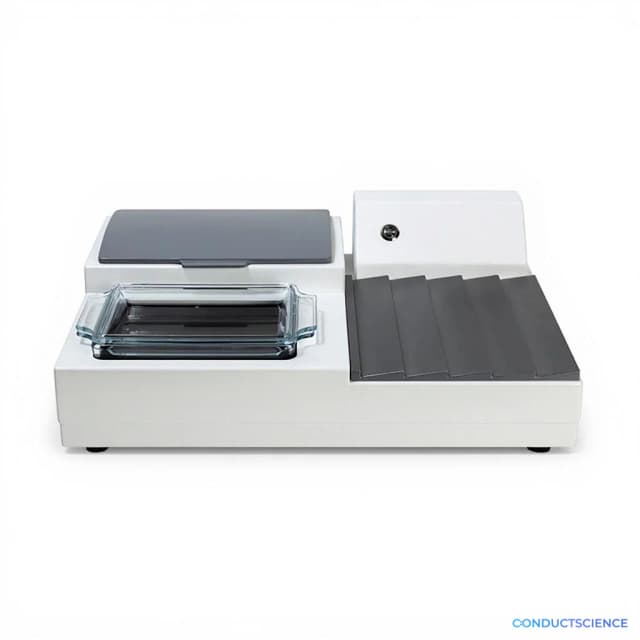
Fully Automated Coverslipping Workstation RD-3000A
High-capacity automated coverslipping system for histopathology workflows, processing up to 120 standard microscope slides with consistent coverslip placement and mounting medium application.

Louise Corscadden, PhD
Director of Science · ConductScience
Ask Louise about Fully Automated Coverslipping Workstation RD-3000A fit, setup, configuration, or quote prep.
Already working with us? Sign in to connect this with My Scientist.
Key Specifications
Full details →- Model fit
- Configured during quote
- SKU family
- RF-0044
- Shipping box
- 65.1 x 84.9 x 73.3 cm
- Ordering
- Online checkout and quote request available
- Category
- Slide Staining & Drying
- Build notes
- Confirm accessories, station layout, and support needs before purchase
The Fully Automated Coverslipping Workstation RD-3000A is a high-throughput histopathology instrument designed for automated application of coverslips to microscope slides. This system processes standard 26×75mm microscope slides with 24×50-60mm coverslips in a continuous, unattended workflow. The workstation features a multi-tier slide handling system with capacity for 120 slides arranged in 6 layers of 20 slides each, enabling batch processing of large sample sets.
The instrument automates the critical final step in histological slide preparation, ensuring consistent coverslip placement and mounting medium application across multiple samples. This automation reduces manual handling variability and processing time while maintaining the optical quality required for microscopic examination and digital pathology workflows.
How It Works
The RD-3000A employs a precision robotic system to automate the coverslipping process through controlled dispensing, positioning, and application mechanisms. The instrument first positions a microscope slide from the multi-tier carousel system, then dispenses a controlled volume of mounting medium onto the tissue section. A coverslip is selected from the supply magazine and positioned over the mounted tissue using pneumatic or servo-controlled actuators.
The system ensures bubble-free mounting through controlled placement speed and pressure application, followed by gentle compression to achieve optimal optical contact between the coverslip and tissue section. Temperature and humidity control maintain consistent mounting medium properties throughout the processing cycle. The completed slides are automatically transferred to output positions for drying and subsequent microscopic examination.
Features & Benefits
Automation Level
- fully-automated
Slide Capacity of Slide
- 6 layers, 20 per layer, a total of 120
Slide Specifications
- 26*75mm
Cover Slide Specifications
- 24*(50±10) mm
Brand
- ConductScience
Research Domain
- Cancer Research
- Clinical Diagnostics
- Developmental Biology
- Histopathology
- Neurodegeneration
- Pharmaceutical QC
Dimensions
- 849*733*651(L*W*H)
Shipping weight
- 36.71 lb
Shipping box
- L: 65.1 cm
- W: 84.9 cm
- H: 73.3 cm
| Feature | This Product | Typical Alternative | Advantage |
|---|---|---|---|
| Slide Processing Capacity | 120 slides in 6-tier system (20 per layer) | Manual systems process 10-20 slides per batch, semi-automated systems typically handle 50-80 slides | Higher capacity reduces operator intervention frequency and enables overnight processing of large sample batches. |
| Slide Compatibility | Standard 26×75mm microscope slides | Most systems accommodate standard slides, some require proprietary formats | Universal compatibility eliminates the need for special slide formats or adapters commonly used in laboratory workflows. |
| Coverslip Size Range | 24×50-60mm variable width accommodation | Fixed coverslip sizes or limited adjustment range | Variable width capability accommodates different tissue section sizes without requiring multiple coverslip supply magazines. |
| Automation Level | Fully automated from slide loading to coverslip application | Semi-automated systems require manual slide positioning or coverslip loading steps | Complete automation reduces operator handling time and eliminates manual positioning errors that affect slide quality. |
| Footprint Efficiency | 84.9×73.3 cm bench footprint for 120-slide capacity | Comparable capacity systems often require larger installation space | Compact design maximizes processing capacity per unit of laboratory bench space, important in space-constrained facilities. |
The RD-3000A offers high-capacity automated coverslipping with 120-slide batch processing capability in a compact laboratory footprint. The fully automated workflow and variable coverslip accommodation provide operational flexibility for diverse histopathology applications while maintaining the precision required for diagnostic-quality slide preparation.
Practical Tips
Perform slide positioning calibration daily before processing critical diagnostic samples to ensure optimal coverslip alignment accuracy.
Why: Environmental factors and mechanical settling can affect positioning precision over time.
Clean mounting medium dispensing nozzles after each processing session to prevent blockages and volume inconsistencies.
Why: Dried mounting medium residue can alter dispensing accuracy and cause uneven coverage across tissue sections.
Load slides with consistent orientation and verify tissue section positioning before starting automated processing cycles.
Why: Proper slide loading prevents processing errors and ensures optimal coverslip placement over target tissue areas.
Monitor the first few processed slides in each batch to identify mounting medium dispensing issues before completing the full run.
Why: Early detection of dispensing problems prevents processing an entire batch with suboptimal mounting quality.
Document processing parameters including mounting medium type, batch size, and environmental conditions for quality control tracking.
Why: Consistent documentation enables correlation of processing conditions with slide quality outcomes and troubleshooting.
Ensure adequate ventilation around the workstation when using organic solvent-based mounting media to minimize vapor exposure.
Why: Automated dispensing may increase solvent vapor levels compared to manual application methods.
Schedule processing runs during off-hours to maximize unattended operation benefits and reduce laboratory workflow disruption.
Why: The 120-slide capacity and automated operation enable overnight processing of large sample batches.
Replace coverslip supply magazines when half-empty to prevent feeding issues during critical processing runs.
Why: Coverslip feeding reliability decreases as supply magazines approach empty, potentially interrupting automated processing cycles.
Setup Guide
What’s in the Box
- Fully Automated Coverslipping Workstation RD-3000A main unit
- Multi-tier slide carousel system (6 layers, 20-slide capacity per layer)
- Coverslip supply magazine
- Mounting medium reservoir and dispensing system (typical)
- Power cable and connection hardware (typical)
- User manual and technical documentation (typical)
- Installation and calibration tools (typical)
- Initial supply of consumables for setup testing (typical)
Warranty
ConductScience provides a standard one-year manufacturer warranty covering parts and labor for the automated systems and mechanical components. Technical support includes installation guidance, operator training, and troubleshooting assistance throughout the warranty period.
Compliance
What mounting media are compatible with the automated dispensing system?
The system accommodates standard aqueous and resin-based mounting media commonly used in histopathology. Consult product datasheet for specific viscosity requirements and dispensing volume ranges for optimal performance.
How is slide positioning accuracy maintained across the 6-tier system?
The workstation uses precision mechanical guides and positioning sensors to ensure consistent slide alignment throughout the multi-tier carousel. Regular calibration procedures verify positioning accuracy within specifications.
Can the system handle tissue sections of varying thickness?
The automated mounting medium dispensing can be adjusted for different tissue section thicknesses. The coverslip application system accommodates standard histological section preparations typically 4-10 micrometers thick.
What maintenance procedures are required for consistent performance?
Routine maintenance includes cleaning the mounting medium dispensing system, verifying coverslip alignment mechanisms, and calibrating positioning accuracy. Daily cleaning of slide contact surfaces prevents cross-contamination between samples.
How does processing time compare to manual coverslipping methods?
The automated system processes slides continuously without operator intervention, significantly reducing hands-on time compared to manual methods. Total processing time depends on mounting medium curing requirements and batch size.
What quality control features ensure consistent coverslip application?
The system includes position verification sensors, mounting medium volume monitoring, and automated bubble elimination protocols. Built-in quality checks flag slides requiring reprocessing or manual intervention.
Is the system compatible with digital pathology scanning requirements?
The automated coverslipping process produces slides with consistent optical properties suitable for digital pathology scanners. Standardized mounting reduces focus variations that can affect automated scanning workflows.
Have a question about this product?
Have a question? Just ask.
Send it over and we'll email you a personalized answer — no call, no scheduling.
Prefer to talk it through?