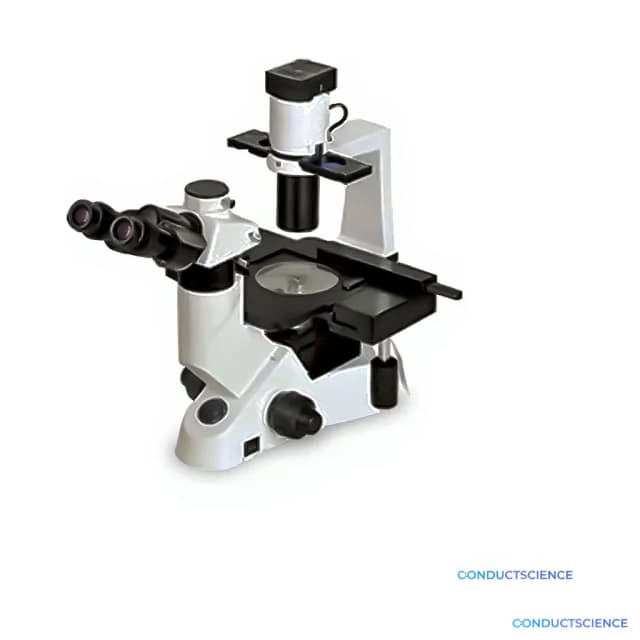
Trinocular Inverted Microscope — Research Grade, Phase Contrast
Research-grade inverted microscope with infinite optical system, trinocular head, and phase contrast capability for live cell imaging and tissue culture applications.

The Trinocular Inverted Microscope (BIO-0536) is a research-grade inverted microscope designed for live cell imaging, tissue culture observation, and routine laboratory microscopy applications. Built with an infinite optical system, this microscope provides superior optical performance with minimal spherical aberration and excellent image flatness across the entire field of view.
The compensation-free trinocular head enables simultaneous observation and documentation, with a 30° inclination for comfortable extended use and 360° rotation for multi-user accessibility. The infinite plan phase objective (10X, N.A=0.25) combined with P10X/22mm and P16X/15mm eyepieces delivers clear, high-contrast imaging suitable for cell culture monitoring, micromanipulation procedures, and basic fluorescence applications. The coaxial focusing system provides precise specimen positioning with 0.002mm fine adjustment resolution.
How It Works
Inverted microscopy positions the objective lens below the specimen stage, allowing observation of samples in culture vessels without removing coverslips or transferring specimens. The infinite optical system eliminates spherical aberration by using parallel light rays between the objective and tube lens, ensuring consistent image quality regardless of the optical path length.
The halogen illumination system (12V/30W) provides transmitted light through the ELWD condenser with iris diaphragm, enabling Köhler illumination for even field illumination. The phase contrast capability enhances visualization of transparent specimens by converting phase shifts in light passing through different cellular structures into amplitude variations, revealing internal cellular details without staining.
The trinocular design splits the light path three ways: two eyepieces for binocular observation and a third port for camera attachment or additional accessories. The 242×172mm stage accommodates standard culture vessels up to 110mm diameter, with 120×75mm mechanical translation for specimen positioning.
Features & Benefits
Weight
- 14.0 kg
Dimensions
- L: 63.0 mm
- W: 65.5 mm
- H: 30.5 mm
Comparison Guide
| Feature | This Product | Typical Alternative | Advantage |
|---|---|---|---|
| Optical System Design | Infinite optical system with compensation-free trinocular head | Finite tube length systems or dichroic-based trinocular designs with light loss | Maintains full light intensity to all three ports while supporting optical accessory integration without image degradation. |
| Condenser Working Distance | ELWD condenser with 75mm working distance | Standard condensers typically offer 15-30mm working distance | Accommodates thicker culture vessels and provides clearance for micromanipulation procedures. |
| Stage Capacity | 242×172mm stage accepting vessels up to 110mm diameter | Smaller stages often limited to 100mm diameter vessels or less | Supports larger culture flasks and multiple specimen containers for efficient batch processing. |
| Focus Resolution | 0.002mm fine focus adjustment with coaxial controls | Fine focus resolution typically ranges from 0.001-0.005mm | Provides precise specimen positioning for high-magnification measurements and critical focus applications. |
| Head Adjustability | 360° rotatable head with 30° inclination and 55-75mm IPD adjustment | Fixed heads or limited rotation ranges in basic models | Enables multi-user access and ergonomic viewing positions for extended observation sessions. |
| Power Compatibility | Universal power supply (AC85-265V, 50/60Hz) | Region-specific power requirements often limit international use | Ensures worldwide operation without voltage converters for international laboratory installations. |
This microscope combines an infinite optical system with extended working distance condenser and large-capacity stage, providing superior optical performance and versatility for live cell applications. The compensation-free trinocular design and universal power compatibility make it suitable for multi-user research environments worldwide.
Practical Tips
Establish proper Köhler illumination by centering the condenser light source in the objective back aperture while adjusting iris diaphragm opening.
Why: Ensures even field illumination and optimal image contrast for accurate observations and measurements.
Clean objective lenses with lens paper and appropriate solvents after each use, particularly when examining specimens in culture media.
Why: Prevents protein buildup and salt crystallization that can degrade image quality and damage lens coatings.
Allow halogen lamp to reach thermal equilibrium for 10-15 minutes before critical observations or image capture.
Why: Eliminates illumination fluctuations and color temperature drift that can affect quantitative measurements.
Use the lowest effective illumination intensity to minimize specimen heating and phototoxicity during live cell observations.
Why: Preserves cell viability and prevents thermal drift while extending halogen bulb operational life.
If image appears dim or uneven, check condenser height adjustment and ensure iris diaphragm is properly opened for the objective in use.
Why: Improper condenser settings are the most common cause of illumination problems in transmitted light microscopy.
Verify parfocal alignment when switching between eyepiece magnifications to maintain consistent image plane focus.
Why: Ensures measurement accuracy and prevents focus drift when documenting specimens at different magnifications.
Allow halogen lamp housing to cool for at least 30 minutes before handling or bulb replacement procedures.
Why: Prevents thermal burns and extends bulb life by avoiding thermal shock during handling.
Store microscope with dust covers in place and stage lowered to minimum height when not in use.
Why: Protects optical surfaces from contamination and reduces mechanical stress on focusing components.
Setup Guide
What’s in the Box
- Trinocular inverted microscope body
- P10X/22mm eyepiece pair
- P16X/15mm eyepiece pair
- 10X infinite plan phase contrast objective
- ELWD condenser with iris diaphragm
- Halogen lamp assembly (12V/30W)
- Universal power supply with cord
- Stage insert for glass slides
- Instruction manual
- Dust covers (typical)
- Allen key set for adjustments (typical)
Warranty
ConductScience provides a standard one-year manufacturer warranty covering defects in materials and workmanship. Technical support includes application guidance, troubleshooting assistance, and optical alignment procedures for optimal performance.
Compliance
References
Background reading relevant to this product:
What magnifications are achievable with the provided eyepieces and objective?
With the 10X objective and provided eyepieces, total magnifications are 100X (with P10X eyepieces) and 160X (with P16X eyepieces). Additional objectives can be added to extend the magnification range.
What is the maximum thickness of culture vessels that can be accommodated?
The ELWD condenser with 75mm working distance allows examination of specimens in thick culture vessels including T-flasks, deep well plates, and other standard tissue culture containers.
Can this microscope be used for fluorescence applications?
While optimized for bright-field and phase contrast, fluorescence capability would require additional components (fluorescence illuminator, filter cubes) not included with the base system. Consult product datasheet for fluorescence upgrade options.
What camera systems are compatible with the third port?
The trinocular port accepts standard C-mount cameras and adapters. Camera selection should consider the infinite optical system requirements for proper image formation.
How precise is the mechanical stage positioning?
The mechanical stage provides 120×75mm travel range with smooth operation, though specific positioning accuracy specifications should be confirmed in the product datasheet.
What maintenance is required for the halogen illumination system?
Halogen bulbs (12V/30W) require periodic replacement based on usage hours. The adjustable brightness control helps extend bulb life by operating at reduced power when full illumination is not required.
Can additional objectives be added to expand magnification range?
Yes, the infinite optical system is compatible with additional plan objectives. Ensure new objectives match the infinite correction and mechanical specifications for proper performance.
What are the requirements for proper Köhler illumination setup?
Proper Köhler illumination requires adjusting condenser height and iris diaphragm while observing the objective back aperture to center the light source and achieve even field illumination.
Have a question about this product?
Upgrade Options
Related Products