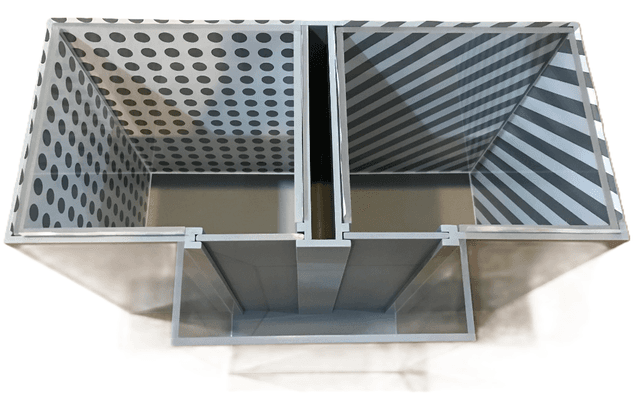
Visual Discrimination Chamber
Behavioral testing apparatus for visual discrimination and learning studies in laboratory animals, enabling controlled presentation of visual stimuli with response monitoring.
| Automation Level | semi-automated |
| Species | Mouse, Rat |

The Visual Discrimination Chamber is a specialized behavioral testing apparatus designed for assessing visual perception, discrimination learning, and cognitive flexibility in laboratory animals. This controlled environment enables researchers to present visual stimuli while monitoring subject responses, providing quantitative data on visual processing capabilities and learning performance.
The system supports multiple experimental paradigms including two-choice discrimination tasks, reversal learning protocols, and complex visual pattern recognition studies. Researchers can systematically evaluate how subjects distinguish between different visual cues, assess learning acquisition rates, and measure cognitive adaptability when stimulus-reward contingencies change.
How It Works
The Visual Discrimination Chamber operates on the principle of operant conditioning combined with controlled visual stimulus presentation. Subjects are presented with two or more visual stimuli simultaneously, with responses to the correct stimulus reinforced according to predetermined contingencies. The system records response latencies, choice accuracy, and behavioral patterns to quantify visual discrimination performance.
Visual stimuli can include geometric shapes, patterns, brightness levels, or spatial configurations. The chamber typically incorporates response mechanisms such as nose-poke ports or lever presses, allowing precise measurement of choice behavior. Environmental parameters including lighting conditions and stimulus presentation timing are controlled to ensure experimental reproducibility.
Data collection encompasses multiple behavioral metrics including percent correct responses, reaction times, bias indices, and learning curves. This comprehensive approach enables researchers to distinguish between perceptual deficits and learning impairments while controlling for motor function and motivation variables.
Features & Benefits
Behavioral Construct
- Visual Discrimination
- Learning and Memory
- Cognitive Flexibility
- Pattern Recognition
Automation Level
- semi-automated
Research Domain
- Aging Research
- Behavioral Pharmacology
- Developmental Biology
- Learning and Memory
- Neurodegeneration
- Neuroscience
Species
- Mouse
- Rat
Weight
- 6.06 kg
Dimensions
- L: 65.0 mm
- W: 36.0 mm
- H: 27.0 mm
Comparison Guide
| Feature | This Product | Typical Alternative | Advantage |
|---|---|---|---|
| Stimulus Control | Programmable visual stimulus presentation with timing control | Manual stimulus presentation or fixed display systems | Ensures consistent stimulus parameters and enables complex experimental protocols with precise timing requirements. |
| Response Detection | Multiple response mechanism options | Limited to single response type | Accommodates different species and experimental designs while maintaining measurement precision. |
| Data Collection | Automated behavioral metrics recording | Manual scoring or basic response counting | Provides comprehensive quantitative data with reduced observer bias and improved temporal resolution. |
| Environmental Control | Isolated testing environment | Open testing areas with variable conditions | Minimizes external variables and ensures reproducible testing conditions across sessions. |
The Visual Discrimination Chamber provides controlled visual stimulus presentation with automated response detection and comprehensive data collection capabilities. The system supports flexible experimental protocols while maintaining standardized testing conditions for reliable behavioral assessment.
Practical Tips
Regularly calibrate stimulus brightness and contrast using a photometer to maintain consistent visual presentation conditions.
Why: Visual perception studies require precise stimulus control to ensure reproducible results across sessions.
Clean all surfaces between subjects using appropriate disinfectants to prevent odor cues from influencing behavior.
Why: Residual scents can create unintended behavioral biases that confound visual discrimination results.
Establish baseline performance with simple discrimination tasks before progressing to complex paradigms.
Why: This approach confirms proper system function and subject capability before investing time in sophisticated protocols.
Monitor response mechanism sensitivity regularly as mechanical components may require adjustment over time.
Record environmental conditions including ambient lighting and temperature during each session.
Why: Environmental variables can influence visual perception and should be documented for proper data interpretation.
Ensure proper ventilation in the testing area and monitor animals for signs of stress during extended sessions.
Why: Animal welfare considerations are essential for both ethical compliance and valid experimental results.
Setup Guide
What’s in the Box
- Visual discrimination chamber (typical)
- Control software and interface cables (typical)
- Stimulus presentation panels (typical)
- Response mechanism assemblies (typical)
- User manual and setup guide (typical)
- Calibration tools and reference materials (typical)
Warranty
ConductScience provides a standard one-year manufacturer warranty covering defects in materials and workmanship, with technical support for setup and operation questions.
Compliance
What types of visual stimuli can be presented in the chamber?
The system supports various visual stimuli including geometric shapes, patterns, brightness gradients, and spatial configurations. Specific capabilities depend on the stimulus presentation system configuration.
How is response accuracy measured and recorded?
The system records choice responses, reaction times, and response patterns with high temporal resolution. Data includes percent correct responses, bias indices, and learning curve parameters.
Can the chamber accommodate different species sizes?
Chamber dimensions and response mechanism positioning can typically be adjusted for different rodent species. Consult product specifications for specific size accommodations.
What maintenance procedures are required?
Regular maintenance includes cleaning between subjects, calibrating stimulus brightness, and verifying response mechanism sensitivity. Software updates and data backup procedures should also be performed regularly.
How long do typical experimental sessions last?
Session duration varies with experimental design, typically ranging from 15 minutes to several hours. The system supports both acute testing and chronic studies with multiple sessions.
Can multiple chambers be operated simultaneously?
Multiple chambers can often be controlled from a single computer system, enabling parallel testing of multiple subjects. Network capabilities depend on the specific control software configuration.
What data formats are generated by the system?
Data output formats typically include text files with timestamps, response codes, and performance metrics. Consult software documentation for specific export options and analysis tool compatibility.
Have a question about this product?
Accessories
Enhance your setup with compatible accessories

Frequently Bought Together