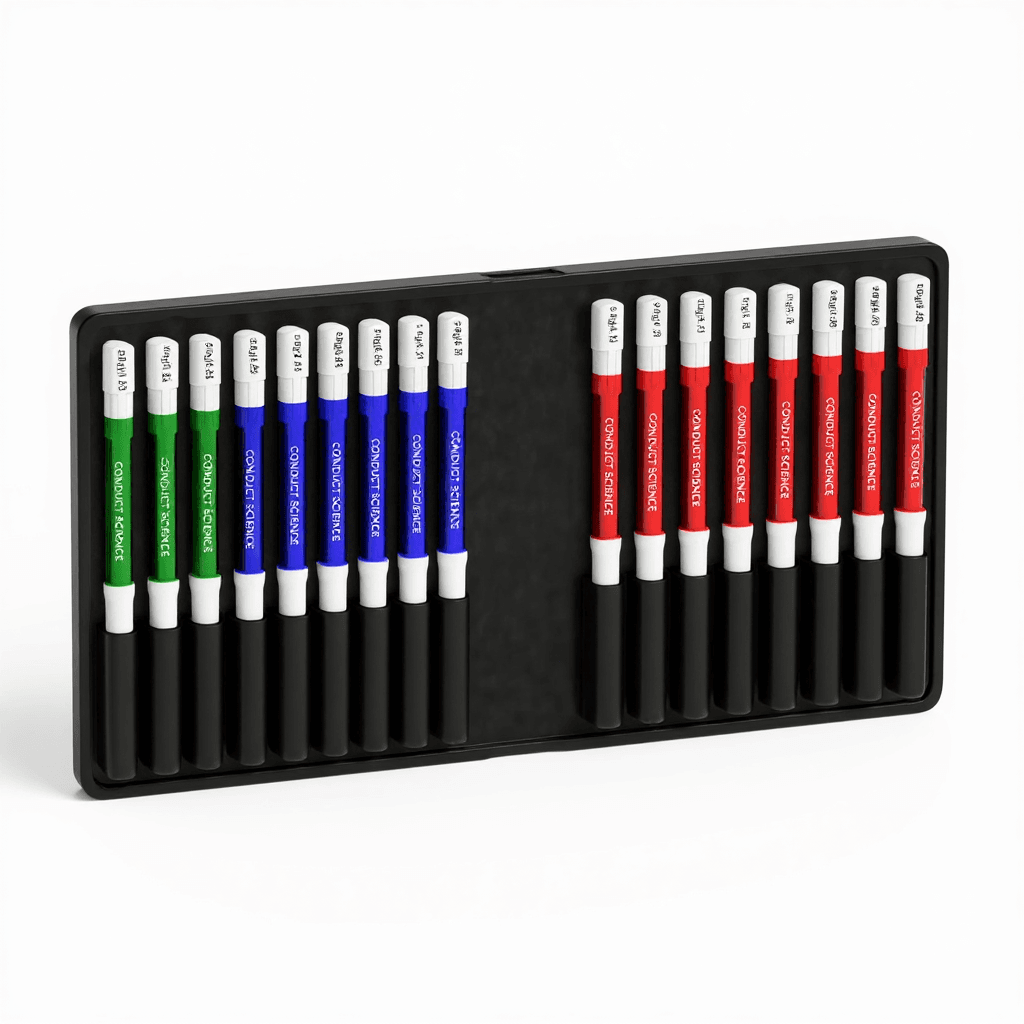
Von Frey Filaments
Calibrated 20-filament system for quantitative mechanical nociception assessment in rodent pain research, featuring retractable design and logarithmic force scaling from 0.008g to 300g.
| number_of_filaments | 20 |
| filament_type | retractable |
| humidity_range | 60% to 80% |
| force_scale | logarithmic scale of actual force aligned with linear scale of perceived intensity |
| application_method | perpendicular pressure against skin |
| anatomical_regions | foot, lip, cheek, plantar surfaces |
The Von Frey Filaments set provides precise mechanical stimulation capabilities for quantitative assessment of nociceptive thresholds and tactile sensitivity in rodent research models. This 20-filament system employs calibrated monofilaments arranged on a logarithmic force scale from 0.008g to 300g, corresponding to size designations from 1.65 to 6.65. The logarithmic scaling aligns actual applied force with linear perceived intensity, enabling systematic evaluation of mechanical pain thresholds and allodynia development.
Each filament features retractable design to protect filament integrity during storage and transport while maintaining calibrated force delivery. The system operates through perpendicular pressure application against target anatomical regions, with reflexive paw withdrawal monitoring serving as the primary measurement endpoint. This configuration supports standardized protocols for mechanical hyperalgesia assessment, neuropathic pain characterization, and sensory nerve function evaluation in mouse and rat models.
How It Works
Von Frey filaments operate on the principle of controlled mechanical deformation to deliver precisely calibrated forces to target tissues. Each monofilament is engineered to buckle at a predetermined force threshold, ensuring consistent stimulus delivery regardless of application angle or duration. The logarithmic force progression (0.008g to 300g) corresponds to the psychophysical relationship between stimulus intensity and perceived sensation, enabling systematic threshold determination.
During testing, filaments are applied perpendicular to the plantar surface or other target anatomical regions until buckling occurs, indicating force threshold achievement. The reflexive withdrawal response serves as the primary behavioral endpoint, with threshold determination following up-down or staircase methodologies. The retractable design protects individual filaments from damage while maintaining calibration accuracy across repeated testing sessions.
Features & Benefits
number_of_filaments
- 20
filament_type
- retractable
humidity_range
- 60% to 80%
force_scale
- logarithmic scale of actual force aligned with linear scale of perceived intensity
application_method
- perpendicular pressure against skin
anatomical_regions
- foot, lip, cheek, plantar surfaces
measurement_principle
- reflexive paw withdrawal monitoring
replacement_availability
- replacement filaments available
Behavioral Construct
- mechanical nociception
- tactile sensitivity
- pain threshold
- allodynia
- hyperalgesia
Automation Level
- manual
Temperature Range
- 18°C to 24°C
Species
- Mouse
- Rat
Research Domain
- Behavioral Pharmacology
- Neurodegeneration
- Neuroscience
- Pain Research
- Toxicology
Weight
- 4.0 lbs
Dimensions
- L: 25.4 in
- W: 20.32 in
- H: 17.78 in
Comparison Guide
| Feature | This Product | Typical Alternative | Advantage |
|---|---|---|---|
| Number of Filaments | 20 calibrated filaments covering 0.008g to 300g range | Basic sets often include 8-12 filaments with limited force range | Comprehensive threshold mapping enables detection of subtle sensitivity changes across full mechanical spectrum |
| Filament Protection | Retractable design with protective storage case | Fixed filaments prone to damage during transport and storage | Maintains calibration accuracy across multiple testing sessions and laboratory relocations |
| Force Scaling | Logarithmic scale aligned with linear perceived intensity | Linear or arbitrary force progressions without psychophysical basis | Corresponds to natural perception relationships for more physiologically relevant threshold determination |
| Environmental Specifications | Defined 18-24°C temperature and 60-80% humidity operating ranges | General room temperature recommendations without specific ranges | Ensures consistent filament behavior and reproducible measurements across different laboratory conditions |
| Application Versatility | Compatible with foot, lip, cheek, and plantar surface testing | Primarily designed for single anatomical region assessment | Supports comprehensive sensory mapping across multiple body regions in single system |
This 20-filament system provides comprehensive mechanical nociception assessment capabilities with retractable design protection and logarithmic force scaling from 0.008g to 300g. The specified environmental operating parameters and multi-region compatibility support standardized protocols across diverse pain research applications.
Practical Tips
Verify filament buckling behavior before each testing session by applying to calibrated scale at specified force threshold.
Why: Environmental conditions can affect filament stiffness and alter buckling characteristics over time.
Store filaments in retracted position within provided case and avoid exposure to extreme temperatures or humidity.
Why: Temperature and humidity fluctuations can permanently alter filament mechanical properties and force calibration.
Apply filaments perpendicular to skin surface with gradual pressure increase until clear buckling occurs, maintaining 2-3 second contact.
Why: Consistent application technique eliminates angle-dependent force variations and ensures reproducible stimulus delivery.
Record both positive and negative responses during threshold determination using established up-down or staircase methodologies.
Why: Statistical threshold calculation requires response data from forces both above and below actual threshold for accurate determination.
If withdrawal responses appear inconsistent, verify subject acclimation period and check for environmental disturbances affecting stress levels.
Why: Stress responses can significantly alter mechanical sensitivity and confound threshold measurements.
Inspect filament tips for damage before each use and replace any showing deformation or surface irregularities.
Why: Damaged filaments can cause tissue injury and deliver inconsistent forces that compromise measurement validity.
Allow minimum 5-minute intervals between applications at same anatomical site during threshold determination.
Why: Prevents temporal summation effects that can artificially lower withdrawal thresholds through repeated stimulation.
Test each anatomical site multiple times and calculate average threshold to account for response variability.
Why: Individual response variation requires multiple measurements for statistically robust threshold determination.
Setup Guide
What’s in the Box
- 20 calibrated Von Frey filaments with retractable design
- Protective storage case
- Force calibration reference chart
- User manual with testing protocols
- Application technique guide (typical)
Warranty
ConductScience provides 1-year manufacturer warranty covering filament calibration accuracy and mechanical components, with technical support for protocol optimization and troubleshooting.
Compliance
References
Background reading relevant to this product:
What are Von Frey Filaments?
Von Frey Filaments are calibrated nylon monofilaments used to measure mechanical sensitivity and pain thresholds in rodents. Each filament applies a specific force when bent, enabling precise quantification of tactile sensitivity.
How do Von Frey Filaments work?
Filaments of increasing stiffness are applied to the plantar surface of the hind paw. The threshold force that elicits a withdrawal response is recorded. The Up-Down method determines the 50% withdrawal threshold for statistical analysis.
What research applications use Von Frey Filaments?
Von Frey Filaments are the gold standard for measuring mechanical allodynia in neuropathic pain, inflammatory pain, and post-surgical pain models. They are essential in analgesic drug development and pain mechanism research.
Have a question about this product?
Accessories
Enhance your setup with compatible accessories
Upgrade Options