01
1 of 3
Find a public record
Start with data that already exists in a public repository.

ShareScore · ConductScience
A free public standard for research data
Setting the standard for how the public benefits from science
Too often, the data behind a paper becomes hard to understand, combine, validate, or use again. ShareScore shows what is missing and how to fix it.
76.4M
research records scored so far. Anyone can inspect the result.
Explore the public results01The invisible loss
A scientist can spend years recruiting participants, running experiments, and recording observations. The public helps pay for that work. Then the paper appears, while the data behind it may be left as a folder another researcher cannot confidently use.
A file called final_final_v2.csv can contain years of knowledge. Without clear methods, rights, file guides, and history, the next scientist has to guess. Replication slows down. Studies cannot be combined. Public investment produces one discovery when it could support many.
final_final_v2.csv
Shared does not always mean understandable. Open does not always mean reusable.
02The idea and the person
ShareScore checks 25 practical signs that another researcher can find, understand, and reuse a dataset. Then it shows the evidence and what can improve.
“Every dataset deserves a second life.”
Fundamentally, we believe that science is really about the data underneath. Every dataset deserves not only the first publication, but also a second life, where other researchers can continue to build, improve, add, and create a bigger story, so we can help make fundamental discoveries.
I come from a company called ConductScience. We are an organization that builds tools for science. ConductScience creates instrumentation and software that creates research data. That is how I started to understand this whole space over the last decade or so.
We realized this was a really big problem: a lot of instrumentation and outputs from science did not talk to each other in common formats. So we went through tons of descriptions of data across many repositories. We looked at 25 signals of care and did validation testing.
ShareScore told us that better-prepared records were more likely to become shared sources for later work. It seems obvious. If you have better data, other people will use it and build on it. That is our goal: to make data reusable and let science compound.
03Built as a public service
04How it works
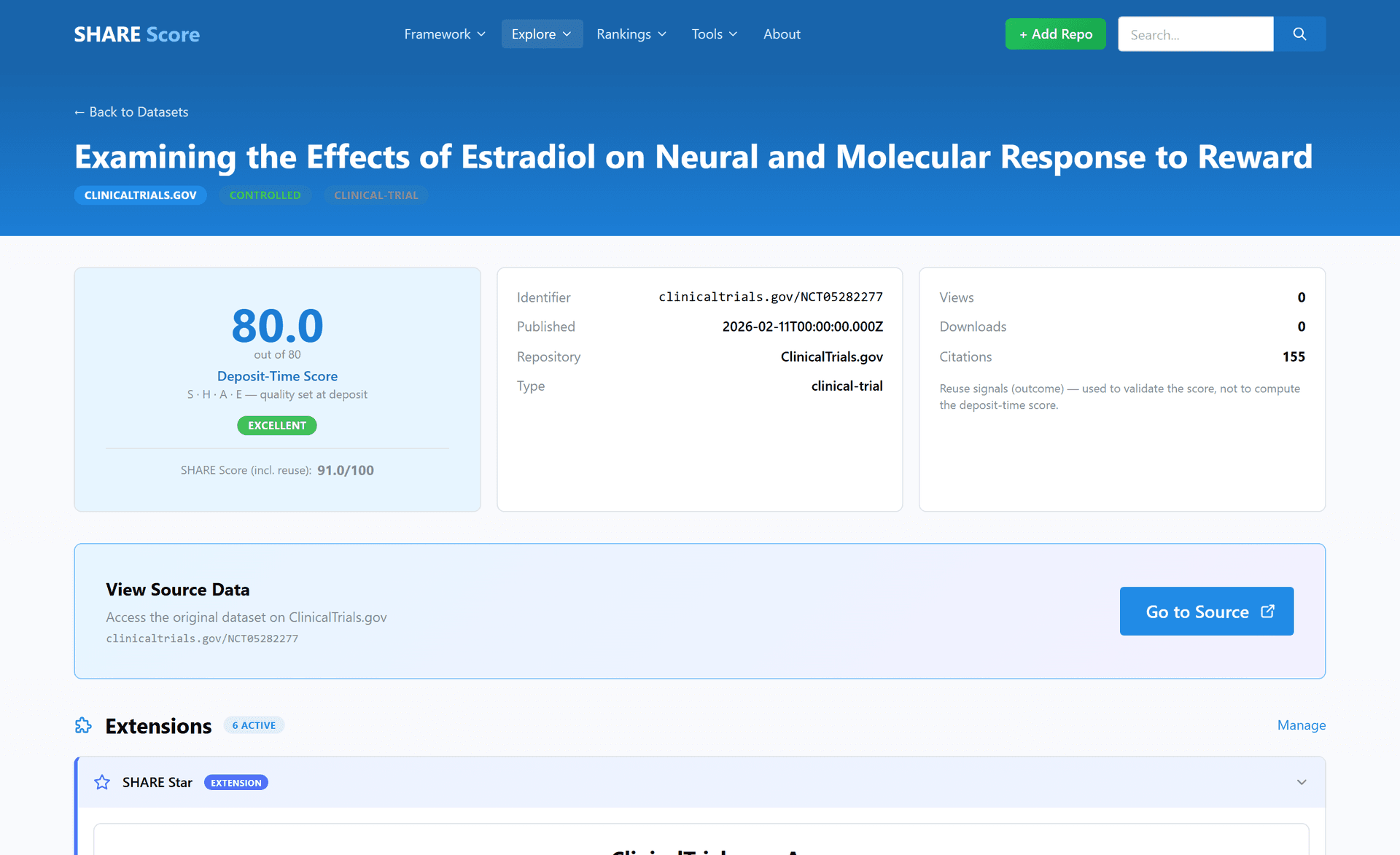
A single public record moves from an opaque deposit to an understandable path for reuse.
01
1 of 3
Start with data that already exists in a public repository.

02
2 of 3
The result is inspectable, with the source, preparation score, and reuse signals in view.

03
3 of 3
Researchers can check missing signals and get feedback before the next person tries to reuse the work.

Find it. Understand it. Improve it. Reuse it.
05What happened
2.36×
In 154,569 research records, every 10-point higher ShareScore was associated with 2.36 times the odds of a verified derivative within three years.
154,569 research records · strictest preregistered definition. The field-adjusted estimate was 2.72× across four broad field groups.
Review the validation evidence ↗06Who it reaches
The same standard can follow research across fields and repositories, without asking a judge to trust a black box.
ShareScore release 0.9.0 snapshot, September 8, 2026. The 139,169 figure is indexed researchers, not registered users. The $21.9B figure is a provisional FY2026 map of NIH funding through July 13, 2026, across 1,394 institutions.
Guided evidence
07What can endure
Repository systems explained far more of the variation in scores than individual researchers did. Improve the place where scientists deposit data, and every depositor can benefit.
4,518 researchers · 28,085 research records
08Independent recognition
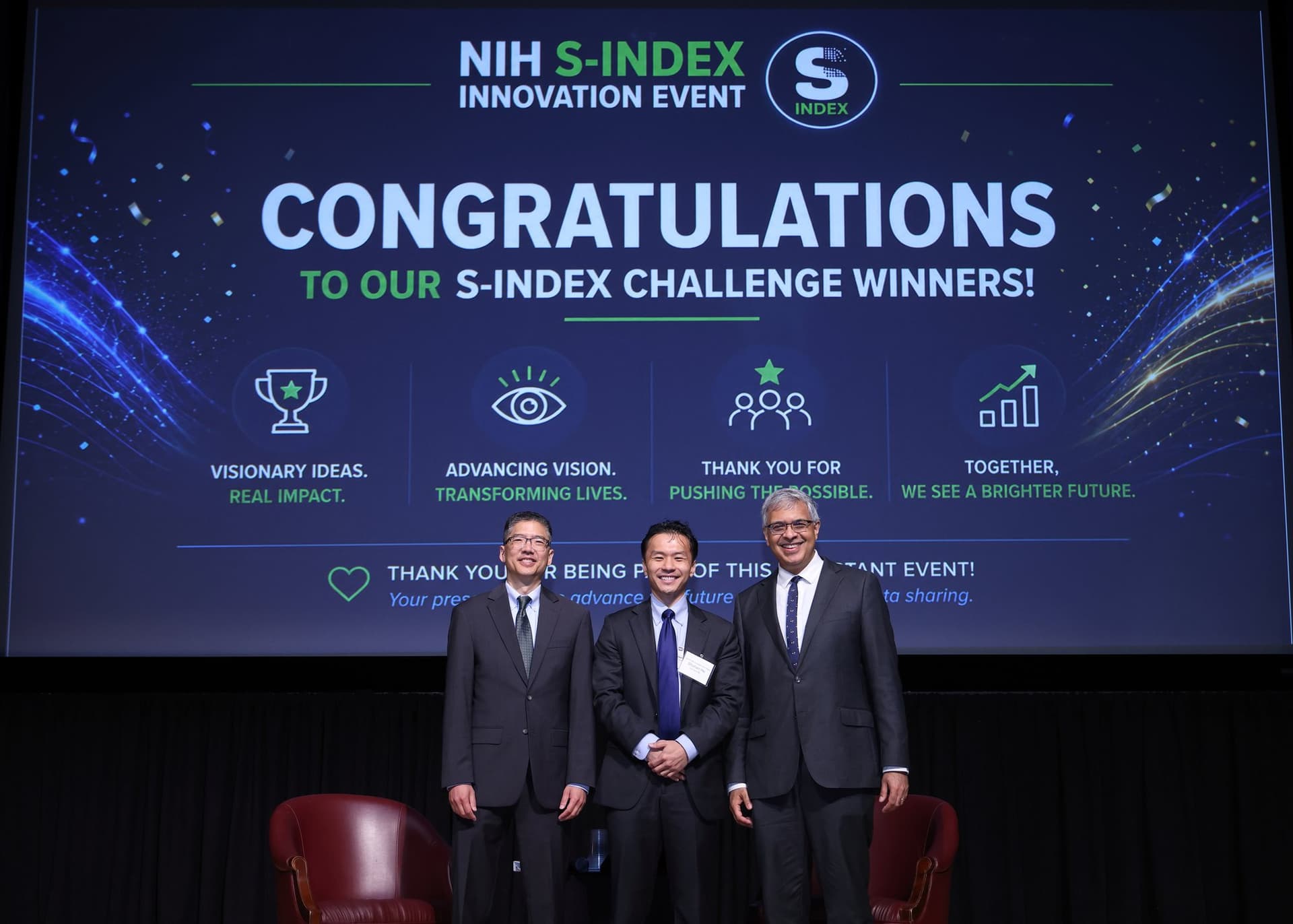
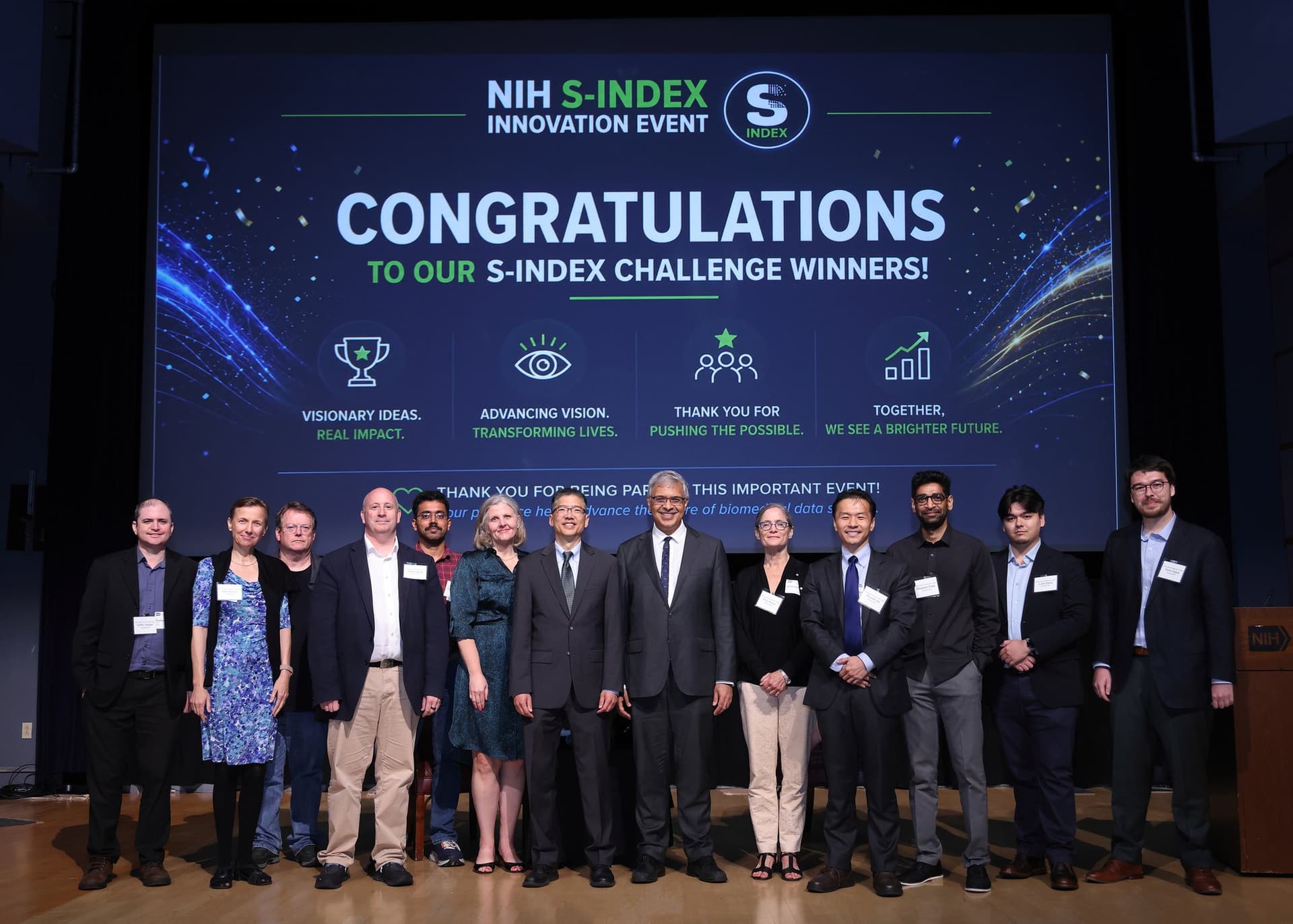
Seven finalist teams presented their models to senior NIH leaders after evaluation by independent subject matter experts and a federal judging panel. NIH recognized ConductScience with a $300,000 award for the SHARE Index.
The finalist field included people affiliated with Harvard Medical School, MIT, Yale, Mount Sinai, and Northwestern.


A scientific service to the public
ShareScore gives researchers, repositories, and funders a shared way to make that future visible.
Evidence snapshot prepared September 16, 2026. Validation results describe prediction and association, not causation.