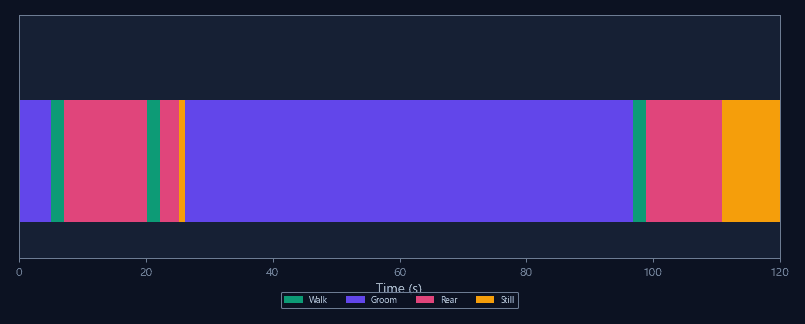
Behavior labels per frame
Discrete behavioral state label and classifier confidence score at every frame. Standard ethogram includes locomotion, rearing, grooming, freezing, and resting.
CSV
Automated classification of grooming, rearing, and user-defined behaviors
ML classifiers label behaviors frame-by-frame with temporal smoothing — replace hours of manual ethogram scoring with reproducible automated annotation.
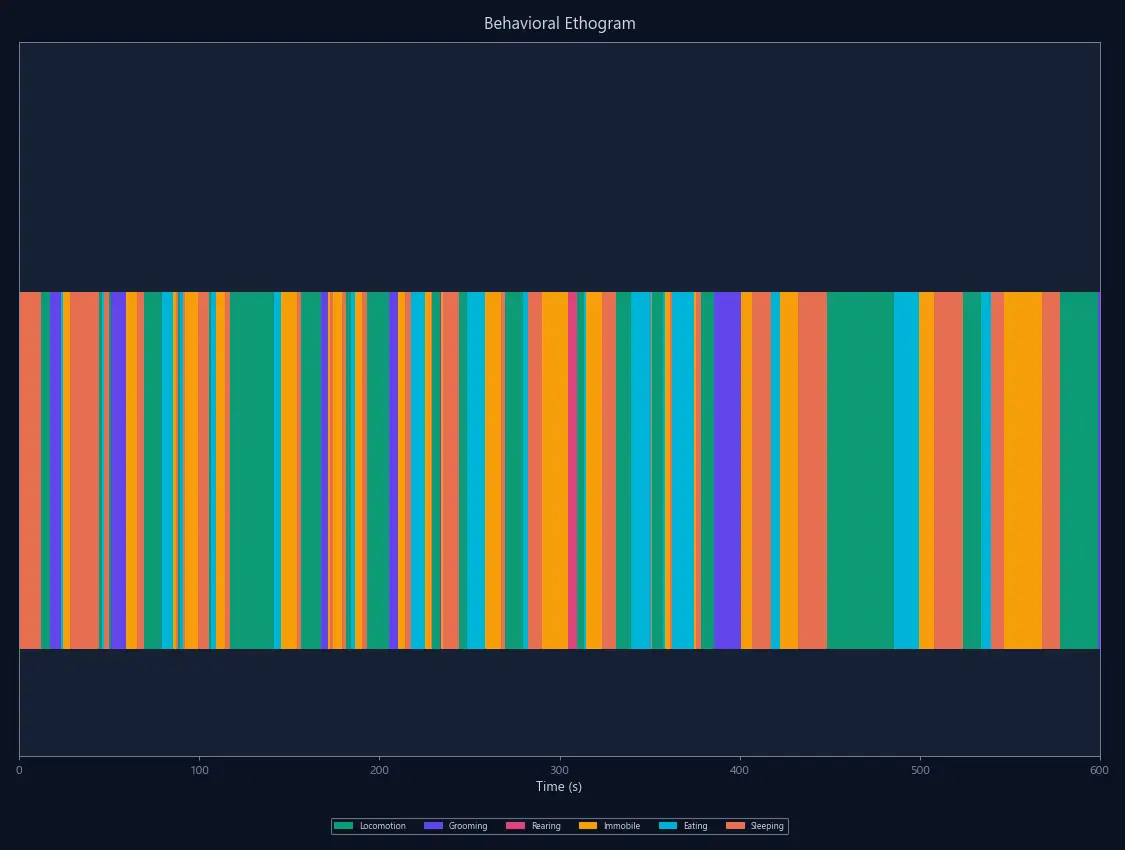
Trained observers spend hours scoring behavioral videos frame by frame. Inter-rater agreement is often modest, threshold criteria drift across long scoring sessions, and expanding the ethogram to include additional behaviors multiplies scoring time linearly. The result is a bottleneck that limits sample sizes and delays analysis.
ConductVision applies machine learning classifiers to pose and trajectory features, assigning behavioral labels at every frame. Weighted temporal smoothing prevents frame-to-frame label flicker. Users can define and train classifiers for custom behaviors specific to their experimental model.
Discrete behavioral state label and classifier confidence score at every frame. Standard ethogram includes locomotion, rearing, grooming, freezing, and resting.
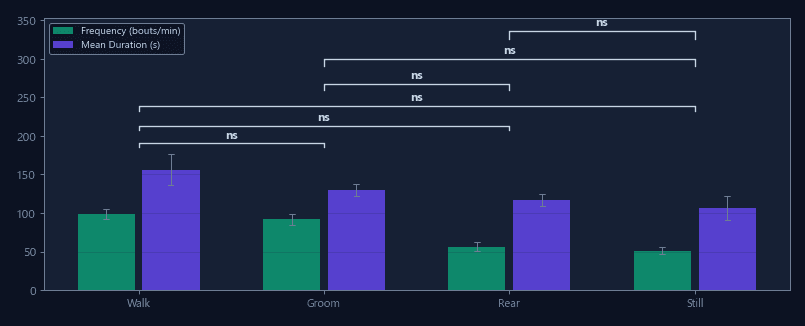
Number of bouts, mean and total duration, and inter-bout interval for each classified behavior. Summarized per session and per user-defined time bins.
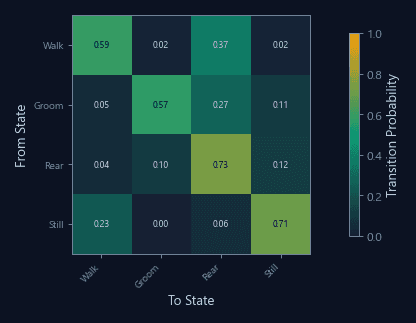
Probability of transitioning from each behavioral state to every other state. Reveals behavioral structure and sequence patterns altered by experimental manipulation.
Score grooming bout frequency, duration, and sequential pattern in SAPAP3 knockouts or marble burying models. Temporal smoothing preserves micro-bout structure while eliminating noise.
Quantify scratching and grooming directed at specific body regions in atopic dermatitis or pruritus models. Classify cephalocaudal grooming sequence disruption.
Identify and classify repetitive motor patterns — circling, head bobbing, route tracing — in pharmacological or genetic models. Distinguish stereotypy from normal repetitive behavior.
Generate a complete behavioral profile — time budget across all classified behaviors — for phenotypic comparison across genotypes, treatments, or developmental time points.
| Feature | ConductVision | Typical systems |
|---|---|---|
| Scoring speed | Real-time — seconds per session | 3-5 hours per 30-minute session |
| Reproducibility | Deterministic — identical output | Variable — kappa 0.6-0.8 |
| Custom behavior support | Train new classifiers from annotation | Fixed ethogram in most systems |
| Temporal resolution | Frame-level with smoothing | Typically binned to seconds |
| Transition analysis | Full transition matrix output | Manual compilation required |
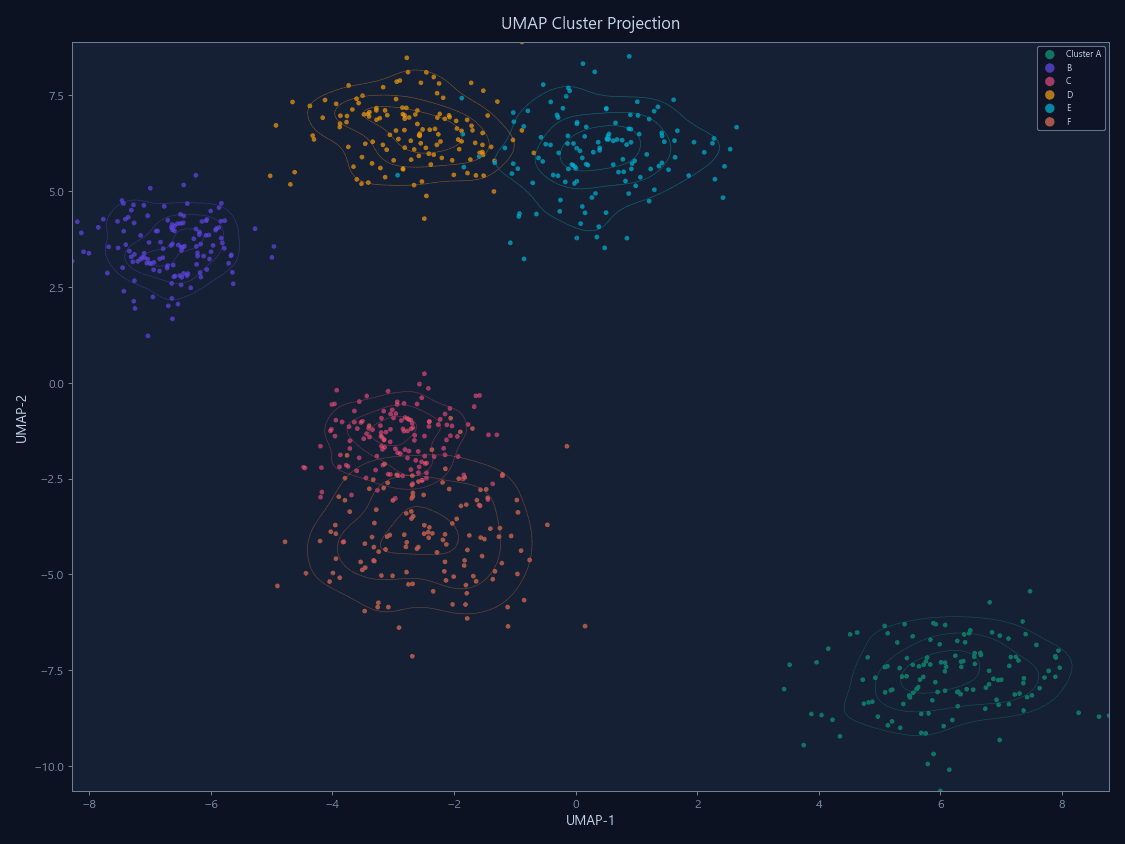
Unsupervised behavioral clustering reveals structure without predefined ethograms — UMAP visualization and novel behavior flagging.
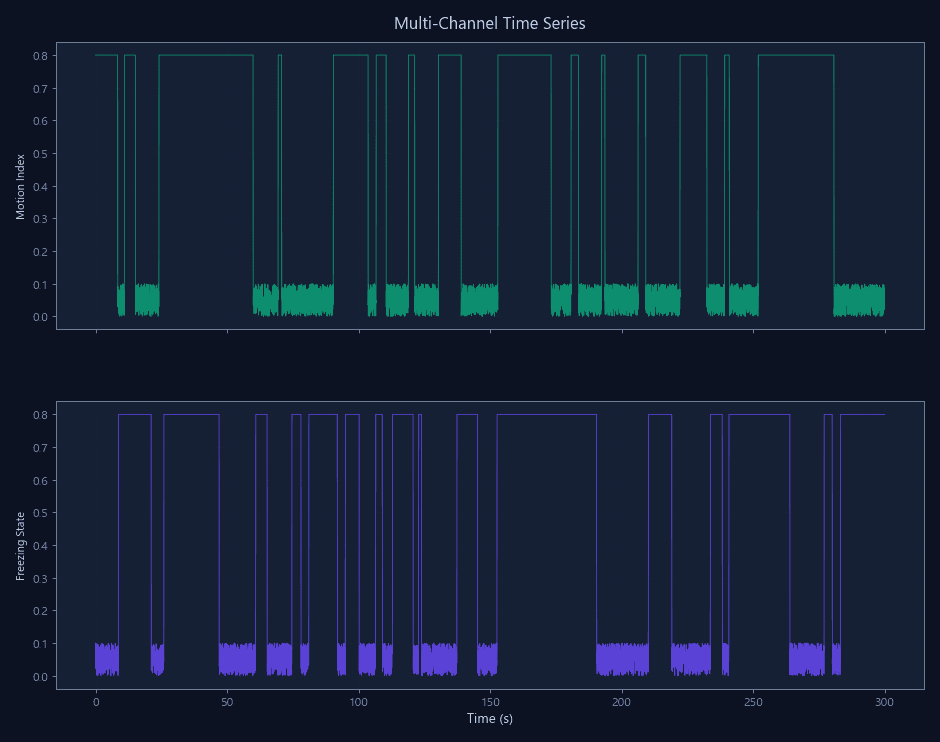
Dual-mode automated freezing scoring with TTL/serial apparatus integration for fear conditioning paradigms.
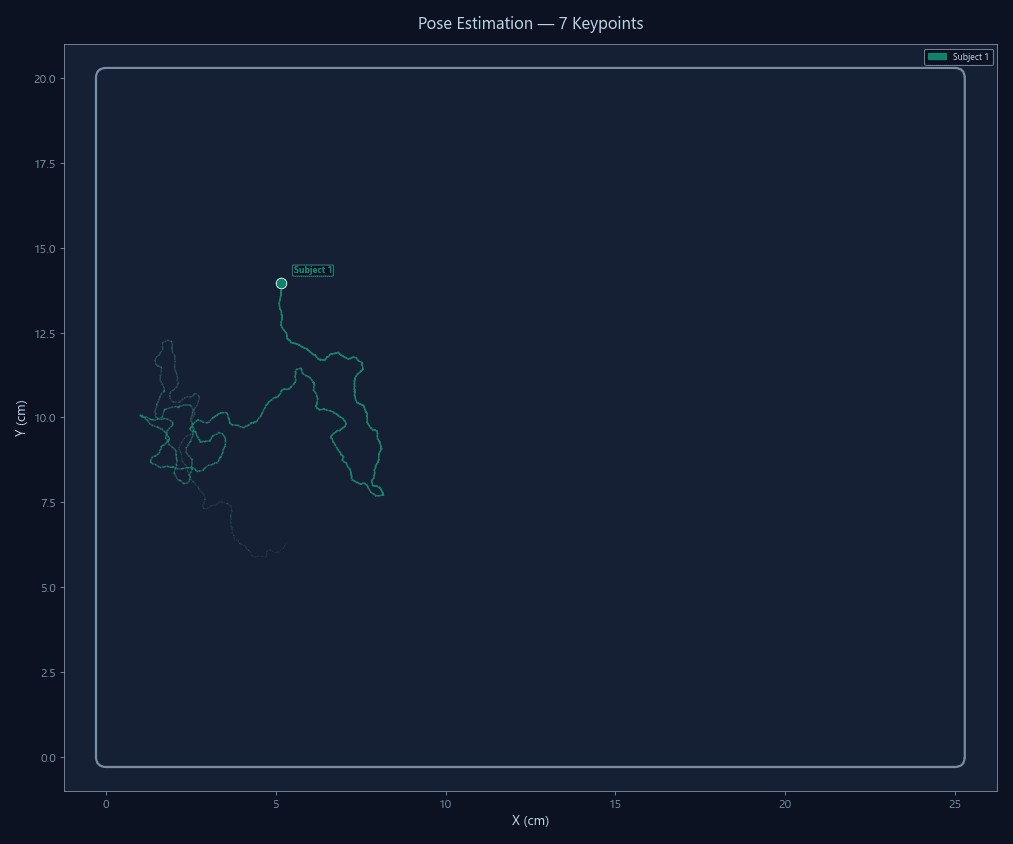
Multi-keypoint body part tracking — head, paws, tail, body center — with pretrained and custom model support.
Upload a session and see grooming, rearing, and locomotion scored automatically with frame-level resolution.
